


MJNewton
-
Posts
1354 -
Joined
-
Last visited
-
Days Won
1
Everything posted by MJNewton
-
 Our 150L Range Trubune UVC has a 12L Zilmet Hy-Pro expansion vessel connected to it, stock photo as follows: The system is 18 years old and the last few years I've had to repressurise the EV (to 2 bar i.e. supply pressure of 2.2 bar less 0.2 bar as per the instructions) pretty much annually whenever I've started seeing dripping from the PRV. This last year, however, has seen me having to do this monthly and indeed even more recently I am doing it weekly! Clearly something amiss. No water comes out of the schrader valve when pressed, so I am assuming this means the internal bladder is still intact. Speaking of the valve I assumed it was likely to be the issue and so I replaced its core but to no avail. Suspecting that my new core might not have seated well (it was a slightly different shape to the original) I have since also added a short (and, admittedly, very cheap) extension piece to the valve with its own sealing valve in it but still the air is gone within a week and the PRV passes during reheat. Any thoughts as to where the air might be going? I've tried some soapy water around the valve (conveniently it sits in a recess under that black cap and so can hold a small pool of liquid around its base) but haven't spotted any leak. There's no signs of corrosion or other issue on the EV. Maybe I should just spend £40 on a new EV and be done with it, but thought I throw this out there in case there's something I might be missing? I'm going away on business tomorrow for a week and so will fight the temptation to do any too invasive today, but I have at least repressurised the EV once again which should cover the majority of the time I am gone.
 -
Does a portable electric heater without a thermostat exist?
MJNewton replied to london8's topic in Other Heating Systems
(Removed wrong link) -
Does a portable electric heater without a thermostat exist?
MJNewton replied to london8's topic in Other Heating Systems
I think multiple heaters is your best bet, and will give several other benefits besides. -
Does a portable electric heater without a thermostat exist?
MJNewton replied to london8's topic in Other Heating Systems
Ah, yes, getting ready for school in front of the gas fire. Roasting - burning in fact - one side of your body whilst the other side was literally freezing. Kids these days don't know they're born. There, I've officially turned into my Dad. -
Does a portable electric heater without a thermostat exist?
MJNewton replied to london8's topic in Other Heating Systems
That cannot be predicted and accommodated by the manufacturer otherwise they'd have to configure the stat to enable safe usage of the heater in a worse case scenario such as being situated on a bed, sofa etc. One has to assume the heater is used in accordance with the instructions and not put on/near anything that would be affected by the heat. -
Does a portable electric heater without a thermostat exist?
MJNewton replied to london8's topic in Other Heating Systems
In the ones I've seen the thermal cutout is separate (but co-located hence the caution). Very limited sample size though. -
Does a portable electric heater without a thermostat exist?
MJNewton replied to london8's topic in Other Heating Systems
Understood. I hesitate to recommend this, but bypassing the thermostat is always an option, and convector heater wiring is usually easily visible and accessible. Be careful not to inadvertently bypass any safety cutouts though if doing this. -
Sounds reasonable, particularly the reality check as to whether a joint *really* is likely to ever need to come apart and, even if it might, whether chopping out a permanently attached fitting will suffice. I suppose compression fittings are pretty bulky too which might have relevance in some situations.
-
Does a portable electric heater without a thermostat exist?
MJNewton replied to london8's topic in Other Heating Systems
Have you found this with multiple heaters or just the one? I am sure our backup heater would effectively remain permanently on if cranked all the way round to max. Note that the thermostat is usually under the heat source and so is measuring the incoming air flow - at ground level - which will be significantly cooler than the air elsewhere in the vicinity (certainly that at sitting/standing height). -
Are compression fittings (decent ones from, say, McAlpine) a good happy medium? I am thinking in terms of being both watertight but still dismantleable(sp?) ...
-
I heard someone say it reminded them of a festival urinal... 😂
-
Just watched the following video showing a recent retrofit of an ASHP, and whilst the owner seems pleased as punch I was left flabbergasted. A thought even briefly crossed my mind that maybe it was a prank video! I don't know where to focus with my dissatisfaction, but in a nutshell: - Massive grey washing machine plonked so conspicuously in the garden - Pipes and cables run all over the outside of the property, and 'all over' really isn't much of an exaggeration - Shoddy workmanship involving unfilled holes, pushfit plumbing on show etc - Considerably greater system complexity than what was there before. 8 hours of troubleshooting on first use tells me everything I need to know. - Probably other things too that I've missed as I felt the need to vent somewhere before I'd even finished watching! The owner, who I must say seemed like a lovely bloke and an intelligent one at that, seemed mostly bothered about the empty kitchen cupboard that'll need a bit of tarting up than anything else! Is this what the future holds? Surely we can do better than this.
-
Yeah, I was always concerned about Honeywell's TPI control algorithm which, whilst excellent at minimising (effectively eliminating) overshoot/undershoot does so at the expense of upto 6 demand cycles per hour (actually, writing that down I think it can be lowered to 3). I've been expecting having to deal with the consequences of additional wear this will have on the system for 14 years now but so far, touch wood, no failures to report.
-
That joint is under pressure from both sides so even if you were to close down either/both radiator valves it'd still be subject to water being pushed up from below. The nut might just need ever so slightly nipping up. And I do mean slight - being overtightened is just as likely to cause a leak as being undertightened (and can be a more difficult situation to reverse back from).
-
Ooh nice. Will be interesting to see what I've got, and whether a 2kg tub of Fernox DS3 will dissolve it!
-
I'd like to see that. I am considering descaling ours in the spring/summer and would like to know what I might be up against!
-
MVHR into a cold roof ?
MJNewton replied to Post and beam's topic in Mechanical Ventilation with Heat Recovery (MVHR)
Ours is in a cold loft and we've never had any issues as far as I am aware. The unit is insulated internally and only the control boards sit outside of this and likely warm themselves up enough not to be a problem. -
Cold air from range hood ventilation
MJNewton replied to Eldad's topic in General Self Build & DIY Discussion
Are you sure that terminal has something in it to prevent backdraft? To me it look like the type fitted to many a log burner, and just serves to let smoke out and prevent rainwater getting in. -
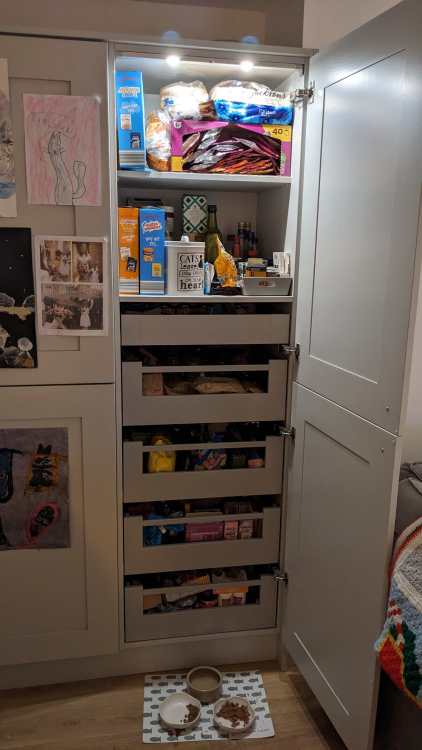
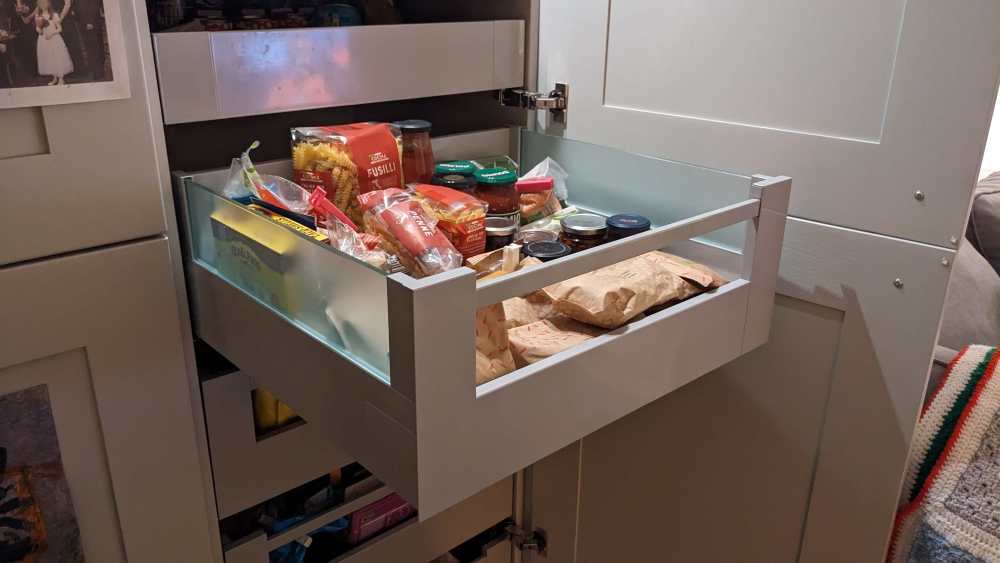
We spent ages - months in fact(!) - debating what option to go for for our 600mm larder unit and there was something about the wire frame pullouts that seemed less than ideal. Whether it was the amount of space it took up, having to pull out far more than what you actually need, reaching over things to get stuff out from the back, I don't know. We then stumbled across the much simpler approach of using full-width and fully-opening deep drawers for the section below eye level and open shelves above. There's also a shallow drawer for tins (a lot of tins - must be over 50). We've lived with it for a few years now and wouldn't change a thing about it. The drawers obviously work much better than the shelves, but we just make sure the rarely-needed items are located at the back on the latter. With drawers it doesn't matter as everything is equally accessible. (Forgive the rather messy shelves - I've just taken these photos following a whole bunch of shopping being thrown in today... I'm sure it could be dressed better!)
-
Really disappointed with our worktops...
MJNewton replied to MJNewton's topic in Kitchen Units & Worktops
Hi Karl! There's always potential for ambiguity and different people's interpretations of tolerance, however notwithstanding this in my view if the tolerance is '3mm within 3m' then I'd take that to mean that over any 3m length the difference between the highest and lowest points should be less than 3mm. Thus your units could ripple like a (square) wave but if you were to locate the lowest unit then all the others must be no more than 3mm higher than that and you'd be fine. It might not sound a lot but 3mm is a fair amount for something that is infinitely adjustable. Do you want to elaborate on your situation? Did you cancel the templating or did the surveyor say it was far out? If the latter I'd expect them to be advising what improvements were needed and where etc. Gosh, this thread is a blast from the past. Funny reading back how concerned we were at the time... A few years on and we love the worktops and wouldn't change them for anything else! -
Mvhr funny noises and dripping
MJNewton replied to Pocster's topic in Mechanical Ventilation with Heat Recovery (MVHR)
Yeah, and of the four air sections I'd expect it to be the only one where water would appear. (Okay, perhaps the occasional stray raindrop might get sucked in through the outside air intake too.) There's still the issue of why this water wasn't draining away though. Or have you solved that? -
Are you accusing my doorbell of being racist? 😉
- 14 replies
-
- 1
-

-
- external light
- light bulb
- (and 3 more)
-
Mvhr funny noises and dripping
MJNewton replied to Pocster's topic in Mechanical Ventilation with Heat Recovery (MVHR)
Remember the 'extract from dwelling' air will have some heat extracted from it thus raising its relative humidity which, at the saturation point, will cause condensation to form. -
It has night vision too!
- 14 replies
-
- 1
-
-
- external light
- light bulb
- (and 3 more)
-
I'm not sure I should admit this but that is pretty much what I've got! Specifically, a Reolink Doorbell with AI person detection that triggers a Shelly smart relay to turn the porch light on. It was born out of an overreaction of being annoyed by the PIR sensor triggering in the wind! Overkill, yes, but it works ridiculously well.
- 14 replies
-
- 2
-
-
- external light
- light bulb
- (and 3 more)


