AliG
-
Posts
3211 -
Joined
-
Last visited
-
Days Won
11
Everything posted by AliG
-
We just received drawings from MBC showing that they will cut expansion joints in the passive raft foundation. This then had me asking the question what happens to the UFH pipes when they cross the expansion joints? Waiting to hear back from the foundation engineer, but it doesn't seem like it would be an unusual issue, so has anyone come across this before?
-
Out of curiosity, this then needs installed. I can see an electrician looking at it and saying £1000 plus the work to install the panels on the roof maybe being the same again, so is it much cheaper than going to someone who would do supply and fit? Maybe I am too high on the costs?
-
I found a ruling re late submission of forms. If you look at point 9 here, it seems to suggest that filing the wrong form and then being allowed to refile the correct form outside the 6 week limit is possible. http://www.landmarkchambers.co.uk/wp-content/uploads/2019/02/Croke-v-SSCLG-judgment-1-February-2019.pdf However, there is nothing stopping you making the argument that the 6 week limit was missed. A reasonable argument would be that they were too tight to consult a lawyer and fill in the correct form. But I think the judge probably knows of this previous riling so will allow the filing to proceed. He will still not have considered anything about the case other than this.
-
I agree with what is being said here in the last few posts. Basically anyone can fill out the form asking to challenge a planning appeal. So far he clearly has not paid a lawyer, hence he filled in the wrong form. Tbh I didn’t know you just had to fill in a form, useful info. The issue of who it is served on is not clear. The guidance suggests just the minister, but practicality suggests that you and the council are involved so should be served also. The N208PC form does have a space to fill in interested parties. I think the thing is that you have to be included in case the others don’t defend the case. It seems like you were served which has to happen within seven days. First point is the rules say 6 weeks to file, no exceptions. If he filled out the wrong form I am not clear the judge can give him an extra week to fill out the right form. He will also then have 7 days to serve you after filling out the form again. What he has served you so far is incorrect. You then have 21 days to file you received it. But first I would apply to get it thrown out on missing the 6 week deadline. The papers you are served with should show if he is seeking an interim remedy, basically an injunction. As @Adsibob says the reasons to challenge are very narrow and he is probably wasting his time. Maybe he just enjoys messing you around. The court won’t consider the merits and whether they want to even take up the case until the paperwork has been correctly filed.
-
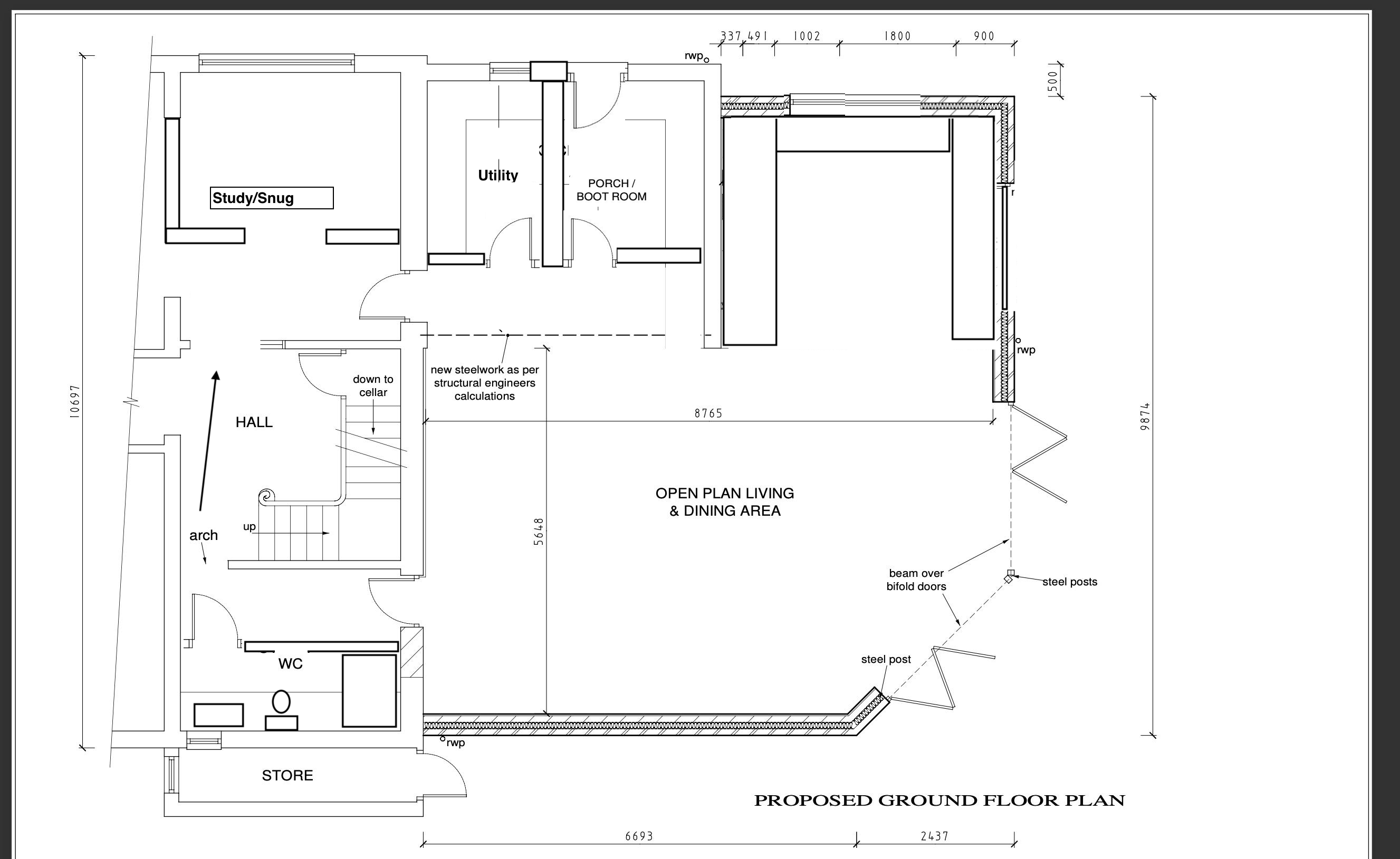
Welcome @h18ant Having just commented on another design where people feel the architect did a poor job, you certainly have what looks like a very nice design here. If you are happy with costs to build the roof I won't comment further. As others have said, my main concern, having read your brief, is that this is a much smaller house than you planned for. I too would go along with the start bigger and see what planning says route. Thoughts/suggestions, without making the house larger. 1. The rear hall is just wasting space and wouldn't actually work as a boot room. I would merge it into the utility room and make it dual purpose. 2. Two kids sharing a bedroom will need/deserve a larger bedroom and need a fitted wardrobe. In the current design I would maybe steal 0.5m from bed 4 and add it to bed 3. 3. There is room for fitted wardrobes in the bedrooms if you want, just needs shown on the plans. 4. Is there a reason for the skylights in the bedrooms? Including the extra costs on the roof they will cost the best part of £4k each and frankly the light would just be annoying above a bed. We have a double height bedroom and the light from the high windows is annoying in summer. A Velux on the half landing may work better than the skylight over the landing. 5. There is room for a wardrobe in you bedroom if you put the bed on the west side and the wardrobe on the opposite side. I would do this and make the en suite maybe 1,4m wide. I f you wanted a dressing room I would put it between the bed and the en suite and you would need to make that wing of the house around 1m deeper, making the dressing room around 1.4m wide and the bedroom 3.5m long. 6. Im just not sure about the downstairs layout. The pantry is off the sitting area, the table is in between the door and stairs and there is large area which may end up unused space. It may just be how the furniture is currently shown. A simple change would be to put the table where the two chairs are shown and then make the sitting area to the east side of the door with a space through the middle between the front door and stairs. I would have the bottom of the staircase at the other side, closer to the kitchen and utility room, this would free up more space for furniture in the lounge area on the east side of the room. Presumably there should be a cupboard under the stairs? 7. I would do away with the log burner. Expensive and even more so with the chimney in the middle of the roof, plus it isn't even a focal point, just stuck in the middle of the stairs. You'd have to have a flue or chimney up the centre of the staircase. If you could make the house a little deeper it would free up a lot of useful space, 0.5-1m to the front of the kitchen/master bedroom and to the rear of bed 3/sitting room which is quite small. This would keep the same basic design, but gain you another 10-15sq metres.
-
Sorry, I feel we are bombarding you a bit here, but I do think it stems from what seems to be a poor effort on the part of the architect and I hope we are helping. The plans are unimaginative. However, it may be that he has been given a very tight brief and not wanted to diverge from it. I think your slightly redone version of my drawing also works well(copied below). It gets the WC down towards the front of the house. I do think if you could get matching archways at each side of the hall it might be nice, otherwise open it up on the left hand side. Assuming that the dining room is little used, then the distance from the kitchen is not a problem and it is a straight shot. As to the angle on the corner. I presume that the overlooking issue is upstairs. Downstairs windows usually don't matter and you currently have a window looking towards the neighbour, although further away. I can see you want to take advantage of the view, but I had a good look at the elevations having read people's comments. Why not just have windows facing north and west in the kitchen, but only west in the master bedroom. That way you can square off the corner, which I do think matches better the rest of the house, and will especially help the look of the roof. I would also bring in the wall on the north side another 0.5m so that it is more clearly an extension and looms less over next door, the roof would be slightly lowered by this. I think you could lose that much space easily. I don't know how difficult it would be, but considering the style of house and the fact that you are losing what must be a very nice window on the stairs I would look to replace it with a skylight or cupola centred right in the middle of the square formed by the staircase. This is more in keeping with the style of the house and you will need this light in the front hall which will be very dark. Offsetting this, en suites don't need sun pipes. You could do away with them, just have the lights come on using a PIR. So lose 5 sun pipes, add one nice large skylight. Initially when we designed our house I told the architect to make sure the en suites had windows, but during the design process we did away with most of them and don't really notice at all. Final point, but having had a look at the elevations and with the picture you provided of the house, what was the architect thinking with that little canopy at the back and the two full height windows in the master bedroom. It would be so out of keeping, The door on the side really is the way to go. Much more in the style of the house. Look at the beautiful symmetry of the front of the house, the current rear elevation is very poor. Did you ask for full height windows in the bedroom? They look very strange.
-
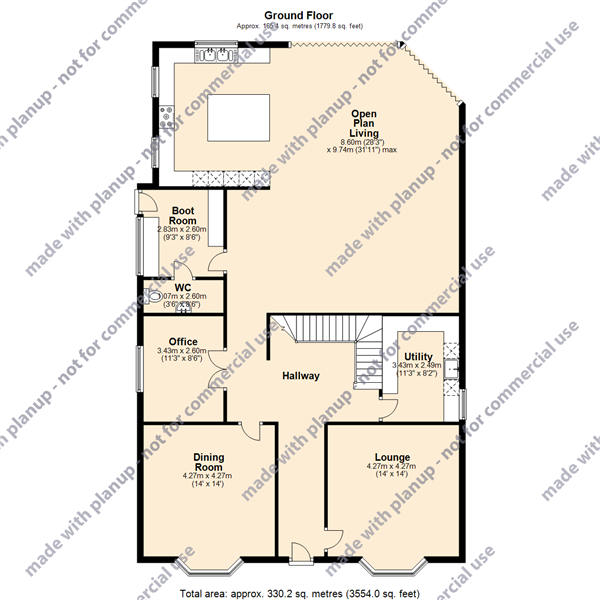
Very rough suggestion. Personally with 6 bedrooms I would look to put a laundry room upstairs, but that would require a lot of changes. It might be possible to do matching symmetrical arches on each side of the hall with this design. The dining room could have a door towards the kitchen and at the side towards the hall.
-
I don't want to be harsh, but I agree. I started to write up a long response previously but didn't manage to finish it and lost it. I think the thing I most don't like is having to go through multiple rooms to get to the WC. It will be a real pain from the lounge. I would have the WC and an extra door into the kitchen where the utility room is and the utility next to the boot room. Does the boot room not have a door because it has a south facing window? If it really is a boot room full of coats etc I would want a door. In such a large house I wouldn't want people to be coming effectively directly into the living room from outside. I would make the living room a smaller study and knock the hall through so that the door into the kitchen is in the hall, if that is possible (as drawn by @Iceverge previously). I would think it is as there is already a door and glass panel there. You can do this as you have another lounge plus a big open kitchen family room now. Have you considered does the new door have to be at the back and not the side? I would think it would be better to have the boot room/utility space where the kitchen is with a side door and the kitchen at the back so it can have windows to the garden. It is a bit hemmed in at the moment. Upstairs the main thing I would change is making that narrow ensuite wider. 900mm is not a pleasant width for an en suite.
-
Death of MHRV unit
AliG replied to DaveAndAnnaUK's topic in Mechanical Ventilation with Heat Recovery (MVHR)
I have moved the thread to the MVHR forum. Sorry to hear your problems. I often wonder about our units, we have three and two are in lofts even though I didn't want them to be. At some point they will break and we will have to take the ceiling down to replace them. A couple of things spring to mind although they don't really help to get things fixed. Firstly, I mentioned this on another MVHR thread, I turned off the humidity boost function on mine as I found that whenever the humidity rose due to rain etc it kicked in and it was n boost way too much. I switched them all to running constantly at the slowest speed. This hopefully puts less wear on the system. Secondly, I find it very odd that you have condensation dripping from both sets of ducts. Presumably you have extracts connected to bathrooms and kitchen and supply ducts connected to other rooms. Why would the supply ducts drip? This is just the same as all the other air in the house, I don't see why it should be condensing any more than any other air in the loft. Hopefully when you get if fixed you can change the filters yourself. It seems like access is pretty easy and it should just take a few minutes if you can get to the units. Paying £300 a time would really upset me. Watching the video again a couple of things spring to mind to check. Could there be a problem with the condensate drain. If this is set up correctly surely it should catch all the condensation inside the unit and it should not get wet. Could the unit be sloped so water is gathering at the other end from the drain or the drain be blocked. Maybe it is blocked internally as it seems only wet on one side. One of our units didn't have the drain fitted initially and it started to create a wet patch in the ceiling in days. I think quite a lot of water condenses inside the units. If it cannot drain away would the whole system just keep getting wetter. Similarly could water be getting into the exhaust or air inlet where they go out through the roof. -
Here (Edinburgh) they use a 9m from the boundary rule for upstairs windows of habitable rooms. I assume the 13m rule is something similar. If that is the case if the windows can be put on another side of the extension the rule may not apply.
-
We had around 200sq metres of Amtico in our last house, the whole ground floor plus an upstairs games room. The wood effect, was very nice, a lot of people thought it was actual wood. In the games room it was still immaculate when we moved out. Basically in low traffic rooms it should not get damaged, especially if you are careful. In the hall it got mildly scratched up, not so much that I was bothered, but I could see it. In the kitchen and conservatory we had a marble tile effect Amtico. I had it removed and placed with tiles and wood. It just looked too obviously fake to me. It looks to me like Karndean Van Gogh is a bit more expensive than Amtico Spacia, so your cost of £70 a square metre looks about right. You might be able to get it a few pounds cheaper. It absolutely has to be done properly. The company that did ours did a fantastic job. The showhome had Amtico in the kitchen and you could see the joins in the plywood beneath it. Any issues will show as it is so thin.
-
Hi CJ, I am in Edinburgh and just starting our second build which is a house for my parents. My advice would be that it would be too much cost and stress. One hour from Edinburgh gives you most of central Scotland, but assuming you mean within commuting distance of Edinburgh then your budget just won't stretch to it. Looking at our current build and others I am seeing in the area, basically by the time you buy the land and build the house you will be lucky if it is worth what you have spent. The upside though for most people is they do get the house that they want. Build costs have soared with rising materials costs. Indeed I would go further than @ProDave and assume a cost nearer to £2500 a square metre once you take all costs into consideration such as landscaping, professional fees etc. The 1970s bungalow behind my house just sold for over £700k. The buyers are going to knock it down and build a 200sq metre house. There is no way it will be worth the £1.2-1.3m they will need to cover their costs(The design looks very expensive). That is what you are up against, there are very few plots and people are willing to pay over the odds for them. But I feel your pain of wanting a house that works for you and your wife as you get older. We have designed a house with a bedroom downstairs for my parents. The vast majority of developer built houses have no bedroom downstairs and too many bedrooms upstairs. Wholly unsuitable for an older couple. Occasionally I do see a Bilder do something that might work for you. Bellway are building some bungalows and cottages in Livingston for example which would probably be in the £3-400k range. You might also find some houses in the Shawfair development which looks like it will be very nice in a few years or in Winchburgh where there is a lot of building going on. But it would just be a matter of being very focused on looking for the right thing. I would also look at developments by Dandara. What you are looking for is surprisingly unusual, it shouldn't be.
-
Where is the kWh price heading in 2022?
AliG replied to epsilonGreedy's topic in General Self Build & DIY Discussion
OFGEM will announce the new cap around the 7th February and it will run from the 1st April for 6 months (Unless the system changes). I don't understand the call that the cap could rise substantially again in October 22 as the wholesale price of gas and electricity have fallen recently. They are around double where they were in August when the cap was last set and the level in August was around double the historic level. As the previous cap included £528 of wholesale costs and the wholesale price has roughly doubled then you can expect the cap to go up by around £500. A month ago wholesale prices were much higher again, but if current levels hold then the cap will peak out around this level, events in Ukraine may have a bearing on this! With 28m households in the UK, every £100 on bills is £2.8bn, so it is not that easy to fix this. This is almost exactly equivalent to 0.5% in income tax payments. So to keep bills at current levels would be equivalent to a 2.5% tax cut. People on pensions/benefits should see their payments increased by inflation, which will take this into account to some extent. There is the problem that their inflation rate may be higher as utilities are a bigger proportion of their costs. The point is though that if the government then also subsidises utility bills then these people will get a double counting in the benefit which will have to be paid for tax payers. As ever the government does not actually have any money. When the government pays for something it just takes money from some tax payers and gives it to some other taxpayers. You also have the problem of what happened with Universal Credit. Once you give people a benefit like this they won't want it taken away. I think this issue in particular will make the government wary of making large "temporary" adjustments. Basically I don't now what the government will do! (One solution would be to allow utilities to borrow to pay for the wholesale costs today and pay it back from future bills. This would spread the cost over time, but mean bills would be higher for longer) The best thing to do in the long run is actually considerably more investment in wind energy as this has considerably more fixed costs and is not impacted by global commodity prices. Expediency suggests not arguing with Russia until we have fixed the issue of being dependent on their gas. It doesn't actually matter where the UK specifically gets its gas from, as gas is priced on global markets. If Russian gas goes up in price all gas goes up in price. The fact that basically every government in Europe has allowed themselves to get into this situation shows how hopeless they are. If you look for example at Rolls Royce (and they are by no means a well run company) they do understand that the pound/dollar exchange rate has a massive impact on their business and they have a massive multi billion pound hedge in place to mitigate against this. -
If you think of the depth of a kitchen wall cabinet that is 300-400. We have some large cupboards 300mm internally in the kitchen and they are surprisingly useful for small items. One thing I would consider is that if you plan to put a fixed cupboard there, is the window supposed to be centred on the room? In my parents' house when we designed the kitchen we centred the window as if the cabinets were the wall otherwise it would have looked weirdly off centre.
-
It depends what you want to put there. A chest of drawers is likely going to be around 400-450mm deep. You can get furniture 350mm deep but it would be quite restricting. However, you will have skirting boards and it never sits perfectly flat against them or the wall so you have to add another 50mm realistically. Minimum depth to be useful for a wardrobe is around 550mm, to allow for the depth of hangers. Free standing or built in furniture style you would have to allow around 600mm, if it was built out of stud work you would have to allow for the depth of the wall so 650-700mm. However, if the wall is quite long, you could have a wardrobe then a space for a TV, seat etc so it would be less of an issue. What size is the window? I personally would have a bigger space to the corner. Bedrooms can be quite tricky to furnish as if you have a door, then a wardrobe then a window and possibly a radiator you start to end up with almost nowhere to put furniture.
-
Where is the kWh price heading in 2022?
AliG replied to epsilonGreedy's topic in General Self Build & DIY Discussion
So with the data from the Ofgem site and looking around on the internet, the price cap is expected to rise to around £1800. Up to £100 of this will be to cover the losses made by suppliers taking on customers from bankrupt suppliers. To increase the price by 40% they could keep the standing charge the same and increase kWh prices by around 50% or increase both by around 40%. This suggests that the new cap prices will be between 29 and 31p for electricity and 5.6 and 6p for gas. Clearly the government may try and step in to do something about this, although all they could really do is use taxpayer money to pay people's bills. -
Thanks for linking my thread @Nickfromwales I dod think that the PIR boards on the external walls work well. Main recommendation I would reiterate for dot and dab is to seal around the edges of the boards to stop air moving around behind them. This is particularly important at the top and bottom as otherwise cold air will come out into the ceiling void and below the skirting boards. I think the correct way to do it is to create a full edge of dab on the boards, but it may be more practical to simply foam the edges once they are up. I just did this around my garage ceiling as I was suspicious cold air could get into the house from the garage via the edges of the board and it took minutes with a foam gun. Ideally I would have done this everywhere in the house. Do not remove the plaster from the walls if it is sound as this will improve air tightness behind the boards. Another important area is the window reveals. Make sure the edges of the windows are well sealed before the plasterboard goes on. As well as air infiltration it makes a big difference to outside noise. It sounds like inside walls are stud walls. I would avoid dot and dab on interior walls. The main reason is that it is poor for sound transmission between rooms. For all walls I do think it should be standard practice to seal the edges to stop flanking sound between walls. It is included in some details for sound transmission but exactly the kind of works builders think isn't necessary. It is not even time consuming or difficult.
-
The drying time for screed is usually given as 1mm/day up to 40mm and 0.5mm/day above this. So you are looking at 100 days. However, this is without UFH. Everyone says that heating will speed it up, but does not quote by how much. To dry it out with heating you should start with a flow temperature of 25C which you can slowly raise to avoid cracking the screed, so you can probably be gradually increasing the temperature over the next 20 days, I think by 5C every 7 days. You will also need to turn it off before they start. https://www.mpaliquidscreed.co.uk/latest-news/need-know-drying-times From what I can see online, you need a minimum of 75% humidity to put flooring down, but for bonded flooring a level of 65% seems to be what is needed. So I would get a hygrometer which looks like it will cost about £15 on Amazon. You should probably also put the wood into the house to acclimatise before it is laid.
-
If you Google - How long does for a house to dry put - the first answer from the NHBC is 18-24 months to get fully dried out. I didn't really track it in my house, but thE RH nowadays is much lower than was in the first year. Considering the low heat input you have, the house could easily take over a year to fully dry out and will have more humidity than normal until then. The dehumidifier is the answer. I also suspect that running your heating at 21-22C will dry it out much faster as it would considerably increase the differential between outside and inside and increase how long the heating runs for. It would also warm the windows up more and stop the condensation in the mean time.
- 131 replies
-
- 1
-

-
- triple glazing
- condensation
- (and 3 more)
-
I agree. Hundreds of litres are used in building a house. With the lack of heating it will take forever to dry out. A small dehumidifier will take months.
-
I turned off the humidistat on my MVHR as the RH goes up when it rains, which happens plenty here, so the MVHR would run harder whenever it rained. I am by no means an expert on MVHR, but if the RH outside rises well above the inside level could you not get into a vicious circle where the system runs harder to try and reduce the RH, but instead actually makes it worse as it brings in more air from outside?
-
Self build insurance vs JCT Joint name insurance
AliG replied to aims's topic in Self Build Insurance
I am having exactly the same issue. The architect has used the MW contract which specifies joint insurance or other. People I have spoken don't do joint insurance. The issue is that we ordered the frame direct from MBC so it is not part of the contract. My argument is that the contract is covered by the contractor's insurance, but if we want to take out self build insurance that would cover the frame as well as everything else already covered by the contractor that should not be a problem. Then I get put back to me what if the insurance companies argue about who is liable. The contractor's broker says their minimum charge for a new policy would be £2500, I can get self build insurance for £700 so it seems like a waste of money. -
I just checked, we have three MVHR units and hey are showing RH of 37, 45 and 46%. I used to run them on auto boost and it seemed to me that they ran unnecessarily high to try and reduce the RH. I switched them all to just run on the lowest speed as I cannot really feel the difference in RH. When I did all of this I was seeing figures in the 50-55 range, so it may be that it takes a long time for humidity to get down to the dried out range. The only time I ever saw condensation inside our windows was when they laid the screed. The pool has RH in the 60-62 range. When it is cold outside we get condensation on the door lock on the french doors which is a small cold break and gets cold, but have never had it on the windows in there. The temperature never drops below 21. I wonder if your house is to passivhaus standard, has the heating hardly ever been on since you moved in. We run the heating at 21-22 and it comes on whenever the outside temperature is below around 12C. I am guessing that running at 20C with a better insulated house your heating has rarely been on. My guess is that this lack of running the heating would cause a passivhaus maybe to take considerably longer to dry out than a more aggressively heated house.
- 131 replies
-
- 1
-

-
- triple glazing
- condensation
- (and 3 more)
-
Grand Designs - Chisel Cliff House up for sale ay £10m
AliG posted a topic in Property TV Programmes
The cliff top house from Grand Designs a couple of years ago is about to come up for sale and was featured in many newspapers over the last couple of days. Annoyingly there are no actual pictures of the finished house as it is not up for sale yt. It is a pretty tragic story that broke up the family and left them millions of pounds in debt. I suspect the house is not worth anywhere near £10m. Quite a lot of GD houses have come up for sale at crazy prices before being considerably reduced. https://www.housebeautiful.com/uk/lifestyle/property/a36343040/grand-designs-lighthouse-for-sale-croyde-north-devon/ -
We have triangular gable windows from Rationel but they are made up of multiple elements. The largest fixed window they can do I think is around 6sq metres, with a limit of 2998mm in each direction. They are, however, more limited than some in the size of sliders that they can do, which has discounted them from parents' build. The max height is only 2388 I think.