


AliG
-
Posts
3211 -
Joined
-
Last visited
-
Days Won
11
Everything posted by AliG
-
You'd have to seal it around the joist and any light fittings. A really difficult job. My only other thought is that it might be better to put the membrane or some other airtightness treatment on the walls with the insulation inside it. Stops the insulation being bypassed by cold air.
-
From what I can see online the issue of annexes, council tax and planning can get a little messy. You are likely to get permission but it will be for use as an annex only and you will not be allowed to rent it out. This would need further permission at some point in future, the same for a separate dwelling. It will probably get its own council tax bill which you would be exempt from if using it for an elderly relative, but again if you wanted to rent it out or have someone not exempt like a teenager live there then it would become liable for council tax.
-
I agree, summer bypass works like this on my system but makes little difference. Opening windows works much better.
-
I would take up a board and see what is underneath them before doing anything. If there is no insulation under there and you remove the underlay and carpet you are going to lose a lot of heat through the floor even if you fill in the gaps. If there is no insulation I would consider taking up the floor and insulating it first. This will clearly cost more although it would probably pay for itself eventually in lower bills and increased comfort.
-
Planning objections are comedy gold. Do they really think that the planning officer would meet with them to discuss change of use of a garage! I agree with the other comments here. The only other thing I would note is that the door to the north side and the gate/ separate garden area suggest that this has been designed to be totally separate accommodation with its own garden. I think that would raise the concern that it is to be rented out at some point in the future. Of course your neighbour has not mentioned this and planning may or may not think of this. I don't consider the overlooking relevant. They don't say you will overlook them, they say they will overlook you. If you don't mind this then it is not an issue. Generally if you are at ground level issues of overlooking are not an issue, assuming that there is a fence or hedge between the gardens. It may be worth noting this on the plans.
-
I think taping the joints in the insulation works better than the membrane. If cold air gets between the membrane and the insulation it reduces how well it works but is still airtight
-
The easiest way to put an airtight membrane under the loft is to put it under the ceiling joists holding it on with battens. The plasterboard is then connected to the battens and the wiring runs in the space between the battens and plasterboard so that you don't have to try and seal holes in the membrane. You then drape the membrane onto the top edge of the walls and attach it there so you don't have to worry about sealing up around the joist ends. Personally I would not recommend putting membrane on the inside of your exterior walls. I would try to wet plaster them or use some sort of large coat over them if you have insulation going on the inside. The membrane is difficult to attach to blockwork and you will get cold air blowing around behind it.
-
Neighbours soakaway under my driveway
AliG replied to AmKal's topic in Party Wall & Property Legal Issues
I am curious about this. How does a neighbour's soaraway end up in your garden? Is there some mention of it in the deeds? I don't see how they can be on your property without it being mentioned. -
I just pay the normal one. Maybe there is some special circumstance where you pay more but I am not sure when. Could some people have more than one meter?
-
Do you leave your boiling water tap on at nigh?
AliG replied to Adsibob's topic in Kitchen & Household Appliances
Yes they do but that’s mainly a time saver. If you filled the kettle it would cost the same to heat the water as in this application it’s unlikely you heat more water than you use. Just reinforces that really they are a convenience item. The boiling water tap would be more efficient at heating water than the stove top although more expensive than a gas hob. @Russdlis right that your PV can heat it for free. One benefit is that they have a smaller element than a kettle so it is more likely they don’t use more than your PV is generating. However a lot of the time it would be running it will be dark. -
Do you leave your boiling water tap on at nigh?
AliG replied to Adsibob's topic in Kitchen & Household Appliances
Tesla Model X. There’s no justifying the cost but we love it. -
Do you leave your boiling water tap on at nigh?
AliG replied to Adsibob's topic in Kitchen & Household Appliances
Actually an interesting thing to do is consider how often you use an item versus how much it costs. iPhones are supposedly expensive at £1000, yet I use my iPhone a lot more than my similar priced Quooker and my car which cost 80x as much. The running cost of the average car is now around 50p per mile. Clearly some things just have to be more expensive as they cost more to make, but there is not alway a lot of logic in people's spending decisions. Basically people spend money on things they like and don't particularly study the utility. How could you possibly explain people spending £10 a day on a packet of cigarettes! Enjoy your tap. I am sure it does the job you wanted of it, which is all you can ask for. -
Do you leave your boiling water tap on at nigh?
AliG replied to Adsibob's topic in Kitchen & Household Appliances
Each time you boil 1l of water it uses around 0.1kWh so this is using the equivalent of 6 boils per day to keep the water hot, whereas a Quooker is using the equivalent of 2.5 boils/day. Assuming an average boil is around 1l. We have a Quooker, but I am under no illusions that it is simply a very expensive and convenient kettle. I would note that almost everyone I know who has one loves it. If something does the intended job and you find it useful then the expense is less of an issue. They try to make an argument that it saves money over a kettle as people tend to boil too much water. If you boil the kettle 10 times a day this would be true of a Quooker. This less well insulated device would probably need you to be boiling the kettle 13-14 times a day to save anything in terms of running costs. We certainly would never have boiled the kettle more than 10 times a day. The reality is that no one should be buying these for running cost savings. You might save 10p a day in electricity, but only if you drink a lot of tea/coffee, but they cost the best part of £500-1500 to buy and install which more than offsets this. For most people they also actually cost a bit more to run than a kettle. -
Do you leave your boiling water tap on at nigh?
AliG replied to Adsibob's topic in Kitchen & Household Appliances
i would guess it is this kind of boiler unit as it is 2.1litres in size and heats to 98C. https://www.pronteau.co.uk/downloads/installation/proboil-2x-user-and-installation-guide.pdf The manual is not exactly clear, but mentions 0.025kW heat loss at 98C. It doesn't say per what period, but I would guess per hour. It also says that the maximum energy use is 1.5kW and it takes 9 minutes to heat the tank from 20 to 98C. It also says it takes 11 minutes to recover from 1l use and 7 minutes from 2l use which makes no sense at all. The 9 minute heat up time is consistent with a 1.5kW heating element and 2.1l of water. Anyway assuming 0.025kW heat loss then it would use 0.6kWh of energy per day or approx 18p. This suggests that it loses almost 10C per hour so I could see why it comes on quite often to reheat. However the element should only be running for approx 1 minute an hour. It may be that once it has been on the sound continues for a while, worth checking that's it is not running for as long as the sound can be heard. To save money by turning it off it would have to get down to a point where the heat loss slowed considerably. The trouble is that the heat loss slows as it gets cooler and I don't know how to calculate the time it would take to cool all the way down. The least it could be would be 8 hours, but it would be somewhat less as it would slow as it cools down. There is an argument to turn it off when you go on holiday, saving just over £1 a week, but not to turn it off overnight.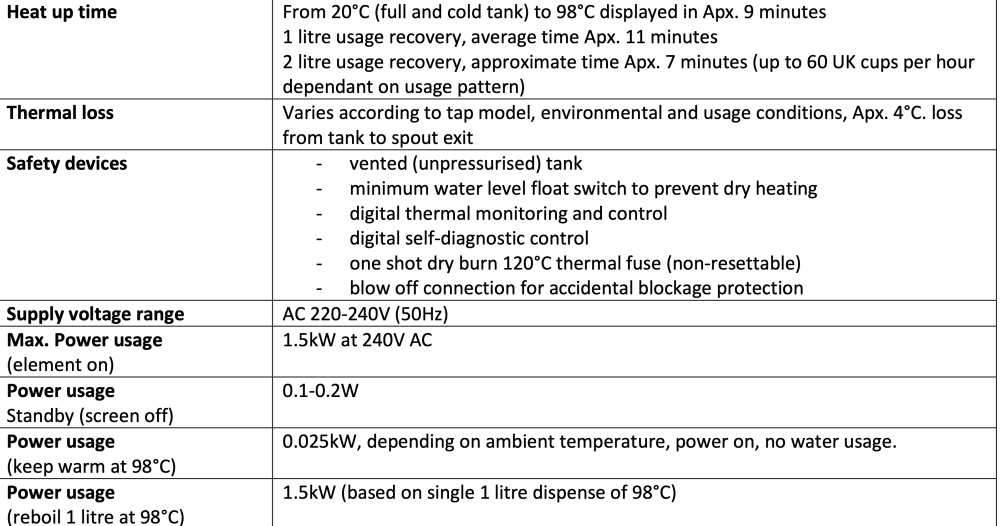
-
Do you leave your boiling water tap on at nigh?
AliG replied to Adsibob's topic in Kitchen & Household Appliances
I already explained that originally! It’s not going to cool down enough for this to make a material difference but I mentioned it in case someone brought it up. If it did cool down that much then it would cost a fortune to run and I’d be much more worried about that. -
Do you leave your boiling water tap on at nigh?
AliG replied to Adsibob's topic in Kitchen & Household Appliances
The amount of energy you need to add is driven by the heat loss. It doesn't matter if you keep topping to up or do it all at once, the heat loss that has to be replaced is the same. Yes. If you had different electricity prices at different times of the day then that would make a difference. -
In central Scotland a mix of render and sandstone would look much more normal although in a rural area the more rustic look might fit in. The all stone pictures probably don't do it justice so I am maybe biased by that. I would be very surprised if stone was cheaper. Best thing to do is get some quotes and see rather than speculate. You will need some stone anyway. Ultimately it is probably a few thousand pounds either way as there is not that much wall. So I would also consider what you prefer and whether the planners are happy with any render or not.
-
Do you leave your boiling water tap on at nigh?
AliG replied to Adsibob's topic in Kitchen & Household Appliances
It would make no material difference to turn it off at night. I would also be concerned that constantly turning it off and on would make it more likely to break. It will lose a certain amount of energy over 24 hours. Whether you replace this all in one burst or in small increments over the day will make no difference. The only slight difference would be that you lose less energy when the differential between the outside temperature and the water temperature is smaller, but in this case the water would barely cool down and that would be negligible. The same principle applies to central heating in a well insulated house (in a badly insulated house the temperature could get down close to the outside temperature and the it would stop losing energy) I am a little concerned if it needs to heat for 2 minutes every 15, that does suggest that it is not well insulated. We have a Quooker and you cannot hear it running, you can see the red light come on and maybe hear a click if it is quiet when that happens, but I don't think it comes on that often. I would check your smart meter when it comes on to see how much energy it uses when it runs. If it runs 8 minutes an hour, that is over 3 hours a day. If it had a 1kW element that would cost almost £1 a day. Hopefully it has a really small element. Quooker quote 10W/hour heat loss, so around 0.24kWh a day or 7p. There should probably be a spec somewhere for standing losses. -
Thanks guys, surprised that the electrician did not know this.
-
The electrician came along yesterday to connect up a site supply while they are building. He says that there is no earth. I messaged the DNO who installed the supply but then realised maybe it was the fault of the supplier who installed the meter. So if there is no earth who should I speak to?
-
unforseen cavities/cold bridges in timber frame help
AliG replied to hotnuts21's topic in Heat Insulation
MBC seem to have figured that out. We were discussing how to do this as sealing around the joists is awkward. They tape it to the top of the wall plate then wrap it round the outside of the ring beam so the joists are air tight. But it has to be done whilst the walls are going up. Your solution of foaming PIR between the joists was my suggestion before we knew about this. -
unforseen cavities/cold bridges in timber frame help
AliG replied to hotnuts21's topic in Heat Insulation
That should work That is what MBC were going to do with my parent's house, but it means you have to put battens under it for lights etc. We are putting a VCL on top of the roof which is the spec for the EPDM we are using. Our VCL runs up the walls then under the ring beam and over onto the roof, to seal things up. However, if you are selling PIR into that space then you just need to run the VCL up the wall and tape it to the PIR/Joists. However, this assumes a VCL above the roof deck. There has to be one somewhere. -
unforseen cavities/cold bridges in timber frame help
AliG replied to hotnuts21's topic in Heat Insulation
Someone else may know better than me, but I am not sure that filling the steel with foam will make much difference. The path for heat loss is mainly through the steel itself, not through the air inside the steel. The heat would still travel through the steel. Is there any option to put insulated plasterboard in these areas on the inside of the steel? You would probably see more benefit filling the timber cavities. However, looking at the pictures, putting insulation on the inside of the wood and also taping up the area so that cold air cannot get in from the city might be better. i.e. put insulation in the gap between the last two joists as otherwise the inside timber of the cavity is a cold spot. This is what we will be doing on our warm flat roof, although it does not have the small cavities that you have there. -
That's getting into the area I would expect. Depends a bit on prevailing prices. Another way to think about it is probably that you need to be into the top 0.5-1% of houses in the area by price. There are around 200,000 pools in the UK, which is less than 1% of houses. Of course this wold still vary a bit depending on the absolute values also. For context around 3% of houses in Edinburgh are worth over £1m which is similar to the South East outside London.
-
Clearly the recent gas price increase is not favourable for pool heating. I am up from around £500 to £1200 a year. I have offset this somewhat by moving to Intelligent Octopus and changing the time the filter runs to start at 1130pm and end at 4pm. Thus it runs almost all the time on either low overnight electricity or PV. Since doing this the average price of my electricity is actually lower than it was before the latest price increase. So I am probably looking at around £2300 a year including servicing at current inflated energy prices. Edited it up from £2000 to account for less PV in winter.


