


jayc89
-
Posts
1389 -
Joined
-
Last visited
-
Days Won
1
Everything posted by jayc89
-
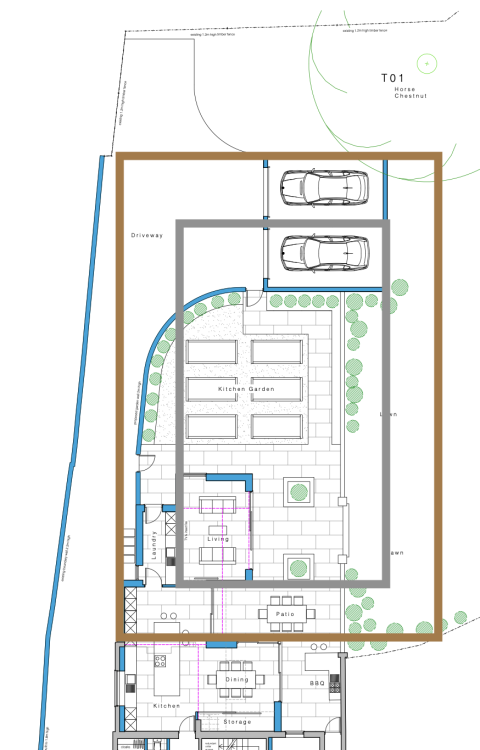
Yeah that was along similar lines to what I was thinking. I believe I have the space around the basement area to create a 45 degree slope, although some of that sloped section is where some of the, above ground, extension foundations would go, so presumably I'd need to shutter and pour those prior to backfilling the slope? Grey being the basement outline, brown being the ~3m sloped area around it.
-
Even if I do the majority of the work myself? Genuine question as I'm sure there's costs I've not considered, but my, relatively naive, idea was to hire an excavator and dumper, probably 13t excavator and 9t dumper, dig using the "open cut" method (45 degree slope down to the foundations to avoid the need for additional bracing - I think I have the space for that) spread soil out across our paddock (approx 1 acre) so save on grab hires, some sort of passive slab (spec'd by engineer) and ICF walls (again spec'd by engineer), again done myself, and given the "garden" roof, presumably external damp proofing (opposed to internal membrane + sump) + waterproof cement mix as the damp proofing strategy. The roof was my biggest unknown and where I suspected a large chunk of cost would be hidden, which brings us to this post.
-
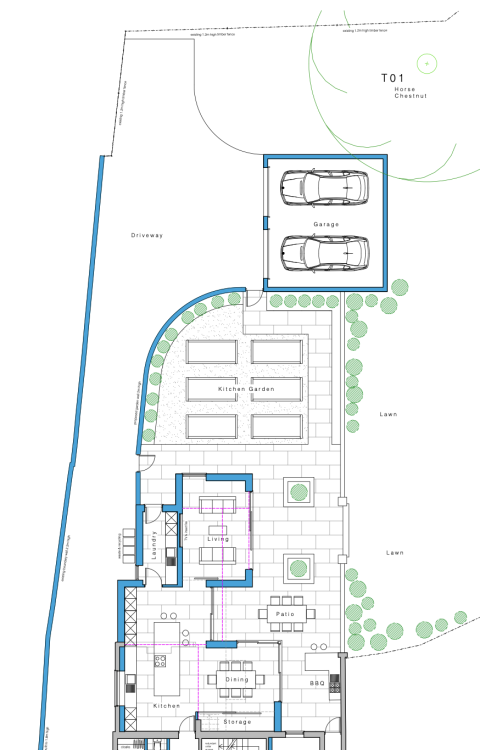
It would be reasonably sized to connect the house to the garage. Distance between the house and the garage is 16m, to maintain a simple "box" shape to it, width would be approx 12m (because the garage is offset to the garage). If we were to go ahead, it could only be for recreation so cinema room, bar/games room, gym, plant room - we're in a flood risk 3 zone (never actually flooded..), which means we can't use a basement for bedrooms etc AFAIK
-
Our extension plans include a rear extension to the house and a new, detached, double garage some 16m away from the rear of the house. Between the two will be a "Kitchen Garden", raised planters for veg/herbs etc. It's probably pie in the sky stuff, I have no idea how much it would cost, even with me doing most of the work, so I'm musing right now, but could a basement run from the new extension (remaining 45 degrees away from the existing foundations, of course) to under the new garage? Technically it seems possible to me, what I don't see much detail on is what the "roof", or section of basement beneath the garden would look like. How is this typically done? Block and beam on supporting I-Beam steels (the damp proofing detail makes me think this option could problematic) ? A reinforced slab cost in-situ with supporting formwork? I assume whatever the roof structurally looks like, it would be covered in some sort of DPM which makes part of the external damp proofing strategy for the basement?
-
I always fill and tape PIR regardless. Belts and braces.
-
Figured it out. Turns out the fixed section, isn't fixed, rather it's a top guided window that's screwed shut (no locking mechanism). I wish I had thought of @Russell griffiths suggestion ahead of time though!
-
Got a Rehau Rio to fix. One side opens, the other side is fixed, but it looks as if it should open, so there's quite a depth to screw through, which doesn't feel right, does the fixed side somehow come out so I can screw through the frame only? (I know lugs would be better than screwing through the frame, but apparently they're not available for Rios...
-
I have an acre paddock that is just outside the local plan (our overall plot straddles it, with the current house being just inside it). Eventually I had hoped to build on the paddock but it looks like the chances of doing so are getting slimmer.
-
It would certainly be beneficial, but if the bricks aren't visibly darker in that area, it's unlikely that the mortar is causing your current problems.
-
Batten it out, floor, walls, ceiling, let the spray foam guys in, cut it call back, VCL onto the battens, cross batten for service void, if needed, and plasterboard.
-
That would be my starting point. It needs to be lime. If you start putting anything impermeable on the internal face you'll just trap any moisture in there; it has to be able to escape one way or another. Keep the room well ventilated until you manage to find the source.
-
What's it pointed with; lime or cement?
-
Presumably solid wall construction? What's been used to point/render the wall in that area?
-
Pack and glue, let that set and then offer the clips up to the bottom of the shims? Should work, will check the nail holes in the side of the clips will have something in the new timbers to grab onto. Will get some pics up tonight.
-
Made a start on this yesterday. Some of the centre cross overs have gaps up to 10-15mm, so much so the nail holes in the truss clips have nothing to grab onto! I've managed to get 6x clips in each new timber so far, 3x at end each, it's the central joists that seem to have dropped - shall I just pack those ones out with some timber shims and D4?
-
Do you need to reduce to 25mm MDPE? What's supplying your hot water? I have 32mm MDPE coming in, converts down to 28mm copper, full bore lever as a stop tap, them up to the unvented cylinder multi-bloc before teeing off and reducing down to 15mm/10mm for outlets. Plastic's quite bulky, IMO copper is far better for tight spaces.
-
When is a self build house considered completely built?
jayc89 replied to iMCaan's topic in General Construction Issues
We live on a street which was self-build central in the early 2000s, a real eclectic mix. Our PO wouldn't allow us to use timber cladding on one elevation because "it wouldn't be in keeping with the surrounding area" 🤦♂️ Render is fine though, even though there are zero houses on the street that are rendered. Go figure. -
When is a self build house considered completely built?
jayc89 replied to iMCaan's topic in General Construction Issues
When you start thinking about the extension? -
Semi-rigid ducting tight bend
jayc89 replied to jayc89's topic in Mechanical Ventilation with Heat Recovery (MVHR)
Pressure drop is indeed what I meant! Anywhere I can get 90mm elbows online? All the normal places don't seem to list them on their sites. I've dropped BPC a message and even they're having to check their stock for them. -
A couple of my duct runs cross the loft between the original part of the house and an extension which is approx 600mm lower, which means they'll be above the insulation level at this point. Options I've thought of; - Wrap them with insulation at this point, between where they protrude the insulation in the "original loft" and where I can get them back below the insulation in the extension loft. - stick a couple of 90 degree bends on them so the ducts follow the insulation level Bends would be easier, but I haven't factored them into my velocity calcs. Should I go with a couple of lengths of duct insulation instead? Ducting is 90mm, and the longest runs are approx. 16m.
-
closed panel walls fixings Fixing to the internal walls of a passive house
jayc89 replied to KevT's topic in Introduce Yourself
I drilled holes, filled them full of sealant and then screwed the battens into them. Haven't done an airtest but it seems to have done the trick. -
closed panel walls fixings Fixing to the internal walls of a passive house
jayc89 replied to KevT's topic in Introduce Yourself
I've a renovation with internal wall insulation. I plan to board the external walls in the kitchen out with Ply before plasterboard to allow me to hang wall units/shelves etc. -
Not being done under BR. In terms of pitch, no idea, a quick Google suggests 30 degrees?
-
I used these - https://www.loftleg.com/loftlegxl - and some 22mm Caberfloor I had left over. Pretty solid.
-
I have a lean-to to roof at some point, it's approx 1m x 4.5m and runs along the side of the house, finished with some spare slates I have kicking around. The lean-to will likely get used for a couple of water accumulators at some point, so needs to be water-tight and insulated to some degree. I've just pulled out a load of 4x2 lengths from another room, that would otherwise be turned into firewood - Could I get away with roofing the lean-to using these?


