SteamyTea
-
Posts
23402 -
Joined
-
Days Won
190
Everything posted by SteamyTea
-
If you have 150mm of concrete in total under the pipes, and no insulation, then? A quick calculation suggested that you are loosing 150 kWh.day-1 though the floor.
-
That will not be where the problem is. The problem area will be the ground floor and the ground. Is the ground floor about 50 m2?
-
Where is the insulation?
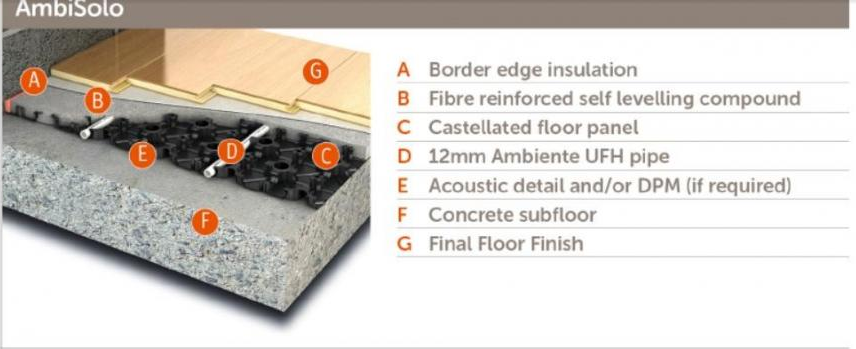
-
You work out the energy installed in the buffer, and divide it by the power the heating system is taking. So you will have ~ 3 kWh of usable energy stored. If your heating is drawing 6 kW, then: 3 [kWh] / 6 [kW] = 0.5 h Half an hour. But if your UFH system only has insulation to refurbishment building regs (around 70mm), then you will be loosing heat to the ground. If the thermal conductivity of the material is k = 0.03 W.m-1.K-1 The U-Value will be around 0.4 W.m-2.K-1 So if your UFH has a mean temperature of 35°C, and the ground temperature is around 8°C, then you are loosing almost 12 W.m2. If you run the heating for 10 hours a day, that will be 0.12 kWk.m-2.day-1. Now as you have almost 100 m2, that will be 12 kWh.day-1 (ish)
-
Not sure what you mean. But you need to use the mean flow temperature of the UFH system as the floor temperature and use 8°C for the ground. So your delta T may be around 30 K, rather than 12 K for a radiator central heating system. This is what a lot more floor insulation is needed than building regs suggest.
-

Combi, Storage Combi or electric shower?
SteamyTea replied to Rachieble's topic in Boilers & Hot Water Tanks
As much as I hate suggesting it, how about 2 combi boilers? -
Vent Axia internal humidity
SteamyTea replied to Pocster's topic in Mechanical Ventilation with Heat Recovery (MVHR)
Only thing I noticed, is that the black wire hanging loose?
-
Selecting DHW cylinder for ASHP + solar thermal
SteamyTea replied to muhrix's topic in Introduce Yourself
Turn it down till you are not happy, nothing to worry about. Most dishwashers take a cold feed only, some older ones may take a hot feed. Same with washing machines. -
Real world passive house heating demand figures?
SteamyTea replied to Smallholder's topic in Boffin's Corner
Some trees may counteract this, they can shield in the spring, summer and autumn, but allow light though in winter. As long as they are not evergreens. -
Help me to understand GSHP performance
SteamyTea replied to Benguela's topic in Ground Source Heat Pumps (GSHP)
Mug. Milk. Sugar is best in a pudding. The real secret is that if you try to extract more than half the energy avialable, then systems start to get inefficient. This us not the same as having a system that is double the required size. This is really what sets the sizing if a system. -
500 quid buys a lot of booze.
-
Dry ice in a can, is there such a thing?
SteamyTea replied to epsilonGreedy's topic in General Self Build & DIY Discussion
You used to be able to get cans of nitrogen (I think). This came as a kit, with a bit of pipe insulation, to freeze water in pipes if you could not turn the supply off. https://www.wickes.co.uk/Wickes-Pipe-Freezing-Kit/p/424921 Seems (expletive deleted)ing odd way to get some foam off, just use the correct solvent, which is not acetone. -
Help me to understand GSHP performance
SteamyTea replied to Benguela's topic in Ground Source Heat Pumps (GSHP)
Yes. By modulating the power during a heating cycle, they can optimise the CoP. This is because heating is not linear. When you have a large temperature difference between a hot body and a cold surroundings, you have high losses, when the temperature difference is small, you have lower losses. Therefore, when heating initially starts, you can put in less energy for a similar temperature rise. As temperature parity gets closer, you have to put in more energy (mathematically, when the surroundings is an infinite heat sink, you can never reach parity, unless you have infinite energy. This is why 'warp drives' don't exist, but the infinite probability drive might). By having the control to modulate during the heating cycle, frosting can be reduced i.e. work the ASHP less hard or take less heat out the ground, for a bit longer. Then increase the flow temperature from the HP as you reach maximum temperature, but for short amount of time. Frosting is a combination of time, flow rates, temperature differences, and in the case of ASHP, relative and absolute humidity. It is all about finding the sweet spot as all the above varies. Worth remembering the the overall temperature differences that a HP works are are similar to a thermal boiler, just lower down the scale. Why we should really use the kelvin scale and not the pesky, arbitrary celsius one. Or create a new temperature scale that has zero at the coldest that the refrigerant gas gets to. Then you will see temperature rises of 90 STs (going to name this scale after me, have to be careful though as we have an St, for stanton number, St = h/pvcp, where h is coefficient of heat transfer, p is density, v is velocity, and cp is specific heat capacity at constant pressure, it is used in geothermal energy, well it should be, but I think it gets forgotten about). -
Help me to understand GSHP performance
SteamyTea replied to Benguela's topic in Ground Source Heat Pumps (GSHP)
You don't have a fan on a GSHP. It is the compressor that needs the omph to get started. Think a large diesel engine starting from cold. Except higher pressures. -
Only a few minutes to set up a spreadsheet and work it out yourself.
-
Help me to understand GSHP performance
SteamyTea replied to Benguela's topic in Ground Source Heat Pumps (GSHP)
Will that be the very small, Cornish, Kensa, that employed a mate of mine. I would take that claim with a pinch of Cornish Sea Salt. -
What choice HW tank for cottage renovation?
SteamyTea replied to Caddy's topic in Boilers & Hot Water Tanks
And you can fit it all yourself, except maybe the pump wiring. -
Always worth keeping a bit alive, you may want to transplant a bit into a neighbours garden to reduce the value of their property.
-
Sometimes, the obvious is so simple.
-
Or about 125 tonnes of carbon dioxide 622kg/tonne). Which is about the same amount my driving has caused in the last 20 years (30,000 miles/year at 0.2 kg/mile).
-
Drinking coffee here.

-
Explain why please. I understand that they control flow rates, regardless of inputs and outputs. I may have misunderstood it though.
-
If there is some expanding foam between the joists and the insulation boards that will act as an adhesive. Just a matter if how much. As you have around 20mm difference, you could fit some counter battens on 20mm off stands from the joists. Just depends how easy it is to get under the floor. And builders can be twats, they forget who is paying them.
-
The closer the mass is to the joist the better. Think of it as a torque, the longer the spanner, the more you have to move the free end. That free end is the deflection. https://www.engineeringtoolbox.com/beam-stress-deflection-d_1312.html
-
Tumble dryer question
SteamyTea replied to iansr's topic in Mechanical Ventilation with Heat Recovery (MVHR)
I have a washer dryer, the dryer part is a condenser. Had it about 10 years now, probably used the dryer less than 10 times. I did spend a whole pound, at Poundland earlier this year on a new washing line. That is the third one I have bought in 20 years. Trouble is, they are too long, so I found the unused half of the previously bought one, as I was putting the remains of the new one away. So that is the next 20 years sorted.