


SteamyTea
-
Posts
23956 -
Joined
-
Days Won
203
Everything posted by SteamyTea
-
Brent Crude is £48/barrel ($64). About 50% of the energy in a barrel can be converted to heating fuel, so 850 kWh. £10k will buy 208 barrels (today) or about 180,000 kWh.
-
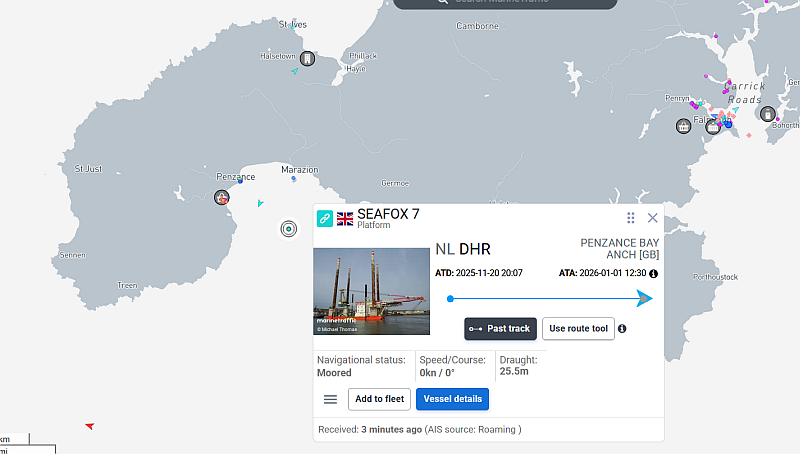
I did some work for a UK turbine manufacturer in the early 1990s. I think then we were the biggest global manufacturer, though they used the term 'leading' which means very little. They still make turbine parts there, Vesta employ a lot of people. This is currently in Mount's Bay, but think it is just parked up.
-
Some of that kit will last 20 years. in 2022, the UK used 1,200,000 barrels of oil a day. So we have to get a new barrel every 14 seconds. A barrel of oil is currently a similar price to 400W PV module, that would produce about 500 kWh/year down where I am (I am quite happy to cover Cornwall in PV). A barrel of oil has about 1700 kWh of energy in it, but we cannot extract much more than about 70% of that. So in just over 2 years, a PV module would produce about the same raw energy as a barrel of oil. Then about 18 years for nothing.
-
Try my secondary glazing idea that I suggested for your main windows a while back.
-
 These people could supply all the kit needed. Any GRP fabricator could do it, but no reason what you could not do it yourself.
 -
Why not coat the PU/PIR sheet with GRP, then fit into place. Works well on boats.
-
I don't have green fingers, what to do?
SteamyTea replied to Post and beam's topic in Landscaping, Decking & Patios
Greatest Of All Time -
I don't have green fingers, what to do?
SteamyTea replied to Post and beam's topic in Landscaping, Decking & Patios
-
Huge difference between set and actual room temperature
SteamyTea replied to iMCaan's topic in Underfloor Heating
Think this may be a social class issue. Just put room numbers on everything. -
road planings --experience of them over time AS
SteamyTea replied to scottishjohn's topic in Driveways
Can you soften it with a blow torch. Or put some mix in a barrel and light a fire under it. Pour into hole, put a metal, or even timber, plate over it, then drive over it a few times. Rinse and repeat till level. (Road making materials are, by mass, the world's biggest recycled materials) -
Bloody tired of being confused. What heating system to fit ?
SteamyTea replied to Big Jimbo's topic in Other Heating Systems
So bathed in warming microwaves. Non of us are far from a military base. I used to live and work in High Wycombe, home of HG Air Command. Now I am fairly close to RAF Portreath, and RNAS Culdrose. Would have to cross a 'radiation' zone to get out. -
I don't have green fingers, what to do?
SteamyTea replied to Post and beam's topic in Landscaping, Decking & Patios
Not on its own, but a few of them on a short circuit scrambling track will sort it out, and you can charge an entrance fee. -
Bloody tired of being confused. What heating system to fit ?
SteamyTea replied to Big Jimbo's topic in Other Heating Systems
Only read your abstract of what you intend to do. Does your incoming mains support this, there will be a drop in flow once all them bends in the pipes and the length of the pipe rums is taken into account. Effectively two different types of heating systems. Not a problem as suck, but needs a bit of careful thought re flow rates, flow temperatures emitter areas and the different heat distribution within a room i.e. where the radiators are located. As I am sure you have read from people that run their HPs efficiently, they are effectively 'on' all the time, so room usage is just a distraction. Treat it as a room that is always at 21°C. (maybe a slight setback at night). Fit as much as you can by all means, the marginal costs difference is minor, and maybe negative. Don't think there will be need for additional wiring, but it does depend on if it is an AC or DC coupled system. Initially get a suitable inverter for your capacity that is acceptable to your DNO i.e. how many amps you can connect per phase. Worry about battery storage when you build the second house, the energy market will have changed (again) by then. You have to fit one, so no point fretting about it. If you put the cabling into conduit, you can fit another cable into it for battery storage (EV charge points are usually in a garage, where batteries may go in the future). Bet that is (expletive deleted)ing noisy, fit quadruple glazing. As an after thought, and replying to this This is why some of us have to do the right thing, we cannot rely on others. It also stops them having to know anything. -
That's Scotland's entire population served.
SteamyTea replied to saveasteading's topic in Wind Generation
I don't understand the 2012 pricing. 2012 was when we held the Olympics. And a good TV series about it. -
That's Scotland's entire population served.
SteamyTea replied to saveasteading's topic in Wind Generation
I think you are misunderstanding the whole concept of 'new generation'. If you accept that we need to replace, and run, extra electrical capacity, which also includes the associated infrastructure, and it is also agreed that the price is fixed until some future date i.e. 20 years. Then wind and solar are coming in as the cheapest. To put it into automotive terms, it is like buying a car. A new Ford Focus is between £24,200 and £33,770, on a finance deal, with Ford's BIK, the monthly price is between £140.48 and £343.84 (https://www.ford.co.uk/content/dam/guxeu/uk/documents/price-list/cars/PL-New_Focus.pdf) Buy a second hand Focus, over ten years old, and the prices vary from £360 to £3, 984 (AutoTrader). No good comparing two very prices. even if the product seems the same, while arguing that they are the same. -
Pool room in a garage (not swimming!)
SteamyTea replied to Frazer G's topic in Garage & Cellar Conversions
Parents has a 3/4 size billiards table. Apart from that, can't help. This may help. Poolhall Richard -
That's Scotland's entire population served.
SteamyTea replied to saveasteading's topic in Wind Generation
I think so. Works out cheaper than new gas. -
I don't have green fingers, what to do?
SteamyTea replied to Post and beam's topic in Landscaping, Decking & Patios
Did you include landscaping in your plans, think you can get the VAT back. Sounds like you need to remove topsoil, sieve the weeds out, then respread. Maybe start with grass seed. -
That's Scotland's entire population served.
SteamyTea replied to saveasteading's topic in Wind Generation
I am fine, but thank you. -
That's Scotland's entire population served.
SteamyTea replied to saveasteading's topic in Wind Generation
Had a bit of a traumatic day today, so not really kept up with the news, but the results of the power supply auctions were released today. 8.4 GW of wind. https://www.gov.uk/government/news/record-breaking-auction-for-offshore-wind-secured-to-take-back-control-of-britains-energy -
Self build offgrid strawbale house in Scotland
SteamyTea replied to Pord67's topic in Introduce Yourself
So is living in a tin shed, animal skin tent, igloo ect. Have lived in a Queen Anne period place, that was misery, but it may have b cause it was my last school. -
There is around 120 GWh of battery storage approved for the National Grid. I do not know many domestic, or very small scale systems are connected, but suspect that it is a small fraction of that. So when it comes to 'smoothing the grid', which will affect wholesale prices, the Big Boys are already on it. So spend your money carefully and size any battery system to take best advantage of your own PV production. Or treat it as a hobby, it is probably a cheaper one than most.
-
Huge difference between set and actual room temperature
SteamyTea replied to iMCaan's topic in Underfloor Heating
The Copenhagen model allows for it to be both on and off, simultaneously. The room temperature will only be revealed when it is measured. -
https://youtu.be/gnsoRheU_v8?list=RDgnsoRheU_v8
-
Lay what you can, then fill where the missing ones go with some concrete. Then cover in cheap vinyl flooring.


