


SteamyTea
-
Posts
23956 -
Joined
-
Days Won
203
Everything posted by SteamyTea
-

Floor slab insulation. Test my logic please?
SteamyTea replied to saveasteading's topic in Barn Conversions
Have you work out the price by U-Value, rather than thickness. Regarding unfaced sheet. Unfaced are used a lot in the composite plastic industries because it is easier to adhere to. For any sheet insulation there will be a certain amount of compression when the initial pour of concrete is added over the top. There has been some discussion in the past about whether it should be polystyrene first then PIR, or the other way around. I can't remember what the outcome was, but seemed to remembered it was counterintuitive. The insulation manufactures should have that information. There will also be a long-term creep as well. PUs can keep shrinking for years. They also absorb moisture (as do most materials) that can affect the k-Value quite significantly. I think polystyrene is a bit better in this respect (though it does depend on density. It really comes down to what you want from your floor insulation. I am with @JohnMo in this respect. Get the very best performance you can financially justify, you can put it right later. -
If you read the work of J Richard Gott, he states that the longer than something has been about, the longer it will last. AC lighting has been around a long time compared to modern DC lighting. So you have to consider the replacement costs, the potential difficulties of getting like for like replacement, separate wiring circuits etc etc. You can buy, from Poundland, LED builds that plug into an ordinary bayonet or Edison Screw fitting for a pound. Why complicate things, it is a light build.
-
Bullshit Jobs
-
Several years ago, a neighbour of mine was working for a large, London based legal company. She had it written into her contract that she could use the companies IT facilities to do her Amazon trading. One of her duties was to post many legal documents, she used to slip in her own packages with no one noticing.
-
Isn't OFGEM meant to put a cap on it on predicted future prices (they are not really predicted as they are forward contracts as far as I know).
-
Right. Does still make me wonder if, with true WiFi connected system, if the routers are getting overloaded. I know when I have more than 5 things connected to mine, it gets unreliable. This has happened with both a real router and using my phone as a hot spot. My newer hotspot phone has the option to specify how many devices can connect to it. It has been much more reliable than my old phone (but let range) but I do only have about 3 things connected at any one time now. I did play about with Node Red a while back, but got bored.
-
If the problem is loosing local WiFi connection, would a dedicated router sort the problem?
-
Welcome. Brilliant. Hunt around on here and start dispelling many of the myths about this wonder product. My chemistry is not good enough to fully appreciate just how useful it is.
-
Just one, looks like she has a large nut cracker
-
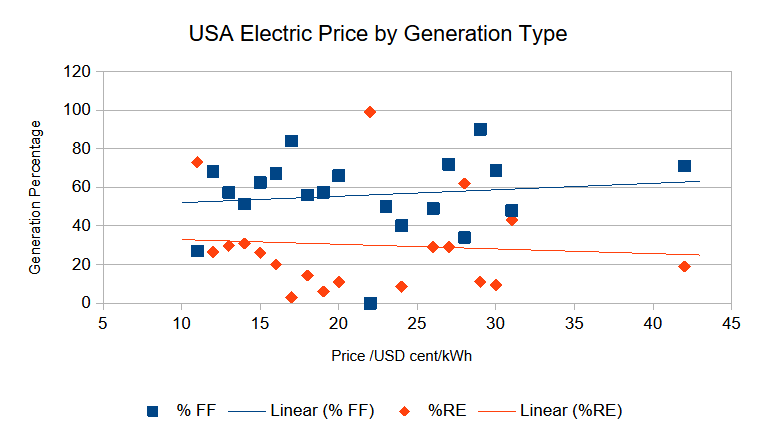
A few minutes looking at the data and it shows a messy picture. But generally, the trend is that the more RE generation there is (less fossil fuels) the cheaper the kWh price is in the USA. It is messy because of the different stages each state is in implimentaion, amount imported from neighbours, and climatic differences.
-
Maybe they need to install some more capacity. https://en.wikipedia.org/wiki/List_of_U.S._states_by_electricity_production
-
SIP experienced contractor
SteamyTea replied to Sabine's topic in Structural Insulated Panels (SIPs)
Welcome Is there a reason that you have chosen Structural Insulated Panels and not other methods of construction? -
The pictures are better on radio. One problem solved. Fires in homes are coming under more scrutiny and legislation, so why bother. Another problem solved.
-
As you are not using natural gas, have you thought of Air to Air Heat Pumps? Regardless of what system is used, plenty of floor insulation will help, best to get it done early as it is hard to add it into a slab later.
-
The consultation on the new regs finishes in a few days time. https://www.bbc.com/news/articles/cev8mrgky9eo
-
Will the thickness of the tiles affect the height of where the stairs finish?
-
Never heard of MIMO, but then, IT people are like chemists, except they just use letters. Multiple input, multiple output https://en.wikipedia.org/wiki/MIMO
-
Are the nails there for a reason i.e. holding the timber in place. Used in proper engineering all the time. Cost a bit more but are good.
-
Baxi 105e Instant-end of service life advice please.
SteamyTea replied to FlatMax's topic in Boilers & Hot Water Tanks
The useful efficiency will be pretty poor initially as little condensing may be happening. The 12.5 kW you have limited to may only be a rough setting and is the thermal output. The efficiency may be down to 65% at start up, which is getting close to 20 kW. Or Was it heating water then? -
Where else does one vent off.
-
Do they mean Building Regulation limits, which are pretty poor.
-
Hello. New member. St Albans, Hertfordshire
SteamyTea replied to MikeInStAlbans's topic in Introduce Yourself
Spent some time there. -
Hello. New member. St Albans, Hertfordshire
SteamyTea replied to MikeInStAlbans's topic in Introduce Yourself
Welcome. Used to live up your way. Do they have a traffic warden again in St. A now? You will find that the term Eco is rather dismissed on here. Low and extremely low energy is the preferred term. -
Does aerobarrier negate need for airtightness detailing?
SteamyTea replied to SBMS's topic in Ventilation
@Pocster is my dealer. -
Does aerobarrier negate need for airtightness detailing?
SteamyTea replied to SBMS's topic in Ventilation
True, and itching as well.


