Mr Blobby
-
Posts
536 -
Joined
-
Last visited
Everything posted by Mr Blobby
-
We plan to install aluminium blind boxes (about 250mm high) above some windows for external blinds. What is the best way (if there is a best way) to render over the aluminium? The front face of the box has 15mm lip at the bottom but otherwise the front face is just smooth aluminium. Two challenges then. First challenge is how to get the render to stick to the aluminium. Mesh, scrim cloth, something else? Second challenge is to do this in a way that will not crack given that aluminium may expand in the heat. We intend to use a silicone render like sto which will hopefully provide some elasticity but welcome any suggestions as to render choice. Has anyone rendered over a smooth surface like this before, and if so how?
-

Intake and Exhaust Ducts
Mr Blobby replied to Mr Blobby's topic in Mechanical Ventilation with Heat Recovery (MVHR)
So I now have two lovely 200mm holes cored through my gable end for the MVHR intake and exhaust duct. (Thanks to @Conor for reference to core-master) (also 2x78mm holes for ASHP flow return) I have 200mm blauberg pipe to stick in the holes. From there to unit I have zhender comfopipe plus. What sealant/adhesive is best to stick pipe/sleeves to the blockwork. Stixall, CT1? -
Making the most of excess solar with a 3-phase supply
Mr Blobby replied to Tom's topic in Photovoltaics (PV)
Do you have an electric car? My concern with the harvi is that it is wireless only and for our install the signal may not be reach the EV chargers outside. Or even the Eddi as we have a lot of block walls to go through. It is my understanding that a 3-phase zappi will connect 3 CT clamps easy enough. Then set the zappi as the master device talking to the Eddi over cat 6, thus removing the risk of wireless signal failure. This is the theory. I would be interested to know if this actually works in practice. -
Timber or Casoline type ceiling void
Mr Blobby replied to Mr Blobby's topic in General Construction Issues
Good question. On top of the hollowcore slab (ie the first floor covering) will be 10cm screed. That may be 5cm insulated screed and 5cm standard screed. The insulated screed was originally intended to make fixing of ufh pipes on first floor easier but we binned the upstairs ufh so no reason to have the insulated screed now. Unless of course it reduces sound transmission. Screed not pured yet. First fix plumbing is in. Roof on, most windows in, we are a whisker away from completely watertight. On top of the screed will be mostly tile/wood, not much carpet, although wife may overule me on this. Above the kitchen will be tiled bathroom so the noise transmission here is the key. I guess some rockwool in the void here would make sense, or is there some bespoke gypsum casoline product? -
Timber or Casoline type ceiling void
Mr Blobby replied to Mr Blobby's topic in General Construction Issues
Do I need to worry about sound through a hollow core slab? I had hoped that the density in the slab would be a pretty good sound insulator. If not then what additional sound insulation should be installed in the void, some rockwool, or something else? That's interesting. Our gaps have been sealed with dry concrete a long time ago. -
Timber or Casoline type ceiling void
Mr Blobby replied to Mr Blobby's topic in General Construction Issues
The cynic inside me suspects our builder had joiners lined up. Looks like metal is the way to go. -
In a brief conversation with our plumber last week he said our ASHP flow and return will go to the buffer tank only. And then from the buffer to the hot water cyclinder and ufh manifold (with a valve switching betwen the two circuits of course) That's odd I thought. I must have misheard him. I explained to said plumber about how the UFH flow temp will be way below the DHW flow temps so that's not really going to work because I really dont want to maintain a 50 degree buffer, but he was quite insistent. Surely ASHP must be connected to both buffer and UVC with a 3-way (or 2x2-way) valve switching flow between the two. I'm pretty sure that's how the ASHP controller expects to be set up. Is my plumber talking nonsense? Or have I missed something here?
-
The architect details on our block cavity passive build include a gypsum casoline MF suspended ceiling under the hollow core slab. Our builder wants to use timber instead of metal casoline to construct the 200mm ceiling void. Our builder says timber is more solid than a metal suspended ceililng. Reading the posts on here it looks like the metal casoline type is easier to get level. I don't see much evidence on here of timber construction for the ceiling void/suspended ceiling. Which ceiling void construction is best and why? Timber or metal?
-
As said above, your DNO may not like your plans. Single phase? You can buy now buy a hybrid inverter with more than two strings for more than two elevations. Although I note you also have shading issues so looking at optimisers.
-
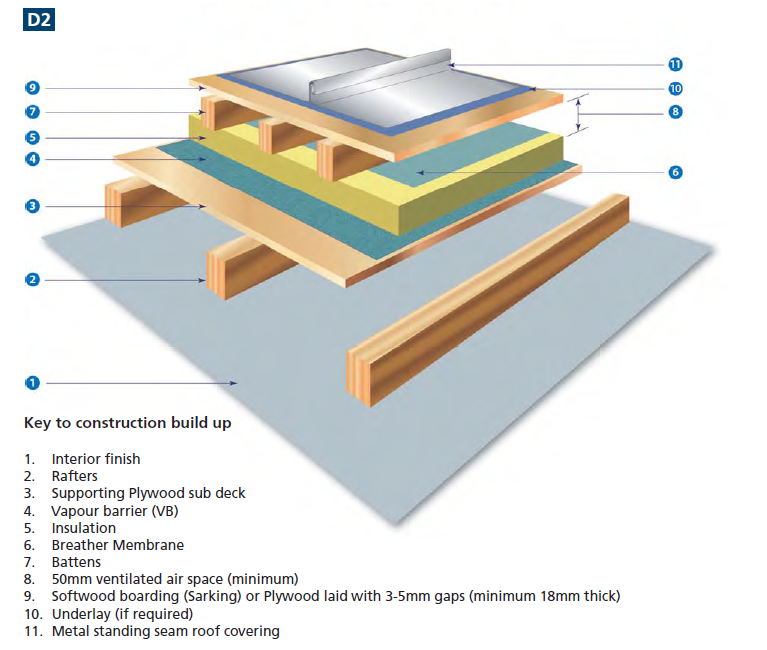
You need to talk to your zinc roof installers to agree the roof buildup. The federation of traditional metal roofing contractors has a guide, so warm roof is like this: As others have said, you can put some rockwool between the rafters to increase insulation. That's what I would do beacuse it would reduce noise but as others have said this becomes a hybrid roof and then you need to be sure of your condensation analysis. We were in your position last year and we decided to scrap the warm roof and then go cold ventilated roof (with warm loft space) so we could put more insulation between the rafters and then pir under that. We changed the ply for sarking board, and that was a good idea. No need to worry about it getting wet during construction and cost is not too much more.
-
ASHP Water Tank and Solar Excess..
Mr Blobby replied to MMcGill's topic in Air Source Heat Pumps (ASHP)
My understanding is that myenergy devices talk to each other over Ethernet so 3 phase zappi is connected to meter tails and then to Eddi over cat 6. You must be installing an EV charger, right? -
ASHP Water Tank and Solar Excess..
Mr Blobby replied to MMcGill's topic in Air Source Heat Pumps (ASHP)
Why do you need a 3 phase Eddi? Surely it's a single phase immersion and the Eddi nets the total of 3 CT clamps on the meter tails? -
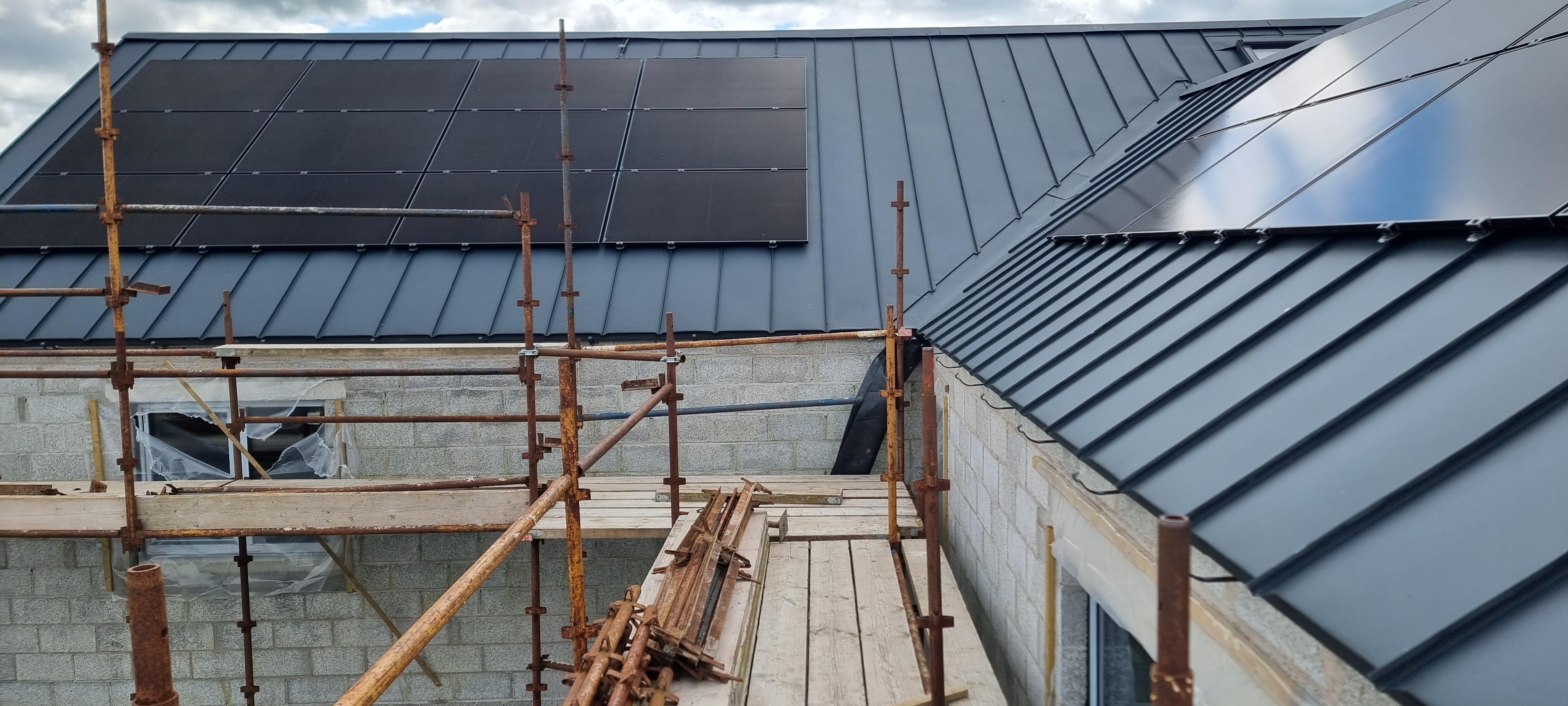
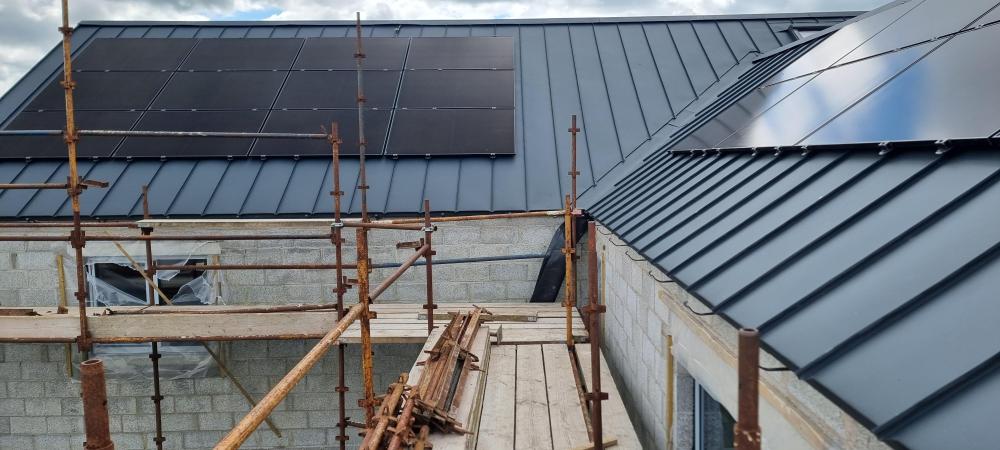
I take it all back. It took three blokes three and a half days to put the panels on the roof and connect them up and I love them. (cables run to ground floor no isolator) They will come back to install the inverter that I will supply (install price included) so not a bad deal at all considering some of the outrageous profiteering from a many solar installers. The fitters took their time to line everything up and cable tie all the cables off the roof. I know some people just hate the look of panels but I actually quite like them and should have maybe put some on the front SW elevation instead of keeping them hidden at the back of the house. My builder hates the sight of them. Yes I did powdercoat the clamp disks to match the roof colour 🙄
-
Ours seem to have window specification codes on both the inside and outside panes. No kite marks. So not so easy to figure out, unless of course I've missed some small markings somewhere. I'd post a picture I took earlier to explain better but I left my phone in the builder's van. 🙄
-
Our recently installed internorm widows include some with low-G glazing units and some laminated units to reduce noise by a few dBA. How do I know if they are installed the right way round, with the outside pane on the outside? I can't see any obvious markings on the glazing so how would the window fitters know which way round to insert the glazing units into the frame?
-
The 400 litre tank was specified in the same diagram as the manifold location drawing that was largely ignored 🙄 I have learned from this experience never to assume the trades will read plans or listen or understand airtightness or do the obvious. I think line paint is my best friend from now on. Anyways, I spoke to the plumber and the manifold is now being relocated to the inner wall. He did of course assume a 300l max tank and says he's never seen a 400 litre tank. I wouldn't describe the plumber's mood as delighted but he is moving the manifold to the internal wall. And that's the main thing. Plumber also tried to talk me into a split ashp instead of a monoblock again but that's another story. Says monoblocks get locked in defrost cycles they can't escape. I remained steadfast.😬
-
I guess my concern with the manifold plumbing moved behind the tank is the repairs after the install. Not being a plumber then maybe I don't see what the plumber sees as the final solution. Maybe all the pipework connections and joins will be accessible with no joins/valves hidden behind the UVC. Otherwise the plumber will need the arms of an octopus and the eyes of a wasp to connect up pipes the other side of the tank. As long as everything can be accessed and maintained in the years to come without the need to remove the tank then all's good. If however the plumber has assumed a small 150l tank that won't obstruct the manifold plumbing then we may have a problem 😬
-
Yes, maybe as a skilled tradesman he has a very good reason for hiding the manifold behind the planned UVC that is not obvious to the layperson. 🤔😬
-
Does this not depend on the temperature of the water in the tank? With ASHP heating the water to a lower temprature than a gas boiler and all that.
-
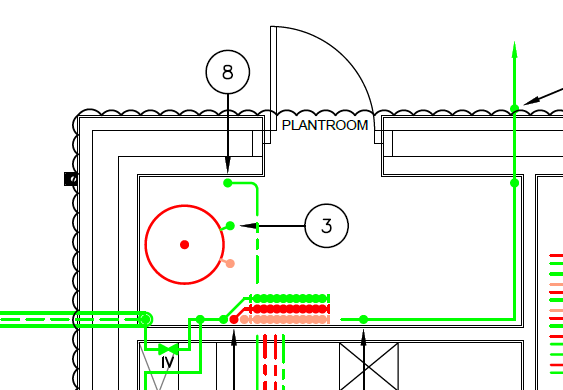
Another day, another surprise on the site. Plumber was doing first fix running mlcp pipes into the plantroom where the manifolds and UVC will live. I had to leave the site to go to some other commitments. Never a good idea. Drawings are like this: ... with the manifold and plumbing deliberately placed on the accessible side of the UVC. The room is 1100 wide and with a proposed 400l tank of diameter 750 then only a small child will squeeze behind ithe UVC. (the external door is replaced with an internal door on the far right of the drawing) To my surprise the plumber has run all the pipes (and trimmed them) to the outside wall behind the future UVC. Where he thinks the manifold will go but it will be inaccessible unless it is high up above the top of the cyclinder. While this looks ok now without any UVC installed, I thought it would be bleedin obvious that when the cylinder is installed then the manifold would be hidden behind it and perhaps more difficult to plumb. Before I raise this with the plumber, is there anything wrong with putting the manifold on that wall behind the UVC. I;m no plumber so maybe I;m missing something hrere. Maybe the intention is to have the manifold up high where long arms and a step ladder may be able to reach it. And run pipes from the front of the cylinder to the back. That just sounds like a far worse option than having accessible plumbing in front of the UVC. Is it? Does my plumber know something I don't or is this a bit of a bollox?
-
Does this block retaining wall look right?
Mr Blobby replied to swankypants69's topic in Landscaping, Decking & Patios
It should have a drainiage ditch against it filled with stones wrapped in geotextile with a drain at the bottom. The geotextile will stop the drain clogging up. I agree with comments above block flat, wider at the bottom. Single skin without any drain is not good I think. For extra points paint the back of the blocks with bitumin paint and/or seal with a membrane to keep out moisture and protect any finish on the blocks. -
Latzel still delivering to Northern Ireland ok and no customs charge. Not sure about claiming back the VAT but even including the vat the prices are still about 30% below UK prices.
-
What battery are you installing? My understanding is that the fire risk with LFP lithium ion phosphate batterries is greatly reduced. We plan to install a pylontech force battery which is LFP (someone correct me here please if this is not the case!) We are also installing 3-phase inverter and 3-phase supply into the house. Our inverter and battery anre going in the garage which should be the goldilocks temperature of not too hot and not too cold. And outside the thermal envelope to keep the heat out of the house in the summer time.
-
We got prefalz aluminium standing seam and would definetely do it again. At 200 m2 its not cheap but it does look amazing, despite some crapness from the installers. Aluminium gives colour options to match windows and gutters if that's your thing. A couple of things to think about with standing seam. Firstly, the roof buildup costs a bit more before the standing seam beacuse sarking boards need to be laid under the metal. Also, maybe consider narrower seams. We asked for 400 centres instead of the standard 600 centres. This costs a little more because of the extra labour required but looks, I think, awesome, and supposedly reduces canning. Time will tell if canning is actually reduced. Closer seams also gave us more options to attach pv panels with S5 clamps and repeated nicely across the panels. On the back of the house of course, where they don't spoil the look of the roof.
-
https://task32.ieabioenergy.com/publications/advanced-test-methods-for-firewood-stoves/&ved=2ahUKEwiImuWLmdaFAxW6V0EAHY5VDoQQFnoECBQQAQ&usg=AOvVaw1WUtpQXEuNQ2I6Fw9m_ZKB