Moonshine
-
Posts
2094 -
Joined
-
Last visited
-
Days Won
6
Everything posted by Moonshine
-
Yes, the resilient layer between the floor and the joist is for impact noise and doesn't do much for airborne noise transfer. Question, are upstairs rooms going to be carpeted? if so carpet and a thick underlay are pretty good at impact isolation. yep, ScreedBoard is a solution and performs well (see robust details E-FT-5 and E-FT-6), also if you are laying on a sub floor construction, similar products exist with a resilient layer under a interlocking chipboard (e.g 19mm JCW Acoustic Soundboard). Speaking to JCW in the past they don't recommend putting their Soundboard directly onto joists, as the point loading over loads the resilient material. I have specified joist caps before in a project where space was a premium and no sub floor construction, but the joist caps were only 50mm, where the joists on site were 75mm so they went with the regupol option. https://www.customaudiodesigns.co.uk/acoustic-joist-cap.htm https://www.soundstop.co.uk/ZMJCAP50.php https://flooringwarehousedirect.co.uk/product/regupol-studwork-isolating-strip-self-adhesive-15m-roll/ It is imperative whichever option is taken that no rigid connections (e.g. screwed) are made between the new flooring and the timber joists, this includes the room perimeter and flaking strips should be used to make sure that the floor is truly floating. Also note that the sub floor construction may help stiffen the whole construction (e.g. joists fixed together by boarding) and help with bounce. It may help the airborne sound insulation as you have doubled the surface mass, due to two layers of floor.
-
Yes, particularly in timber frame, which basically doesn't have the same mass per unit area as masonry that is effective at insulating against low frequency. It is also really dependent on the detailing of the design, and workmanship. Sound insulation of timber framing can be a complex matter that i won't go into in a MVHR thread. @PeterW a solid sealed core door won't so much 'transmit' the sound, but impinge its transmission more than a hollow core door. FD30 fire doors, which are solid core with seals at the jambs but not the threshold (small gap, though if a true fire door / smoke requirement couldn't have the gap) will probably achieve Rw 25 dB, and if a threshold seal around Rw 30 dB. Lorient have a very good database of how there acoustic seals perform based on different door / blank manufacturers. http://www.lorientuk.com/acousticsearch Building regs for entry doors in Rw 29 dB, so i can't really see what would have the need for internal door sets of >=Rw 25 dB, @Sjk what is your sound insulation needed for, kids play room, music room, adult dungeon?
-
A sealed solid core door, with a threshold seal will provide good sound insulation, but the same without the threshold seal wont be that much of a degregation acoustically, but probably will give enough of a gap for air ventilation.
-
Sealed doors in internal room? What's the issue?
-

Floor plans - any last minute advice please?!
Moonshine replied to Mrs CFS's topic in New House & Self Build Design
Looks nice, and massive floor area. No real comment, but i would scrub your boys name (and maybe boy's bathroom) from the drawings, just call Bed 1 and Bed 2 for data protection as these drawings and names will be on public display (like now). -
On site, and found this monster!
-
When you come to select plasterboard the surface mass of a selection of types are in the post below
-
If you are doing a external wall with two 100mm block, and 100mm cavity noise intrusion won't be an issue, however other facade elements such as glazing and vents are the potential issue. Oh they do, and they do sell. So many use timber framing, e.g. Persimmon do loads of timber frame, so much so they brought a timber frame company, Space 4.
-
Are you looking at internal walls and floors rather than external facade elements? If you are looking at internal spaces, building regs require a minimum sound insulation of Rw 40 dB. This can easily be achieved with standard plasterboard on timber studs with a bit of mineral in the cavity. Or if you are going masonry a 100mm block will do it. If you want to increase over the minimum Rw requirements with timber then look to use additional layers of denser plasterboard (or even resilient bars), or with masonry use denser block.
-
I wouldn't quite say timber is hopeless, relative to masonry, correctly designed and built it can perform as well as masonry overall (Rw), however where masonry comes into its own is low frequency resistance as it's got significantly more mass to it. If you compare the low frequency range sound insulation measure (Ctr) masonry is so much better.
-
Nice location and good plot size. I can see what you mean about the old windows (i was being nosy as i am in the Devon area, and came across the old plot sale particulars), glad you were able to get those windows changed, especially for the views in that area!
-
Plasterboard or Aquaboard?
Moonshine replied to TheMitchells's topic in Bathrooms, Ensuites & Wetrooms
yep, 12mm cement board, have a look at the info for another cement board product https://www.jameshardie.co.uk/product/hardiebacker/ -
Plasterboard or Aquaboard?
Moonshine replied to TheMitchells's topic in Bathrooms, Ensuites & Wetrooms
Why not use some thing like Aquadry Backer Board instead of plasterboard, to save having to tank? -
My common sense would be to only lag pipes (hot and cold) in unheated spaces.
-
Resonating plasterboard wall - buzzing plumbing
Moonshine replied to readiescards's topic in Sound Insulation
Yes it is, and can cause noise issues, I was involved with a project where noise from high pressure pumps were causing issues due to pump pressure pulsations propagating along long runs of hydraulic pipe work that ran through noise sensitive areas. Water is a pretty incompressible fluid and energy transfer though this medium is efficient. What the circulating pump is doing, is every time there is a fluid compression from the pump it gets sent down the fluid in the pipe. Say the pump has a operation speed of 1200 RPM (20 Hz) and 6 pumping element (lobes / vanes), it will create a 120 Hz pressure pulsation down the pipe and make the pipe and anything that its fixed to vibrate and create noise. In your ASHP, it seems that the circulating pump and system is creating large pressure pulses. So how to stop it? Try another circulating pump that creates a reduced magnitude of pressure pulses, as @ProDave seems to have found. Fit a hydraulic noise suppressor / pulsation dampener (though I doubt there there are any specific for ASHP's, as one looked at were in the 3000psi range) Make sure that the pipe work is not touching building elements, especially if they are lightweight (e.g. plasterboard). Use resilient pipe mounts. if sound is still propagating from the pipe, lag with a product such as Soundlag 4525C. -
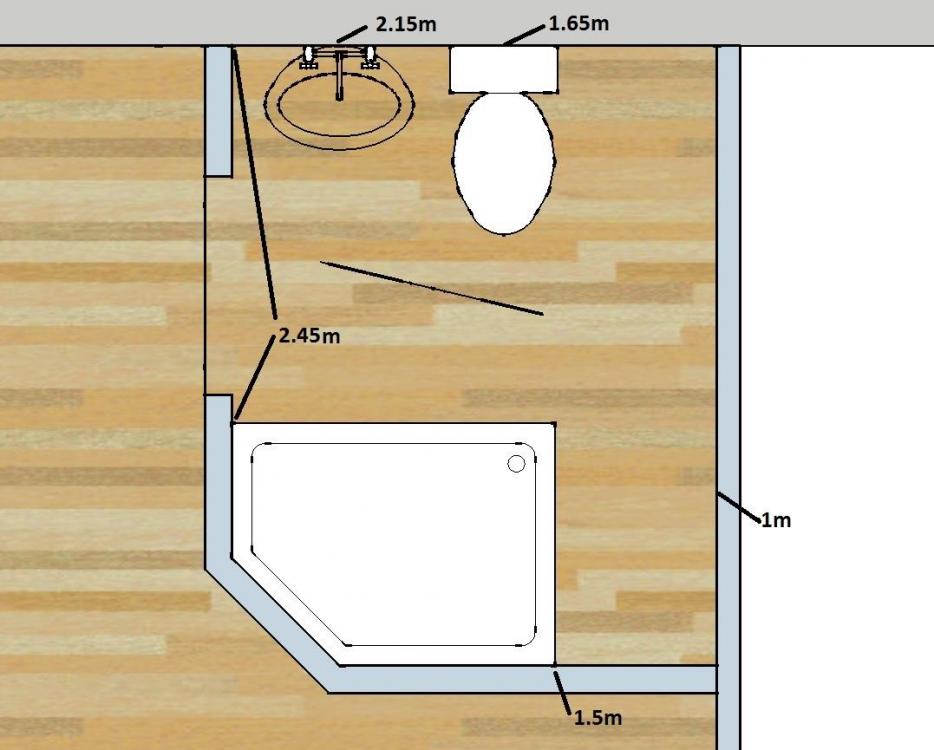
I am looking to put a en-suite in an existing bedroom in a pitched roof. The en-suite is based on a 1200 x 900 shower tray with cut corner to minimise the intrusion into the bedroom, with the door opening inwards to the shower. Below is a sketch of the space as i see it working, with the ceiling heights marked on in the key areas, i think that the heights are o.k (they may come down by 50mm for more insulation in roof void). I am not too sure about the clearance above the toilet, any thoughts or guidance on minimum heights, and laying out a en-suite in a eave?
-
https://blog.tafkas.net/2012/10/03/gathering-and-charting-temperatures-using-rrdtool-and-highcharts/ not done it myself, but it seems the above has.
-
How technically minded are you? you can knock up a cheap temperature logger using a raspberry pi, having the pi inside and the sensor through a window seal and it will log the information in 5min (or what ever you want) chunks to an excel file I could dig out the python code i used to this if you wanted to.
-
What type of boarding above rafters
Moonshine replied to Moonshine's topic in Roofing, Tiling & Slating
I was incorrect in my assumption that the OSB would be impermeable, as @JSHarris above the roof construction i am thinking is Tiled roof on 25mm battens Roofing membrane 25mm counter battens (running down roof) 18mm OSB above rafters 200mm rafters with 200mm mineral wool in cavity Vapour control layer 50mm PIR between battens below rafters Acoustic resilient bar below battens 2 layers of 15mm SoundBloc -
What type of boarding above rafters
Moonshine replied to Moonshine's topic in Roofing, Tiling & Slating
Is it, i hadn't realised is was permeable, that is good. That would help reduce the total thickness of the roof, so i could have a 175/200mm rafter, cavity filled with 175/200mm mineral wool with OSB above and PIR below. -
I am looking at a potential roof construction, to put wooden boards (~9mm) above the rafters, and below the counter battens / battens and tiles. As the boards will be a Impermeable barrier i will be leaving a 50mm (BS5250) vented gap between the underside of the boards and the insulation. The question is, what type of boarding to go for, OSB or a treated ply? any thoughts
-
The "35DB noise reduction" they are quoting, is likely the sound reduction index (Rw), and a Rw of 35 dB is possible, by i would be asking for the test (BS ISO 10140-2:2010 / or BS 140-3) that backs up that claim, and ensure that that value includes the frame system and isn't just the performance of the glass by itself. For an alternative Pilkington do a 6/16/6.8 Insulight Phon incorporating Pilkington K Glass, which is tested (i don't know if it includes the frame) that achieves an Rw of 38 dB, and argon filled U-value of 1.5.
-
Do as JSHarris says; Also "Where allegations of noise from such works are substantiated by the Environmental Protection Team, a Notice limiting the hours of operation under The Control of Pollution Act 1974 may be served." So first off, don't get any allegation of noise reported to environmental health, second if you do, stop and be nice to any visiting environmental health officers, and third if you do get a notice, abide by it. Your site has some close neighbours, so try and keep them on side, and don't take the pi$$ too much.
-
Costs involved in full planning permission application
Moonshine replied to Willow2220's topic in Planning Permission
you can get some lidar information for free https://environment.data.gov.uk/DefraDataDownload/?Mode=survey -
Costs involved in full planning permission application
Moonshine replied to Willow2220's topic in Planning Permission
add to that, potential - Air quality - Noise assessment