Moonshine
-
Posts
2094 -
Joined
-
Last visited
-
Days Won
6
Everything posted by Moonshine
-
British Gypium usually spec wall systems with 25-50mm APR1200, which is 12kg/m3, and true you don't need to fill the cavity. But.... by going denser and thicker with the insulation you will get a better overall result (as long as its not overly compressed), especially at low frequencies. On a limited area of wall the marginal extra cost is probably worth it if the overall aim is acoustic seperation.
-
They got fined £18k! https://www.bbc.co.uk/news/uk-england-london-47811545
-
Fill the the 95mm stud cavity with 100mm mineral wool (or similar porous insulation) min density 24 kg/m3 (loft is usually around about 12 kg/m3). DO NOT USE PIR! You are going to want to de-couple the wall linings from the stud work, with a resilient bar or equivalent. Next you want to provide some mass to the construction, so on the resilient bars fix two layers of 15mm dense plasterboard (e.g. SoundBloc) on the bedrooms side, on the bathroom side, you can use a cement based board such as 12mm hardie backer. If you are going to tile the whole wall you can just have one layer this board, as the tiles will give the additional mass needed. if you could make it 145mm thickness, you could go for a staggered stud wall construction. Also if you can don't put any electrical sockets or penetrations in the wall linings. If you do end up using resilient bars make sure you use two different lengths of screws, a potential on site issue if too long a screw gets used on the inner layer of plasterboard, they go right through the resilient bar and potentially into the stud, making the bar pointless.
-
any particular issues around windows and doors, e.g setting out and water ingress?
-
I am thinking of having the front facade of the lower floor of a proposed house (~24m2) as a stone facade veneer affixed onto blockwork. Has anyone used it and any potential issues / advice?
-

Help with my noggins please
Moonshine replied to ToughButterCup's topic in General Construction Issues
what is the stud centres? -
logically i would say no, as it only included older properties from pre 1930 and earlier. Sounds like Property B has been included as the drawings are based on the old boundary lines, and not accounting for the new boundary of the property split.
-
Yep, that is what it states, so question to you, how do you achieve sustainable development, and how do you prove that a development is sustainable? Think about a potential site that is located on a flood plain, the council could very rightly say, "That sites on a flood plain, that's not sustainable", and have a material objection to planning being granted. It's not the council planners job to determine how the site could become sustainable, if you want to develop it, the onus is on you to show what the impact is, and how it can be mitigated so that that the potential flooding doesn't cause issue to future occupants of the site.
-
To be fair you are looking to build a big house, from looking at the plans that is a floor area of 280 m2, using the rule of thumb of £1,500 - £2,000 that is £420k - £560k, plus the cost of the double garage. Not sure what the quotes are coming in at, but if they are in the half a mil range i wouldn't be surprised. However its a great looking house and reminds me of one recently built of similar size near me, i don't know the full economics of it but if sold a few years ago for £700K, so i would have thought that the build costs would have been less than half a mil to get some profit after land cost
-
Do they have one for a self builder, throwing £50 notes into the breeze?
-
Alternative to standard scaffolding - who needs it anyway
Moonshine replied to Sue B's topic in Project & Site Management
One i spotted in Italy a couple of years back. I presumed the cones were there as an exclusion zone for the blast radius of the gas cylinder.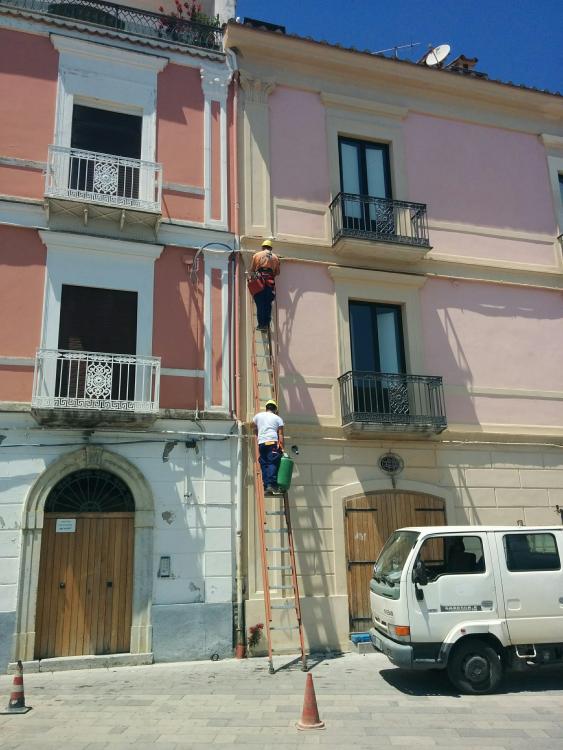
-
If you could that would be great as currently struggling visualising what you mean.
-
Not come across that rule and you need to check your local authority requirements, do they have any planning guidance documents? my plans going into planning soon are for a 6m depth from house to rear boundary, and the local authority has a minimum area requirement which mine exceeds. I hope it will be o.k.
-
Its a planning thing to allow turning within the curtilage of the dwellings, i don't think that there is enough space for the template turning area, withing each curtilage, so there may need to be some shared area. However that doesn't mean i can't make the turning area as large as possible within each curtilage to minimise the area needed to be shared, that said the planners haven't specified how many point turn is required. https://youtu.be/iLKR9tCiwvA?t=16
-
and these guys https://www.walesonline.co.uk/news/wales-news/beautiful-200-year-old-giant-15477459
-
I am working through the site layout plan, and the site is beginning to work better with turning on site with a shared turning area with two plots next to each other. Does anyone have any thoughts and potential issues of having this type of arrangement?
-
how about, Hire a meaty core drill with bit of required diameter, drill holes, and morter in a plastic pipe in the new hole.
-
Investigating any increase in Consultants Required for PP
Moonshine replied to Ferdinand's topic in Boffin's Corner
As a 'consultant' i agree with these points, and in my own field land is getting more constrained and potential impacts are more prevalent, but also that i am of the opinion its always been a developer that has to prove to the council what the impacts of the development being applied for are. -
i was on site earlier this week, and got chatting to the SM off a reasonably sized builder in the local area, and they said that their starting point build cost was £1,300 / m2 floor area including foundations.
-
*rant* pre-application timescales *rant*
Moonshine replied to Moonshine's topic in Planning Permission
I got my pre-app response back recently, just shy of 7 months after being submitted, its pretty positive with comments such as the principle of the development, design, scale and massing is considered acceptable, which has to be a big tick! There is one thing in the response that is going to cost me £££ at this stage that i hadn't accounted for, but not the end of the world. Lets see how it goes once the full application goes in, in a few weeks time, but at least it gives me the confidence to proceed. -
Concrete with a floating floor will give so so so so much better performance that significant majority of timber floor
-
That won't do a great deal for the impact noise, the most effect method is a floating floor via resilient layer under floor, or carpet with a decent underlay.
-
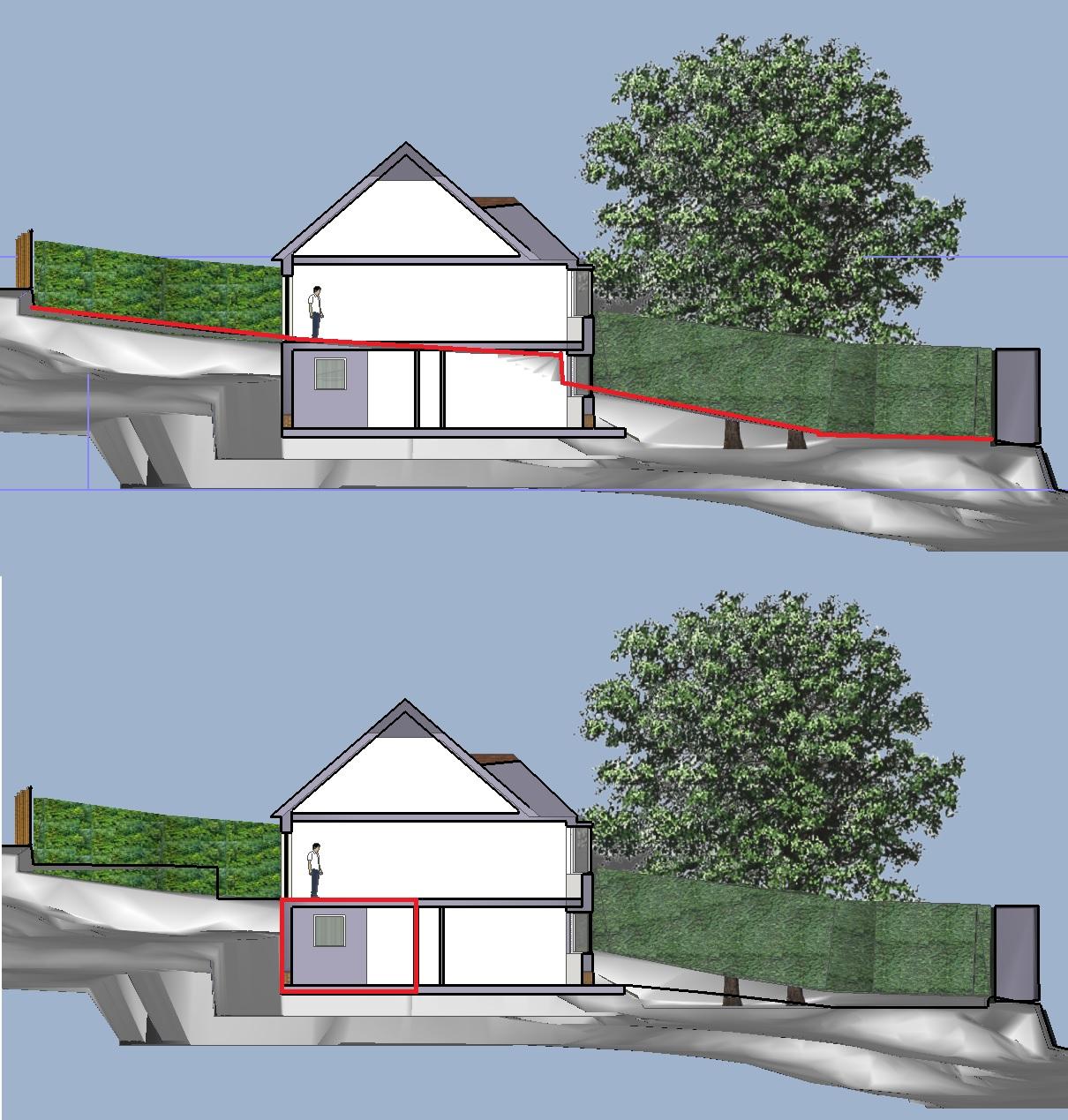
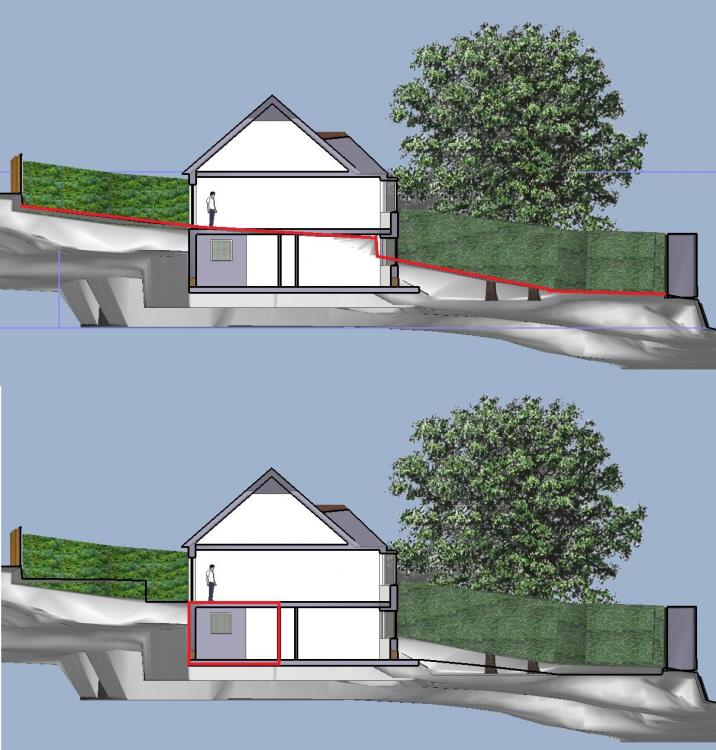
Thanks, i am aware of the increase in volume once its un-compacted. @Bitpipe are you willing to share what the associated cost involved were, to use as a yard stick? The existing site level is the red in the top figure below, and area i am thinking about is red in the bottom one
-
Shouldn't be rock, but everything is going to have to be taken off site.
-
I am looking to develop a plot on a sloping site, with the rear garden level a level (first) above the entrance at the front (ground), so about 3m difference. Working on a hypothetical depth of the house being 8 metres, I am trying to work out it it's worth excavating the full 8m back or going a fixed distance in at ground level, e.g. 4-5m. The pros being that it increases the habitable space and may make the construction more straight forward, with the retaining wall tying up with the line of the rear external wall. The con's are the cost increases in excavation, retaining wall and build cost The site will need a fair bit of excavating anyway so it's may only be a relatively small increase in cost. Based on a 8 m wide house it would be about 96m3 extra to excavate, but an increase in floor area of 32m2. I can sketch the levels and change a bit later