


saveasteading
-
Posts
11094 -
Joined
-
Last visited
-
Days Won
98
Everything posted by saveasteading
-
Re my field, which is Civil Engineering ( thus including drainage and Structural): To a large extent the bco will decide on needing more or less, independent and expert input after seeing the proposals and meeting you. If your written proposals and calculations look as if they follow the regulations, then they may have a run through it themselves or have their retained Engineer do so. OR reasonably require it all to be done or certified by a qualified person. Anything that is not a detailed process in the reg's though will need expertise. The bco will never do it for you. For example , if you have used the published calculations and methods for drainage and presented them well then they will probably accept that. "- I could easily have fudged the numbers in order to get away with a cheaper system. I didn't, because I'm not an idiot)." the bco trusted you in both understanding the process and in not cheating. Plus they've seen plenty local projects and know the likely size of a system. For normal size houses with smallish rooms, the joists and walls can come straight from published tables. The Scottish regs are particularly practical on this and you barely need an SE. But a beam? No way. Must be by an Engineer. It's not just knowing how to calculate the beam that takes that span, but where the loads are coming from. I don't think any of that outsourced technical input stops it it being self build. I'm struggling with a definition. You must be the project manager. And the site manager. It is not a complete package by a main contractor. The risks are yours. Is any element at all of hands-on essential? .. I don't think so. If one gets the whole box built by a kit contractor, then brings in finishing trades is that self build? Just about, because it could still go horribly wrong.
-

Public liability insurance - nothing else (yet)
saveasteading replied to Drellingore's topic in Self Build Insurance
If you've explained beforeand ive missed it, refer back to that please. But I'd be v interested to know why you volunteered for GD? Our project is a farm barn. We all discussed GD and couldnt see any advantage but several disadvantages. Pressure, criticism, public scrutiny, the world hearing of our finances and life plans. In one word, pressure. -
I'm renovating a pitched small farm shed, 12m x 9m, to be a garage, store, workshop. We are putting 40mm composite on the roof and walls, nothing on the floor. The doors may be up and over , with virtually no insulation, or perhaps a wooden pair, a little better. Heating will likely be infra red pointing at work bench. It won't be Baltic. Not a garage at all then? No car type door? I suggest you design it for that, including any PP and building regs it needs. Otherwise the insulation and ufh are wildly excessive. Lose the parapet and fit external gutters and this will reduce risk long term, and make construction easier and insulation better. You can add a rainwater barrel for car cleaning nearby. All in all, there's a good few £k saving.
-
I can hardly carry it. 25kg. Once in place I just have to let it bounce and gently steer it. I was going to hire one but there are few sources round here. I'm very glad I bought this heavy breaker rather than a lighter one or a drill/breaker as there was more, and stronger, concrete than expected. I used my battery sds for the subtle stuff to avoid damaging brickwork... also good for slicing clay, ... but it barely scratched the heavy concrete.
-
Its certainly very well insulated. Lucky car. What is the garage door spec? Is it insulated? What draught seals are around it? If not a very special garage door then your heat will pour out of it and all the extensive insulation will be pointless. It's designed to a house spec. Either that is all your designer does, or you intend slowly turning it into a habitable room which I can't condone.
-
Converting Section of Front Garden to additional driveway/ parking.
saveasteading replied to Charlotte22's topic in Driveways
It doesn't seem that neighbours would complain, as others have done this already.. so the council wouldn't be aware or interested. Nearly always worth a chat to the immediate neighbour. If you make the new surface permeable then you aren't affecting drainage either and it is 'a good thing'. Membrane, sub base, grids with gravel. -
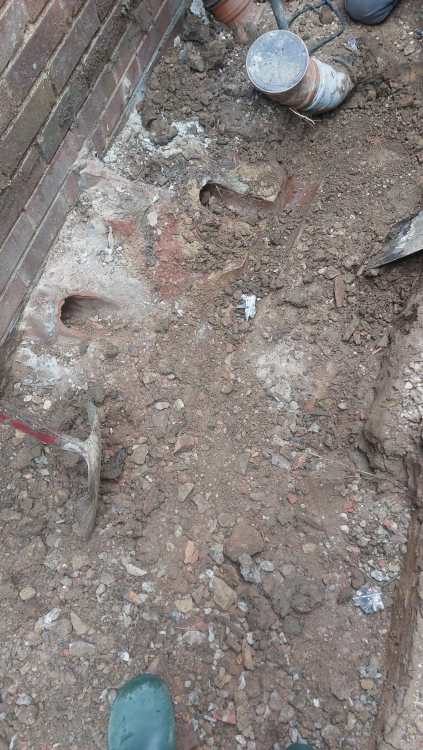
The hammer is there for effect. I had a lad doing most of the graft. My main role was to stop him overusing the hammer. Some of what was buried shown below. I bought a Titan breaker which proved to be a good move.
-
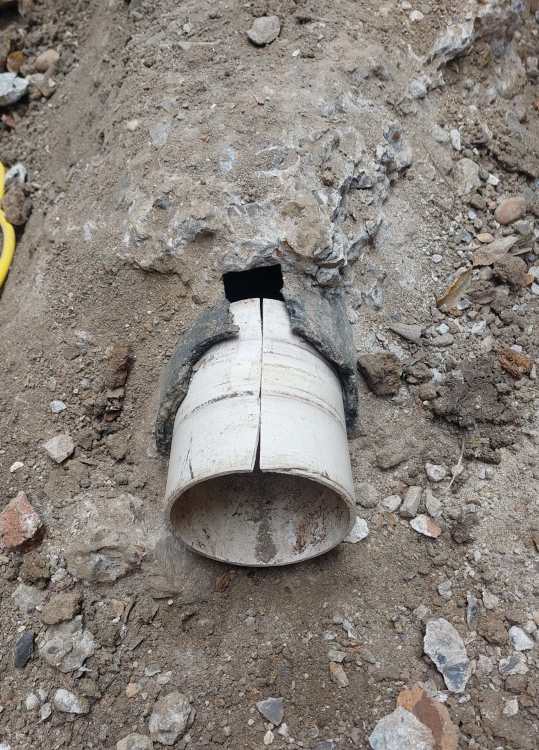
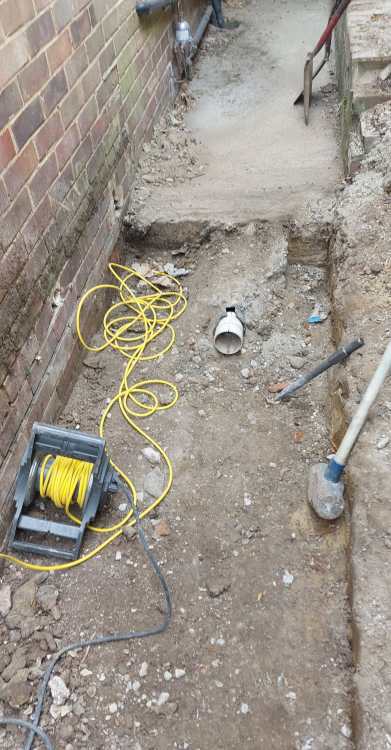
I'm very pleased with this pragmatic solution which is definitely not a bodge. We decided that after 30 years it was time to reduce the internal damp of this crummy extension. So I planned on 2 days of cutting back the earth fill which was only 2" below dpc. 2 weeks later: The ground was filled with redundant drain runs, footings and loads of concrete because the working drains of clay or pitch fibre were at ground level. It's all working out, but is a long way off proper depths etc. So I'm faced with forming this connection to a pitch fibre pipe...(the rest is full of holes in the skip)... the pipe worked only because the pipe was acting as a former for the concrete. Can't break out any more concrete or the pipe will keep breaking. I'm not breaking out the concrete path Couplers don't fit because there is no protruding pipe. SO. Here is my solution. See the white pipe. I have cut a 1" lengthways slice out of the short length of pipe so that the diameter reduces and it squeezes into the pitch fibre. By cutting a wedge shape it expands outwards to be a coupler diameter. Tap white pipe further in. Fit drain pipe over white pipe. Duct tape over the slice. Concrete surround. There may be an imperfect joint of white to coupler but that happens in lots of connecters. I should add that the pipe carries only my workshop sink drain, and leads to the vent riser pipe. I've never had so many 'surprises' in the ground. The perils of refurb.
-
How does your garden grow?
saveasteading replied to recoveringbuilder's topic in Landscaping, Decking & Patios
i used about 300mm., mostly in the ground. i know that @marshian's will work too because I have great success with brambles spreading thus. Good idea actually and i do it with rosemary: just lay a branch on the ground with a brick on it. slightly snapping the branch seems to help too. not so convenient if pinching a bit from elsewhere. -
How does your garden grow?
saveasteading replied to recoveringbuilder's topic in Landscaping, Decking & Patios
The easiest tree to grow from a branch or root cutting. -
Advice on connecting cores of SWA cable inside junction box
saveasteading replied to Tim Shand's topic in Electrics - Other
I was trying to use them, but I think the noses are too wide and too thick. maybe mine are not actually gland pliers but something similar but chunkier. I had to jam in a screwdriver to wedge the nut in position, and that worked. -
Shower Enclosure - Extraction
saveasteading replied to richo106's topic in Bathrooms, Ensuites & Wetrooms
I've got this and its a powerful shower. . A very few splashes may wander out but onto a mat which feet will make much wetter. I like it and would do it again, and is so much nicer than a door. Another decision I'm pleased with is to fit a big grab handle, whether your family needs it or not. With it there it is second nature to hold it when manoeuvering or lifting a foot, and avoid slips. Stainless steel screws too. I don't think it looks clunky, just sensible. -
Advice on connecting cores of SWA cable inside junction box
saveasteading replied to Tim Shand's topic in Electrics - Other
I can advise on what I'd do different next time, having done it for the first time last month, after great advice from BH. Bigger box. My sausage fingers needed lots of room for wiggling wires about and to get a spanner inside. I'd def use the one from screwfix because the knockouts /seals are brilliant compared with what I tried first. SF say its unbranded but that is wrong. Wagos. I failed with screw connectors because there is so much wire and its stiff. Bought cheap connectors from SF and succeeded but didn't like them so Wago next time. Tightening the nuts. Really awkward and the extra space will help. Earth. I used the supplied terminal but the one mentioned above seems much easier and more secure. There is a good video on Facebook which helped with basics. I hate to think how long the first endvtook me. Several goes at it because I'd tangled or left something off. Stop and think. The other end 1/4 the time. -
Does that summarise it? But Germany presumably think its OK. The WP had readers' comments including that the US power companies are very anti.
-
This is from the Washington Post. Does it happen here as well as in Germany? Typically 800W. In Germany, balcony solar is hugely popular: as many as 4 million systems hang on railings there, equivalent to the capacity of several large power plants. (Yes, there is a one-word German name for it: Balkonkraftwerke.
-
How does your garden grow?
saveasteading replied to recoveringbuilder's topic in Landscaping, Decking & Patios
I've got a fig in a big pot (actually an inpection chamber ring) and it grows but never fruits. Perhaps because it's from a Spanish cutting. Is yours a UK friendly variety? -
Mansards with no soffit ovehangs
saveasteading replied to jackcowdrey's topic in Lofts, Dormers & Loft Conversions
Brackets fixed to the rafters (probably the sides then a twist) or to the wall. -
OK. Paddle lines, colour variations, perhaps some microcracking. It's a matter of taste. But do ensure that the contractor is a specialist ( does nothing else) and is aware this will be exposed and of your expectations.
-
Good thinking. The building regulations are accessible online and straightforward too. Downhill all the way with access for clearing blockages and that's about it. It's all logical but BH will help with challenges or queries.
-
I hope you are not expecting a beautiful surface that needs no covering. "Polished" is a warehouse finish.
-
With one client whose architect would not contemplate external gutters, and with only the end available for outlets, I doubled up on outlets, ie a full gutter would flow over one to the next one. On another we took the gutter out through the gable to a big hopper with external dp, and with an overflow wier... so any freak rain would overflow outdoors. Once the water is in the downpipe it will cope easily, its the entry to the dp that is restricting. ie overdesigned acc to the regs. I imagine and hope that they coped with this year's downpours. External gutters are good and why hide such an important feature of a building?
-
Gravity fed or pumped chamber to drainage field?
saveasteading replied to flanagaj's topic in Waste & Sewerage
For fertiliser yes. -
Gravity fed or pumped chamber to drainage field?
saveasteading replied to flanagaj's topic in Waste & Sewerage
Anybody know a good reason for pumping it out. Gravity seldom fails so I like it. Ditto. Always full for the chambers that work that way. A big plus for me is that they will continue to work 90% ( well enough) if there is no power or the pump breaks -
Steel goalpost built 200mm or whatever to the front. Clad sides and roof. Move door forward fixed to the frame. a lot of money for small benefit.
-
Gravity fed or pumped chamber to drainage field?
saveasteading replied to flanagaj's topic in Waste & Sewerage
What comes out is liquid and looks almost clean. If you have a test chamber you will have the comfort of seeing, even testing, this. A chamber is a good idea anyway. What muck remains in the effluent will continue to break down in the soakaway. A pump should be unnecessary and is another thing to go wrong. I wonder why a manufacturer has one included apart from draining uphill.




