

saveasteading
-
Posts
10067 -
Joined
-
Last visited
-
Days Won
82
Everything posted by saveasteading
-

ICF and Insulated Raft Junction
saveasteading replied to PaddyP's topic in Insulated Concrete Formwork (ICF)
Assuming your overclad comes nearly to ground, then rain will drop off and run away, and only the very bottom of the cement board can get wet. I think I would paint the bottom (exposed area plus 100 above and all the way down) in black bitumen paint, 2 coats. this then looks like a narrow shadow in finished form. (Blackjack or eq, £25/5l tin.) -
That sounds expensive, but is to them too. Such claims do not reach the high court until reviewed at a few levels, and can even be thrown out at the last minute, on the basis that this is not a good use of the court's time/ should have been negotiated elsewhere. I would guess the court cost might be £10-20k if it goes that far, and you would get most costs back as long as you win. An expert lawyer should give you a forecast of the likely outcome. I would be surprised if a court over-ruled the planning appeal unless there was a blatant disregard of a written principle. Is it bullying or red mist? Has anyone said you must hold up the works? If so, then I think you can state that you will seek reparation for abort costs, when you win. If not then what happens if you lose?
-
SIPS or ICF
saveasteading replied to jimmy_stocks's topic in Energy Efficient & Sustainable Design Concepts
No, as most of the material cost is the foam fill. It is simply an expensive product to manufacture, transport and hoist. You are paying for quite a bit of factory time, with all the costs that incurs. I have no experience of building with it, but have researched and had quotes, and it was always easier/cheaper/better another way. BUT it comes into its own for simply shaped buildings of ideal dimensions, and will be quick on site which has a value to some clients. Also some people simply like it, and there is reduced scope for build quality problems. -
Except nissen huts and the modern farm equivalent....very cheap for keeping the rain out, but not appropriate for housing.
-
Spain import Californian almonds for their speciality products (marzipan and turron, and a soup I have forgotten), while thousands of hectares go untended. I think almonds in shell are worth about E2 /kg , so not worth the attention.
-
Got me looking again, as I have had a few designs to take over where chimneys were not above fire places, in two different positions according to different views and other space anomalies. This doesn't happen if the cad programme is in 3d. This may have occurred here too. The isometric does not tie in with the cad drawings (one chimney has disappeared, which perhaps you have already mentioned.) And I just noticed that the tapering lean-to. This sort of detail is usually functional, to squeeze an extension into a tight space. I think it is here intended to provide quaintness, but it has no internal wall under it so needs a very big beam to support both roofs and the upper floor. Also columns to support the beam, will spoil the lines in or out. The living room needs other steel beams too, which will intrude below the ceiling. I suggest the lean-to is omitted as it will be stunningly expensive floor space that could easily be elsewhere. h18Ant I am being philistine again but my usp is understanding value and buildability, and I hate to see projects go wrong, and it is better to have an achievable project than cut quality and scope later. Before committing to a metal barrel, have a word with the cladding producers to see if any are prepared to bend to that radius, and a joinery or steel fabricator about the barrel structure. I would ask your architect very bluntly if they have considered how this is built, to please show any columns and beams that may be required, and do they know a source for the barrel structure and cladding, and for the tapered bricks for the chimneys (which are more conventional on the cad drawings), and does it fit with your budget (they may say yes but it will be your risk).
-
Caberflor osb factory at Inverness imports trunks from Norway, this sort of size.
-
Insulating a pebbledash solid wall and damp concerns
saveasteading replied to Ben Weston's topic in Heat Insulation
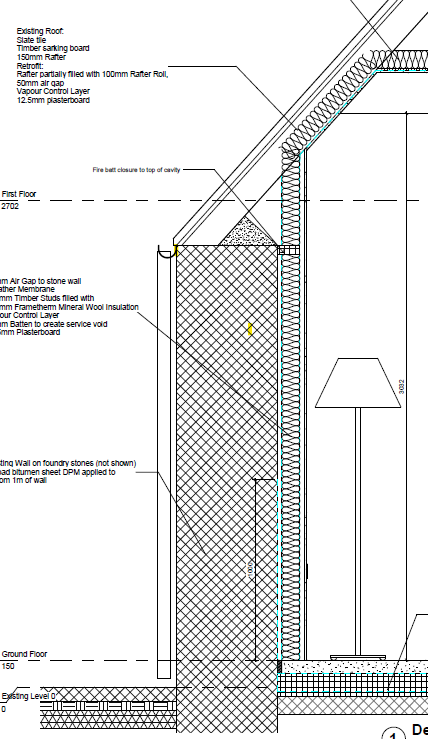
Returning to this supposedly expert study... When we took on this project I assumed that there would be any number of how to do it/ advice /even stated methods in the regulations. Far from it, and it seems that different councils and inspectors even have their own (differing) expectations Currently I propose to avoid any drilling of holes through the 600mm of wall, to maintain the physical and thermal barrier, then apply 1m of bitumen sheet to the bottom metre inside, and leave the remaining 2-2.5m exposed. then a 50mm air gap. Inside this a timber frame filled with insulation, and sealed on the outer side by a breathable membrane, and the inside (before boarding) with an air-tight membrane. AS far as I am aware this is not exactly specified anywhere else, but nothing else is either. The air gap will be continuous to the roof sarking where it can breathe. Where does moisture come from? Not a lot up from the ground as it is granite and dampness doesn't rise far (as discussed earlier). Roof and gutters will carry away 99% of rain that currently dribbles down the walls. the ground is pure sand so it won't be wet around. pointing will be repaired or tided. So the wet is only from driving rain (which will run down the wall) and general moisture. Before any of that gets through 600mm it should be dried by the air and wind. Any and all advice and speculation welcome.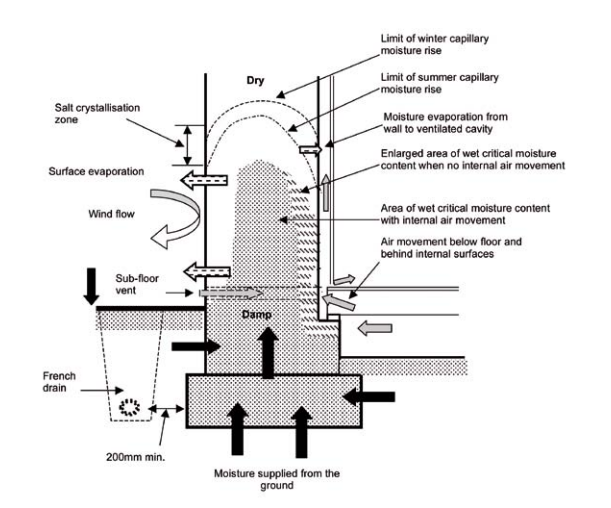
-
Philistine comments from me , which feel free to ignore. This is rather a 'sampler' of what can be done to resemble various rural styles and 'arts and crafts'.. The materials and detailing are important if it is going to have the charm that is implied. Barrel roof metal cladding? Expensive and tricky. Barrel roof: a tricky joint to the other materials, and the dormer...this will rely on several boxes of silicone, I'm afraid Barrel roof will need an overhang to allow gutters. 'Large flat rooflight'. inset to hold rainwater. in the place that a ridge beam should be. Lots of joints and seals to build and maintain...high maintenance. Chimneys...good luck finding the bricklayer who is interested. So many corners and interfaces and not many plane surfaces. Add £500/m2 for the 'architecture' to a more standard indicative cost for your area? What is that for you ? £200,000? But it is certainly different so bravo, if the budget works. Do please have a highly skilled builder look at it and tell you what are the worries and costs. There are issues here which I would (as a contractor) see as challenging and happy to try out, but only at your expense and risk. It will also be slow.
-
I was taught that we first make the building airtight, then add ventilation, which is controlled unlike draughts. I think our chefs will require an extract fan, but surely they are available with electrified shutters.
-
The pressure is very high...enough to blow (or suck) open unlatched (even sprung) doors. Therefore any draught will be significant and affect a candle/ smoke match. As ProDave has explained previously, the official testers just want to give you a rating, and aren't keen on improving your airtightness, hence his diy before the test.
-
The 'small bit' is 1m long as the ties are quite high (hence the walls displacing in the first place). It might be the solution though, if we cut the ties off close to the rafters, losing 2 x 300mm, then try to get the stubs off on the ground, salvaging most of the wood. This tool looks 'the business'.
-
Insulating a pebbledash solid wall and damp concerns
saveasteading replied to Ben Weston's topic in Heat Insulation
OK done that. It is a bit of a rant unfortunately, and calling surveyors idiots isn't measured or encouraging. However, I am perfectly happy to hear advice that shows we do not need to spend money and time on the low level tanking currently intended. btw we got this idea / solution from a blog elsewhere, for a similar farm steading. I considered the bottom metre being tanked as reasonable (an extension of the dpm) and the wall can still breathe outwards and will be unsealed for the remainder of the wall height. However the drawing I copied doesn't show tanking either, so perhaps this is not proven. Our walls are currently wetter inside than out, as the air and wind evaporate water on the outer faces. When the gutters are repaired the wetness will reduce and only driving rain will wet the walls, and obviously will run down an make the bottoms wetter. Rising damp is impossible as our footings are on porous sand. Advice also welcome on ventilating the wall. The cross section I coped here shows ventilation through the wall, to pass up the new void between stone and new inner lining. That will suck a lot of heat out of the building so seems unwise. But I know from another Buildhub member that there are cases of Officers insisting on this. -
Insulating a pebbledash solid wall and damp concerns
saveasteading replied to Ben Weston's topic in Heat Insulation
The wall is 600mm thick granite, so any form of dpc is out of the question. I will look at your references with interest.
-
Old fashioned, lever the tails up, knock them through and claw hammer/nail bar? With the twist on them, does the levering/mole grips work?
-
Can't do that as we had the whole roof sprayed, and I don't fancy the fumes. Not as bad as tanalised by a long way but too risky I feel. I forgot some old floor boards had been sprayed before removal, and put some on a wood-burner.....despite them being ultra dry and porous with worm holes, they didn't burn well at all and made a lot of smoke. The timbers are the right size to try slicing in half, and can then be used as our wall studs. There is some worm but really not significant and now treated. What shape they will take when split we don't know yet. Failing that they will form the terraced garden. Re. cutting with a sabre saw.... having tried similar with a multi-tool I found it was slow and burnet a lot of blades. A disc-cutter that could fit on a sabre saw would do the trick, but doesn't seem to exist, That is the issue I think. The approved design method is driven by tradition and evidence rather than calculation. As it is designed for use by non-Engineers (or Engineers who don't do calculations any longer) , the consultants will never have handled the document, and so revert to what they can calculate....it is costing us a lot and would be much worse if I couldn't argue some points which 'may be justifiable'.
-
Insulating a pebbledash solid wall and damp concerns
saveasteading replied to Ben Weston's topic in Heat Insulation
That's good then. I came across a really interesting paper on rising damp in stone buildings. It basically says that damp rises to about 1m, and to live with that and line the inside. Not always possible (or easy) though. So we will be applying a bitumen liner 1m up from dpc . -
It is simplistic to assume that forces go at 45 degrees, but it is a sensible assumption. If the base shown here was 150 thick then it would also be narrower, so less strength both ways. If it was built the same width as the wall then the forces would act on a smaller area of ground, and may settle. There are many assumptions in building, and most are based on common sense and the experience of centuries. If the Engineer says 750 wide then by all means ask why, but then do it....there are many good reasons....loads, ground conditions, ground strength. If you pay your Engineer more, then he may allow time to reanalyse and may save you a little concrete. Or if you do a more extensive ground survey. A little extra concrete (£100 worth?) is probably the optimum.
-
Insulating a pebbledash solid wall and damp concerns
saveasteading replied to Ben Weston's topic in Heat Insulation
Agreed. There are so many optional ways to get RICS (including auctioneers, estate managers, estate agent) that you must ensure that building construction is their speciality. -
That's a new one. 'Compacting issues", so some of the 200mm of concrete levels nicely but some won't? Concrete moves when shovelled, but it contains lots of stones and is not easy to level. For precision the price goes up a great deal, and for ultra precision they have to grind the top off again.....and it is usually unnecessary. What look like flat slabs in retail warehouses are up and down just like yours, but nobody notices other than the racking installers (who adjust for it). It is not a bowling rink so shouldn't matter. It is remarkable that we are all still reinventing how to build a house, but we are. I agree with drawing your situation to scale, starting with floor finishes and working down.
-
But still use blocks on top, to get air flow and also allow adjustment for precise height. I am not one to overdesign, but then I could design the timber spans. In your case it is much simpler to use extra blocks, laid flat , which are going to cost you £4 each or so x 20. option 1 then. Option 2 is just wrong I think as you show the blocks under every 4th joist, and the others allowed to deflect.
-
Unfortunately we are having to remove a section of building and replace (I wouldn't, and think they can be fixed, but have not prevailed, mostly because we can't get builders or designers to do tricky stuff.) So 40 tied trusses have to come down. The wood is good apart from a few ends, and can be reused for roof or inner walls. Any tips on how to get 50 year old twist nail connections undone? Either up in the air if the demo people will consider it, or on the ground once chain-sawn apart. 2 twist nails per joint, right through 2 x 45mm, and 30mm extra length bent back. For the interest of anyone....interested. I calculated the design using the Scottish Government 'how to do it' guidance for 'non-Engineers'. Tied trusses with ridge plates, and some shear walls. The local Engineer we are now required to engage is specifying Ridge beams (big) and props, and no ties: I guess because they never have to use the simpler, standard method. Then another ridge beam and some steel beams to support the ridge beam!
-
Yes they do or they lose money. If it takes only a day to look at an enquiry, then visit site, then calculate and write out a quotation then they are doing well. That is a day at say £250 which is cheap for someone who can do all that. win one if four. A bigger business has estimators and admin for which they add a percentage (5%). A smaller business perhaps doesn't think that way, but one way or another it has to be paid for. The new-start business doesn't do this and so has a £1,000 advantage, for first job only.
-
It is included in the overhead, along with admin, accounts, insurances etc. Every client pays it. There comes a time as a specialist contractor when you don't agree to do every tender sent to you, want to know how many are tendering, and need some element of trust that you are not being used as a 'check price', or to get free ideas. I am not commenting on the original question re roof cost by saying this, as I haven't looked at it. Major house developers make 25% profit, to shareholders, after other bonuses are paid. Big contractors claim to only make 2-3%, but perhaps that is 5% now, but have big overheads. Probably coming to 25%, but that is on a higher cost as they are using subcontractors with margins included. A reasonable mark-up for a small builder is 20% to cover everything.

