
saveasteading
-
Posts
10892 -
Joined
-
Last visited
-
Days Won
93
Everything posted by saveasteading
-
Help - Drainage Condition
saveasteading replied to bob the builder 2's topic in General Self Build & DIY Discussion
You can do this. Calculating the percolation rate requires a spade for a small hole, a bucket and a watch. It is not worth fiddling the results as it is you who will have stinky ground. read here and come back with any queries. https://www.jdpipes.co.uk/knowledge/sewage-treatment/how-to-perform-a-percolation-test.html then write it up on a posh table to inspire confidence. -
Discount Offers of the Week
saveasteading replied to Ferdinand's topic in General Self Build & DIY Discussion
Better than a ladder, but only if it is sitting flat on the floor, not up steps. -
Ceiling cracks - could this be structural?
saveasteading replied to Novice894's topic in General Structural Issues
First impressions as others. an are of ceiling has been replaced using 2 boards. Why the joints should appear is not clear, and worth looking for clues, as Gus suggestions. My guess is that the joints are not fixed over joists, or enough. The worry would be if the repair was done for a reason that has recurred. The best outcome is that it needs more screws into the joists, and perhaps noggins the other direction. -
I used actual Wago on a lighting circuit and called in the electrician to connect to a suspect 2 way switch, and to certify it. He stripped all the Wagos off and fitted boxes. I had done all the complex feeds through floors and ceilings (builder's work and thinking) so it was still worth it. Electricians had quoted stupid money for surface mounting. He wouldn't say why they wouldn't leave on the Wagos. I guess they would have wanted to check all my connections, and then they used their preferred methods. Or is there a fundamental worry about wires popping out?
-
Cemfloor say Pouring between 40mm and 50mm of liquid floor screed for underfloor heating is optimal. The diameter of the heating pipe is included in this depth. We are going for 50 as 40 doesn't allow much tolerance for any wobbles.
-
Discount Offers of the Week
saveasteading replied to Ferdinand's topic in General Self Build & DIY Discussion
I got a smaller version of that in a diy store but it looks the same. Not to be confused with a professional version made with tubes. Even standing at 2m it feels very wobbly, but is better than a ladder for a longer job. I took to climbing to it on a step ladder rather than through the hatch. Also it is bolted together so is a performance unless you can keep it erected. And the bolts need checking every time. For that high version, I think I would want to tied it to the wall. For the right diy job, and with care, it could be ok. -
Is it a groundbearing floor or suspended? Pipe along the skirting? Doesn't have to be round. 60mm dia for a 5kW burner if I recall and prorata mm2 for smaller or bigger.
-
Help - Drainage Condition
saveasteading replied to bob the builder 2's topic in General Self Build & DIY Discussion
The subject is in my expertise, but it is complex. Would need to know what you have proposed. Using a crate manufacturer can save having to use a consultant, but you know the answer will be lots of crates. My interest has generally been to avoid lots of crates using other solutions. Even then, there may be other considerations eg soakaway location and design. The query re drainage field etc doesn't seem to make complete sense....I think bco trying to be helpful but getting in a muddle re terms. As ProDave says....have you a percolation test? What are your results? With more info perhaps we can help. -
Timber frame quotation - bit of a shock!
saveasteading replied to LnP's topic in Costing & Estimating
I think they remain decent value for their standard models, which are designed for maximum efficiency, don't need redesigning and have negligible risk. Then add transport, hoisting and then overhead and profit for a business in a factory. Stick built has timber straight to site at best price, and the joiner working for you (or the main contractor) not for the factory. But there may be design costs, more can go wrong, and it takes longer on site. -
Discount Offers of the Week
saveasteading replied to Ferdinand's topic in General Self Build & DIY Discussion
Got one 3 weeks ago when it was £299. NB they charge for delivery, non-optional, no collection from a shop.... NB2 not available in Highlands postcodes , regardless if this is Inverness, where there is an Aldi, or Rockall. there is more to this story: perhaps later. It has had a hard 2 weeks. If anything it is a bit narrow, but the same machine seems to be at TS for twice the price. -
No. That is a very good thing and gets you a lot more heat as well as reducing ash. I meant a specific air feed from outside to the back of, or even connected to, the stove. Search for 'wood burner external air feed'
-
new windows just fitted but with issues...
saveasteading replied to New home's topic in Windows & Glazing
No. And contractors who make up stories like this are perhaps not very good at what they do. Anybody can buy and fit a window. Not everyone can do it well. Keep on at them because once they are gone, these are your windows to live with. -
Would this be possible - Temp power to barn
saveasteading replied to Space Race's topic in Consumer Units, RCDs, MCBOs
Makes sense. You mean disconnect your temporary supply back to the way it was once finished with? I have been tempted in the past to save money by simply connecting cables through, but it is worth putting in a kiosk for safety and control. It also means you can turn off your power without access to the source. BUT if you are going to need a new electric supply then I recommend getting that in ASAP, again to a kiosk. This is normal and acceptable to the electric company. All designed and connected by a certificated electrician. -
How a planner got planning permission.
saveasteading replied to Tony K's topic in Planning Permission
Which includes that allowing more houses brings in immediate cash from central government ( a lot of cash), as well as the later rates. And that the senior councillors can expect to be patted on the head and given gongs by their masters. -
I wouldn't touch it until you see what happens over the winter. The ground is exceptionally dry and so there may be shrinkage and this sort of thing happens. In the winter the ground may recover, and it would be a shame if the crack was filled and it could not move back to shape. Anyway nothing to worry about. How wide would you say the crack is, in mm or the traditional measure, coin thickness?
-
How does your garden grow?
saveasteading replied to recoveringbuilder's topic in Landscaping, Decking & Patios
Excellent . One of them poss slightly bigger than optimum. Do they have a 'runner' fibre along the length that has to be removed. or do they snap clean in two? Better picked and discarded than allowed to grow mature, as the plant will make seeds instead of feeding you. Until the last few anyway, when you leave them and collect next years seeds. -
Renting a garage for off-site storage?
saveasteading replied to puntloos's topic in Project & Site Management
Stores are very vulnerable to theft. At least a container on site is in sight ( if you are staying on site), and will be covered by the project insurance. But it is pretty obvious to thieves, what will be in there. They get very hot or cold seasonally. Don't hire. Buy a clapped out one from a hire company, that is just too bad too rent out again, but you could live with. Then you have to get rid at the end, but poss to someone with a similar need. For storing kitchens and windows etc, I think it must be very short term....most outlets will work to your agenda. Absolutely. -
Cladding options (now that Siberian Larch is contraband)
saveasteading replied to Kelvin's topic in Timber Frame
We have chosen Russwood, or rather the family have. From what I gather, they are selective of the timber quality, so I am hoping to see far fewer knots, twists and wide grain than might come with a pile of every plank out of a tree trunk. Also, this is for only 50m2, so the cash cost is not horrendous. -
Bitten off more than I can chew but persevering
saveasteading replied to OutdoorsDolly's topic in Introduce Yourself
Welcome. What is the construction? Cracks may be less significant than you think, if it is stone. What part of the country? A commercial builder will almost always want to demolish and build new. A very hands-on self-builder may be able to save the structure and money....but there are risks. Let us help. Pictures will endear you to the forum. -
Building in the Scottish Borders with Dan-Wood
saveasteading replied to LegoHead's topic in Introduce Yourself
with a plot being £60,000 in the remoter parts of the Highlands or £300k in SE England, the formula doesn't work everywhere. You can easily spend that if you don't think the project through, and leave the decisions, and especially resolving problems, to others. In business I never allowed more than 5% for contingencies, and then designed my way out of changes and problems, rather than spending money on it. Careful thought like your current discussion is a good example of avoiding overspend. If anybody knew what the 5m 'rule' applied to. Is it the excavation, wall of the tank, or where the water is? Or even the centre? Depending on circumstances* you might even get formal approval of 4m. * ground permeability, amount of flow, options to change shape of chamber, slope of ground. -
New Build Plans - Critique
saveasteading replied to Duncan62's topic in New House & Self Build Design
I don't do layouts, so no comment on the above. What is the purpose of the glazing over the entrance? If only to light the stairwell then it is large and requires the complex dormer housing. I resist valley gutters but appreciate the reason here. Just be aware of the risk of blockages, and need for cleaning regularly. I would make the gutter oversized, and feed a hopper outside the house. Unfortunately the dp would be above a door. Avoid internal drains as they gurgle and block. Also I can't read the dimensions. What are the heights? -
If you don't have them already, it is worth getting a set of small, precise, hard screwdriver heads. I find I use them a lot on watch straps, electronics etc...and grub screws. They provide a better fit to very small screws, are harder steel and so can tighten better. I think mine was a set of heads with handle from TS.
-
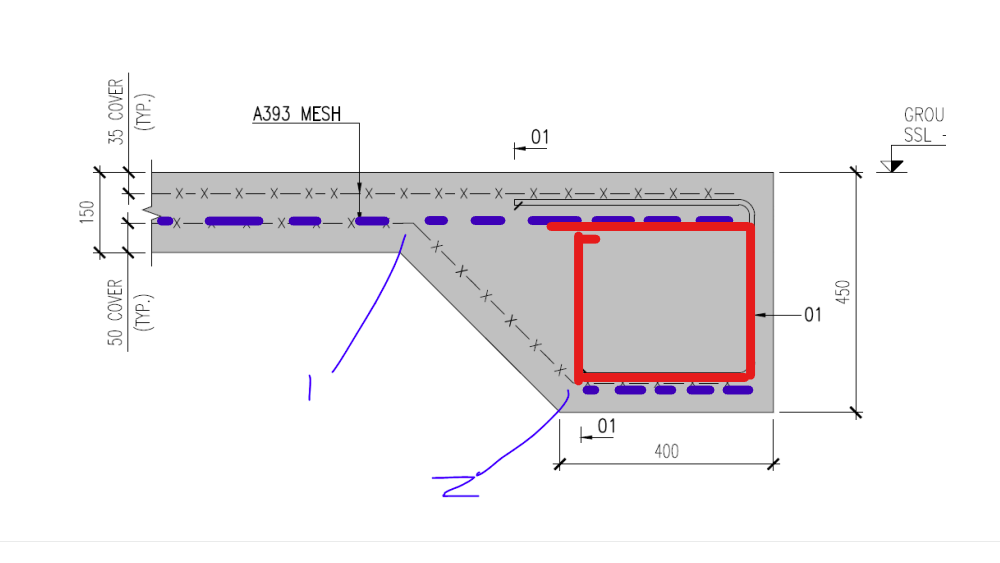
That is not normal. I would cut the mesh into flats and link them with bent bars, which you can bend on site if necessary. Actually no...I would extend both top layers of mesh to the full width, and build a cage to form the edge beam, made of stirrups which link top and bottom.
-
external insulation External insulation on a 500mm+ solid stone wall
saveasteading replied to Chris HB's topic in Heat Insulation
Stone is certainly more interesting than block. This is not the work of a master mason! There doesn't seem to be any coursing, more of an undulating pattern. Do you know what kind of stone is used locally? Because we have granite, we use the kind of lime that goes quite hard, and has to be used before it sets, which was a surprise after reading so much about lime staying soft for days. Most people wont be interested it is 'just a building'. But there may be an estates manager, or a retired clerk of works who could be interested to help. Also try to find what other conversions have been carried out recently, as there may be information to be had.- 19 replies
-
- 1
-

-
- solid walls
- stone walls
- (and 3 more)
-
Interesting. I still mean what I mean, but perhaps need another fancy term for it. Groundworker (digger driver) thinking he knows about concrete..... what would an Architect know about it? of course you add water, everybody does it no need to compact it when it is wet enough no need to cover it as it has plenty of water and needs longer to dry. any more?
