saveasteading
-
Posts
10890 -
Joined
-
Last visited
-
Days Won
93
Everything posted by saveasteading
-
No. Nothing is cheaper for that reason. Curtains, bedding, timber, cheaper in uk Tiles, Wine, cheese, branded european goods, cheaper eu. Google dunelm mill thermal curtains
-
Discharge distances from boundaries?
saveasteading replied to Drellingore's topic in Waste & Sewerage
The outflow from a package treatment can go straight to watercourse. The volumes are low so do not increase flood risk. Rainwater should not. The 5m rule is to stop it interfering with existing or future buildings of neighbours. Or, i would suggest, it creating a direct stream to the watercourse and increasing flood risk downstream. Where there is an orchard it may be reasonable to assume that it will not be developed..depends where it is. -
I read the regs as, yes it does. The formula is based on volume of water and percolation rate, then allows 1/3 reduction for a trestment plant. That is a crazily small reduction. The resulting drainage field is then stupidly huge. For a 4 bed house on clay you could be in the 100m2 of drainage field area My solution is to calculate draw the whole thing, then do it in phases...with phases 2 and 3 taking a while. The jcb driver said he has put in dozens of tanks, but never seen more than an old fashioned soakaway...so bco doesn't seem interested. But then, the jcb driver hadn't seen anyone checking if the tank was level, or being surrounded with gravel or... etc. Drainage tunnels seem no different to a perf pipe with lots of gravel. If i was a bco i might accept that as a reasonable equivalent. .
-
You are not expected to replace asbestos cladding with more asbestos, or even fibre cement, Replace with grey steel cladding without asking. If at all nervous send a courtesy note to the planner. Have to repair, going to use x in colour y. You prob won't get a reply but are covered.
-
I had one of those, same problem, tried everything and failed. Sold the flat, with the issue, but would othereisd probably have changed the screen.
-
They look good. For somd reason, curtains are half the price in britain. We use Dunelm Mill. So worth a look. I did, £48.
-
That looks like an industrial door (for a warehouse). Probably made of flat steel folded to shape, with a polystyrene core. So insulated, but with a lot of cold bridges at the circumference and some through the structure. Does it feel cold? Covering the inside would be feasible but ugly. I stick with the big curtain solution. It will isolate the room air from the door and reduce air cooling.
-
A photo of the door would help. If from a recognised uk suppler it is probably insulated. Reflective surfaces send some energy back where it came from. Indoors though, not a lot.
-
Self Build Novice - Navigating Minefield of Options!!
saveasteading replied to Lucasgrantmaw's topic in Introduce Yourself
Quite right. It can allow the SE to be precise rather than sensibly cautious, and save more than its cost. I just mean, work with the SE and that is likely to be a relevant but not overblown report.- 11 replies
-
- 1
-

-
- isotex
- eps foundations
- (and 1 more)
-
First check that the door is not insulated. Metal doors are often filled with polystyrene. There is still a lot of conduction through the edges though. Fabric wont make much difference, but a heavy curtain could slow the flow of air. You could face the inner side with thin insulation. What is the context? Is that your door? It looks like a deep-freeze door.
-
Wooden bench on top of radiator?
saveasteading replied to Garald's topic in Central Heating (Radiators)
Maths is a tool. Numbers don't exist. That is until a certain level, where maths becomes philosophy, but the mathematicians cannot necessarily understand the practical use of sums or quantities. I showed a construction drawing to a PhD mathematician, and he was a bit boggled by the concept of scale. -
Self Build Novice - Navigating Minefield of Options!!
saveasteading replied to Lucasgrantmaw's topic in Introduce Yourself
My thing. Tell us more about the ground, tree varieties and distances and the optimum answer should be clear enough. NB not all Architects and SEs know the relative costs of methods. For now, assume piling costs for reasons of caution, and we can try to save cost later. Re the building structure. to some extent it depends on the building. Simple shapes suit kits, complex shapes suit being built on site. That could also affect the foundations decision. This doesn't always need to be complex. If you find an SE who knows your local ground conditions, then a couple of holes dug with them in attendance may suffice. Are / have any other houses being built nearby? -
Wooden bench on top of radiator?
saveasteading replied to Garald's topic in Central Heating (Radiators)
I don't agree. I think the flow of air upwards from an efficient radiator can be quite strong, and of course draws in more air from below. Any blunt obstruction close to the rad is going to interfere with that air flow. For a big lump of a radiator it may not matter so much. I have no evidence other than observation, in hydraulics labs and of fire experiments. Hot air rises. Obstructions limit flow. -
Our joiner is off to do work more to his liking. No falling out, it is just that he has been great at 'big and new,' and doesn't want the fiddly stuff. Our family and friend team has therefore been installing stud, to create a box in a box, and cross-walls. Very impressive so far for beginners. (They have had a year now of getting to know all the trades so far, and done a lot of the work) The attention to detail to form an airtight box would not otherwise have been so good. Plus they have the luxury of stopping to think, or have a conference call. As a result we are also retaining more height and width in the roof rooms, and paying attention to acoustics through walls. They will keep asking around for another joiner (there are 2 stairs, then more stud, and kitchens,) But, just in case, how easy or difficult or easy is it to install a stair, made by one of the specialists? My feeling is that it is easy enough. The thing is that I have supervised dozens of stairs (timber, steel, concrete) but never been hands on, apart from decisions to overcome issues. If it looks easy then.....either it is easy, or they are skilled at it. Up til now I have been able to give crash courses, but stairs are, wait for it, on a different level. The stairs will be riser, spiral, riser so pretty standard, made of pine, and the openings are already formed. All fixings to timber. Not ordered yet.
-
Need advise on roof Insulation with 7cm rafters
saveasteading replied to GlanMenai's topic in Heat Insulation
This is your friend for the summer. Sun hits slate and makes it hot, air flows through and under the slates and carries a lot of the heat away. After that, your added insulation will do the rest, except for a few days a year. I have little time for multi-foil. I even attended a building control presentation by one of the MF companies. (an excuse for free sandwiches). I kept quieter than usual, and my questions were polite, but there was a tendency towards...'this is approved by BC', 'the normal way of measuring insulation is not helpful'. It absolutely depends on the air gaps on both sides, and a layer of dpm or bubble wrap would do at lest half as well, and better if reflective. Therefore I would save the cost of MF and instead buy PIR. Read previous posts re gap filling. Then line with more inside for the insulation and as a thermal break, before boarding. RE the strength of the rafters. The area at the eaves is pretty useless, so if you build a small wall down there, it will be tidier. But it wall also stiffen the rafters significantly. Put down a wall plate first to spread the load, then fit a stud up into every rafter, with plenty of ring-shank nails or screws. then insulate and board. Propping a rafter at 1/4 span pretty well doubles the strength. Perhaps add some sockets. -
Fancy Awning Plan - Pergola?
saveasteading replied to puntloos's topic in New House & Self Build Design
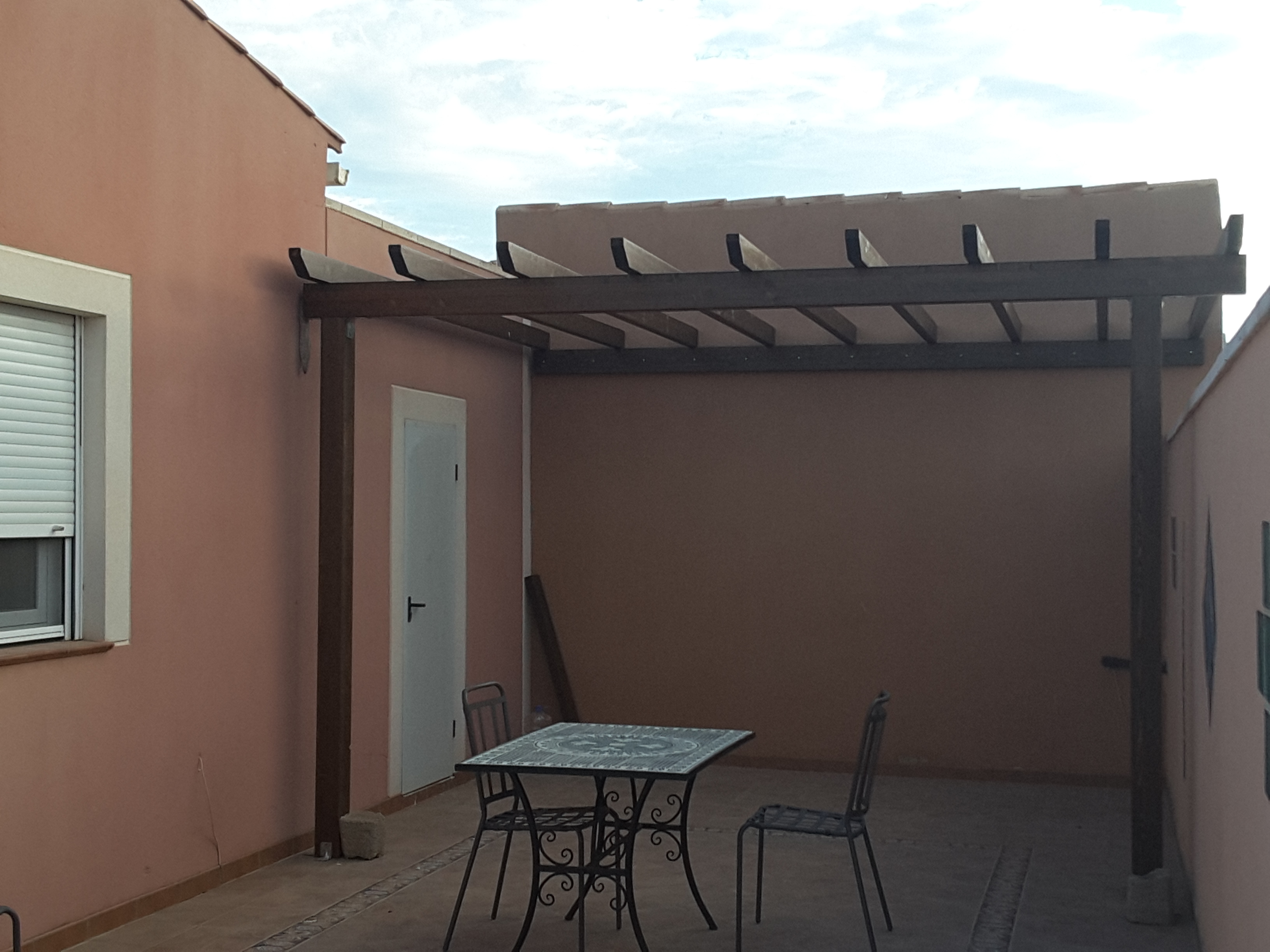
found it. Diagonal braces added, which makes it very much stronger and improves the appearance. And stick cover for shade. like this, tied down by wires onto screws .this sort of stuff
-
Fancy Awning Plan - Pergola?
saveasteading replied to puntloos's topic in New House & Self Build Design
Found. The rafters are screwed down with very long screws. dont seem to have a photo with the covering.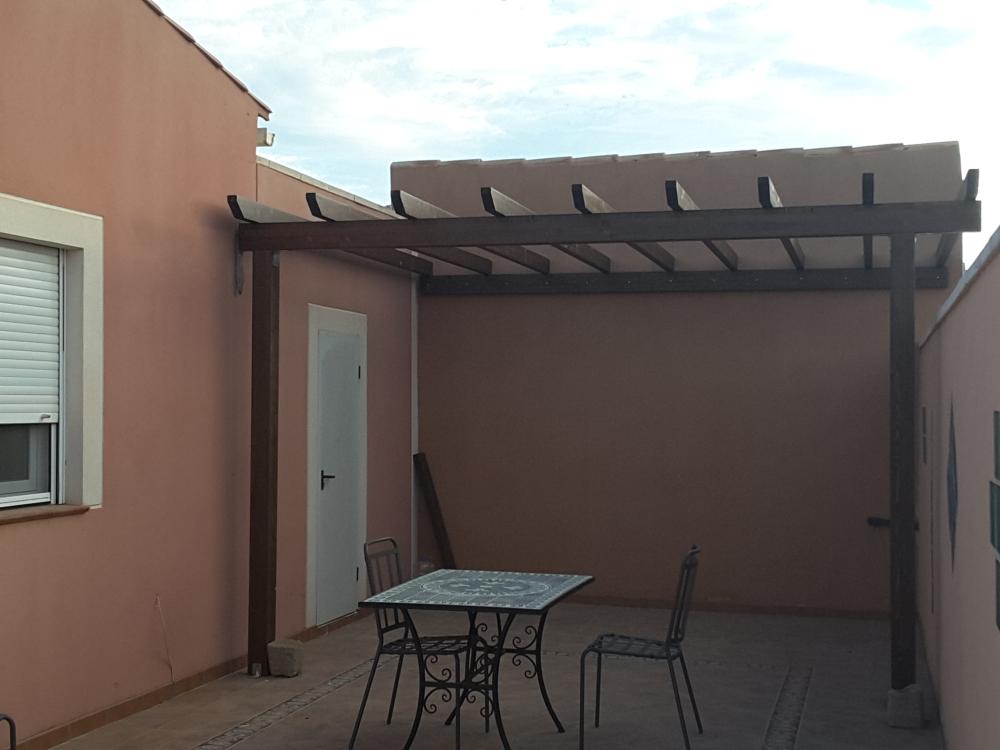
-
Cheaply covering a large area
saveasteading replied to Nick Thomas's topic in Landscaping, Decking & Patios
PeterW advice abut layering is good. The cheap stone will be half the price of the expensive. Talk to either the quarry or a haulier who sells stone. Tell them what the plan is and ask what stone they have. Include reclaimed stone, and crushed brick or concrete should be cheap for your base. That will come in 20 tonne loads. Beware that the cost is per tonne, and you get something like 1.8 tonnes per m2, ie les than it sounds. Can you get a lorry in? If so, a friendly driver will move forward as it slides out. Membrane yes. 60p /m2 for non-woven, which is best for keeping weeds under. That will also stop mud coming through and mixing with your stone. I don't think you will need weed-killer, and can always zap any that come through. But why stone it over? green is good. Yes, so if you have a barge in an adjacent estuary, that is an option. otherwise...no. -
Fancy Awning Plan - Pergola?
saveasteading replied to puntloos's topic in New House & Self Build Design
I meant to but couldn't find them on my phone. Will look again. -
Fancy Awning Plan - Pergola?
saveasteading replied to puntloos's topic in New House & Self Build Design
I would definitely keep the feet apart from the grass, by fixing them on plinths. This keeps them away from rot, insects and lawnmowers. For a blind system as shown, I think you have to commit to a full kit. -
Fancy Awning Plan - Pergola?
saveasteading replied to puntloos's topic in New House & Self Build Design
I made my own using laminated timber, cut to size by the manufacturer. Then erected it single handed in one day. About 3m x 4m. The materials cost much the same as for a very flimsy kit. About £800 I think. On its own as a skeleton it is a feature without a purpose. Do you want shade or waterproof? Just for shade, lovely as it would be to pick grapes, any plant will drop stuff and need maintenance. But a solid roof ends up having to be a proper roof, waterproofed, otherwise it will drip and get slimy. We wanted shade so fixed rolls of sticks on top. -
Porcelain will be very slippy when wet. Also make sure any tiles are suitable for cold weather as well as nonslip. I have observed paving laying differences uk and Spain. You don't see a lot of cracks and potholes in a spanish street or square because of 1. The weather. But 2. Because under the tiles is a reinforced concrete slab, suitable for forklifts. But good builders do the same in domestic situations too. Therefore as above...dig out some more ground, lay compacted stone. Then I would lay a concrete slab with mesh, 70 thick. Then the tiles or slab are a finish. All on a slope. If you want, you can break up the existing material small, to use as hard-core on the bottom.
-
Chat GPT for building regulations - insane!
saveasteading replied to GaryChaplin's topic in Building Regulations
Broker told me that staff leave and take leads with them, or simply sell the lists to competitors. Hence many of the contacts we get at exactly the right time. -
Chat GPT for building regulations - insane!
saveasteading replied to GaryChaplin's topic in Building Regulations
Why can they possibly need my phone number, other than to sell? Least suspicious is to direct sell, most is to sell in a list. -
Chat GPT for building regulations - insane!
saveasteading replied to GaryChaplin's topic in Building Regulations
Me too. my name is Qwerty, and my postcode is AB1 2CD....the trouble is that may be a real person in Aberdeen. No, I ducked out too when it got personal. They don't need this info, just want it.