
saveasteading
-
Posts
10890 -
Joined
-
Last visited
-
Days Won
93
Everything posted by saveasteading
-

Flat roof top coat EPDM, GRP, Liquid Polyurethane?
saveasteading replied to Warrentdo's topic in Flat Roofs
Car patches to building oligarchs' yachts? -
As my earlier post. Cheekbones, I was assuming you agree/accept this, otherwise my other comments are redundant.
-
Flexible Drainage Couplings...
saveasteading replied to Mulberry View's topic in General Self Build & DIY Discussion
That is much better. There is still some flexibility there if the chamber drops a tad. -
I never understood the problem. Do radiators have loose steel in them?
-
Flat roof top coat EPDM, GRP, Liquid Polyurethane?
saveasteading replied to Warrentdo's topic in Flat Roofs
I have a fibreglass cover on an area of flat roof with upstands, and it is fine after 6 years. But a big 400m2 roof we had done failed at joints (too big to absorb differential movement?), very expensively as the roofer had disappeared. I therefore favour flexible sheeting with guaranteed seals. For DIY I fancy the stuff that comes in tins simply paints on and becomes a single flexible layer. But there seems less of it about so perhaps there are issues. -
But reading proposals, it seldom is anything other than waffle and some bird boxes. The formal approaches give more marks for furry animals with big eyes, than for insects etc. The best biodiversity probably comes from rotting wood and some shrubs...and a muddy, messy pond. I would use that approach next time I have to.
-
I can't see how drainage tunnels are any better than perf pipe and gravel, except they have done tests and they are 'a thing' for the bco to accept. Borehole drains silt up over a few years and are last resort. But you have sandy soil so lucky you. But 1.5 hours is quite slow still.* I agree with the above...make all your rainwater drains French drains, (at negligible extra cost) and the pond will be almost dry until a big storm comes. It is also more sustainable as you are spreading the water out. * have you tried digging deeper. The top may be compressed or silted up.
-
Yes, for the cost of re-levelling their lawn. Negligible cost, but then add legals. Is it a long way from the house and anything else that could bd damaged? Any existing damage is likely to bd blamed on you too. But I wouldn't count on the wall moving at all. There are many tons and friction resisting any shove. Don't go there i suggest.
-
The trouble with sewage pumps is what happens in a failure, eg power cut. So usually you are required to provide a couple of days secure storage capacity. That gets to be a big tank, but a specialist pump supplier can advise. With a good treatment plant, the outlet water should be very light grey, so perhaps the need for foul storage can be argued away. But still any overflow has to be dealt with.
-
Not "eventually" but very quickly. The air flow is high and the garage would very soon become cold (or hot) from chucking out the waste warm, (or cold), air. It would soon be very inefficient. The installers should know this and i would be concerned if they suggested or agreed to do this.
-
From experience, osb does not react well to paint, which causes wood flakes to spring clear of the surface. That was using intumescent paint. I agreed with the bco to use external masonry paint ( internally). This was for extensive lining as a backing instead of blockwork in portal frame buildings.That wouldn't look good in a domestic situation. Thereafter we used mdf instead, very successfully. It needs a gap as otherwise there are inevitable lips. We chamfered all the edges. The idea of clip-on boards is interesting. I think you could use ordinary panels (kitchen/ shelving) and get the clips, rather than proprietary systems. You can get very hard (thin) chipboard, also available fire or damp proof. They are coloured pink and green. Screws would show.
-
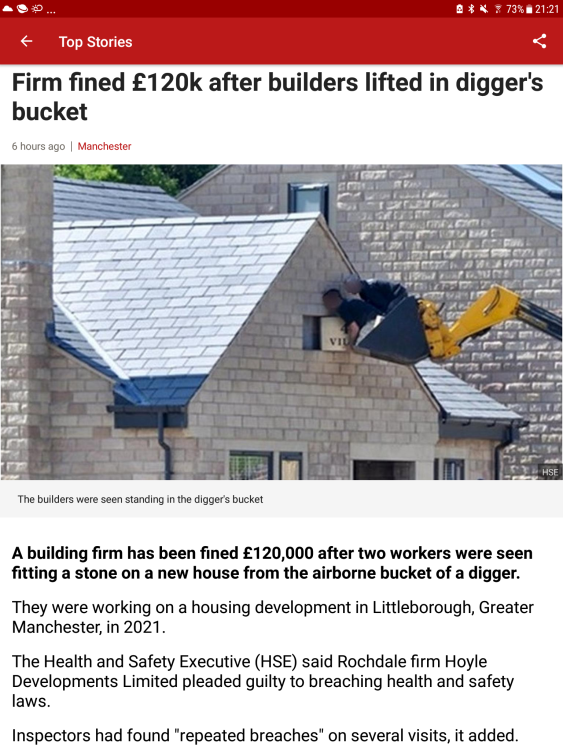
An expensive shortcut. Seems they had 3 warnings before this.
-
This would probably be local (uk) timber. Fast growing, wide grained and less strong than Finnish/ Russian/ Canadian. There are loads of timber mills round Inverness and the structural timber is all C16. Thus bigger sections are required and not cheaper than the imported stuff. I asked and they said they couldn't compete, even with Russia out of the equation. In the words of a Finnish timber supplier...our timber is the best because the forest land is so cold and so flat.
-
Garage construction. Stick build or blockwork?
saveasteading replied to Russdl's topic in Garages & Workshops
Noticed this late. It depends in the field. If 'unlikely to be developed' then it doesn't need protection. Might need justification such as green belt / aonb. My favourite, for what it is worth, esp if you can DIY it, is timber...it always fits. Unless having a heavy roof, when use masonry. -
Flexible Drainage Couplings...
saveasteading replied to Mulberry View's topic in General Self Build & DIY Discussion
The earth we walk on moves up and down seasonally, but we don't notice. To avoid this damaging buildings we take foundations down to a depth where this is minimal. Let's look at clay which is most affected seasonally especially where near trees. Foundations can be quite deep. Drains are usually nearer the surface so will rise in winter and fall in summer more than the building with deeper foundations. Hence the flexible joints to avoid breaking the pipes. This was more a historic issue, with clay or fibre pipes. If the foundations are shallow then it shouldn't be an issue. The SE can advise and bco should accept it. I prefer normal pipes but with a flexible filler (eg polystyrene) around them through the wall or footing. In summary, there is good reason for flexible joints but it isn't always the only or best solution. -
cutting 210mm hole in timber frame?
saveasteading replied to markharro's topic in General Self Build & DIY Discussion
Def worth using a hole saw. Neat and quick. -
DIY ers become craftsmen (and woman)
saveasteading replied to saveasteading's topic in General Joinery
Can't do that with the tech (or my it skill perhaps) where I am. But it is a steading so is narrow, then has the internal stud and insulation. I'm hoping the team has been studying door construction, as I haven't and have always had experts do it. Eg I have subtly mentioned allowing for floor finishes and linings, and hope it works with door sizes. -
Interesting, thanks. I have read the rulings on enclosed cupboards and am none the wiser. I think we will use the principle of reading the simpler rules, and not pushing our luck.
-
DIY ers become craftsmen (and woman)
saveasteading replied to saveasteading's topic in General Joinery
No I don't think I would measure, as long as it looks reasonable. But we'd like to comply and somebody has calculated these distances as appropriate. If I'm ever in a wheelchair I'll be glad of the ramped entrance, level ground floor (which required some cute design) wide enough doors and general space. I don't think there are any minimum standards in England and longer. The site team will be looking at your helpful comments soon, but are on other priorities today. Does an architrave have any purpose other than aesthetics and covering the plaster edge? Balance is to be preferred of course. -
Interesting. Old bricks tended to be bent and twisted so a thicker bed would have resolved the problem. You can still get rustic bricks. They cost more and the brickies will hate them and try to reject about 1/4. I wonder if bricks used to be more expensive than mortar in some areas.
-
DIY ers become craftsmen (and woman)
saveasteading replied to saveasteading's topic in General Joinery
Thanks again. All the advice cut and pasted to the site team who are also grateful. First responses is that the doors have to be where they are, and will be without architraves if necessary. The approved design first makes the rooms work as intended, but also must show clear space and access for disabled access. A Scottish rule, and a good one, so that an ageing occupant (or other need) can live on one level. I am wondering if we should have diagonals next to door hanging studs, or if the double stud plus dwang (noggin) suffices. The intended doors are rather heavy. -
With apologies if any of my generam comments about "brickies" causes offence. I have encounteted so many so called brickies, plumbers etc, with minimal skill and less knowledge, but the certainty that is attached to ignorance. Also several who are a source of wonder and delight. If there is a better way of wording then I will try. .
-
It seems clear that hard fitted equipment and furnishings are deemed vat recoverable. So tiles yes, carpets no. Utility wall cabinet yes, washing machine no. Curtain pole yes, curtains no. Etc.
-
We had 3 phase just 20m away but the transformer would need changing . £15k. Advice from many sources (incl here) was that it was very unlikely that we would have it all running. And yes, 3 electric cars may need charging, but charging systems/ timing systems will come too. And we will have more solar panels. What some people were getting wrong was that a 12kW ashp uses about 3kW, that being the whole point of them So we will have 350m2 off single phase.
-
New member... over budget at the start, what to do?
saveasteading replied to worriedexpat's topic in Introduce Yourself
He works for a company that has a policy to start high, and quickly tells you he can do better. I don't give them a second chance. Price matching is easy for businesses that don't have the skills/ethics to offer a competitive price. And they will be lacking in service too. Others give the fair price every time. I know which I prefer, but it can take some finding.