
saveasteading
-
Posts
10074 -
Joined
-
Last visited
-
Days Won
82
Everything posted by saveasteading
-
 Gravel grid cells are too small for type 1. Needs to be 20mm down stone to fit. Hence gravel in the title, but grit is better. It has to be full so that the weight is on the stone. It isn't good for heavy vehicles, especially turning, and needs a strong base. Better in your case to design in stone and add geomembanes to suit the ground and loading. If you cut too many corners you may end up endlessly topping up.
 -
Yes that would be correct, if well made, as reservoirs can be waterproof without any tanking. It is just cost really, Brick would stop water flowing in and through, even if it wasn't static water, which most floods are. Any dampness would be under the dpm and would dry out eventually. If the fill is clean stone it won't subside due to wetness. 1mm settlement should not occur. Agreed though that not all construction is well done. So this does need supervision or a trustworthy contractor who looks at drawings (2 big Ifs) I had an old project subjected to about 300mm of flooding, and it was at a fast flowing major river, so not just static water. It was surprising, and pleasing, how well it performed. The walls up to slab were single block footings, simply to contain the slab. Using steel mesh instead of fibres does give some more security but again at a cost. Fibres would save 200m2 x £10 here.
-
A Lift (as opposed to a Stair Lift)
saveasteading replied to patp's topic in General Self Build & DIY Discussion
Suits up to 2 small and related people, close in both senses. Doesn't appear to have room for a seat, let alone a wheelchair. These lifts move very very slowly too. My estimate was for a bigger one, but it may not fit in typical rooms. As with most improvements, it is not intended to increase value, but allow the owner to live comfortably without moving -
Preferable to RC, but not unless the whole house is ICF. A brick and block cavity wall or solid wall will do just fine, will be much cheaper and easy to resource.
-
A Lift (as opposed to a Stair Lift)
saveasteading replied to patp's topic in General Self Build & DIY Discussion
These prices are right. About £20k for the minimum size lift, plus builders' work plus some design. Say £25k but more if project managed by the contractor. Building regs too. Best say 30k and hope to improve. It probably needs a dedicated power supply, but the motor is simple and not hungry.( a threaded rod on the end of a drill, scaled up). Stair lifts have zero value at house sale time. Give away to medical charity at best. How a lift in the corners of 2 rooms affects value I have no idea, especially as floor space is lost. I wouldn't approach the lift companies advertising to thd retirement market , but to a local lift specialist as they can do any size and don't have smoozy sales people -
Sorry Iceverge, I disagree with this. Unless a raging river, masonry will not be at risk from flooding. It is supported by internal fill and anchored by the house weight. I would hazard that a concrete beam to the perimeter will be 4 x the cost of masonry. RC walls to 1m are specialist and expensive. So do it well. Why wouldn't you? I don't disagree . Round about 1m and more and it becomes worthwhile, but may need extra footings. Access is the other differentiator or building on a slope.
-
Let's say it is 20m x 10m. Build the wall to whatever construction is appropriate. Up to your concrete level makes it easy. Fill with stone in layers, compacting as you go. Use good stone on top, and blind. Then polythene dpm horizontal and turned up the wall face. This provides a break between concrete and wall, as well as waterproofing. Then insulation including between wall and slab and another polythene layer. Then your concrete. 200m2 is quite a big pour: one day if access is easy. Sometimes 150mm is specified but 100mm is enough, so 20m3 which is 3 x the biggest wagons of readymix......not insignificant. This slab should have contraction joints to control cracking, ie have tidy joints where you want them. All concrete cracks but it can be controlled with these joints, steel mesh or microfibre and minimising water content. As someone else will be detailing it, that is enough for background. If access was difficult then you might consider beam and block instead if fill.
-
That's what the filters are for. Usually it will be lime scale or sand from the filters, but it is near impossible to keep muck out of a repair to the mains. They will often flush through, but can't always, and some may escape. I have heard of insects getting through, so keep the filters in place and check again next year or so. There may be more gauze filters if you have a fancy mixer.
-
That was sadolin. Light oak, and dark palisander. I wouldn't use anything else, just because I know this works.
-
No problem with the right prep. What size will it be? If an architect can't deal with this then they need changing, so a good chance to test some.
-
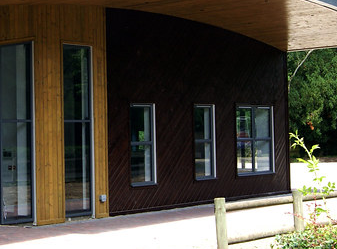
I think it might be sweet chestnut, as it was trendy at the time, about 15 years ago? Here is one I did, with standard but tanalised T & G, stained 2 colours. The light colour hardly changes the timber colour but freezes it from fading to grey. Most of the walls are horizontal cladding. In full sun, the dark colour fades in 10 years. In shade it barely fades.
-
Remove cooker hood chimney - how?
saveasteading replied to Sparrowhawk's topic in General Self Build & DIY Discussion
They are very sharp, and the metal will be wobbly and quivery when released. I got a very deep cut while fitting one, and that was on the factory edge. The screws are into brackets fixed to the wall. -
have to check if there is exemption for forestry. so it is strong enough. No, it doesn't need reinforcement for the tractor, as it isn't about to fall through. reinforcement is for crack control. you should have a deeper perimeter about 400mm below ground, for strength and to be below frost and other weather effects. 100mm would do it if yo can be that precise, on top of 150mm of good compacted stone, on compacted ground. Reinforcing mesh A142 at mid depth, using spacing blocks. now you are possibly into regulations. it then needs to be much stronger for regular occupation. If you were challenged on it you might have to show that the space was seldom used, and not for long. No that is sensible, as long as the occupier is safe. Structure, fire escape etc. Imagine the tractor going on fire: would the office occupier know, and be able to escape?
-
What building regs apply to a wooden garage,?
saveasteading replied to joe90's topic in Garages & Workshops
I like that plastic stud. Better and cheaper than masonry or concrete, easy to screw down and seal. Looks solid too, ie not the kind with voids through them. The reviews say they are not tong in bending but that will be fine for the shed base....just got to deal with the doors being higher. -
Aesthetically yes, but more chance of leaks. Nothing should depend on lots of mastic. perhaps I am exaggerating. Staining, and differential fading. And if the wrong fixings are used, they run in purple. I don't like this. I expect the architect still has the new timber image in their portfolio.

-
What building regs apply to a wooden garage,?
saveasteading replied to joe90's topic in Garages & Workshops
Those timbers above the sole plate are not treated at all. I am not happy about that. A timber co MD told me that Britain is not like other countries, being constantly cold and damp, so never to specify Canadian Redwood. It is ok in a country with very cold winters when the bugs and moulds die. But here everything stays damp and rots. They even issued a note to say this to every architect and customer who asked for a quote. The same applies, but more so, to European pine. Can we rely on a painted on treatment? The exposed ends will surely need to be soaked in wood treatment or painted annually. -
Great idea. Make it easy for them.
-
What building regs apply to a wooden garage,?
saveasteading replied to joe90's topic in Garages & Workshops
Any thoughts on my concern of the slats not mating together tightly, vertically? I resolved never to have t & g cladding boards longer then 3.6m, as it will reduce the problem, but doesn't remove it. In these garage the t & g is structural though, so it might settle unevenly over time. Or perhaps the weight with the roof on forces the timber into place. I wish I knew. I think a skilled person could go round it with a float and feather the edges enough. Tamped finish first, then floated smooth and sloping on the outside. actually I would float to slightly inside the wall line. You try it and report back please. -
ditto. They are under-resourced and overworked and much blamed, but real people trying to help. The ones that deal with drainage are not tree huggers but qualified and sensible.....that I have encountered anyway. I like that they always accept my proposals (not always the obvious) , so they are by definition very astute and sensible.
-
No. The hurdles are much the same and for the same reasons. Don't worry, you will get there, and the multiple options gradually converge to a solution. Nobody is out to catch you out but, at some stage, you stop studying the options and choose a way ahead that the authorities will be happy to agree to. I have had the 'pleasure' of training the family in construction as they are on site and I am far away. Their main worries have been that there are so many things to consider technically, financially and aesthetically, all at once. But, but but...and then it gets complicated by some experts and many non experts with differing ideas and knowledge.
-
You could have a single inline fan with 2 ducts into it. I can't see it is worth the hassle though when a fan is £30. What you show here looks sensible and will vent the shower which is important. Does a utility room need its own extract? I have not checked the rules. There is no source of steam unless a tumble drier doesn't vent outside. A big enough fan in the shower area might suffice.
-
Yes it is almost unavoidable unless it is composite cladding (foam core) or Sinsusoidal (agricultural) and I wouldn't have either. Yes. Haven't used it but have often considered it, then gone for normal timber (price). In my experience pine cladding will last for decades if bought with good vacuum, preservative treatment, then stained, and constructed carefully. I would use thermawood rather than concrete with wood patterns on it, because I hate false patterns, esp if they repeat. On our conversion we have used untreated, but selected, larch and it looks (and smells!) stunning. I would treat it to keep the redwood colour but have been outvoted and so it will go grey and slimy. It is Scotlarch, which feels light enough to be thermawood but it isn't heat or vacuum treated. I am assuming it is very well seasoned and then only selected panels are used. Quite expensive but not as much as the other proprietary options.
-
What building regs apply to a wooden garage,?
saveasteading replied to joe90's topic in Garages & Workshops
For strength of a weak slab that makes sense structurally. But it will collect water and be generally unpleasant even if not a leak or rot instigator. I suppose the slab could slope away at this point but this is getting over precise. I am going off this construction. OR I will work something out that I am OK with. I think this involves raising all timber off the slab. The plastic bearer you mention: is this effectively a shoe that forms both a dpc and an outer barrier? Then sealed with mastic I suppose. Sounds sheddish rather than garageish. Maybe Ok for Latvian or continental weather , but not our damp and drizzle. Thinking about it, my garden shed has a floor on bearers, so this can overshoot the slab then support the walls. N/A for the t & g construction. -
Metal cladding has been big in my career, but I wouldn't have it on my house walls. Untidy around windows and a bit too industrial. On roof yes. In fact I have done loads of buildings with metal walls and overclad in timber, usually stained. Probably not on my house though.
-
Yes this is normal. You have to compact it as you go (150mm layers) and yet not knock over the walls. Best to use crushed hard-core for density and to avoid voids. Then for the top layer a better quality with more fine stuff. Then probably a sand blinding for level control. Slab into smaller areas? Do you mean crack control?