
saveasteading
-
Posts
10887 -
Joined
-
Last visited
-
Days Won
93
Everything posted by saveasteading
-
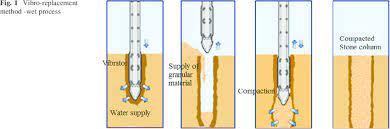
Leave a gap between the 2 differing buildings. link them with a corridor or utility rooms or orangery or whatever. then if one of the buildings moves relative to the other, as is very likely, the damage is only at the abutment of the link to the building. You can design it to be a failure point that is readily repaired, or even flexibly so that it absorbs some movement. To be sure that we're talking about the same thing By vibro I mean vibro replacement. a rig vibrates a hole in the ground and fills it simultaneously with gravel. Thus it compresses the ground sideways and it all becomes denser and stronger. the pile of gravel does transfer load downwards too, but that is a bonus. I've specified it several times ( and always used Keller) but some ground is so loose that it can't be used. The machines are sometimes smaller than the one shown. I haven't seen water being used as the sketch shows here.
-
On very loose ground I favour vibro. The main attractions are the flexibility of spacing and that the ground is being strengthened rather than the building going on stilts. It saves on reinforced edge and cross beams too. If the design allows , I would have a link between the 2 parts like a railway carriage has, to let any movement cause least effect.
-
It's standard single skin from Colour Clad. It is on tile batten to allow an air gap and flow, then dpm on osb on rafters.
-

Can ACO eliminate the need for DPC being 150mm above ground level?
saveasteading replied to Grsz's topic in Damp & DPCs
No, it just means that they haven't spotted this gross error. There is an awful lot to look at in a short time. Plus when builders do something unusual it may not stand out. In this case the paving is too high so they have bodged in a drain. But I don't think the bco can withdraw a certificate. You could phone and ask. What's the worst you ask. The best is that the wet bit will go permanently green. The worst is damp up the wall and into the house and the render falling off. This is a walkaway or £20,000 discount matter. Any subsequent party may also spot this and the builder will end up reducing the price. And he maybe needs the cash now. The solution is to lower the paving which will cost several £k and might not look ideal. -
Getting frustrated with heating suppliers.
saveasteading replied to MikeSharp01's topic in Other Heating Systems
As an MCS accredited installer, Alto Energy will apply for and administer the grant on your behalf. Payment is made by Ofgem to Alto Energy after completion of the installation and then forwarded directly onto the homeowner. -
Excuse that i haven't read the previous discussion but I saw this. Usually a whole building needs piling or it doesn't. It depends on the ground of course., columns have very high concenteted loads. Walls are heavy too. Then there is the floor which has a lighter load. They must all stay put relative to each other. But you say underpinning the existing. So the ground is solid 2m or so down? Why pile? Piling some and underpinning some will risk differential movement. This isn't to be dabbled with and needs an SE. Excuse me if that's already covered in the duscusson. Also, a turnkey builder will add 20 to 30% for the management and risk. Diy saves that but will be a full time job for you, plus all the risk. It's my skill set but i still add 5 to 10% for contingencies.
-
Getting frustrated with heating suppliers.
saveasteading replied to MikeSharp01's topic in Other Heating Systems
It reads to me that anyone who can justify their interest can get the training. £30, repaid after yoh turn up. So I'd go as Engineer, designer, contractor, environmentalist, developer? My plumbing is poor but i understand the principles. Then they design the project and I must buy the kit through them. Then it gets installed by ' an approved installer". That might be me clutching their certificate while supervising a plumber. Then they come and commission it. That might be 2 hours if its all ok. And then they apply for the grant and pay it to me. Do they charge for that final process, and how much? It's all a bit vague and I'm assuming deliberately so to avoid saying , look its a way to avoid rip off plumbers. But maybe it's just not well explained. -
Confused about birds mouth cut dropping ridge height
saveasteading replied to flanagaj's topic in Roofing, Tiling & Slating
There's good reason for roofers to put up temporary timbers and measure the lengths. Nearly all buildings have twists in them and the cumulative effect can be dramatic. Then allow for the complex abutments at both ends. I'm no expert but I've seen seasoned joiners get it wrong. I wonder if it is safe to mass produce after the first one? I suspect not. It is much worse at hips. Even with a precision made steel building (computers all the way) we knew to allow sliding joints to make sure they fitted. -
Increasing size of sewage treatment plant?
saveasteading replied to flanagaj's topic in Waste & Sewerage
The ones I know most about simply work by gravity and flow. In the first chamber the sewage enters by a high pipe but turned down into the bulk to avoid splatter, The outlet is similar so that solids float high and sink low but stay put and fester. Then the second chamber receives only very grey liquid, and gets the bubble treatment and then has an outlet near the bottom and the third one's outlet is at at the top. Thus one flush goes in and the equivalent comes out. I have a single, ancient, brick chamber , and it works only as the first chamber above , but what comes out is cleaner than you'd expect and goes off to a primitive soakaway......somewhere . I had it sucked out after 10 years of our use, but I think it will have had 30 years before. There was a maximum of 200mm at the bottom and a crust* of 100mm. I don't think annual cleaning is necessary if it is working properly. * it was brown of course. I rested a brick on it for some reason, and it stayed put for a few minutes before needing rescuing. The stuff on the bottom was foul slimy grey stuff plus 'objects, various'. Ohhh and a lump of roof that had been chucked in by some previous cowboy. -
Cracks on the outer wall, should I be worried?
saveasteading replied to EmilyT's topic in Brick & Block
No. It is normal for cracks to run from large openings in walls. The lintel will be unaffected. How long has the crack been visible? Has it changed recently? If if it is to 2mm on the surface it is probably less on the masonry. Raking out some render will show. -
Increasing size of sewage treatment plant?
saveasteading replied to flanagaj's topic in Waste & Sewerage
1. The manufacturer can advise but I'd be surprised. It is an air bubble pump in most systems, like in an aquarium and the power is light bulb level. 2. Again I'm surprised if any allow this. I like the principle of 3 chambers, as digestion continues if there is no power, and the arrangement prevents anything flowing through untreated. Can you can advise which makes have these disadvantages? -
Or you could compact the sub base properly then the slab doesn't have to be a bridge. Interesting, and im looking forward to it. I've never heard of that but it's likely to be as crazy as his other innovations. Worth reading about this madman as an example of what not to do. Did he not believe in physics or simply in hoc to his own 'genius". Do they still praise him in Architectural circles? It's worrying.
-
Omnie Lowboard 2 insulate on non insulated ground floor
saveasteading replied to Griffithsg83's topic in Heat Insulation
It doesn't. Insulation works by being a barrier to energy transfer. In simple terms, pir or mineral wool keeps air in pockets, forming a resistance. Reflective foils only work if they have an airspace to bounce energy back into. If sandwiched they don't do that. It's great that you are seeing through the nonsense. -
Omnie Lowboard 2 insulate on non insulated ground floor
saveasteading replied to Griffithsg83's topic in Heat Insulation
Perhaps this isn't best for you. Heat loss will not be so extreme through the flooring you heat the room rather than the floor. Correct. It would be totally useless sanwiched between the floor and another layer Omnia is very expensive. Ruling out lifting the floor for now, i would insulate everwhere else. Is ashp the right solution? Possibly not. What has persuaded you so far? Businesses promoting it I guess. -
Omnie Lowboard 2 insulate on non insulated ground floor
saveasteading replied to Griffithsg83's topic in Heat Insulation
That's awful. 22mm chipboard with grooves cut out of it to reduce the tiny amount of insulation down to negligible. This would only suitable for an upstairs room, with lots of heat leaking down to the ground floor. @Griffithsg83 I'd be interested to know how you came across this and if some contractor is promoting it. Tel us more about the circumstances and expert people here will advise. the house, the floor construction. Etc. You are right of course -
Do I see an air brick or two? If so they seem very low and water could be running in.
-
Increasing size of sewage treatment plant?
saveasteading replied to flanagaj's topic in Waste & Sewerage
The next size up won't be much bigger or cost much more. Its mostly air. I don't think that a bigger one works any less efficiently due to under-use, and the nitrate will be no greater. The manufacturer should be able to confirm this. I'd probably just do it. -
Increasing size of sewage treatment plant?
saveasteading replied to flanagaj's topic in Waste & Sewerage
For a single house with up to, and including, three bedrooms, a Minimum Population (P) of 5 people should be calculated. For each additional bedroom in a property thereafter, you should calculate for 1 additional person. -
Looking at it from a different angle. Say £2,000 materials and £280 /day for sums convenience, and 2 sparks working. That would be 50 days, or 10 weeks. Half that seems about right, but add a bit if an expensive area or for a bigger company with overheads.
-
Rough door opening size and door size
saveasteading replied to Kelvin's topic in Doors & Door Frames
For future reference, Would it be prudent to make a door opening template (beatifully squared of course) and to stick build against it? -
Mitsubishi ecodan better control system
saveasteading replied to eniacs's topic in Air Source Heat Pumps (ASHP)
So wasteful (decadent even) to be chucking away heat on this basis. Tell us more please. What temperatures do you want and why. And don't you have pullovers? You need a box to store the heat for a few hours. I expect you could heat the water tank within this process. However, installers won't know anything other than the standard systems. -
Do groundscrews ever come out again? Even easier is pads of stone with a paving slab or 2, or 3 on top. Then timber baulks as sole plate/ beams. Then a shed with internal insulation. Telling us the purpose might spoil the fun but hasten a solution.
-
As Russell. The timber must be higher out of the ground. I don't like the eps under the walls. It will compress a lot as the building will lift /rock in the wind and put all the load on the other side. And rocking will make a repeated point load. The eps is supported laterally by stone as shown but that could change. Seems odd having a permeable sub base with perforated drains. This will be wet. Why? Uplift and sliding must be dealt with. We can return to that. Not using concrete is a great ambition. I'd use a concrete slab though. The carbon will be offset by not having to rebuild this after the first storm.
-
Of course it will. But they aren't linked. 'Down the line' might be 30 years. Moss doesn't damage roofs. So I wouldn't trust anything else they say either.
-
LDC for a Garage/Indoor Pool Refused
saveasteading replied to phykell's topic in Planning Permission
"Can you show me where it says that please" generally ended the debate. I had some issues with LA bcos who had a self confidence beyond their knowledge. I think it was related to being all powerful fof decades. But did I dislike that more with the old timers or the day release boy, I'm not sure. They would always ask for an extra 100mm out of a trench. Apparently nobody had ever refused. No, unless you are you paying for it? With planning it can be more nebulous though. This is not wandering off the subject, but adding background and context. Basically explain what you want and why it is a good thing before they have to ask.

