ProDave
-
Posts
30862 -
Joined
-
Last visited
-
Days Won
427
Everything posted by ProDave
-
value for money house design
ProDave replied to Amateur bob's topic in New House & Self Build Design
And once it has done that, then there is definitely no pee in it. -
Kwikstage scaffolding questions
ProDave replied to Vijay's topic in General Self Build & DIY Discussion
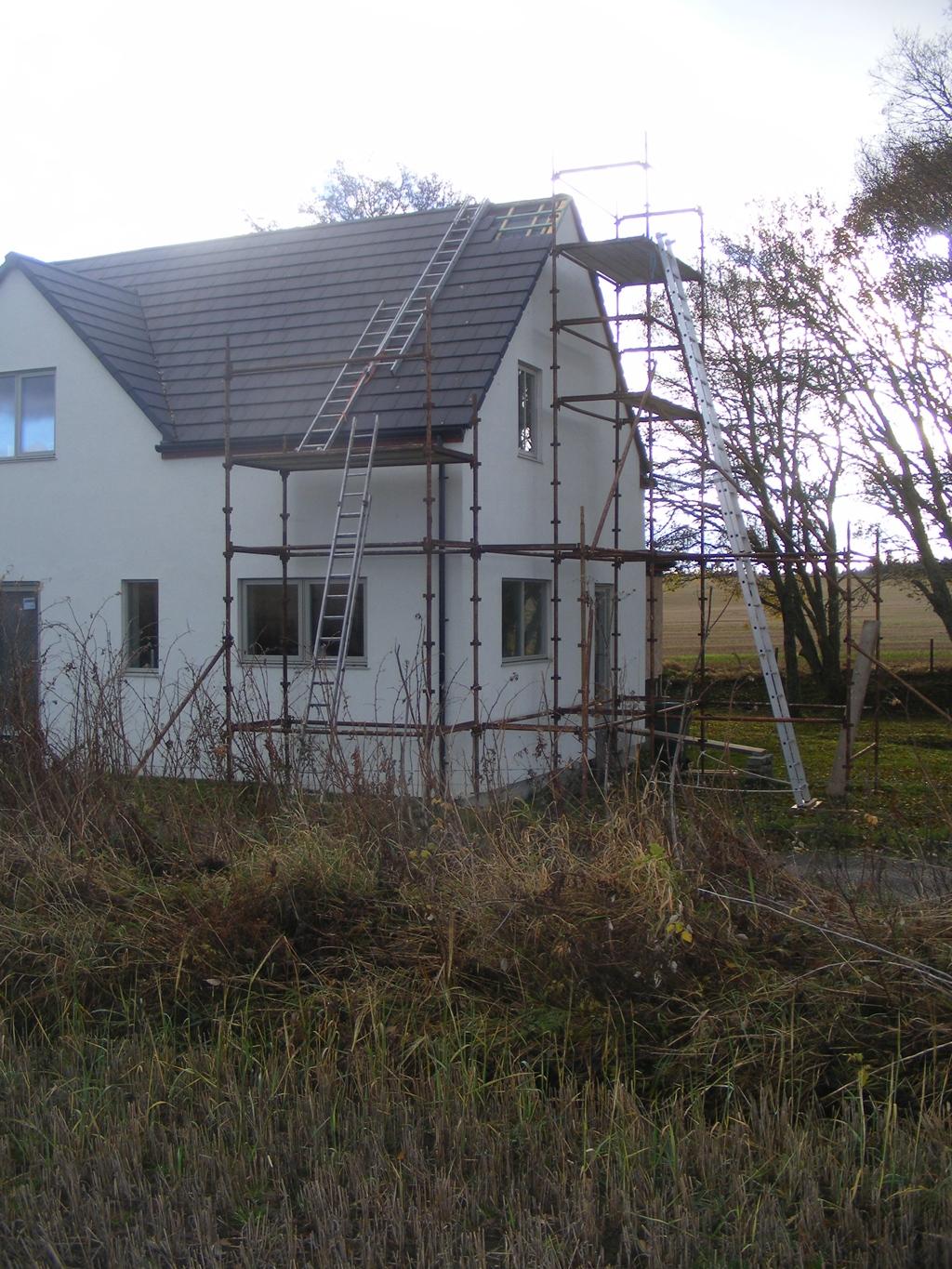
Don't take this as a "how to" rather a "what I did" Here you see my longer ladder right up to the top platform . Re extra bracing. I used some spare diagonal braces to add extra bracing to the corners with the bottoms staked to the ground. Note also the "bracing tower" projecting to the right in the middle of this span.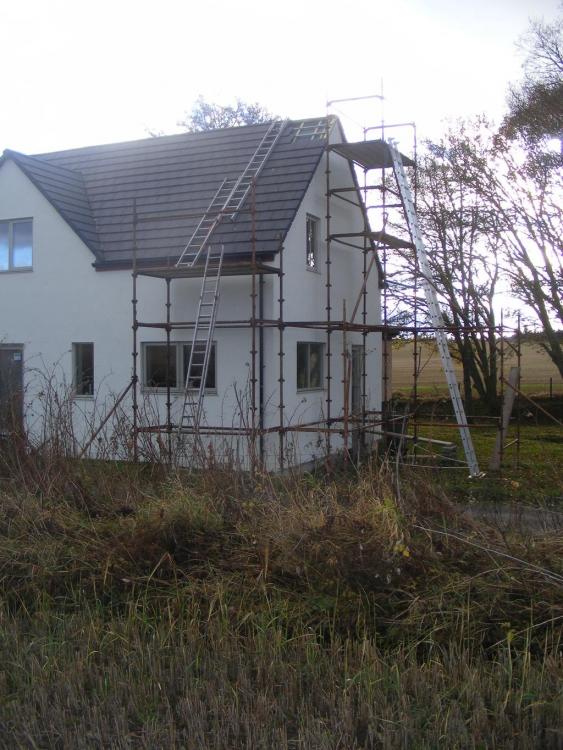
-
Right of Way, Area of common parts
ProDave replied to success1980's topic in Party Wall & Property Legal Issues
I don't know if that plan is to scale, but having ownership of the ROW and the Common parts, would give you access to a chunk of your existing garden that to me looks big enough to build another house on? -
Could you not use two of those brackets for each sleeper?
-
Right of Way, Area of common parts
ProDave replied to success1980's topic in Party Wall & Property Legal Issues
But the OP is not talking about pinching the land. He is merely working out how best he can or cannot use it once he has bought it. -
value for money house design
ProDave replied to Amateur bob's topic in New House & Self Build Design
Divided, well sort of. To the right of the entrance hall is the front to back Kitchen / diner. What most people refer to now as the "Family room" Kitchen to the front, and a sort of living space to the back with a sofa and a tv. To the left of the entrance hall, the rear 2/3 is the snug living room. The front 1/3 is the utility / wc. Both the two living areas mentioned open onto the entrance hall with partially glazed double doors, so they can be open as one big space, or closed off as 2 separate rooms. We emphasised that by having the same oak floor run through both living rooms and the rear part of the entrance hall in one run. the front part ot the entrance hall and utility is slate flooring. Floorplans attached to explain it better (there have been some minor tweaks since the floor plans were drawn, e.g airing cupboard moved into small bedroom 3 to make main bathroom bigger. BW005_-_GF_Plan.pdfBW007 - FF Plan.pdf -
value for money house design
ProDave replied to Amateur bob's topic in New House & Self Build Design
Ours ended up the shape it was, (wider than it is deep) mainly because of the shape of the plot. Plenty of width but restricted depth. Planning limited us to 1 1/2 storey. Our "gable end" rather than "dormer" design, and with a vaulted roof hung from ridge beams, means almost all of the upper floor has standing headroom with very few limitations. I always say it is almost pointless designing the house before you have the plot. -
value for money house design
ProDave replied to Amateur bob's topic in New House & Self Build Design
Yes I have know that for a long time, and fairly similar size as well. About the only significant difference is we have the stairs at the back of the entrance hall as 2 flights, up to a half landing then turning back. That allows us to have the bathroom above the front door. -
value for money house design
ProDave replied to Amateur bob's topic in New House & Self Build Design
Yes very similar to our house. Rectangular house entrance in the middle forming an entrance corridor and stairwell. Rooms either side of this on both floors. Very little space wasted with corridors or circulation space. Works best on a plot that will support a house wider than it is deep.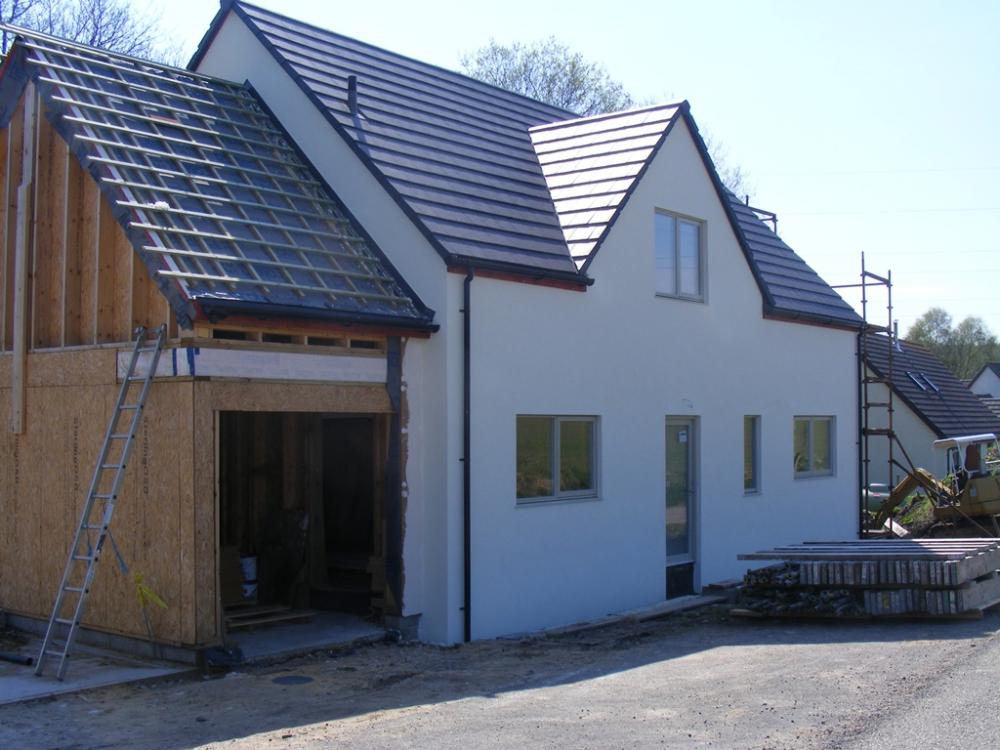
-
Right of Way, Area of common parts
ProDave replied to success1980's topic in Party Wall & Property Legal Issues
Extinguishing a right of way is nigh on impossible, just assume that will never happen. I can't see a problem with fencing it, to prevent cars etc, as long as you provide a gate or stile to access the ROW. And if it is "common parts" you probably have no right to tell anyone using it to clear off either. But the fact it is fenced might just deter them from doing so. -
Ebico still do them https://ebico.org.uk/energy-plans/
-
I climbed the aforementioned 160ft mast before it's demise. I was happy enough inside the tower frame, with my harness clipped on, but no way would I have stood on top like that, even with a decent fall arrest rig (it would still bloody well hurt if you fell off and crashed against the side of the tower hanging from your fall arrest)
-
Thank you. So it appears I was just unlucky (or the local market here is very different) in that I could not find anyone with such a sensible and flexible approach.
-
If I had bought the site, I would have retained the aerial mast. I was once offered a 160ft mast for free. The catch was I had to dismantle and remove it, which would have been no cheap job if you wanted it to be re erected elsewhere, but getting PP to do so would have been near impossible. It looked as though this one just got dragged down in a mangled heap by a big rope from the top and pulled down by a digger.
-
Thank you. All I can say is I wish I could have found an architect like that when I last looked because all wanted to charge the percentage fee, over estimated the build cost, and would not do just the work I wanted.
-
Easiest, Simplest, Cheapest Type Of Flooring
ProDave replied to Adam Smith's topic in House Extensions & Conservatories
I think it is a mistake to make this bit as a conservatory AND take down the kitchen wall. To do so would lead to massive heat loss through the inferior conservatory wall and roof structure. Either make is as a conservatory as a separate room that can be shut off when it is too cold, or make it as a proper extension with a proper insulated roof and walls, with it opened up to the kitchen. -
Easiest, Simplest, Cheapest Type Of Flooring
ProDave replied to Adam Smith's topic in House Extensions & Conservatories
I see the drains as the biggest issue here. If as you say your mains drains run out to the front, then your target is to convert ALL your drains to internal stacks running under the (presumably) suspended ground floor out to the front, to clear that back wall of drain pipes and make the inspection chamber redundant. You will need a rodding eye for the drain run out to the front but that might be able to extend rearwards beyond the conservatory. The drain coming down from the loft looks the hardest to deal with. -
That touches on my pet topic, the level of architects fees. Roughly what percentage do you charge? In my brief encounter a few years ago, the architects I spoke to wanted to charge me in the order of 10%. Now if your fees are anything like that, that's £25K per project (about what they wanted to charge me) and if you are doing "a couple of dozen" like that each year, then that is £600K per year. Are you REALLY earning that much per year (less expenses of course)? Or to put it another way, if you are doing 24 such projects in a year, then you are expecting to devote 2 man weeks to each project. That does not sound like much time at all, and certainly not £25K worth of time. You are doing nothing to dispel my impression of architects as vastly over paid. I invite you to put your side to redress that feeling.
-
I don't know how to break it to you gently, but that staircase will not comply with UK building regs. It will fail the "100mm sphere will not pass through" test between the treads, and between the (yacht rigging) banisters (because they will push apart). It will also fail as horizontal banisters even if solid are not allowed any more as it's too easy to climb up them. So you need to partly block the gap between the stairs, and fit a solid vertical banister with <100mm gaps.
-
If you are selling the Outline (Planning In Principle in Scotland) is probably all you want. Can you not just re submit the previous application? If you are re designing, you don't want too much detail for a plot for sale as it would tie the hands of the buyer too much, on the other hand you do want some, otherwise the planners will just stick on all the standard conditions like real slate roof etc. You need to know enough like how will drainage work to comply with building regs otherwise you could get PP for a house that is impossible to build.
-
Easiest, Simplest, Cheapest Type Of Flooring
ProDave replied to Adam Smith's topic in House Extensions & Conservatories
First, have you talked to your neighbour about joining onto his new wall? His extension looks to be still under construction. Is that wall built on the party line, or set back his side of it so as to be entirely inside his boundarry? -
^^ When we sold a previous house, it came to light that our driveway, from a side road, was in fact leading onto an unadopted private road that we did not have any right to use. There was nothing to say it was private, and the highways had resurfaced it last time the other roads in the village were done. But no, it was an unadopted road and we had no right to use it. Solved iirc with an indemnity policy. Oh and I was never told any of that when I bought the house.
-
I must admit I have briefly looked at pinterest, and found it every bit as confusing and disorganised as facebook.
-
My windows arrived today. They were not due until tomorrow. Good job they arrived late in the day otherwise they would have found nobody in because they are a day early. I did query the delivery charge and this was their response: I guess that's the end of that then.
-
My only dealings with an architect was 16 years ago when doing our first house. I contacted 5 architects, made appointments with 3. Two bothered to turn up to see us. Then both of them gave quotes in the order of £25K. ALL I wanted was someone to take our ideas and turn them into a buildable house and do all the drawings. Neither had a "pick and mix" attitude to services offered they both just wanted to take on a full package of turnkey project management when all I wanted was design and drawings. And to make matters worse, they both based their fees on a percentage of build costs, but their estimated build costs were way over what we had, and if it really cost that much to build would have cost way over it's market value. We ended up building for half their build cost estimate. That is verging on sharp practice to me, over estimating the build cost in order to get a percentage based fee higher. I did not repeat that soul destroying exercise this time. I found an architectural technician willing to do just the work we wanted. Interestingly I have a cousin who is training to be an architect and I saw her a couple of weeks ago when we were down for a wedding. I think I gleaned 3 things from her. 1: she is beginning to doubt if the length of training is really worth it. 2: she has no desire to do residential, she finds houses not challenging and boring. 3: She did not seem to know (i.e I assume not being taught) very much at all about low energy buildings and modern ideas like heat pumps mvhr etc.