


LnP
-
Posts
449 -
Joined
-
Last visited
-
Days Won
2
Everything posted by LnP
-
I installed it next to the outbuilding, in fact in the middle of where we now have a patio. I was a little bit worried we might get smells but we don't. The waste from the outbuilding falls by gravity into the pumping station and there's a level switch in the tank which turns the pump on. It's about 25m to the sewer chamber it connects it into. I looked into macerators, talked to builders and got advice that a pumping station was more of a "proper job". Also my mother-in-law had a macerator when she had a downstairs toilet installed, to get the waste a few meters to the sewer connection. It was unreliable. We're going to be living in this outbuilding during the build so it needs to be up to regular use. You have to dig a hole in the ground for the tank, but we had a digger on site anyway for the trench.
-
I installed this pumping station in a similar situation, from Drainstore. It's been in a year and works fine so far. Completely silent. Single Sewage Pumping Station - 610mm x 1000mm 292 Litres - up to 10m head plus 2 year warranty on pump - Include High Level Alarm
-
I've a friend who's an acoustics engineer. His company get called in when disputes arise. Local authorities are unlikely to police it, but the risk is that a neighbour complains. Even if you have planning permission, neighbours can allege that the noise is a statutory nuisance. His experience is that local authorities are not well equipped to handle those cases which leads to uncertainty.
-
I'm about to submit a planning application for our new house. I'm thinking about putting the ASHP on the opposite side of the house from the plant room. This would keep it away from neighbours and be less visible for us. The house will have UFH and the connections to the ASHP would run under the kitchen/family room, about 14 m. Is there anything wrong with that? Where should the flow and return pipes sit in the foundation build up? Insulated obviously but also in a conduit? Any watch outs? Thanks
-
Interesting. I'm at the design stage for my self build and do want active cooling but still thinking how to do it - heat pump or multi-splits. According to my cheap electronic air quality analyser (CO2, temp and rel humidity), the air in the room right now is 20oC and 65% relative humidity. A psychrometric calculator or chart indicates that the dew point is 13oC. So I'd be getting condensation if I was running the HP with a flow temp of 12oC. Using the heat pump for cooling is attractive, but I'm worried about condensation in hidden places - mould, rot etc.
-
The fact that you get condensation under your rads must mean you're running the HP flow temp colder than the dew point in the house? Are you concerned about that at all? Do the fan coils collect the condensate and drain it somewhere? What is type Q insulation, does it keep the moist air away from the cold pipes?
-
Do these conical filters fit into any 125 mm extract point or do they require a particular fitting?
-
Is that a standard fitting, an extraction point with a filter pad in it, or did you fab it your self?
-
I think I recall Andrew Jones (The VATMAN) cautioning against this. IIRC his advice is that the name on the invoice has to link directly to your build.
-
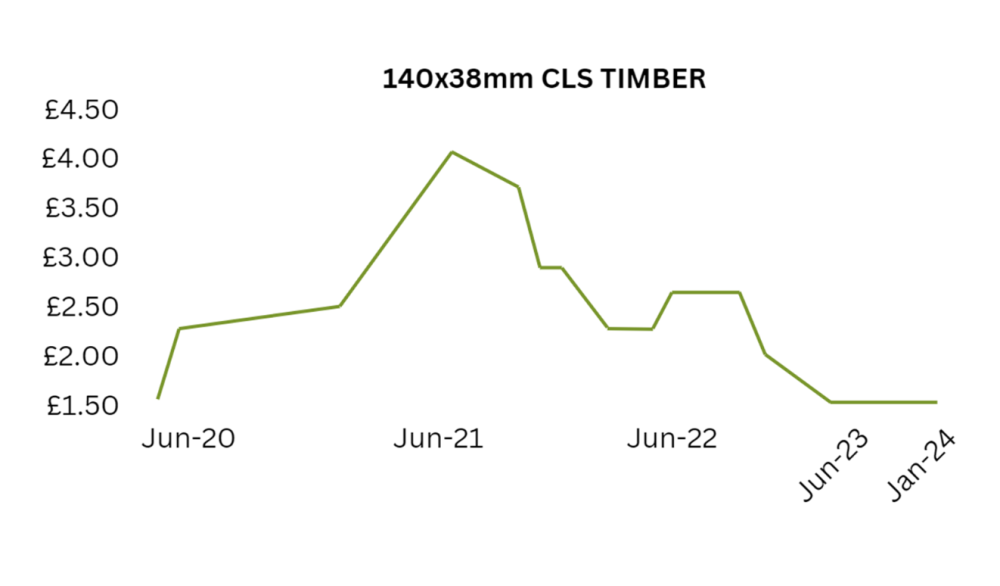
This graph was presented by a timber frame company at a recent demo day. Prices of CLS timber are back to where they were 4 years ago.
-
At my last house, I got my kit from the Electric Gate Shop and installed it myself. I was happy with the tech support. I had imy installation checked for electrical safety by a proper electrician. mains voltage motors photocells on the posts inductive loop in the driveway preventing the gates from swinging open onto a parked car The motors sense if they’re closing on an obstruction, e.g. trapped body part, and you can adjust the force they close with telephone cable back to the house with a button inside the front door so we can open the gates from the house and also lock them open (switch wired in series with photocells). Handy when you have guests As well as the usual remotes, a GSM module which opens the gates when it receives calls from pre-programmed phone numbers. Very handy as you can call it from your car as you approach the house so the gates are open as you arrive. Also handy for allowing access for friends, relations etc. no stops for the leaves when they’re open, but a clever stop which grabs them when they’re closed an electric lock (similar to remote door access in apartments) which is activated automatically by the controller and locks the gates together when they’re closed. This is to stop anyone from forcing the gates open. Works a treat and very reliable.
-
If a qualified ecologist says an emergence study is not required, it's hard to see how the LPA could argue with that. Do you have a planning consultant to argue your case?
-
This company was recommended by my planning consultant, as he had had good experience with them - Rachel Hacking.
-
For our survey, before the ecologist arrived, I sealed up any nooks or crannies which might have looked appealing to sleepy bats. As hoped, he concluded an emergence survey wasn’t required.
-
I paid about £700 3 years ago for a roof a little larger than that. As @markc mentioned, you can do it yourself, but read up how to do it safely and how to dispose of the sheets. Especially take care not to break the sheets or cause any dust to be released. According to the HSE, over 5000 people die every year in the UK from asbestos related diseases.
-
Very helpful thanks!
-
I'm interested to learn more - what are GGR guidelines and where can I find them? Thanks
-
Plans for south facing plot … would appreciate your wisdom
LnP replied to davelank's topic in New House & Self Build Design
@Bramco would you mind sharing what blinds you chose, what were the criteria in your selection, what other ones you considered etc? Thanks -
Maybe he meant lower pressure drop. Even though the pressure in a Venturi drops as the velocity increases, once the flow leaves the Venturi, it won't recover to the full upstream pressure, i.e. there's a pressure drop across the Venturi which increases as the flow increases. But I'm curious though, is Bernoulli and Venturies something we need to consider when designing MVHR systems? I've read this thread with interest as I will be installing an MVHR.
-
There are plenty of timber frame houses with wood siding, plywood sheet roofs with cedar shingles in Canada and the US which are more than 100 years old. There's nothing wrong with this method of construction if it's done properly and maintained, which is true for any building system.
-
I'm coming into this thread quite late, but this demand calculator might be useful.
-
I was curious about what an anti-freeze valve is, and found this useful explanation in case anybody else was wondering! The decision on the best way to protect the external unit from freezing seems to be quite complicated. One aspect not much mentioned in this thread is reliability. Dosing the system with anti-freeze is inherently safe and if you want to, you can test it by taking a sample and putting it in the freezer. Anti-freeze valves are an active protection measure so have a probability of failure on demand and can't easily be tested. I've had a few temperature sensing cartridges in shower controls fail and I suppose it's similar technology. What do they do in Norway?!
-
Is that an extractor to the outside? Does it affect the air tightness? Thanks
-
I spent my first 11 years in a prefab at the Atomic Energy Research Establishment at Harwell. My parents moved into it just after the war in the very early days of the AERE. They were very proud of it. The kitchen had a built in fridge and a clothes boiler/mangle contraption. The hot water was heated by a back boiler behind the fire place in the living room as well as an immersion heater. There were built in cupboards and wardrobes throughout (steel doors). Unimaginable luxury for my mother who had been bombed out of the East End of London. My father used to say it had been designed by engineers, but he was an engineer so he would say that. They were manufactured by the Bristol Aeroplane Company and erected by Italian prisoners of war who had decided to stay in the UK after the war. We talk a lot about timber frame on this forum, but shouldn't forget that there have also been unsuccessful attempts to introduce light steel frame construction into the UK residential market. And yet we are still building houses using the technically inferior bricks and mortar system.
-
What’s the best way to manage removing cooking fumes, smells and steam in an airtight house with MVHR? is there a way to have an extractor vent to outside the house? Is a venting hob the only solution? I assume it’s not a good idea to extract directly into the MVHR? Thanks


