LnP
-
Posts
449 -
Joined
-
Last visited
-
Days Won
2
Everything posted by LnP
-
Presumably imported crude oil which is refined here?
-
VAT Reclaim journey
LnP replied to Benpointer's topic in Self Build VAT, Community Infrastructure Levy (CIL), S106 & Tax
What evidence do they require so they can check that it can be claimed? If the invoice is from Ikea it's obvious, but if you get a joiner to make and install fitted wardrobes, the invoice is unlikely to provide this level of detail. -
Finding ASHP installer who understands fan coils
LnP replied to flanagaj's topic in Air Source Heat Pumps (ASHP)
Pump 1 to the fan coils and pump 2 to the UFH? Is it a given that you need pumps? -
We've put a deposit down on a Fleming timber frame. It's all going fine but I think there will be decisions to make and experiences along the way and I'd like to know if there is anybody else in a similar position interested in sharing how it's going for them. DM me if you're interested in a chat.
-
Keeping stuff mould and rust free in integral garage
LnP replied to Sparrowhawk's topic in Garages & Workshops
Correction, I should have said, actual humidity (g/m3 ) will go up and down, not relative humidity (%) -
Keeping stuff mould and rust free in integral garage
LnP replied to Sparrowhawk's topic in Garages & Workshops
I don't think you need more ventilation. You mentioned that you have large temperature variations. The items in your garage are heating up and cooling down. Because of their thermal mass, if the garage is drafty, that process will lag the temperature of the air coming into your garage. The relative humidity of the air coming in, will go up and down with its temperature. After a cold night when the contents of the garage have had time to cool down, as the day warms, warm moist air getting into your garage will come into contact with items which are still colder than the air, and water will condense out on them. Reduce the temperature fluctuations by insulation and perhaps some background heat. Slow down the rate at which the garage air is replaced by trying to get your garage door less leaky. You don't need much ventilation in a garage; trickle vents etc are there because we introduce moisture into our houses by living in them. -
New self build design, heat and architect
LnP replied to Jack757's topic in New House & Self Build Design
The Zehnder Q450 from HSL was £2651 and the Brink Flair 600 from CVC was £2510. Design required flow for my house is 320 m3/h but CVC say they nevertheless recommend a 600 m3/h unit, which they say gives less noise, greater efficiency and longer fan life. I bought a Worcester Greenstar 4000 25 kW combi boiler in 2022 which cost me £666, but that was with a trade discount. Current online price is about £1500. So I tend to agree, these MVHRs look expensive. Prices from people like CVC and HSL are without a trade discount. -
New self build design, heat and architect
LnP replied to Jack757's topic in New House & Self Build Design
That's an impressive installation and it's good to hear you get good support from CVC. What I'm seeing though is that they are expensive. For my 280 m2 house CVC quoted £9071 supply of materials excluding the duct layout or commissioning for a Brink Flair. That included a 30% discount. Heat Space and Light quoted £7665 supply of materials including the duct layout and commissioning for a Zehnder. -
New self build design, heat and architect
LnP replied to Jack757's topic in New House & Self Build Design
The drawings are impressive, but how well do they match the reality of the installation? Were you able to follow the routes shown in the drawings? -
Did you consider helping them do the RAMS?
-
Some thoughts on the cost of safety … - If you think safety’s expensive, try having an accident (quote from process safety guru Trevor Kletz). - There’s often a benefit to set beside the cost. Think about how we used to do work at height off ladders and now all the handy equipment like portable scaffolds which not only make it safer, but also easier to do a better job. - We don’t have any choice about regulatory compliance, like implementing the CDM roles, but when it comes to choosing how we work, we’re only required to apply solutions which are reasonably practicable. Regarding working with trades, I’m early enough in my self build not to have first hand experience, but I’m hoping that a bit of hand holding with writing RAMS will overcome any reluctance. I have had experience of this in an industrial setting and have found most contractors are happy to cooperate.
-
Reinforcing some of the comments made already ... in my opinion, CDM 2015 is good legislation and not about blame. The whole point of CDM is being organised and clear about who's doing what. That's a good thing for any project and will help it run not only safely but also well. I also agree with comments made already that the usefulness of a RAMS in inversely proportional to its length. There's good advice and templates on the HSE web site about all this.
-
SE refuses to spec beam with underplate
LnP replied to flanagaj's topic in RSJs, Lintels & Steelwork
Is it the three fins (labeled F4) which prevent the twisting, or the seven pieces of angle (labeled B8)? What are the B8s fixed to? -
CVC included the humidity sensor in my quote for the Brink, recognising that you do need one. It’s not integral with the unit though, not that that matters.
-
I’m close to placing an order and agree with all of this. I’m planning fit and forget. Keep it simple. Additionally, from my research: The Brink doesn’t have a humidity sensor built in as standard. You do need one and need to specify one to be fitted in the return duct just in front of the unit. The Zehnder has humidity control as standard. I’m not sure I’ve fully got my head around this, but I think the Zehnder has a more advanced algorithm if you have active cooling (via your heat pump or multi splits). It’s something to do with how it looks at outside and inside temperatures and controls the bypass.
-
Where to mount LED driver for ceiling mounted light strip
LnP replied to markharro's topic in Electrics - Other
You’re not only being a nice fellow, you’re complying with the requirements of CDM to create a Health & Safety File. In principle, this is one of the jobs of the CDM Principal Designer. Do you have one of those or are you doing it yourself? I included the requirement to provide H&S File information in the scope package I sent out to get quotes for demolition and groundworks and got feedback I was scaring people off. -
If you were persuaded by Steve Koonin's views on climate change, but are open to the possibility there might be another side to the argument, you should watch Dave Bourlace's analysis of Koonin's points in his Just Have a Think podcast.
-
I can confirm that the advice I got from Gus was helpful, and the more so because he does it for a living. I'm sure the administrators are well able to spot when people are on the forum motivated by commercial interest rather than collaboration.
-
Fan Coil Units for use with a (cooling) ASHP
LnP replied to ProDave's topic in Air Source Heat Pumps (ASHP)
Makes sense. So is this the type of pipe you'd use, insulated MLCP? Would it be reasonable to assume you could get this type of pipe all the way to the fan coil without having to use any fittings, e.g. elbows to get round tight corners? Otherwise how would you insulate the fittings? Would you need to make the insulation air tight so you couldn't get moist air behind the insulation? -
Fair point and thanks for your helpful interpretation.
-
Yes, I get it. Thanks for your alert. Choosing the foundations is one of the most important decisions in the project. The best one can hope for is to become an "intelligent customer". That's why I'm talking to people and asking questions on here.
-
There are two ways for me to understand your question. If it's a straight one, the straight answer is, no I don't do it for a day job/business and yes I'm a genuine self builder, whatever that is. But since I opened my post by explaining why I'm asking my question, the straight answer should already have been clear. So I'm wondering if your question was rhetorical and intended to demean and denigrate, which would be a pity. Thanks for your comment. Useful to get your opinion..
-
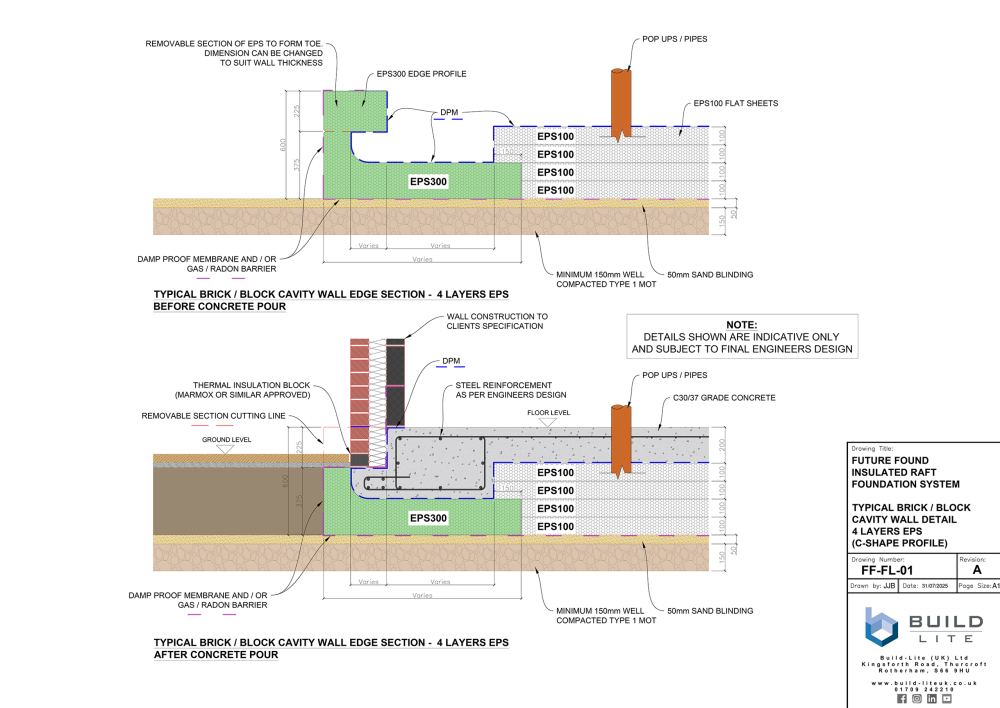
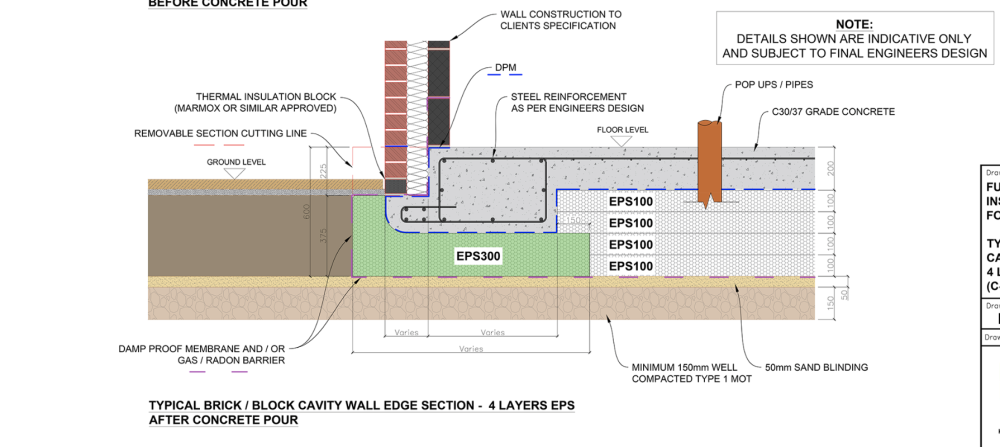
@JohnMo One insulated form work system provider I spoke to, said that NHBC and other warranty providers are not comfortable with having the masonry outer leaf sitting on a different foundation than the timber frame. They're concerned about differential movement. They could supply their system with a separate outer ring beam for the masonry, but recommended a toe off the raft similar to the Build Lite one I shared, for an easier ride past BCOs and warranty providers. One such local builder I spoke to came by with a machine with a large (1.5 m long?) augur and drilled some holes to see what kind of ground conditions I have. He was polite about my interest in insulated raft, but was of the opinion traditional foundations would be a doddle. I'm aware that there are those on here who say that insulated raft is cheaper, when you account for not needing screed, can fix the UFH pipes to the rebar etc. And I've heard it from insulated raft suppliers. I'm getting quotes both ways so will soon find out how it is in my case. Maybe insulated raft is best suited when you don't have the masonry outer leaf to worry about.
-
@-rick- Thanks for your comment. Just checking, did you see the whole image? For some reason, after I uploaded it, I only see the whole image if I click on it and open it. Here it is uploaded a different way. Does that answer your question? They have a toe on the raft which the bricks sit on, but with a course of Marmox blocks.
-
I'm shopping around for foundations for a timber frame structure with brick outer leaf. I don't plan to do it myself but will engage a ground works company to do the install. I've not had a ground investigation yet, but indications are that I have good ground conditions, about 600 mm top soil with compacted gravel and sand below. I've had to dig holes and trenches down to about 1.2 m around the plot for various reasons, and never seen water. I'm most interested in speed of installation, simplicity and cost. Regarding energy efficiency my expectation is that whatever foundations I go for, they can be made be good enough. So I'm not wedded to any particular type of foundations and have been getting prices and talking to installers, suppliers and structural engineers to make my decision. I had been talking to AFT and an installer they had recommended, but as I mentioned in a previous post, AFT have ceased trading in the UK. The recommended installer is looking at carrying on his business with a different insulated form work supplier and is looking at Build Lite. I'd be interested in thoughts or comments on my approach but also on the Build Lite insulated raft system. I've attached their sketch from their website. Thanks