


Bramco
-
Posts
796 -
Joined
-
Last visited
-
Days Won
1
Everything posted by Bramco
-
In fact you could invert those figures and use them for the cooling you might require.. Simon
-
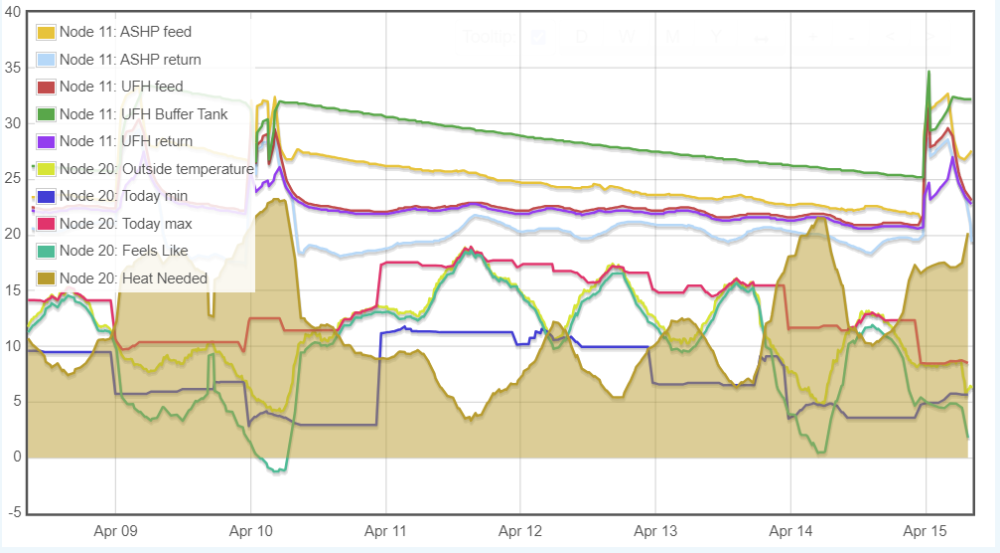
As above, probably not on the ASHP but surely the 'feels like' temperature, often windchill but sometimes just a clear sky at night, must make a difference to the heat required by the house. We've been monitoring the 'feels like' temperature recently and on some nights it can be at least 5C below the actual OAT. You can see this on the graph below. So the question then becomes, should you, in the spreadsheet use an OAT which is 5C or so below what the met office tell you is the lowest OAT? Which would mean a bigger heat pump than the spreadsheet would normally indicate. We're going to use the data to create some kind of 'heat required index' for our build and use that to set how long the ASHP runs for. Simon If you look at the 10th and 14th you can see the feels like temperature drops by about 5C from the outside temperature. Green and Yellow lines. The data is from openweathermap.
-
For us the rainwater went to the dyke anyway, so there was effectively no change. There are 3 houses beyond ours on the dyke which then ends up alongside the village sewage treatment works (don't worry it's quite a way to that). That sewage works dumped sewage into the dyke on 6000 occasions last year - so you might say we're helping to water it down - that's if there's any real flow in the dyke. Fortunately we're upstream from the treatment works 😄 ........ This eventually ends up in the Trent, so don't swim downstream..... Simon
-
No idea - but I wouldn't rely on Google.....
-
Can't remember the number of crates but the total cost with excavation, earth disposal, crates and labour was about £20k total, i.e. not just the cost of the crates - although these seem expensive when you think what they are. Simon
-
Self build affordability in a higher interest rate world.
Bramco replied to gavztheouch's topic in Costing & Estimating
We contracted a builder, so costs are higher than true self build. But it's over 250m2, almost passivehaus, triple glazing etc. At the end of the day we ended up about £2.5k/m2. Simon -
Agreed - we've got a mix of wifi and zigbee. Isn't the supply for POE a bit 'juicy'? I wonder how these compare to a Loxone system? Simon
- 24 replies
-
- 1
-

-
- electric
- background
- (and 1 more)
-
So very roughly speaking around 5kWh per day. We're about the same. With solar PV, batteries and a tariff like Octopus Go intelligent (7.5p for 6 hours at night and 15p export), the marginal 6.5p we could earn by turning everything off is perhaps not worth the effort. One thing we could do is to turn off all lighting circuits during the daytime - we have a number of smart devices to turn things on at dusk and off later on - but these only use a few of those background watts. There's probably one out there but a way to manage this would be to have a wifi controlled circuit switch/RCD in the CU. That way we'd have just 3 or 4 of those loads rather than 10. But again, is it worth the hassle. Simon
-
Self build affordability in a higher interest rate world.
Bramco replied to gavztheouch's topic in Costing & Estimating
Not so sure about that - very roughly speaking our TF was about £100k and the total build about £600k. So a 5% reduction in timber costs doesn't have such a big impact - and don't forget while prices always rise quickly, they're always very slow to come back down again. Things tend to ratchet up. So any reduction in timber prices may not be reflected in your TF quote. Also even if the building trade is in slowdown, most timber is imported and those prices are not impacted by the slowdown. The slowdown is more likely to bring the costs other than the TF down. Simon -
@NailBiter and anyone else trying to register on Solcast, the site is quite confusing. The registration page has 3 boxes with text in them for each type user user. Inside each box, there is a hyperlink but this link takes you to an information page about the service for that type of user. So you end up in a loop. You need to click anywhere in the box for the different user types - it's not obvious that the box itself is a hyperlink. I've suggested to them that this is a little confusing. Simon PS @NailBiter thanks for your offer to help by DM
-
Nope, still doesn't work - I've emailed support, maybe there's an issue with their systems. Simon
-
How did you register for Solcast? If I go on their website, and select Home User, I get switched between 2 web pages and can't register. Frustrating..... Simon
-
@LnP We used Hallmark blinds -> https://www.hallmarkblinds.co.uk/ . There are other members that have used them as well. I think they are manufactured in eastern Europe, Poland? It's about 3 years ago now that we were looking, so things may have changed a bit but back then, there didn't seem to be many (UK) suppliers. External blinds are common on the continent but here, they seem to be only used on commercial premises. Some of the companies we identified had UK websites but didn't seem to have any suppliers. Our criteria were size, we've got some pretty big apertures we needed to cover and price. I don't think there's a great deal of difference between different makes when it comes down to the slats etc. They all seem to use Somfy for the controllers. Ours are all on sliding doors, so if you want to, you can open the door a bit to get some through breeze in the summer, although the downstairs overhangs on our build mean that in the summer, the sun doesn't shine into the rooms if we have the blinds up. Hope that helps Simon
-
Which is a Home Assistant front - and while they may be best practices, not everyone wants to go down the HA route. I've tried it several times and found it to be a massive overkill for what we want to do and massively time consuming to configure. I just need simple access to some of the dashboards that we use when at home. I've used DuckDNS in the past but we now have a double router system, so NordVPN Mesh looks like it might do the trick. Simon
-
Don't think so. But it wasn't something I was taking note of at the time. There's an installation guide you could check. But like I said, you can manage it all from within your firewall if you want to. Takes a bit of effort of course. If you do set things up that way, you can't access the device when you're away from home. Which can be useful if it throws some error. Or if you just want to check on what's happening. We find remote access quite useful. Simon
-
We have a Sunsynk inverter which can be connected to their cloud through a wifi dongle or an ethernet connection. You can also attach a modbus interface - I've done this because their app which accesses the cloud data only updates every 5 minutes, so doesn't really give real time data. So you could simply disconnect the wifi dongle and not connect a LAN connection and just use the local modbus interface - of course you won't be able to use their app but while that is comprehensive it ain't brilliant... Ours btw is still connected to the Sunsynk cloud whiel we're still tinkering. For modbus I've half-inched a nodered set of flows -> https://powerforum.co.za/topic/8451-sunsynk-inverter-monitoring/ to read the data and feed it through to a local open energy monitor server -> https://openenergymonitor.org/. The flows are very comprehensive and also include setting parameters and there's a pretty amazing nodered dashboard . I reckon if any other inverter has a modbus interface, you could use a lot of the flows with only a bit of adjustment. Not massively pretty but below is a dashboard from an openergymonitor server on a Pi Zero 2 which we're using at the moment as we get used to the new batteries and inverter. PV and house load are fetched every 5 seconds and the more slowly moving things every minute. The diverter data is from our Eddi.

-
Where should the vents be?
Bramco replied to CalvinHobbes's topic in Mechanical Ventilation with Heat Recovery (MVHR)
Our vaulted bedrooms have the vents on the walls, while the vaulted living room/dining room/kitchen have them on the ceiling. Can't say we've noticed any difference. The issue with the ones in the living space was more to do with ensuring the battens for the ceiling were deep enough to take the pipes and the vents. Simon -
Thanks - the architect is our son - we think he's done us proud! That's about what ours looks like - I think there were 3 coats on the stairs, not sure about the floor though. Simon
-
VAT on stand alone battery storage to be scrapped.
Bramco replied to Russdl's topic in Energy Storage
Which solar forecast do you use? Tried to get on one that I think is based in Australia but covers the world - but their web site kept taking me round in circles. Found a European one but the forecasts were crap. I use Openweathermap in Nodered to track the high, low, current and wind chill temperatures - I guess I should try to pick out the cloud cover forecast if it's in there. Simon -
VAT on stand alone battery storage to be scrapped.
Bramco replied to Russdl's topic in Energy Storage
@Russdl you should try to get on the intelligent Oct Go. Then it's 7.14p for 6 hours at night and 15p for export. We actually exported enough yesterday to cover the daily standing charge as well as running the house all day long, oven, washing machine, DHW for showers, heating etc. We went for a Sunsynk system that we self installed 15kWh for £5k. Haven't worried too much about not charging the battery at night, as the export rate is high enough so that on a passable day, we're about break even and on good days we're up in terms of costs. Today however...... 😞 Simon -
Hi Kelvin, take a look on our architects web site, lots of photos -> https://lhc.net/projects/ashcroft-creating-a-low-energy-family-home/. If you need a close up I can sort one out. Our 1st floor is also light oak (Brooks - Balmoral Rustic Oak). So the stairs and the 1st floor flooring were both treated with the Osmo oil. The Osmo oil label just says '3040 White'. We're not keen on oak when it goes orange, hence the use of Osmo white oil. We bought some samples from Osmo and tested them out on a sample of the wood that would be used for the stairs before deciding which one to use. Simon
-
Ours went in pretty late and like @Kelvin it's oak and it was protected by cladding with hardboard and plastic sheeting. We used a light (whiteish) Osmo oil on ours - no carpets - everyone to their own.. Simon
-
+1 to that - just helped my son build his shed which is exactly how he did it. Does depend on the ground conditions of course. Simon
-
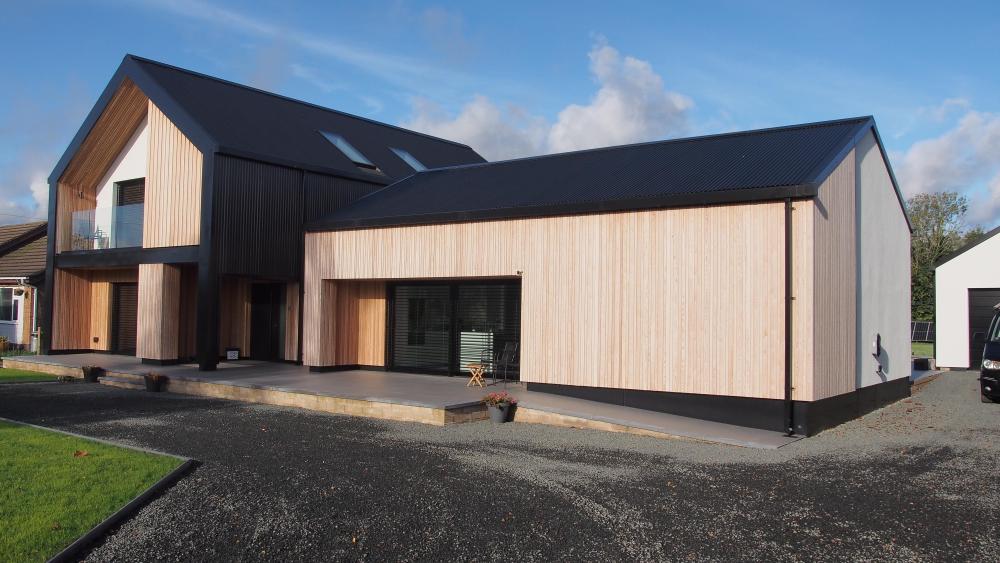
Overhangs are great - in the summer months, the sun is too high to give much solar gain and in the winter months you get the solar gain. Add external blinds and you can control the solar gain. We've found that with the blinds level, then they start to stop the sunlight at around the now, the spring equinox and start to let it in again at the autumn equinox. See attached image. All the south facing rooms on the front have external blinds. More photos here -> https://lhc.net/projects/ashcroft-creating-a-low-energy-family-home/ Personally, I'd try to future proof by having a master bedroom + en-suite downstairs and forget the lift idea.
-
The only gotcha could be the time limits for sending the commencement notice and the final Part 2. It all seems to be an excessively complicated and onerous process BUT if you make sure that the forms are submitted on time, then everything should be OK. And it doesn't matter what is being built, this is all about the fact that a new dwelling is being built and for each new dwelling there is a levy for infrastructure. AFAIK, some councils have a lower threshold for the number of dwellings where the CIL is applied. So in some cases, if a developer is building less than say 5 or 10, then the CIL isn't applicable. Sounds like you, like us, are in an area where every development has CIL applied and then self builders like yourself have to get the exemption. The process is overly complicated but easy to follow - just remember to do it! Simon



