


Bramco
-
Posts
796 -
Joined
-
Last visited
-
Days Won
1
Everything posted by Bramco
-
The open energy monitor guys do a kit -> https://shop.openenergymonitor.com/level-3-heat-pump-monitoring-bundle-emonhp/ And they have a site showing the data from people who have installed the kit and made their data public -> https://heatpumpmonitor.org/
-
ASHP stopped working. What's possibly the problem?
Bramco replied to Marvin's topic in Air Source Heat Pumps (ASHP)
I'd call them and speak to Dave. Hope you get sorted as their support is return to base and test in Grimsby until it fails again !!!!! -
Any ideas what is happening with my PV array
Bramco replied to Omnibuswoman's topic in Photovoltaics (PV)
And if you don't fancy making something, try open energy monitor - they do a great bit of kit with up to 6 sensors that can be used to monitor the whole house and several appliance circuits as well as up to 6 temperature sensors -> https://openenergymonitor.org/ Their systems are all open source, based in Wales and doesn't rely on any cloud servers if you connect up to a local system. More data than you can shake a stick at as well of plenty of graphing options and apps to waste hours and hours of time on. -
How prevalent is unethical and/or corrupt behavior in planning?
Bramco replied to Alan Ambrose's topic in Planning Permission
In our case, they both were ignorant of the actual legislation - or maybe they were pandering to the 'oooohhh, it's Green Belt, you can't build there!!' mob. But the legislation of course says otherwise for 5 specific cases of application. They should have been cognisant of this and directed the ctte appropriately, as our case, as the appeal proved met one of the criteria. -
Any ideas what is happening with my PV array
Bramco replied to Omnibuswoman's topic in Photovoltaics (PV)
Solcast can also be useful for getting forecasts as well as I think for historical data -> https://www.solcast.com/ We use it for a dashboard done with the nodered ui tool - borrowed from another source And I know I need to fix it so the sidebar doesn't show.....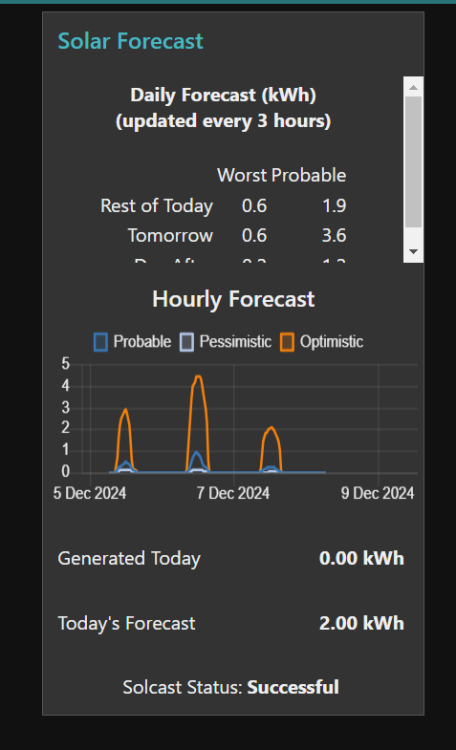
-
How prevalent is unethical and/or corrupt behavior in planning?
Bramco replied to Alan Ambrose's topic in Planning Permission
We did several times. And on our application spoke for the 3 minutes - which landed on deaf ears. The councillors were completely ignorant of the actual legislation for building in the Green Belt and got it totally wrong, as had planning in their advice to the committee. We took it to appeal and won - the appeal effectively said - 'you're numpties, the application is obviously within the specific clause for the Green Belt of 'infill within a village'. The whole thing was quite stressful. Given the borough has a lot of Green Belt, you would have expected planning in their advice to the ctte and the ctte to know what they are doing. -
How prevalent is unethical and/or corrupt behavior in planning?
Bramco replied to Alan Ambrose's topic in Planning Permission
Agreed - which is why we did one! Unfortunately as we were doing it, a builder with options on a plot of land the village would not have prioritized for new housing found a planning department desperate for quick fixes to their housing shortage. So that was accepted into the Borough LPPt2 as allocated and therefore something we had to accept. A great way of saving land that locals don't think should be allocated, is to designate them as 'local green space' in the neighbourhood plan. This in effect makes planning apply the criteria for Green Belt to any decision. Our plan prioritised a number of small plots which added up to about the same as the large plot the Borough allocated. More than 5 years on, only one of these plots have been built on - a brown field site in the middle of the village - the old British Legion site. The large plot allocated by the Borough has only had some preliminary work done. -
How prevalent is unethical and/or corrupt behavior in planning?
Bramco replied to Alan Ambrose's topic in Planning Permission
My understanding is that a Parish Council's view are treated as if they are a comment by a member of the public. And unless they actually bring up specific planning issues, then they are ignored, as are those from members of the public. Sensible Parish Councils won't object to applications unless there is a valid planning legislation point to be made. But there are a lot of NIMBYS around in Parish Councils..... -
Think this was what we did too - if I remember correctly, some inverters have this capability some don't, so you have to choose carefully. The info is on the database, so just download the relevant doc. There are devices that to the limitation separately but ideally you'd have the inverter do it.
-
Any ideas what is happening with my PV array
Bramco replied to Omnibuswoman's topic in Photovoltaics (PV)
At a guess, the spike is maybe what it should be generating and there's a fault somewhere in the wiring which means it only comes through sometimes? I'm assuming the 2 arrays are on separate strings into the inverter? If so, you could try switching the arrays on the inverter - be careful to isolate the DC before you do. This would tell you if there is a fault in the inverter (which would seem unlikely) or in the wiring to the array. Did you do the wiring yourself? If so, it's worth checking each connector to make sure that the connectors are properly clicked into the outside housing. If they aren't, then making a joint can push the connector bit out of the housing causing a fault. EDIT - of course, the spike will be when you came back and slammed the front door in frustration - causing a tremor to run through the house and make the faulty connection work for a bit. -
True - and you'd need a helluva'n inverter for this but it's worth knowing what typical usage would be, so adding up the ASHP, base load etc. and also getting into the habit, if you can, of only using high usage appliances serially rather than all together. That way, it will only occasionally mean that you are drawing power from the grid at the expensive rates.
-
It depends - as with many things.... Your base load will be between 250W and 500W depending on the time of day - more lights on more base load. There are many people on the forum that have their base load down to very small levels by disconnecting all wall warts etc. But let's say you're a typical family, so between 250W and 500W. The ASHP will draw it's 4kW continuously unless it's doing a defrost, when for a short period, it will draw a lot less. Your oven will draw about 3kW until it's up to heat - 5 to 10 mins? Then will turn on and off at 3kW when it needs more heat. Induction hobs tend to turn on and off repeatedly - more often on a higher setting. So assuming everything is on, that's at least 500W + 4kW + 3kW + 3kW as a maximum - 10.5kW but only 4.5kW is continuous. 2 x 3kW is on and off. If you have let's say a 4.5kW inverter, then each of those 3kW has to come from the grid, so at the expensive rate as it's during the day. And we've not taken into account the dishwasher, washing machine and EV charging.... If this is the case and I'm not sure it is, it could be because the maximum PV you can install without contacting the DNO is just less than 4kW, so a smaller inverter would match that. However, if you have a battery system sized for your typical consumption, in our case 15kW, then a larger inverter makes sense and means we almost never take peak priced energy, it's all at the 7p Oct Int Go rate, because we load the batteries at night and our solar does the rest. As for most appliances drawing a peak for a short time, this is true for washing machines and dishwashers but not for ovens and induction hobs and EV chargers and ASHPs draw at the peak rate all the time. And even dishwashers and washing machines can draw 3kW for 5 or 10 minutes as they heat the water. Hopefully your experts will be expert.... What's right will depend on the appliances you have, how often they are used, what your base load is and also, what you want to get out of this. Do you effectively want to only use cheap rate electricity, or is the plan to reduce as much as you can your use of higher rate at a reasonable rate of return for the investment. EDIT PS - the power output of your ASHP is the higher figure, the electricity usage is the lower figure
-
Timber Frame with no blockwork - any downsides?
Bramco replied to North Coast Self Builder's topic in Timber Frame
We had no issues with our mainly corrugated metal roof and cladding timber frame. Also partly timber and render clad. Although we didn't need a mortgage for the build or now. Our insurers weren't interested but put us on to Gallaghers who found an underwriter for us. Bit more expensive but not much. Timber frame is great for getting the frame up, windows in and watertight. If we ever built again we'd go this route. -
Too late to do an edit...... @Archer - you were the OP I think - and I know you said my post was useful, so please take note of the above second thoughts......
-
Rob, I need to go back and edit my post - I was thinking about this yesterday and actually, I'm pretty sure, the real reason for having a larger inverter is if you have more PV than the 3.7kWp (or whatever the number is that you can install without having to talk to the DNO), then you need a larger inverter because they top out at their maximum rating. The usage thing isn't actually that important - especially if you can get the other half to work serially rather than having everything on at once. We have a 5kW Sunsynk and a 6.5kW ground mounted array - in the summer, the Sunsynk tops out at around 5.4kW, so we lose some PV. Not a lot in our case, as the array is at 45deg, to give us lower summer output and higher winter output. We had a standard inverter on the array before we installed the batteries and this was larger and didn't top out. So I should have written above that it depends on your PV array - apologies to anyone I've misled on that - I'll go back and edit the previous post.
-
Ah yes - I remember this now... Getting old, memory not what it was. Doesn't work for DIY installs though, you have to have a supplier do the install to reclaim the VAT - or, I guess, have a friendly sparky that will do the paperwork for you.
-
Check out the price on ITS Technologies - £690 + VAT. It pays to shop around....
-
Friends found one of those - he managed to set things up so that they never seemed to use any Solar and the battery never discharged - not sure how he managed to do that. DIY is pretty simple if you are competent and trust yourself - and AFAIK, doesn't need a sparkies sign off, if everything is connected to an existing properly rated spur that has been signed off. Someone will be along in a bit to either confirm this or tell me I'm wrong. The Sunsynk inverter above, may not be man enough for many homes, ideally you want one that can supply enough power for a couple of big white goods needs, so something closer to 6kW. Also, look at the Sunsynk batteries. The last time I checked these were cheaper than Frogstar. And in terms of battery sizing, you need to match the amount you might need to cover at the higher rates, if you're installation isn't big enough, you'll still be using expensive electricity. There are a couple of other good sites TradeSparky and ITS Technologies with products from many suppliers. We bought and installed a Sunsynk 5kW hybrid inverter and 3 5kWh batteries from ITS for £5k inc VAT. Works very well for us with the 6.5kW Solar array. Loading everything at night on the 6 hours of Int. Octopus Go, means we very rarely use any full price electricity, it's all at the 7p night rate. One thing to think about, is that Solar installs can be zero rated VAT, if done by a sparky (not sure if it has to be an MCS sparky). So you could 'install' 1 panel and get the VAT back on the whole installation. Also, not many systems can cover you during a power outage - Telsa and some others can - if this is important, then make sure you've checked this.
-
Take a look at the specs for either the Shelly device above, or the Sonoff mini. It's very simple, from memory, you take the power and switched live from the wall switch, put them on the wifi switch and take leads from the wifi switch to the wall switch live and switched live (and maybe a neutral). Once you switch the circuit back on at the CU, you can search for the new device in the app. Also, Sonoff do versions for Zigbee as well as wifi - I think zigbee has a better range and is less susceptible to a poor signal. I might be wrong there. If you do go Zigbee, you'd need a Zigbee to wifi bridge to get the devices visible on wifi. Buy one and have a play... they're very cheap. EDIT - if you can wait, go on a Chinese site, they are cheaper there than Amazon. And there's black Friday deals around at the moment.
-
Or the Shelly or Sonoff app, or Google Home or Alexa if you have integrated them into those environments. There are many ways to do this. But it is great that you can simply drop these into the light switch back box, connect up and then either use the switch, or have a command or automation turn them on and off. Don't think they'll fit in the really shallow back boxes though. But with them, if you can extract the back box, the wiring can be passed through one of the holes in the back box, so that the wifi switch sits outside the back box in the cavity. Probably not allowed in the regs mind you but it works. We have a couple in our garage on a double switch, I've added another back box alongside the normal switches to site the wifi switches and put a blanking plate over that.
-
Ditto - and if you just want to turn lights on and off etc., then they can be included in Google Home (or I guess Alexa) and then simple things like turning some lights on at dusk and off on a command are v easy to do without having to get into Home Automation which is pretty techy by comparison. The only mistake I made was to create an command/automation 'OK Google good morning' which turns on a light, says 'where's my tea' on the Google speaker in the main room and starts to play radio 4 on the speaker in the main bedroom. (I get up earlier than my wife). So it's a bit like those bell systems in old country houses, to summon the butler... I should never have done it as a demo of what automations can do......
-
3 bathrooms + guest WC - how much and from where?
Bramco replied to Indy's topic in Bathrooms, Ensuites & Wetrooms
They would say that wouldn't they...... Should be quite easy to price up 1 of the bathrooms according to their spec using the interweb and check out the quote. Use the simplest for speed. We used our builder and his tiler and plumbers to do the bathrooms - worked out very well. We did client supply on all the fittings and tiles, with the exception of the wet room sealing and traps which were specced by the architect. We have 2 en-suites (1 with a £1k egg shaped bath), one family bathroom, with shower over a bath and 1 wc. Sanitaryware was £9500 ex. Tiling is a bit difficult to strip out as the floor tiles were part of the flooring we used throughout. Wall tiles for 1 of the en-suites and the family bathroom was about £500. So let's say £11.5k for the client supply items, that's without of course the labour provided by the builder's subbies. That was 2.5 years ago. EDIT - should add that it's all wall hung loos, top of the range taps, showers etc. from Hansgrohe, Geberit etc. PS - if Brexit hadn't happened, we could have bought everything from Germany for about 30% less than we actually had to pay - don't believe it, check it out for yourself, I did because we'd bought from German outlets before.. :-((((( -
MVHR Options
Bramco replied to Johnnyire's topic in Mechanical Ventilation with Heat Recovery (MVHR)
We have zehnder - it was professionally installed. But having seen the guys do it, it's something someone with DIY skills could do. We didn't bother with a manual boost, we use the auto boost feature which boosts soon after someone starts a shower and clears the steam within a few minutes. One of our bathrooms doesn't have any opening windows, the others have roof lights. The one without opening windows takes longer to clear than the ones with roof lights (assuming of course you've cracked open the roof light a bit). We installed the interweb gizmo, but never use the app, the unit just does it's thing 24/7/365 and occasionally asks for new filters. I guess on reflection, having the interweb gizmo and the app is useful, in that you get a notification a few days before the filters need changing. -
I wonder how many of these there are..... Maybe we need a new section for folks to upload their manuals (duly redacted) so that other folks can glean useful help/ideas, re headings, cross referencing etc. Even whole sections could be plagiarized, for example one on Sunamps...
-
There's been quite a bit on here about 3 phase smart meters being a pain to get hold of and (iirc) being difficult to re connection to the suppliers. Given a new build will have 3 phase to the meter box, you can have a single phase meter connected for the supply and then at a later date trade up to a 3 phase if needed.


