Adsibob
-
Posts
3609 -
Joined
-
Last visited
-
Days Won
10
Everything posted by Adsibob
-
Returning to the point of @Russdl’s original thread, I wonder Russdl if the issue is that you have an enthalpy exchanger when you don’t need one. This article, suggest you don’t, assuming you live in the UK of course: “The average relative humidity in the UK is between lows of 70% and highs of 90% which is considered high, suggesting humidity recovery is not that big an issue in the UK” https://cvcsystems.co.uk/relative-humidity/ Maybe the solution is to swap out the enthalpy exchanger for a regular one.
-
Thanks. The wood has been in the house for about 3 weeks already, albeit it is still in its polythene and cardboard wrapping. Why should humidity be lower for installing a bonded floor? Is the concern that if it is too high the bonding won’t glue properly? I will increase the UFH temp if i can persuade the builder to. I mentioned it to the foreman, but he wasn’t keen. I guess his boss is liable if it causes the screed to crack, so they must be being risk averse.
-

Seeking FD30 Doors in traditional designs
Adsibob replied to Paene Finitur's topic in Doors & Door Frames
But I don’t think that matters. The door will still prevent a fire from passing through it for 30 mins, even if the glazing bar on the side of the fire burns quickly. -
Seeking FD30 Doors in traditional designs
Adsibob replied to Paene Finitur's topic in Doors & Door Frames
Following with interest. I’m finding the same issue, and unless one goes bespoke, I’m finding the only way is to purchase a FD30 which is sufficiently similar that it could be added to to make it look like the style you are going for. So in your case you could buy a plain door with a light in it, then add the four glazing bars onto the door. Not ideal, but i haven’t found any manufacturers doing this, other than an American based outfit, which does not comply to the same FD regs as the UK. -
The manufacturer will just say the floor had to be dry. So not really that helpful.
-
I'm now getting nervous about installing our oak herringbone floor, which the manufacturer has recommended should be glued directly to the screed. Screed was poured precisely three months ago. Where it is being covered in oak, it is about 80mm deep, so probably won't have fully cured for another 20 or so days. I think my builder is planning to wait until then, but won't wait any longer. UFH has been on low over the past 3 weeks so I'm hoping that will help. Perhaps I should turn it up a couple of degrees.
-
The irony is that all my Tado thermostats (of which I have 10) have a hygrometer built into them. We're just not quite ready to install them, as was going to wait until after painting. I guess I could install a couple temporarily. The beauty of that is that once I have internet in (in about 3 weeks) I'll be able to monitor humidity and temperature remotely.
-
I'm sure its quite damp as the cardboard on a a box of tiles that had been on the floor for a couple of weeks was almost soggy when I picked it up the other day to return it. Lucky Topps Tiles are so good about returns. But curiosity as to the level of humidity and whether it is improving during this humid period has got the better of me so I will buy one or two. Probably quite usseful for monitoring living conditions once we move in. Any recommendations for a humidity sensor. Amazon seem to have too many to choose from: https://www.amazon.co.uk/s?k=humidity+meter&sprefix=humidity%2Caps%2C72&ref=nb_sb_ss_ts-doa-p_1_8
-
Did you have my house per chance?
-
A more accurate title for this post would be: Is there a place for a dehumidifier in every building project that involves large quantities of water, used on site in the construction process, whether it be in cement, plaster, screed, adhesive, grout or other substances? In this post, @LA3222 made the point that on a relatively recently built passive house that given the amount of water used to build a house, a dehumidifier should be used as a matter of course. What is standard practice with this? We have a combination of old walls and newly built extension (bricks and (wet) mortar) and a new loft conversion (which was all timber and tile, so not really any water). But we also had about 86m2 of concrete slab poured and about 86m2 of a 70mm to 80mm screed poured. We then re-plastered the whole five bedroom house and are now tiling three bathrooms. So there must be a lot of moisture in the fabric of the building, albeit the slab was laid some 6 months ago and the screed was laid exactly 3 months ago. There is still some tiling and some plastering to go, but otherwise we are pretty done with water (albeit we haven't painted yet and that must contain a fair bit of water). I think there are two schools of thought on whether to speed up the natural drying/curing processes: On the one hand, dehumidifiers will speed the drying process up which is good. On the other hand, if a chemical process is rushed, it can lead to unforeseen consequences. Thoughts?
-
Well that's reassuring. I think that given your MVHR machine is just on factory settings, if you were to get a professional commission, it would probably fix things for you. Maybe they just need to install those variable terminals that allow you to have different flow rates in different rooms, and then they can play around with it to get a more optimal flow rate in the rooms in question. They could hopefully also check your machine is working properly.
-
Maybe take a marble and put it in each duct at the MVHR room, one duct at a time, and see where the marble goes (assuming the ducts all go down from the MVHR room (which applies to most of my ducts, but may not apply to yours) just to make sure the ducts are going where you think they are. For the ones that go upwards, i guess you put the marble at the other end, or throw up a tennis ball? Alternatively, a very long pipe cleaner.
- 131 replies
-
- 1
-

-
- triple glazing
- condensation
- (and 3 more)
-
I'm not sure it works like that. Take these examples from the NCBI website: When outdoor air at a temperature of −8 °C and 100% relative humidity, which is usually very high in winter (point A in Figure 2), is brought to an indoor temperature of 20 °C, its relative humidity decreases to 15%. Thus, cold outdoor air used in ventilation is effective in carrying moisture from indoors. When air at a temperature of 15 °C and an absolute humidity of 5.5 g of water in 1 kg of dry air (corresponding to a relative humidity of 50%) is heated to a temperature of 18 °C, its relative humidity decreases to 40%. Thus, heating can help to prevent high relative humidity. When air at a temperature of 20 °C and a relative humidity of 58% (point B in Figure 2) is cooled to 15 °C, its relative humidity increases to 75%; when the temperature is decreased to 11 °C, the relative humidity reaches 100%. Water condenses on surfaces at such temperatures. Thus, when the temperature in houses decreases locally (e.g. at window panes, unheated sections of the house or poorly insulated walls), the relative humidity rises and accelerates microbial growth. I wonder if you have cold spots in your heating in the locality of where your humidity is
-
I wonder if there is a fault with your MVHR machine, as increased ventilation should really remove moisture from the air, not add it.
-
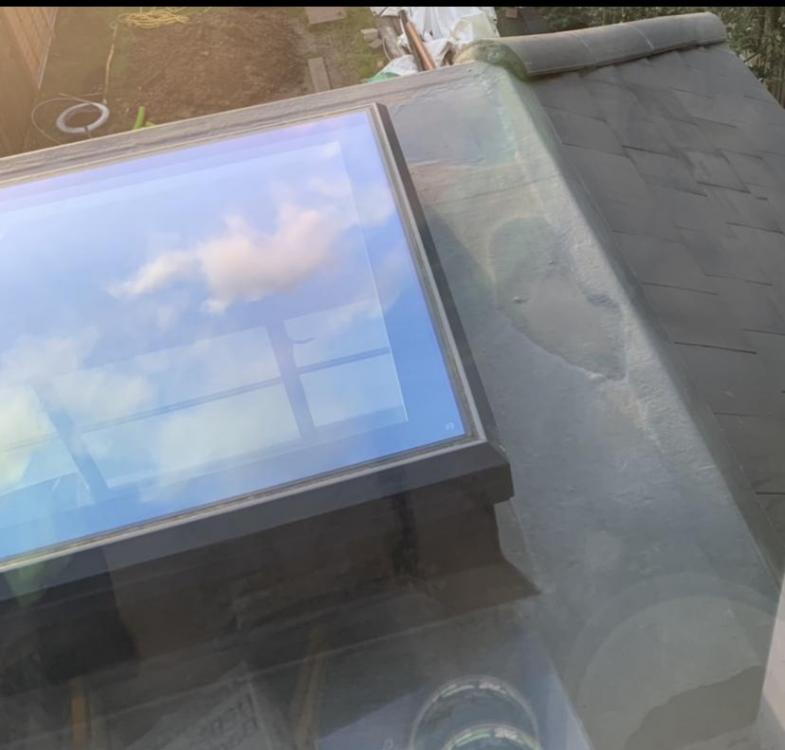
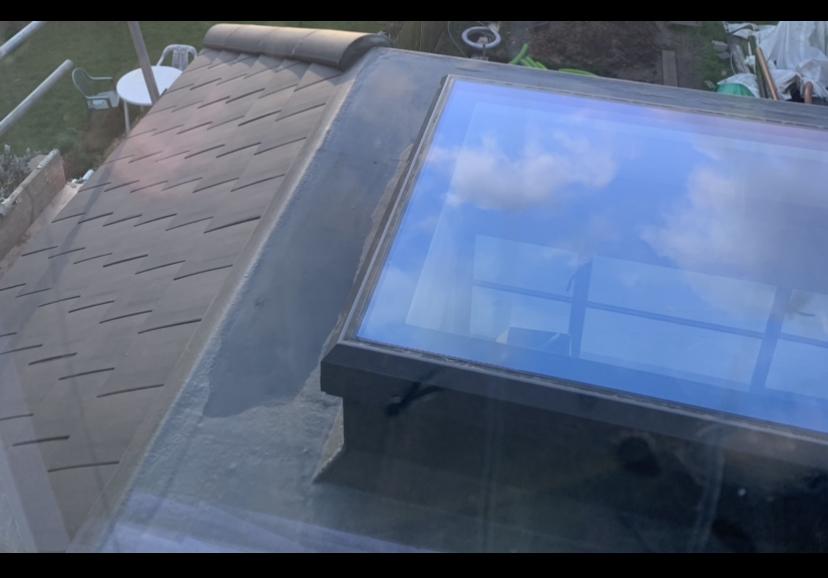
I discovered a very similar issue on my new first floor extension flat roof. The GRP was probably applied 2 or 3 months ago. It never occurred to me to check this ad the builder is really experienced and in the whole had been very thorough and careful (to the point that I get frustrated that things take longer than I would like). But we have pooling! The photos show either side of the rooflight: on the left of the roof light there is quite a large puddle that is about 1m in length and 20cm or 25cm in width. On the right of the rooflight, there is a much smaller puddle, maybe 15cm by 20cm. What concerned me was that these photos were taken yesterday afternoon at about 3:15pm, after a full day of sunshine (albeit the puddles would only have been in the sun for maybe 3hrs as this roof is on the west of the house and shaded by the second floor loft conversion before midday. So I sent them to a RICS surveyor who specified some other parts of the build (though not the roof, so he is independent ) and his view was that there was nothing to worry about in terms of leaks. He mentioned that this puddling can cause moss to grow which can then dislodge and block gutters, but I am trying to view it positively as just another trainee to get gutters cleaned once a year. Our build still isn’t finished, so I will raise it with my builder, but I suspect he won’t accept there are any issues. It’s a brand new GRP roof, so it should be pretty impermeable… I hope!
-
When to commission the MVHR
Adsibob replied to Adsibob's topic in Mechanical Ventilation with Heat Recovery (MVHR)
Hmmm, maybe I should hire some fans and ventilate that way. Annoyingly, builders are too cold to keep the door open… -
We have almost finished plastering. Of the three floors, two are mostly done and the ground floor is half done. We won't be able to finish the ground floor for another few weeks. I'm keen to get the MVHR going soon, as the place could do with better ventilation. My understanding is that the risk of switching the machine on before the house is dust free is that all the pipes and the machine itself will get dirty with dust. If I were to clean the rooms which are dust free, and keep the ducts closed on all the other rooms, could i just run the MVHR in the clean rooms until the others are clean?
-
Very helpful, thanks. Looking at what to purchase, the options available vary in the amount of “gain”, ranging from 0dB to 11dB of gain. E.G.: https://www.screwfix.com/c/electrical-lighting/splitters/cat4740084
-
What does your home cinema look like?
Adsibob replied to Adsibob's topic in Networks, AV, Security & Automation
+1. (This is the neighbour that objected to my planning application 4 times and lied in their objections.) -
Thanks, that’s helpful. So splitting Coax only dilutes signal if both are being used at the same time? If that’s the case, that is a good solution as I think the chances of both TVs being on AND both watching terrestrial is minimal.
-
Thanks. Just to clarify, we wouldn’t have surface cabling, not after the money we have spent on this money pit! It needs to look good! There are floor standing built in cabinets on either side of the chimney breast, so whatever we do, as long as we can recess in skirting board it will be hidden. I was just trying to work out what the options were. One solution would be to drill through the chimney breast, but I would need to make quite a deep hole. Either side. Not sure how easy that is.
-
What does your home cinema look like?
Adsibob replied to Adsibob's topic in Networks, AV, Security & Automation
Good point. Although we have spent a crazy amount of money building a false wall between us and our semi detached neighbours. The party wall was so thin and they are so deaf that I could tell you their exact TV preferences to the minute. They have the TV on all day every day and watch the same soaps and news programmes like clockwork. They spent the first 9 months of our build complaining about noise. Since the false wall made with I studs and SBx board has gone up, no more complaints from them. I looking forward to a house free of Eastenders. I used to love the programme as a kid, but now I have more refined background music taste. The sound insulation between our tv room and my daughter's bedroom above is not quite so good though!? -
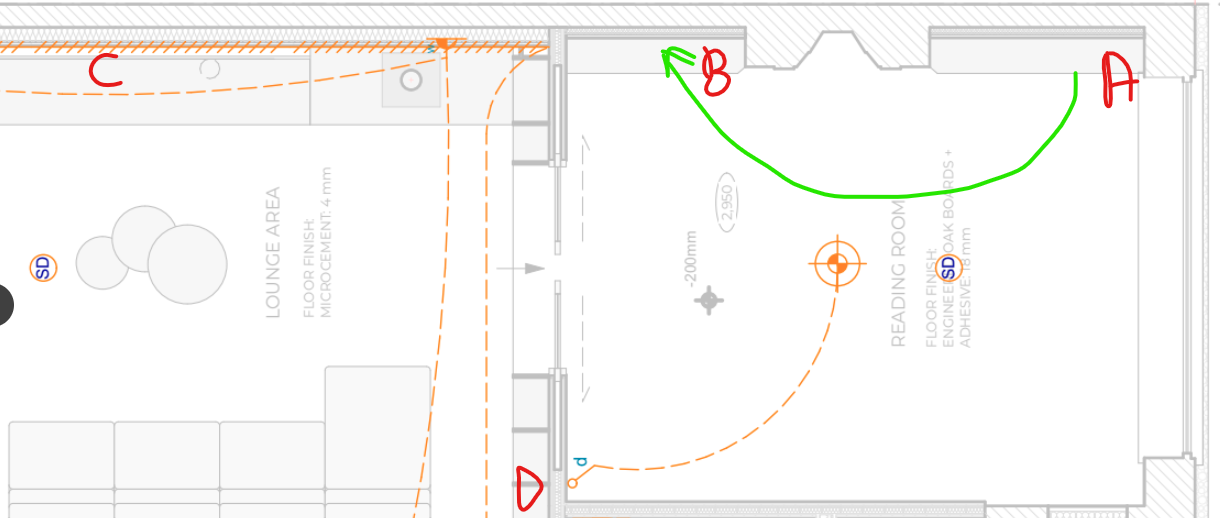
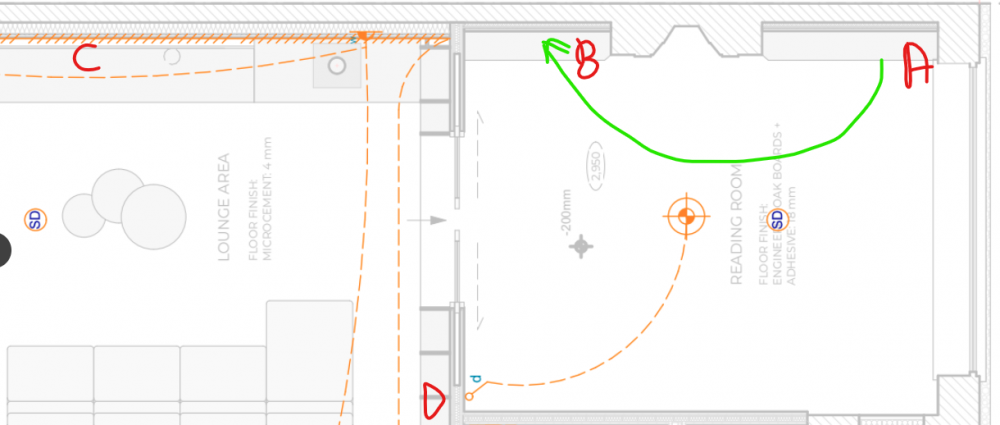
Below plan is my ground floor, showing the front room on the right and an open plan area on the left. We are post first fix, and they have just plastered the front room. Second fix of that room starts next week. The problem is that we never properly thought through our sofa and TV arrangement in that room, and I'm coming to the conclusion that we probably need to move the TV aerial point and ethernet socket from position A to to position B, as shown by the green arrow. Both cables are buried in the wall, with the plan being that they will cut through the plaster and fish them out to do the second fix. Location A is also where the router is going to be, and from that we were going to install a splitter to serve various ethernet cables going to different locations in the house. Although the router has not been installed yet, so presumably when Virgin Media come in a couple of weeks we could ask them to put it elsewhere, though we would still need to get a connection from the router to the splitter which I think will have to stay in position A as otherwise all the ethernet cables in the house will need to be moved, which is not possible. We also have: a second tv and second ethernet point at position C and a third ethernet point at position D The room on the left has not been plastered yet and in fact the wall either side of the sliding pocket doors on the left side is still open/unboarded. Options as I see it to get an aerial and ethernet point at position B are Fish out both cables from A, extend them by about 12m so that they can be concealed in a recess behind skirting board (which has not yet been purchased, so we could get the skirting board that has the recess already routed) and go all along the perimenter of the room (because we can't go across the fire place without drilling through it, although maybe that is an option?) then go over the sliding door and back down into the B corner. Leave the services at A alone and try to split the cables serving C so that they also serve B - not sure what this would do to the aerial signal as presumably splitting it weakens it, or whether one can split an ethernet cable into two with a splitter - I thought splitters only worked if they are plugged directly into the router). Run the cables from A to B in front of the fireplace (which is only decorative) and cover them up with the floor tiles that are being laid as a decorative hearth there, but I'm not really sure this is an option as we will end up seeing some cable as the area to be traversed is wider than the hearth (which only occupies What a mess.
-
Have a look at Mandarin Stone and Domus. Neither are cheap, but Mandarin Stone has a few ranges which are reasonable. Domus is very expensive. If not, Claybrook might do marble tiles as well, not sure. The other (much smaller) company I know which do Marble is Robel, in Stoke Newington. Although London based they will post samples nationwide. But the marble samples I got from them were turkish, not italian. They did however have a beautiful pink tumbled marble that was reasonably priced.
-
So does marble behave differently to Terrazo? I guess that would make sense given marble is a stone, whereas terrazo is made from portland cement. With marble, if you seal the underside before laying it, how does the moisture in the adhesive dry/evaporate?