


Adsibob
-
Posts
3609 -
Joined
-
Last visited
-
Days Won
10
Everything posted by Adsibob
-
 For most rooms in our house, we're just going to have painted window cills internally. If I can still afford to get something better, I want to stay clear of MD. What is the next step up? Pine? If so, what's the disadvantage of a softwood such as pine in this situation? Would i be better going for something harder like tulipwood? Can anyone recommend any good value suppliers?
 -
Yeah, I'm a little gutted because I assumed that being a semi detached we would never get permission to knock it down. About 6 months after we started our refurb, a house on our road, maybe 20 houses down (also a semi) was knocked down and they are now starting to rebuild something in its place. Should have done that.
-
Wow, that’s impressive. i really should have just knocked down my 1930s semi and started from scratch. Would have been quicker!
-
Thanks. I’m doing this on the wall though, not floor.
-
We are laying bejmat tiles (oven baked clay unglazed morroccan tiles - ie the unglazed version of a Zellige). The installation instructions (below) state that because the gaps between the tiles are so tiny, we should use a “very runny flexible liquid grout”. can anybody point me to a product that I could get in a terracotta colour? https://www.ottotiles.co.uk/how-to-installation-guides/moroccan-zellige-and-bejmat-tiles-installation-tips/
-
You could also do it in cement board and then cover it with microcement in your choice of colour and texture. Gives a joint-less finish and probably cheaper than buying a piece of slab. Have a look at Topcret, (other suppliers are available).
-
We are incredibly similar!
-
Largely agree with this. Not quite blackmail, but morally pretty poor performance by him.
-
Just to clarify, it is not the builder’s fault. Builder asked architect what height we wanted everything, architect told him specifically to set the carcass legs so top of units is 856, so that when 30mm worktop gets installed top of worktop is 886. We’ve ended up with 887, so builder was out by 1mm lol. Most builders don’t take well to such accurate specs, but mine luckily takes it in his stride. I’m really over it. It was a mistake, time to move on. As many here have said, we won’t notice after living in the place for a bit. Agree ergonomics is important, but only really for chopping, and for that I can cure the mistake with an extra fat chopping board. The island is really big, significantly bigger than our L, so we will do most kitchen work there anyway.
-
Yes, I was worried about this. Is that because the grout line will be so weak it will just fall out? Are there any specialist resins which might work? What do “magic men” use to fill tiny cracks, for example?
-
if it cracks, the lead time for replacement slab is 5 - 8 weeks. Just not worth the hassle or the delay. He is basically on site 3-4 hours a day, 3 days a week, coordinating the interior fit out. We still have at least 4-6 weeks to go. I need him onside more than I need that additional 14mm. I will get him to buy me some fancy chopping boards.
-
Why would I have that when there is MVHR with an integrated humidity sensor.
-
The architect actually wrote me a message saying he would pay for it. But he also made it clear that this would spoil our relationship and he wouldn’t be going the extra miles to finish the other project management tasks that he had taken on for me. And he is generally a really nice guy, who on the whole has been very good. So, together with all the comments here, I realised I was in OCD madness. I hadn’t even noticed the first time I saw the worktop. It was only my wife that noticed and even she said it wouldn’t bother her (because she is shorter than me but at least 10cm) but she just wondered whether it would bother me. The reality is that 1) my builder has reassured me that he has enough men on site at the moment that they can easily raise the island to whatever height I want and that he’s not going to charge anything extra for it because “it’s such an easy job”; 2) for the L shape, it really just isn’t worth the risk of cracking it and spending a couple of hundred £ in refitting costs just so that I can chop veg with our existing flimsy chopping boards when I can just get one of those fat wooden ones I’ve always wanted. 3) as for the potential mismatch between the island and the L, we are lucky to have quite big gaps between the two, so I think a 25mm discrepancy really won’t be noticeable. And when I do notice it, I will remind myself to stop being such an OCD perfectionist and enjoy my life instead.
-
So it turns out the gap is only 2mm deep and probably even thinner than I thought. Probably just another example of me worrying excessively.
-
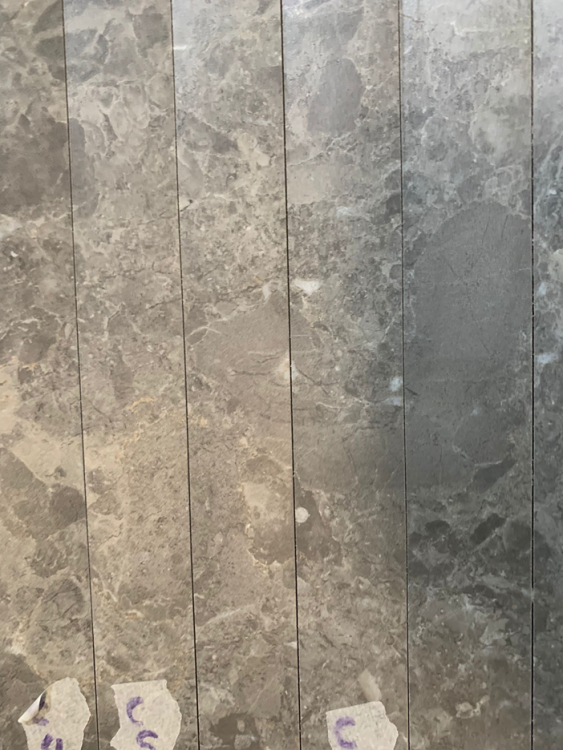
I'm trying to work out if the following could give rise to mould. We are tiling a wet room. The substrate has been tanked and we are installing a series of 6mm thick porcelain tiles on a curved wall, in long narrow strips. The strips are 40mm wide and very long (about 60mm long). Photo below. You can't tell from this photo but each strip is exactly the same width, the visual distortion in widths is because each is on a slightly different plane to the next one so that after 13 or strips the wall curves through 90 degrees. I wasn't expecting the tiles to be so close together. In my head, when we were considering this design i assumed grout would go in between the strips and that whilst that would break up the pattern of the stone a bit, as long as we kept the grout lines thin, say 1.5mm or 2mm, one would still be able to appreciate the pattern. But when the tiler put this in, for some reason that didn't happen, so this part of the shower area will be groutless, with tiny gaps between each strip of tile that is probably just under a 1mm wide and no more than 6mm deep. I queried it with both my builder and my architect (who designed this) and they both said that there is such little room for water in there, that I shouldn't worry. They also mentioned that with MVHR and external wall insulation (only single brick solid wall, but recently upgraded with a 45mm external wall insulation system) mould just won't be an issue. Are they right? What about mould on niches in showers? We were going to have a slight fall in a niche, but it's going to make the tiling much harder. Much easier if the niche is flat, but would that attract mould?
-
I’m not really sure what to do. If it had been installed at 900 I wouldn’t be able to quibble it because although that is still a bit low, it’s a “standard” height. I’m just annoyed, because looking back at my text exchanges I did actually query (before the work top was installed) whether there was enough space at the island for my knees to get under when sitting on a stool, and the architect did tell me that it would come out where it has, but assured me standard was anything between “about 850 to 900”. So I accepted that assurance. If he had said Standard is 900 to 940 but we are doing 887, I just wouldn’t have accepted it.
-
I’m 186cm and my wife is about 174cm. Weirdly she spotted the height issue not me. just had a meeting on site. The issue preventing a simple fix is the 30mm Caesarstone worktop is already partly installed. Almost fully installed; all the stone fitter has left to do is seal the edges to the walls and then install some upstand on part of it. The stone fitter would charge me to come back and uninstall and then reinstall, but it’s not expensive relative to the overall cost, and architect has offered to pay for it, even though he insists he’s done nothing wrong and that I was aware of the height of the worktop. The issue is the stone guy can’t guarantee the stone won’t get damaged andi don’t think the architect is offering to pay for new stone if it does. The stone fitter has done the seams between joins really nicely and he said that given everything fits nice and tight, there is a risk of damage if he has to lift it out. He suggested lifting everything (ie including the units) from underneath, but the lads on site (who fitted the kitchen to my architect’s instructions) say this is not possible because the units are attached to the wall and the only way to detach some of them is to lift the stone first. The island is easier to solve as it’s not attached to any wall and doesn’t have any seams in it. Architect is saying the overall height is fine and I’m quibbling about a non issue. He says he has designed kitchen restaurants where the worktops are even lower at 860, and that standard height is 850 to 900.He also says one solution would be to leave our L shape as is and just raise the island, but I wonder whether that would look odd. He says it would look fine because the island is completely separate. Maybe he is right, maybe he is just pushing me towards the path of least resistance.
-
The appliances are already in, and all fit (our laundry appliances are going in the utility).
-
You are a very loving son. Hope she’s ok.
-
I wasn’t able to be on site this week when the kitchen was installed. My architect was there and updating me with various calls and messages consulting me on various things. He stayed on site for a full 3 days to supervise as well as other things going on. He didn’t however consult me on the height of the worktop. I always thought these were standard at 900 or 925 from the floor. We’ve ended up with 887, which is the height he told the fitters to fit. It’s only 13mm less than what I thought was standard, but where we live at the moment is 915 so this is going to be almost 3cm lower. It feels a bit low. Should I insist on redoing everything, or will I get used to it. Upstands haven’t gone in yet so amount of destruction might not be that bad, but I expect it’s at least a couple of days Labour.
-
You could always lay microcement instead. That’s only 3.5mm thick.
-
@nod just refreshing this question in case you have a moment to answer it. We're laying our marble this weekend and I'm getting nervous! The manufacturer doesn't say anything about sealing the back, just says this: "Fast setting adhesives are advisable in order that the moisture disperses quickly from the Stone or Terracotta. This helps to prevent various reactions that could be caused by the moisture retention of the tile."
-
What about cable management. I have a desk in the middle of the room that will need 4 or 5 sockets. I have put in a floor socket near the desk, but that only has 3 sockets plus Cat6, so will need an extension cable with multiplier coming out of there, and some way of making the 4 cables look nice as they come out the floor and up to the desk. I guess there are probably ways of making a cable tidy look less like a cable tidy, but I haven’t found one yet.
-
What are you doing that? (Sorry, I’m not very good at compliance.)
-
Engineered oak over UFH glue or float an which underlay?
Adsibob replied to Barryscotland's topic in Wood & Laminate Flooring
One advantage of gluing is that heat transfer from the UFH to the engineered wood is improved, because there is no air gap. Disadvantage is that if anything goes wrong, it’s harder to take up, but if you plan carefully and do everything by the book you won’t ever need to take it up. Acoustalay do a decent underlay with a built in vapour barrier and overlap. It is only about 3mm thick, but has very good compressive strength: https://www.screwfix.com/p/acoustalay-300-premium-underlay-vapour-barrier-3mm-10m/73764


