


Adsibob
-
Posts
3609 -
Joined
-
Last visited
-
Days Won
10
Everything posted by Adsibob
-

Floor bounce - PosiJoist Floor Vibration checks
Adsibob replied to readiescards's topic in Floor Structures
Yes, well I want no bounce really. And I'm a big guy (100kg) with big stompy feet and my wife always moans about the floors creaking. I've specified 18mm plywood flooring deck instead of chipboard because I thought that would give more rigidity and I thought that was a good thing to pay extra for, but I guess the joists are just as important. I think 400mm centres is overkill though. Surely 450mm or 500mm would be sufficient, particularly with the 18mm ply as the structural floor. -
Floor bounce - PosiJoist Floor Vibration checks
Adsibob replied to readiescards's topic in Floor Structures
This would increase the amount of posi joists required by almost 50% (e.g. a 6m wide space would require 16 instead of 11) which seems like quite a big expense. I have about 120 square metres to cover, very roughly it's a 7.5m by 10m rectangle plus a 7m by 6.5m, so not a small amount of joists. Surely if the manufacturer specifies 600mm centres, then as long as they are installed in accordance with manufacturer's instructions, they will be solid. Or am I being naive? -
Floor bounce - PosiJoist Floor Vibration checks
Adsibob replied to readiescards's topic in Floor Structures
Thanks @Big Jimbo. By upping the spec do you mean laying them at 400 centres rather than 500 or 600, or do you mean going for wider joists, or both? -
Floor bounce - PosiJoist Floor Vibration checks
Adsibob replied to readiescards's topic in Floor Structures
Reading this thread is making me regret switching from regular joists to posi joists in my spec. The only reasons for the switch were various people on this blog praising the ease of installing MVHR ducting through posi joists, but that was when I wasn't expecting my builder to say that he had never worked with posi joists before. Given I will be using mainly 75mm diameter radial ducting, query whether I should just switch back to traditional joists. Won't those be thick enough to withstand 75mm holes? I really hate springy floors and want it to feel rock solid. Maybe I should have done what @joe90 did which i think was go for JJI joists, with those metal frames for hole supports, but that just seemed like extra work and at over £20 plus VAT for the metal hole support, seemed expensive. I just feel like I'm damned if go for Posi joists and damned if I don't. So given builder is more comfortable with regular joists, perhaps reverting to that is the answer. Or maybe the answer is to ensure builder studies the installation detail of posi joists and follows it religiously. He is very capable, so there is no rational reason for me to be worried I think. Is this something a Building Regs officer would monitor, or do i need to do it myself? I would ask my architect, but he hasn't got experience with posi joists either. The SE was obviously familiar with them, but not sure that sort of supervision comes under his remit. I don't think anything has been ordered yet, but it's happening this week, so not much time to decide. -
Flat skylight - reducing solar gain options
Adsibob replied to tanneja's topic in Skylights & Roof Windows
@PeterW thanks for this recommendation. I gave them a call and they have helpfully offered an option for Sunguard SN35/70 glass as well, which isn't too expensive, considering these are 3G. They are also fairly reasonable for structural glazing as well. Just wondered what your experience of their external flat rooflight is. In particular, what were the upstands like and do you have any photos of the installed rooflight from within your house you wouldn't mind sharing? -
I contacted Sun-X and have an answer from them as to why this wouldn't work with a 3G flat rooflight, at least not the ones with a self cleaning coating. They said: "That could be tricky. Applied internally the film wouldn’t help much, as the reflected heat would get trapped in the airspaces. Double glazed would be much more manageable. Externally, it’d cover the self-clean coating, and also, not last particularly long being a flat rooflight, as rainwater will pool on the surface, rather than running off, and soak through & de-laminate the film from the glass."
-
This is a very ambitious extension. I would recommend you consult a planning consultant first. They will advise what is possible and formulate a strategy to achieve it. You would be surprised with the things they can suggest (like applying for some things under planning and other things under PD). They are expensive, but save you money in the long run.
-
Yes, me too. But my concern isn’t so much about blinds made by the manufacturer of the rooflight itself and sold as an optional accessory. I’m more concerned about learning which aftermarket blinds are recommended for flat fixed rooflights.
-
Yes, Velux might be the market leader for this very reason. I would go with them, but they don’t do flat rooflights as big as I need them (about 1000x2000).
-
We hired an architect and he drew plans
Adsibob commented on Thorfun's blog entry in West Sussex Forever Home
@MikeGrahamT21 this is a good tip. Which brand external blinds did you get? I’m looking for ones that will work with a flat rooflight. -
I’m looking to get a 1000mm by 2000mm 3G fixed flat rooflight for our bedroom. Currently tossing up between: A small custom company who can do one for only £620 glasssquad which is about £900 Www.roof-maker.co.uk which is about £1200. I’m slightly concerned that the first option is too good to be true, but I suspect it’s G value is too high.I am almost certainly going to eliminate roof maker on the basis of price, but this is the only company which also supplies compatible blackout blinds. My question is, should this be a factor or is it safe to assume that an aftermarket blackout blind will be just as good. Roof-maker is ££££ and with a blackout blind from them it’s even more. Which companies have people used for aftermarket blackout blinds for flat rooflights and are they 100% blackout or do you get some light coming through the edges? I’m very keen that our blackout blind works really well. I would prefer automated, but will compromise on that as long as blackout is really good.
-
Brill. Thanks @PeterWand @JamesP
-
I’m in the process of designing my MVHR layout and this is definitely something I want to avoid. What are the recommendations for siting inlet and exhaust? How far apart should they be and can they both be in the same side/orientation of the house? @readiescards, did you ever solve this?
-
MVHR newbie.. help needed
Adsibob replied to Savage87's topic in Mechanical Ventilation with Heat Recovery (MVHR)
@vivienz did you ever manage to retrofit the sound proofing? Did it make a difference? Also, out of interest, what MVHR unit do you have? -
I was about to order my rooflights (I’m going for a mix of GlassSquad, Velux and Sunsquare) when I noticed that Velux brought out a new catalogue a couple of days ago. I’ve had a quick flick through it, but can’t see that anything is particularly different. Has anyone noticed any differences or is it just marketing spin? Appreciate this must seem like major FOMO (and it is!) but just want to make sure I haven’t missed something revolutionary.
-
I'm interested in the Robbens Frankishe terminals that @lizzie has, as I think they will work really well with our interior decor in some rooms. I see from their website that these pretty terminals are compatible with the following size radial ducts: I think the difference between those two diameters must be internal and external diameters, but that would mean the duct is between 10mm and 13mm thick. My question is what airflow rate do I need? Or will i need different sizes for different rooms given it depends on the volume of the room it is extracting or supplying from? Maybe it's a silly question, but I note that airflow rate is hardly mentioned when choosing ducting, only when discussing the actual MVHR unit - surely the airflow of the ducts is just as important?

-
Choosing MVHR - energy consumption angle
Adsibob replied to Olf's topic in Mechanical Ventilation with Heat Recovery (MVHR)
Thanks @JamesP, i wasn’t planning on ever turning it off either, hence my question to @joe90. Wanted to see how he manages it. -
Choosing MVHR - energy consumption angle
Adsibob replied to Olf's topic in Mechanical Ventilation with Heat Recovery (MVHR)
This is probably a stupid question, but given the UK is not really a country of binary weather, and much more a spectrum, how do you actually manage your MVHR in practice. Do you ever have days in spring or autumn that are neither hot nor cold and you end up forgetting to switch on your MVHR but also not opening enough windows? If so, do you get condensation on your windows or does condensation only happen when it is so cold outside that it is obvious that it is winter time? -
Not sure if I’m too late for this, but I would be interested in a Brink Flair 400 from CVC but at the price advertised here, not at CVC’s price which is silly money more. https://www.ventilationland.co.uk/product/34627/brink-mvhr-flair-400-4-0-right.html
-
Thinner and better alternative to 150mm PIR in cold roof insulation
Adsibob replied to Adsibob's topic in Heat Insulation
Hi @Cpd and @Russell griffiths thanks for your feedback. The green roof was not my idea and was more or less imposed on us by a rather ridiculous local authority planning office. We live in a conservation area. This was effectively our fourth attempt to get planning having applied twice and appealed once before hand. We won't be applying again or starting again as this is quite a small aspect of the overall project and i'm not going to tell my builder to stop working and incur an additional 12-16 weeks rental costs at the flat we are living at to take a punt that the planning department might be more reasonable on this ocassion when they have demonstrated that they are complete morons over the last two and a half years. The green rough is a very basic one that shouldn't weigh much (we are talking about an area of about 10 square metres, with the most minimalist greenery i can find), but I note your concerns and will raise this with my structural engineer. As for the leaves, all the nearby trees are actually evergreens so leaves won't really be a problem. I will have to schedule a yearly or twice yearly inspection of the roof, which I can probably do myself as that wall is only 2.4m high. -
Thinner and better alternative to 150mm PIR in cold roof insulation
Adsibob replied to Adsibob's topic in Heat Insulation
It's not PD, it's planning permission. I have planning permission for the height shown, not higher. The reason we are in this position is that we had planned to sink the extension into the ground and drop the floor of our existing house, but we cannot do that to the extent we planned on doing because on exposing the foundations they are shallower than we had expected. So as expensive as aerogel or this special kingspan product is, it's going to be a lot cheaper than underpinning my house! -
Thinner and better alternative to 150mm PIR in cold roof insulation
Adsibob replied to Adsibob's topic in Heat Insulation
@Temp you may well be right. The issue is mainly about increasing the ventilation gap at the top of the cold roof. I'll try and explain what you are seeing below: I have a green roof (the shallow type for very basic plantings). This slopes at approximately 20 degrees down towards a concealed gutter. Then there is a wall which is right on the border with my neighbour's garden. Below the green roof is a cold roof. We are concerned that there is insufficient ventilation because the entry to the ventilation area is itself concealed because it is so close to the concealed gutter. Another issue is that the gutter is so close to the entry that any foliage falling on the gutter might block the ventilation. One way of mitigating these two issues would be to reduce the thickness of the insulation, allowing the ventilation gap (which is currently a channel that is 50mm wide, but with a narrower entry point) to be wider and the entry point to be wider. If we did that, we would probably also drop the positioning of the gutter by 25mm or so. The reason the gutter is concealed is both for aesthetic reasons and because if it was on the other side of the wall it would pretty much overhang the neighbour's property. The design also includes 70mm of resilient bars (the green things between the plasterboard and the 150mm of PIR) but we are doing away with those anyway as I'm not sure sound proofing is essential under this part of the roof, whereas head height is an issue and so we are looking at other ways to increase head height.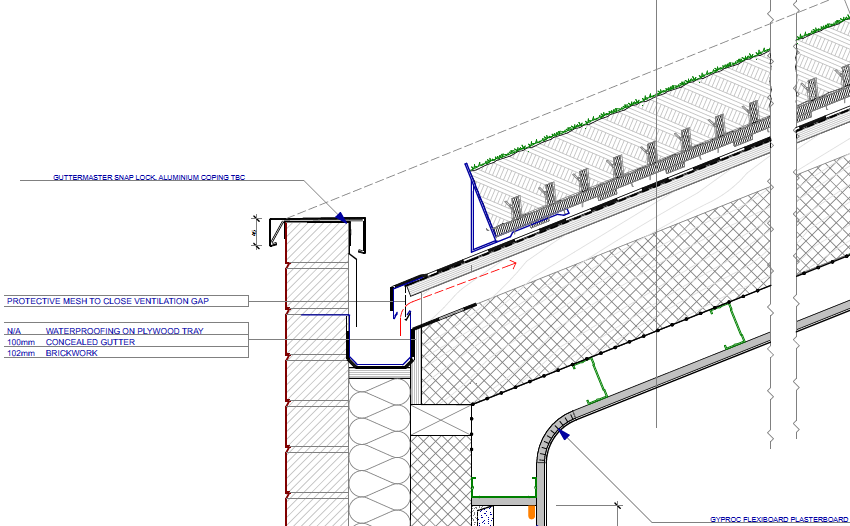
-
Thinner and better alternative to 150mm PIR in cold roof insulation
Adsibob replied to Adsibob's topic in Heat Insulation
@Olf, that is really quite incredible that I can save almost 100mm by going for these two Kingspan products or for the aerogel that @Tempsuggested. Now the limiting factor is the rafter. @Russell griffiths you suggested 125mm was the shortest rafter I could use, is that assuming I stick to timber? What about a steel rafter, anyone know how thin short that could be? -
Thinner and better alternative to 150mm PIR in cold roof insulation
Adsibob replied to Adsibob's topic in Heat Insulation
@Olf this really is very interested and exciting! (Is it a reflection of the times, or my obsession with my build, that results in me getting so excited about insulation?) Having just searched for it online, I found about 5 retailers who won't commit to a price online, it's all "POA" or "call to enquire". So I guess it's very expensive. But might be worth it given the area of roof we are talking about is actually quite small. Given the Calculator @Ferdinandlinked to above doesn't have this Optim-R system as an option, does anybody know how I would calculate how much I would need to replicate the U value provided by 150mm of PIR with this? -
Thinner and better alternative to 150mm PIR in cold roof insulation
Adsibob replied to Adsibob's topic in Heat Insulation
Thanks @JamesP. I don't think i have the space for a warm roof for my extension, but I could do this in my loft conversion where space is not such an issue. Did you just have Pavaflex or did you combine with PIR? Would be interested to know your build up and the thickness of each layer.
