


Adsibob
-
Posts
3609 -
Joined
-
Last visited
-
Days Won
10
Everything posted by Adsibob
-
I think you are right and my architect has listed them in the wrong order. It should go below the concrete slab on top of the hard core.
-
My understanding is that it is to level the roughness of the concrete slab but 10mm might be overkill. Would 5mm be ample?
-
Thanks @Faz . So coincidentally, the two heating zones for that floor almost fall exactly either side of the beam that is too high up. So maybe we just give up on having heating on that strip. I still think there will be some cold patches there though.
-
Our floor build up on our ground floor was meant to be as follows: FFL: Porcelain tiles, underlay and adhessive (15mm) Screed containing 16-18mm wet UFH pipes (55mm) Tacker insulation panel (100mm) DPM Sand binding (10mm) Concrete Slab Hardcore For reasons I won't go into, a structural concrete encased beam has ended up in the floor about 150mm higher than was intended. This means that there is no space to lay underfloor heating over that area unless we raise the floor. The area is a narrow but very long rectangle, spanning 7m in length (basically the whole width of the house) by about 25cm in width. We cannot raise the floor by more than about 55mm. If we do this, Architect thinks we would have space to lay (just over this narrow 7m strip) about 30mm of insulation and 25mm of screed. We would keep to the above build up for everywhere else in the floor and also add some polystyrene to the sides of the concrete encased beam to minimise cold from that. Overall this accounts for maybe 4% of the overall floor space, so whilst it's incredibly annoying I'm trying to remain calm and find a solution. I need to look into the exact type of insulation, but it would be something high end that could. Not sure if Aerogel would work. Also not sure if this is as strong as tacker insulation or if the compressive strength of the insulation is irrelevant. Does anyone see a problem with the above solution, apart from the fact that the floor over that strip will have a bit more heat-loss? Is there an issue with screed being 55mm deep in most of the floor and only 25mm deep over that portion (i.e. on the narrow strip the underfloor heating pipes would be 30mm higher and closer to the FFL than the rest of the floor, which would mean they would have to transport the water against gravity for that small jump). If that's a bad idea, would it make sense to lose screed on the rest of the floor or is that also a bad idea? Should I just have a cold patch with no underfloor heating on this bit of the floor? It's in the middle of an open plan and otherwise well insulated space in a 1930s conversion and extension.
-
Hi @shuff27 that makes sense. I bloody hate LPAs! Look forward to seeing the next version!
-

Thoughts on my draft floor plans?
Adsibob replied to freshy's topic in New House & Self Build Design
V2 of ground floor looks good. You might not need a pantry if you install a couple of full height pullout units or several under counter pull out units. These are more efficient on space than a pantry and with really well if not too wide. 300 or 400 wide work well. saving on the pantry will give you a bit more space. This might enable you to redesign things and give you more space for the study, fit example, which looks a little small. -
Thoughts on my draft floor plans?
Adsibob replied to freshy's topic in New House & Self Build Design
I agree. I also don’t understand why all four bedrooms need an en-suite. Getting rid of one of them makes space for a larger en-suite off the master bedroom. You could then have a jack and Jill bathroom or a family bathroom instead of the two others. -
Sure, but natural light in a space makes a real difference to it. Without bigger windows it will feel dark and gloomy at times. Think of resale value as well. Bigger windows make a room feel airier and bigger.
-
Some of these windows look a little small. And you don’t have any windows in the bathrooms, although I see now you have rooflights. Will this be openable? Will they be large? Even with MVHR you would want openable ones there, for ventilation in summer when you might switch MVHR off?
-
If you are sprightly, I would keep the stairs steep as that will help you keep active as you age. If you don’t use it, you lose it.
-
Am I mad to change my floorplan like this?
Adsibob replied to Adsibob's topic in New House & Self Build Design
Not sure that’s an option, for other reasons. It’s a conversion not a new build so we are limited by certain factors and also are really happy with every other aspect of the layout. -
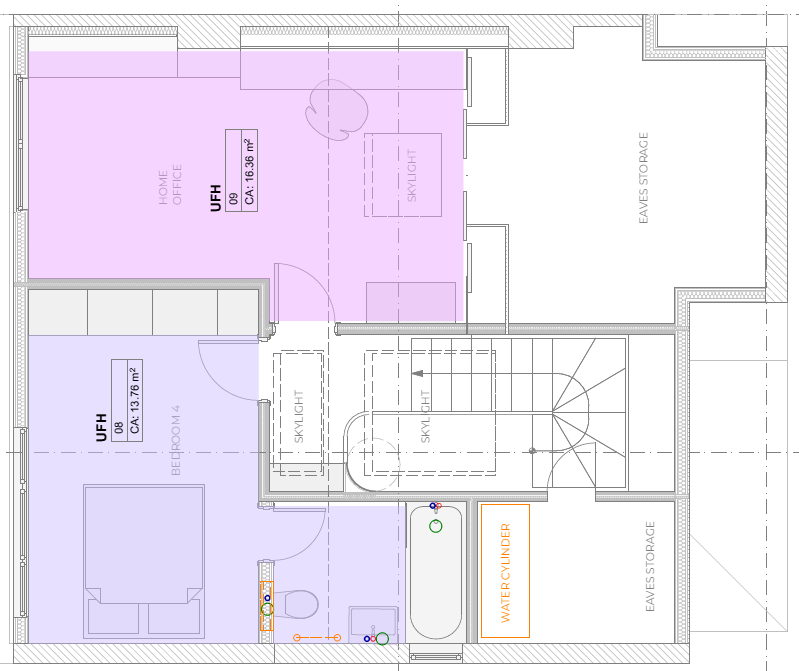
This is the floorplan of my intended loft conversion, as currently designed. Not converted yet so still time to reconfigure the layout. There is no scale shown, but to give you an idea of dimensions, that bathtub is 1700 by 750 and the water cylinder shown in the eaves storage to the right of the bathroom is 1590 by 710 (it's a horizontal 400l Telford Tempest unvented cylinder). And ignore the UFH zones, as we might do without these. I had intended to use the eaves storage to house not just the water cylinder but also the MVHR unit and, if there is space possibly also the boiler, but it's not absolutely necessary to house the boiler there. The reason for this post is that looking over my plans for the umpteenth time, I realised that the access door to the eaves storage off the stairwell is pretty inaccessible. In case it is not clear from the diagram, the eaves storage is on the same floor as the bathroom and the rest of the floor, and so the only way to access it would be by placing a ladder on the stairs - it would have to be a fairly tall ladder because the height from the second step to the floor of the eaves storage is equal to 13 steps which comes to just over 2.7m. I've never had an MVHR system before, but I'm guessing one needs to pay it a visit every so often. I've also never had an unvented water cylinder before, but presumably that also needs some company every so often. Whilst we will control the gas boiler remotely, that would need an annual service and I'm sure after the warranty period it might need the occasional repair as well, so all in all the idea of balancing a 12 foot ladder on that step every time I need access to that space and then crawling through a small hatch just doesn't really appeal. I am therefore thinking of losing the bath tub (we don't really need a bath tub there) and replacing it with a shower, either a walk in shower and making it into a wet room, or just a shower cubicle. But I would prefer a wet room. This would then allow for a narrow, but full-height doorway to get into the eaves storage from the bathroom. But because its under the eaves and the roof slope is 45 degrees, the ceiling height falls very quickly. I think the ceiling height is about 2750 at the boundary of the room and then will fall by 100mm every 100mm one travels from that wall, so by the time one clears the 710 diameter of the cylinder, the height is about 2000 and by the time one reaches the opposite wall 2400 from the bathroom wall, there is only 350 head height there. This is all assuming that eaves storage will be insulated in the same way as the rest of the loft. I would then have the cylinder vertical instead of horizontal, so that there is space to walk past it as one enters from the bathroom. The reason for citing the water cylinder and the MVHR in this corner of the house is that: all three bathrooms are on this side of the house (the other two are directly underneath the eaves storage and the bathroom shown on this plan) as is the utility room and the kitchen. So would keep the runs to the water outlets as short as possible; this also represents a relatively good position for MVHR (assuming there is room to fit it) in terms of ducting runs and being in the loft. I could use the eaves storage on the other side of the floor, but this is much further away from all the hot water outlets and slightly further away from most MVHR vents. The MVHR unit I'm currently considering is Brink Flair 300 which is 650 high x750 wide x560 deep My questions: In general, is my idea of making this eaves storage area the room for the MVHR and water cylinder a good idea? Assuming there is room for my boiler (a Veissman Vitodens 200 which is 700 high x 450 x 360) what are the pros and cons of having the boiler there vs: (A) on the ground floor in a utility room; or (B) in the other eaves storage area shown in this floor plan (ie top right hand corner)? Is it madness for the access door that links the bathroom to the eaves storage to come from the shower area? i.e. I was thinking in replacing the whole area that is currently occupied by the bathtub with a large wet room walk in shower area, with a 900mm shower screen leaving 800 to walk into the shower or to carry on into the eaves storage area. I would probably end up waterproofing part of the eaves storage area as well in case the cylinder ever leaks and have to think of a way to conceal the access door behind tiles that clad the showering area. If the MVHR and the boiler were both cited in this room, would there be enough distance between the MVHR intake and the boiler exhaust? Any views positive or negative gratefully received.
-
Through Cavity Mailbox.....Recommendations?
Adsibob replied to Rob99's topic in General Construction Issues
At the rate we're burning through our contingency, this might be a necessity - I already have the fridge magnets on our fridge, so it would just be the cost of the steel! -
Through Cavity Mailbox.....Recommendations?
Adsibob replied to Rob99's topic in General Construction Issues
Sort of. It's official for our kids, but not (yet*) for us. * might never happen if I'm honest. -
Through Cavity Mailbox.....Recommendations?
Adsibob replied to Rob99's topic in General Construction Issues
I know this is an old thread, but thought I'd revive it as I'm also looking for a through the wall letter chute. Thanks to @lizzie and @Bitpipe and others for the recommendations in this thread. All look like good options, but what I'm looking for is a bit more particular. My requirements (in order of importance) are: Large through-the-cavity-wall mail chute in matt black alumnium or steel poweder coated in Ral 9005 I actually don't need a box to catch the mail, as I'd prefer the mail to fall on the floor. Additional flap on the inside to mitigate drafts when in use Outer plate surrounding the full size slot to be big enough so that it can be engraved with our door number in a prominent font size so that the door number is visible from 10m away. Enough space to add our family name to the surrounding plate (although actually that would never work, my wife and I have double barrelled our names because neither of us was willing to give up their surname and my surname has 11 letters and hers has 8, which would require space for 20 characters!) Basically, I'm looking for a combination of this black through the wall letter box from the website @Bitpipe recommended: https://www.letterbox24.de/D-041-through-wall-letterbox-variable-depth (which comes in the exact finish I want) but with a wider external plate surrounding the actual mail slot so that I can have our door number in a funky engraving like this. I can probably engineer requirement (3) myself, but (4) seems trickier to find. I will give up on (5). Any suggestions? -
All good advice. Thanks everyone. I will leave it as and give up 5cm that I'm probably entitled to for the sake of peace of mind that not even a lunatic like my neighbour will think to challenge it.
-
Not sure if it's relevant to my question about the position of the wall relative to the footings, but in case it is, the footings are 1.8m deep. Structural engineer had originally specified 1m but BCO required 1.8m due to one of my neighbour's trees being quite close.
-
Why would I need to do that? Structural engineer seems happy for the outer leaf of the wall to be built up from the edge of the footing. Is he wrong about that? In practical terms I could quite easily widen the trench as we currently have temporarily annexed a strip of the neighbour's garden (in accordance with the permission afforded to us under the party wall agreement), but that's not what the builder has dug.
-
The planning permission i have for my rear extension gives me permission to build it out along the full width of my property. It's a semi detached property and I have a party wall agreement with my attached neighbour. Builder due to pour footings TOMORROW. Architect calls me today to say that he thinks builder has set out the footings in such a way that extension would be 5cm to 8cm narrower than it should be. I went to the property to meet the builder to see what's going on. Builder shows me he has taken the boundary line from the centrepoint of where the old fence post used to be. This would account for 3cm of the 8cm, as looking carefully at his line there are places where he has deviated from that line by 3cm. However, under the deeds, it's my fence - and I have always been responsible for maintaining it. Via google, i found this: It is normal practice when using a fence to mark a boundary to place the outer face of the fence along the boundary, so that the posts stand on the land of the of the fence's owner. This rule would suggest that the builder is wrong to take the boundary line from the centre of the fence post, and as my fence post was 8cm or 10cm wide, that would suggest a discrepancy of 4cm to 5cm. Having said that, the same article notes that this won't always be conclusive. I looked at my party wall agreement and note that it says I am to reinstate the fence after the building works have finished. If by the word "reinstate" there is an implication that it should be reinstated in exactly the same place, then that ignores the above rule. In any case: the party wall surveyors never asked me who owned that fence or where the exact limit of my boundary is - they've generally been quite sloppy so this is par for the course; and my neighbour and I both agree that reinstating the fence would look silly as it would be right up against the wall - I won't see it, so i care little about what it would look like, but it will inhibit the walls from breathing and will also cost me an extra £400 to £500 in fencing material and labour which I rather avoid. My builder has agreed to shave a bit off the trench wall to give me the additional 3cm so it is more accurately under the centreline of the fence post. But even doing that I would lose the 4cm to 5cm. I know that doesn't sound like a lot, but it will make a slight difference to the internal space. My fear is that even though legally I am probably entitled to use that additional 4cm to 5cm, relations with my neighbour are difficult at the best of times and if he believes I am taking his space he will probably kick up a fuss. What would you do?
-
If there is, please let me know. That’s exactly the kind of thing I would like.
-
You would want the titles merged because when you come to sell it will be administratively easier (and cheaper).
-
You will need a conveyancer then, as the title to your property is being changed your mortgage company needs to consent to the change. Even if that wasn't the case, I would use a conveyancer. Land is a valuable investment and the law in this area is riddled with idiosyncracies. Not worth risking getting it wrong imo.
-
I think you are right @Dave Jones. Though it may be possible to find shorter lead times if rather than the usual big names, I go small. To that end, can anyone think of small, preferably but not necessarily British, manufacturers that might not be on the radar of most roofers and builders. Alternatively, would it be crazy to import 140 sq metres of clay tiles from somewhere like asia? Surely the answer is: yes that would be crazy!
-
I've tried them. Anyone else?
-
I think I have answered my own question: the thing to look for in a roof tile is short lead times! Crazy situation in the UK right now. Everyone seems out of stock. If anybody knows of a supplier than can supply a clay interlocking roof tile in Sandtoft's Antique Grey or Slate Engobe (or another manufacturer's equivalent colour) in less than 12 weeks, please let me know. I never anticipated it would take 12-20 weeks, which is what all suppliers are telling me, to get roof tiles.
