


Bonner
-
Posts
876 -
Joined
-
Last visited
-
Days Won
1
Everything posted by Bonner
-
I am quite sure the ‘site’ in question is the new plot however this is something you can’t afford to get wrong! I would phone your local authority to double check, preferably getting it confirmed in an email.
-
You need the capacity (volume) to contain a storm surge of rainwater. If you can demonstrate your pipes have 21m3 capacity, BC should accept it.
-
No, solid timber rafters in this case although I am sure they could have designed with I-beams if needed.
-
Not necessary in England (AFAIK). I did use a SE but only for a raft foundation and one steel beam. Everything else was covered by manufacturer’s specifications/calcs.
-
I have a vaulted roof with glutam beam and rafters, designed and supplied by the supplier of my roof trusses and floor joists. They did all the calcs, no SE involved.
-
They do rotate but their moment of inertia is relatively low due to slow speed. If the wind drops they can stop within a revolution due to drag. Large turbines will keep spinning (and generating electricity) for several minutes when cut off, giving operators precious time to switch over to another source.
-
I agree, nothing to worry about here. Most likely a slight weep in a joint (if anything) and there shouldn’t be any joints in the screed! You might find the pressure shoots up after the screed is poured due to chemical reaction.
-
MVHR ? Who needs it? I don't.
Bonner replied to ToughButterCup's topic in Mechanical Ventilation with Heat Recovery (MVHR)
Assume you are referring to @ToughButterCup’s CO2 monitor? My bedroom is typically 1200ppm at night, over 2000ppm without MVHR running. -
MVHR ? Who needs it? I don't.
Bonner replied to ToughButterCup's topic in Mechanical Ventilation with Heat Recovery (MVHR)
Another vote for MVHR here, this is my inlet pre-filter after a month! We are in a rural village so probably a combination of wood burner smoke and agricultural dust. Anyway I prefer not to let fresh air in the house.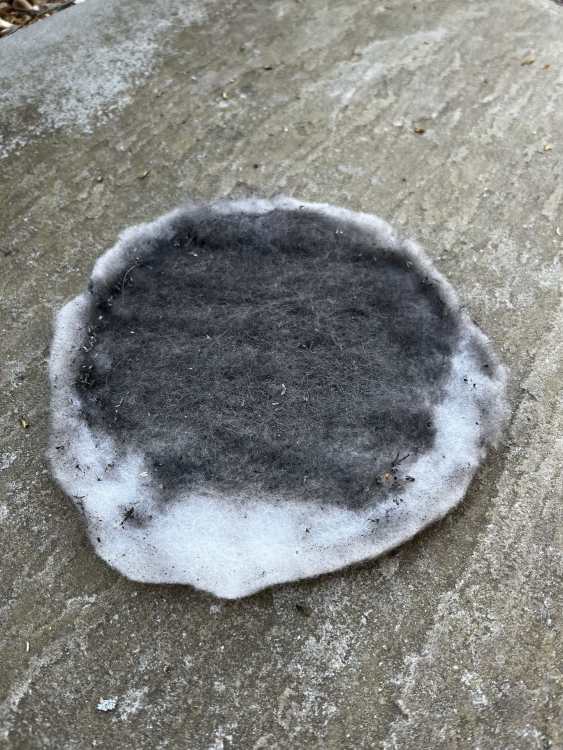
-
I think @craig is an expert in window specifications.
-
How to fix a leak from these shower fittings?
Bonner replied to David001's topic in Bathrooms, Ensuites & Wetrooms
Well done for getting those off! It certainly points towards the connecting pipe unless there is a leak from the waste pipe (water can track across the ceiling and only appear at joints). Otherwise you will probably need to cut out the wall to find out what’s going on. Note I am only an amateur DIYer, suggest you wait for @Nickfromwales professional advice before going any further. -
Possible to do an extension with no driveway/road?
Bonner replied to Bethanyboo's topic in House Extensions & Conservatories
Anything is possible, just costs a bit more to carry materials in and out. For an extension you will only need a mini/micro digger which will go up the footpath. Assuming you have access to the road on the left, bulk materials could be dropped over the hedge by Hiab and waste taken away with a grab truck. Suggest getting a local builder round to have a look on the ground. -
How to fix a leak from these shower fittings?
Bonner replied to David001's topic in Bathrooms, Ensuites & Wetrooms
As it’s not leaking continuously, the problem is downstream from the mixer, from the outlet of the valve to the hose. Can you take the mixer cover plate off to see any leaks? Mine is turn and lock fitting. What about the hose outlet, have you tried taking that off? -
Looks like a very old school 🙄
-
Implication of not using MVHR
Bonner replied to Indy's topic in Mechanical Ventilation with Heat Recovery (MVHR)
I told them that I am a qualified engineer which they accepted (I am a chartered mechanical engineer but knew bugger all about MVHR before I started!). Was going to do a report but they never asked for one. -
Implication of not using MVHR
Bonner replied to Indy's topic in Mechanical Ventilation with Heat Recovery (MVHR)
I bought a brand new unit was about £750, gone up a bit in the last three years. Rigid plastic ducting and valves were another £500. The MVHR is very basic but does exactly what it needs to, runs continuously at 30% speed with occasional manual boost. Of course you can spend more on sensors and auto controls but even a basic unit is infinitely better than trickle vents. https://www.ventilationland.co.uk/en_GB/p/itho-daalderop-hru-350-eco-unit-hr-rft-high-rise-350m3-h/9795/ -
Implication of not using MVHR
Bonner replied to Indy's topic in Mechanical Ventilation with Heat Recovery (MVHR)
MVHR is one of the best things I did, wouldn’t like to live in a house without one. Self installed for less than £2k. -
I have these oak veneer doors throughout, mixed with tiles, laminate and carpet floors. https://deantawood.co.uk/products/internal-doors/oak-doors/galway-interior-oak-door/ Personally I would avoid painted doors whether factory or DIY as they show marks.
-
Normally 22mm to baths. 10mm is pointless IMO, more expense and complication with little or no benefit. Make sure isolation valves are full bore.
-
Viability of using two different floor build ups next to each other.
Bonner replied to G and J's topic in Foundations
Yes, we have a combination of solid floor and B&B. Due to cock up we ended up with a step but easily levelled up with additional 25mm insulation on the low side. Continuous screed throughout. -
Just looked back at my application form. Since they ask for copies of your planning approval and drawings, I think you need to reflect details shown in these documents, in your application. So if your drawings show a workshop, that is what you need to declare. I can’t see anything in the rules which exclude a workshop, garages are clearly allowed so why not similar permanent structures? Sheds are excluded presumably because they are not considered permanent.
-
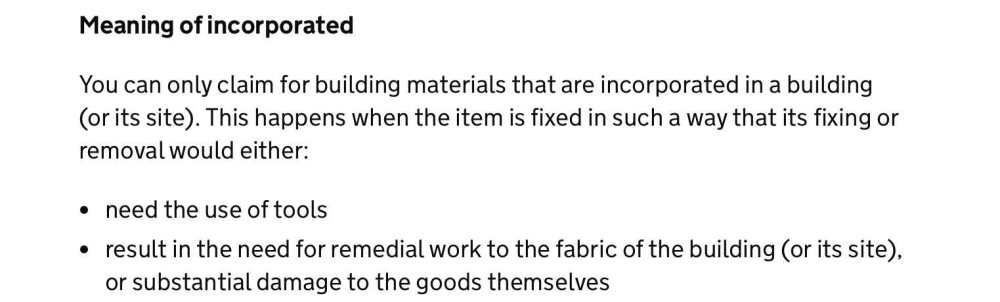
In my recent experience of VAT claim, they ask few questions. I would just put the SIPs on the materials list (no explanation is necessary). If they ask what they are for, then you can argue it’s part of the approved plans. As per the snip, you can claim for materials incorporated in the site and the list of allowable items rules out sheds but not workshops. There won’t be any issue with the ASHP, again no explanation needed unless they ask. https://www.gov.uk/guidance/vat-refunds-for-new-builds-if-youre-a-diy-housebuilder#goods-you-can-or-cannot-claim-for
-
Is it time to start getting creative with kitchens?
Bonner replied to Bancroft's topic in Kitchen Units & Worktops
+1 for big drawers rather than cupboards. Separate pantry is best for all the paraphernalia. -
Are you buying a workshop kit or just materials? Contractor to build it? ASHP installation by self or contractor?
-
Depends where you are in the country but even if you have it redone, it may still need a lot of water to keep it green year round. If it bugs you so much, think seriously about a gravel garden with drought tolerant planting.



