


S2D2
-
Posts
437 -
Joined
Everything posted by S2D2
-
They may be able to provide a firmware update if it's a known issue, or it could just be some fluke that you won't see again. The induction hob isn't a major issue, it's still supplying the vast majority of the load from the inverter, it just gives a very small amount of "unexpected" import/export.
-
Seems reasonable, 20° is a very low slope so will be in view of summer/midday sun. Indeed if you have a 0° slope you'll get 100% of South facing energy by facing them North 😉
-
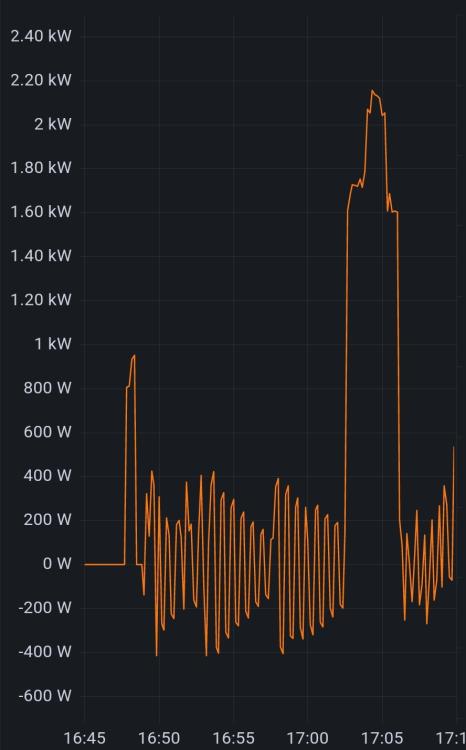
The induction hob switching can confuse the inverter, here's my grid usage when pulling an average of 900W to the hob but oscillating around this point as the inverter tries to keep up: This would probably explain your messy spike just before two, but it does not explain why the inverter didn't pull from the battery at all for the spike just after two. If your installer is slow to respond you can try the inverter/battery manufacturer directly.
-
Yes, this CT clamp detects the import/export power to a given accuracy. The arrow is to ensure it is installed the correct way as reversing the clamp will reverse the polarity of the reading. Are you cooking with an induction hob, or just a simple resistive load like an oven?
-
New member - stuck for what to do next to warm the house
S2D2 replied to Sparrowhawk's topic in Introduce Yourself
You've outlined the priorities well, it's never going to be pretty so chase your biggest issues first: Boiler/rads - new gas boiler and rads will solve the health-affecting 11°C indoor temps, even if it does cost an absolute fortune to run. Make sure the replacement is also suitable for the finished, insulated product. Then, you have until next winter to reduce that cost by improving insulation/airtightness: Loft is easy/cheap, fill your boots Remove cavity draft: ducting air bricks properly and sealing other external penetrations. If you're completely happy the cavity draft is gone, EWI is possible, but rewire and graphene bead fill in the cavities may be a more reliable way to add insulation and reduce any remaining hard-to-fix airflow issues. Ground floor starts to get into the serious disruption but absolutely needs doing, windproof but breathable is most reassuring to me for timber joists. When the drafts disappear and the house starts to feel stuffy you know you're on the right track, PIV is the cheapest ventilation solution or upgrade to MVHR if you're so inclined/like to close internal doors. Forget the house being super cheap to heat unless you want to move out and go for serious levels of disruption. Adding the insulation you can will get you well into comfortable and affordable heating, passive houses are just chasing the diminishing returns after that point. Finally, cost all that up first, include your time if DIYing and check there isn't another house that you could move to that would solve the issue for a lot less hassle. Probably the answer is no, but that will at the very least give you the conviction to crack on. -
Solar+Battery - more PV AC coupled vs less PV hybrid?
S2D2 replied to DragonQ's topic in Photovoltaics (PV)
Solax (and I believe GivEnergy too) provide a local API on some inverters so you can get whatever fidelity the inverter sees. I'm logging 10s data from mine without issue, plenty scope to see kettles on etc. -
Sadly yes, it uses around 5W idle and 105W when firing. Using smart meter data so accurate reading too. No idea where that's going. I've always thought it was a lot but the specs have it rated at 115W so it's performing "as expected", just inefficiently. It is 9 years old now though. You can probably just ignore it then, only 1-2% max in your case which may only become relevant at the extremes of flow temp.
-
Using some extremely questionable extrapolation from smart meter data I looked at a random heating cycle on the boiler to give a reference point: 45 degrees flow temperature 4kWh gas consumed Firing/pumping for 0.65 hours at 100W, so 0.065kWh in electic, or ~0.2kWh in gas money ~5% of consumed energy (in cash terms) is the electricicty consumption at this flow temp I'll have a go at tweaking the flow temperature to get a flow temp -> efficiency function which could then be combined with the above graph for an overall optimum. As a side note, there are a massive number of assumptons here, my boiler is not in the heated envelope so I'm assuming that electrical input energy is lost. Maybe the pump instead loses energy to the flow water? I have no way of telling.
-
Something I've been meaning to look at for a while, but never got round to, is where exactly the optimum lies from a cost perspective. From that graph alone you'd assume a boiler running 24 hours a day at the lowest temp to meet heating demand, but actually my boiler uses 100W extra electricity when firing/pumping, so that would be 2.4kWh a day, or around 7kWh in gas money. Clearly there is likely to be a point of diminishing returns but I haven't done the sums yet.
-
Can you use Hybrid battery inverter without solar input?
S2D2 replied to BMcN's topic in Energy Storage
Isn't the usual trick taping a plastic bag to the drawstring and attaching a vacuum at the other end? -
Can you use Hybrid battery inverter without solar input?
S2D2 replied to BMcN's topic in Energy Storage
If you have an existing duct for cable runs the CT can be extended with cat6 up to 100m usually. It would save the DC -> AC -> DC -> AC losses of a second inverter for the battery. -
It's been a good end to the month for PV, I've generated around 115kWh this month, 10% ahead of the PVGIS estimates.
-
It's more revealing as a 32 bit binary: 11111111111111111111111111111110 I.e. one short of the max value. Or some weird little endian signed integer for no reason. From a software perspective, here be monsters.
-
Insulating under block and beam floor with perlite
S2D2 replied to Patrick's topic in Heat Insulation
From what I've seen this issue mostly applies to 90's houses where the common build up is block and beam, 50mm EPS, floating chipboard floor. Worse, like mine, big gaps are often left in the EPS to run ground floor heating pipes... So the insulation is okay (read: better than nothing), but there's a bunch of space under the beam and block that won't be on show that it feels like there should be a solution to add a boatload of insulation to. The lack of a DPM is a key limitation though as ground gases can't be ignored. -
Insulating under block and beam floor with perlite
S2D2 replied to Patrick's topic in Heat Insulation
Yes, still no luck for retrofitting unfortunately, from the technical docs: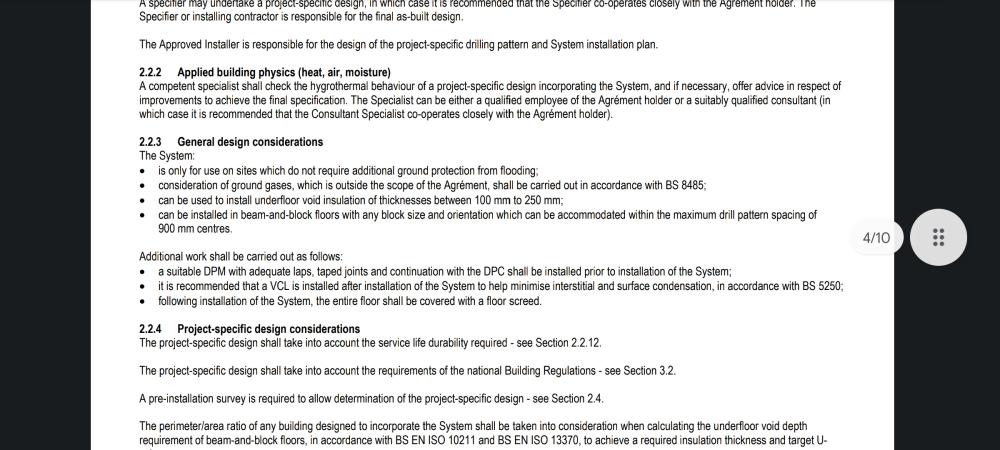
-
In my opinion this is the most reliable method for comparison, ours came out at something like 4.1 kWh/hdd. Remember to include the electricity consumption which is lost into the house as heat too. Adjust if you have any CoP input. Easy enough to factor in exposed perimeter giving an average U value which seems to me the best metric for direct comparison. You don't even need to plot it, just take your annual usage and divide by the total HDD for the year, see: https://www.degreedays.net/. Plotting daily does allow you to filter out the summer days which will skew the regression fit quite significantly once you factor in electric consumption. Mine came out at 0.66W/m2K if I remember rightly, plenty room for improvement but it is a 90's house.
-
Get some more quotes, that's ridiculous for a 4kWp install. Take 40% off and it would be reasonable. Less if that's switching for a hybrid inverter, it's not clear from the quote.
-
Solic 200 like Blackpool Lights - Help Needed
S2D2 replied to canalsiderenovation's topic in Air Source Heat Pumps (ASHP)
Sorry OP I can't help with the lights, but this requirement got me curious. Can anyone shed light on why this is required? It's a high base load to rely on and the (vastly more expensive) Eddi doesn't seem to mention this requirement? -
Insulating under block and beam floor with perlite
S2D2 replied to Patrick's topic in Heat Insulation
The airflow through reasonably well packed beads will be vastly reduced relative to outside air due to viscous drag etc. So I would neither rely on it for ventilation (though indeed it is not airtight) nor worry about it for insulation. I don't have any figures for you but it would be not too much effort to model. -
Thanks both, unfortunately not enough room in the CU but it was trunked neatly at ceiling level so could be a lot worse.
-
As a point of reference, the standard install practice for my Solax hybrid inverter's CT clamp is to extend it (ours was done with CAT6 internally, the manual does not specify) and the install manual says not to go over 100m, so plenty of room to play with. Ours runs ~10m with no issues.
-
Update on Energy Use Based on 4 years of Actuals
S2D2 commented on TerryE's blog entry in The House at the Bottom of the Garden
This does seem high, but perhaps it's just a big one or some things were added to be frozen? The sample size is small so could be affected by something like that. I don't monitor mine directly but smart meter data shows it has a background usage of around 365kWh/year. Add a bit for things being put in, door opening etc. Also if you're using a smart plug to monitor I found mine on a dehumidifier was overestimating by 20%, which may go part of the way to explaining it. -
Cost/benefit analysis of different size of array
S2D2 replied to Omnibuswoman's topic in Photovoltaics (PV)
Here it is, just input your postcode then the other parameters, it lets you play with different configurations etc. and most people find it lines up with real world performance reasonably well: https://re.jrc.ec.europa.eu/pvg_tools/en/#PVP I don't have a basic guide reference, I think you understand the fundamentals from the spreadsheet but the forum will be happy to answer any specific questions I'm sure. If you have a smart meter at your current property, you can get into some proper analysis of what you might self use in the new house with respect to plug in electric, see my other thread: I have a system installed now and have started logging data so can share more on real usage soon, but others have posted various data in this forum topic before. The key takeaway is it's massively usage dependent, every household is different and will self-use different amounts. You can change usage patterns to address this, but solar is very unpredictable. A battery helps smooth this out but they are very expensive at the moment. We installed a small one (3kWh) as we don't consume enough to go down the Octopus Go/E7 route. For the shading, it will affect you differently throughout the year. Whilst the average for a 2m dormer might shade 1.7m, in winter with the sun at 15 degrees it might shade more like 7.5m. I believe PVGIS can model this to show the overall effect, but I've never used it for this. This may push you towards all the panels on the west side, or it may not be an issue. Also check vertical mounted panels on the South wall, depending on the space you have there and view on aesthetics. As you haven't tiled yet, in built panels will be "cheaper" for you as you will save on tiles, so probably stick as many as you can up there, just consider the shading. -
Cost/benefit analysis of different size of array
S2D2 replied to Omnibuswoman's topic in Photovoltaics (PV)
Be careful assuming self use will be so high, if the hot water and car charging are set up as a divert that will greatly help self use but for heating (unless also divert with some logic if you're not installing a heat pump?) and plug in electric (assuming this is house load?) your generation and consumption are unlikely to line up. I found self use for house load was as low as 30% using PVGIS and smart meter data. With an E/W split you definitely need to be using PVGIS data as generation will be a lot lower, I'm unsure if this is already factored in? If that dormer is on the East roof am I right in thinking it's towards the South end of the roof? That would shade panels significantly on the larger portion of the roof so would need careful consideration. -
Yes, this is the case. I was confused as to why the location of the CT clamp mattered along the cable but have finally spoken to the electrician and the actual reason is that he's not happy to fit a connecting block to the tails within a stud wall and wants it to remain accessible, hence they want to do it in the meter box and run the electric cable from there. Ugly cable across the garage it is then.



