Carrerahill
-
Posts
2132 -
Joined
-
Last visited
-
Days Won
10
Everything posted by Carrerahill
-
do micro inverters need to be g98 compliant ?
Carrerahill replied to morg-ris's topic in Photovoltaics (PV)
I bought some of the cheap Chinese ones, they are not certified compliant with anything, but that is not to say they could not comply. In an ideal world they would not be connected, but my little 120W and 260W grid-tied inverters from AliExpress seem to work quite well, apart from if you accidentally hose them, they blow up... As @Dillsue says above I am not actually correct in what I said earlier, for connection, yes, it should be G98 or G99 compliant, that is perfectly correct, if it is for some funding, grants, payment and link in with your utility co. it should be MCS certified installers/approved kit. It has been a long day and I have spend 2 days sorting our solar designs for a charity with government funding who need to use fully MCS accredited installers and kit, so I had MCS on my mind and lost sight of the question it seems. -
do micro inverters need to be g98 compliant ?
Carrerahill replied to morg-ris's topic in Photovoltaics (PV)
It is not so much compliant with G98 but MCS compliant although I appreciate some do state G98 compliance but that isn't really correct. Any inverter connected to the grid should be MCS compliant. However, I have some micro inverters that I bought for experimenting and they are neither, however, they have anti-islanding mode which was enough for me to use for experiments and tests. -
Absolutely. So your full draw at full chat for ASHP & EVC together would be 43A. Lots of spare. Make sure the consumer unit and all associated wiring for these circuits is good, even just checking terminals have not become loose, 43A continuous through the night would soon turn a loose terminal into a arcing burning mess.
-
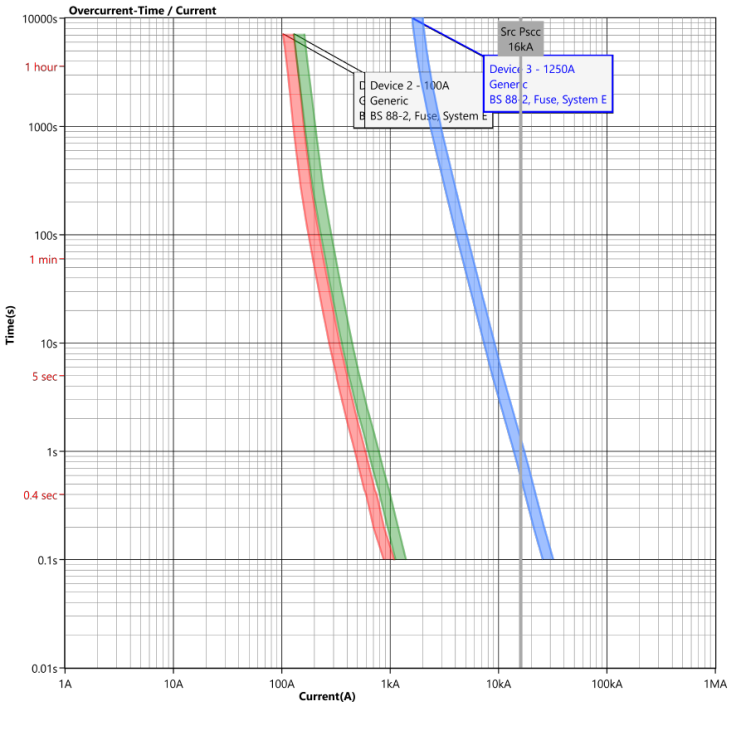
Note breaking curve for 80 & 100A BS88's - you can put nearly 25% more through them for 100 seconds. The 1250A BS88 is just a potential upstream protection device.
-
Is that 8kW output or input? Lets assume worst case and that is input, then I doubt it will pull full current all the time. Worst case is the two will therefore pull 65A solid. I would assume you're on an 80A or 100A BS88 cut out fuse - so leaves 15A spare at night. BS88 will not blow at rated current would be over 2.7hours, so even if you did peak 90/100A sometimes, on a 80A you would be fine. You can get EVC's which have CT clamps on the main tails and monitor load, if it peaks over a pre-set (you can per-set) value, it drops output to the EVC until it fixes. In my personal & professional opinion, I think you are fine. See if you can workout what size fuse you are on - only real way to know is to kill everything and pull it, means you need to cut the seal and you are not meant to, but if I have £1 for every time it was done I would be a millionaire.
-
How did you fit your PIR into wall cavity...
Carrerahill replied to Carrerahill's topic in Brick & Block
We have a 100mm cavity. I think I will cut the sheets down, I will try and make use of the longer (640mm) last cut piece in the gables and things. On your own build, I wouldn't go for the EPS beads full fill, keep the cavity clear, there for a reason for it, let it breath. -
I have a thermalite/concrete block cavity wall going up, 50mm PIR specified for the cavity. We will be doing the insulation, bricklayer said he can build the thermalite walls first leaving the wall ties and we can fit the PIR, or he will build thermalite and block simultaneously and we can follow him and fit insulation. The next minor issue is the sheet size, I just bought 4x8 sheets, I was sort of hoping to try and wrangle them in as whole sheets by poking wall ties through or something (I was not thinking it through when ordering materials) but I think I will make more penetrations and holes than just cutting them all square to 450mm and putting them in piece at a time, I can then foil tape them and foam joint any bad bits. So I was just looking for some feedback and thoughts from you guys as to what you did (or builder did for you). I am angling towards getting the inner wall up first, cutting the sheets to 450mm slices, fit it all snug, tape it all up, foam it where needed and make sure the corners are nice and tight and what not, and generally create a full building "wrap" of insulation.
-
I worked for a multinational conglomerate in their engineering division, essentially we designed solutions for clients, however, as part of the divisions within the firm we would sometimes spec our own equipment, this usually then led to someone from the sales department of said division calling us and wanting to get involved, we often tried to keep them out of it because we designed a suitable solution, not a solution based on a product we happened to sell. Anyway, we got involved with them and we ended up having some meetings with the client, an account manager flew in and we went to the meeting where I presented the solution, she just kept looking at me as if to say "what the hell are you doing" because I was using different manufacturers and advising against one system for another etc. Later in the car on the way back home I said to her, "I am an engineer, I will propose, to the best of my knowledge and abilities, a solution that best meets the British regs, and the needs, standards and budget of my client". She took it quite well and I also gave her technical feedback on their product as to why they were not suitable and she finally agreed with me, but I bet she is still trying to sell a product that might not actually be the ideal solution!
-
In-Ceiling Height Norm for Flats
Carrerahill replied to Jack O's topic in New House & Self Build Design
It depends on many things, like what is the construction, steel frame and concrete might have 100mm where steels run but up to 350mm between them. However, I would bet my bottom dollar on it there is not anything like 200-250mm of clear free space. I think you will need a rethink. Things are tight, developers like to minimise wasted height, also developers like to keep buildings under the magic 18m for example as then fire regs are more onerous, fire fighting lifts, maybe sprinkers... so they try and keep it lean, although your development will be well under that (I would presume) architects and developers still stick to a fairly standard building detail. Put it this way, my mechanical consultant colleagues often get called to site to discuss duct routes on flats as the voids are not big enough, even with flat duct! Dare I say it, a fold down TV sounds a bit OTT - save your money, there is a recession coming. -
Ah, that image is rather deceptive, I assumed that was a loft space or something! Yes no swinging from it then! In fairness, if you give it a good wiggle you will know. A little scootch of glue between the timbers in the middle might not be a bad idea to give you belts and braces and cheap solution for a few dabs.
-
On a side note, that all looks very neat and well done. People often treat framing as rough, there is no need for it to be rough.
-
Took down a mezz level we built 12 years ago made from 2x6 when my parents moved business premises, about 30 pieces of 2x6 ranging from 3m-4.8m - ripped a lot of it down to 2x3 and used it to build a large garden shed/woodstore/tumble drier area/kids toy/general junk store complete with 11mm OSB sheathing and roof from saved sheets of OSB. I then clad the shed in the old T&G floorboards from our old sunroom, which I ripped the T&G off then used a propane torch to burn to create a shoshugibon treatment then oiled. It is also 4 courses of concrete block off the concrete slab floor using the left overs from the build which I did to Scotland-proof the lower structure from the wet weather. My first solar array went on this shed so its got some pretty green credentials! I still have 4 pieces of the 2x6 left that I was thinking of building a picnic table with.
-
Nailed at the ends and angle nailed into the central timber that is going nowhere and over such short spans will be strong enough. If you angle nail the middle both from the outside aimed towards each other that will form a very strong fixing because it is not just a straight pull out. 1 ring nail each side, set properly, you could swing off it (do a swing test on each) add in the centre nails and another at each end, that thing is solid. I've build a lot in my time at a self-build level, I have also demolished and done a lot of down takings in my time and sometimes a single nail can be enough to become a real problem, do no underestimate a good nailed connection.
-
Contaminated with what would be my first question, then see if that could be treated. A small scale take on a slowsan filter or UV or what not. If there is an existing mains supply locally, then this could possibly be used to feed a potable water buffer tank(s) with booster which could be filled say over night every night (timed pump/level circuit). We do a lot of stored boosted water for flatted developments, A to boost pressure and B where water supplier are not happy about the new connection capacity requirement. We have a small block of 12 flats where the water mains is existing and undersized, a small tank room and a booster pump has solved this. It may not work for many many reasons, but I am sure a system could be had to provide potable water for <150K. Could the existing supply be upgraded cheaper? Friends upgraded a 250m supply to their house with the use of a mole to run new line, worked out quite cheap, another friend with a farm had a new line pulled in through his existing line with a splitter mole which is pulled by a draw wire through the existing pipe and splits it as it goes pulling behind it the new line.
-
I agree with this. I always solder and always use copper, unless really not possible (or temporary). I have a pushfit stop end and a test jig I made with a pressure gauge, ball valve and Schrader valve which also lets me pressurise pipe runs not yet active (I fill with water then use a compressor to blow up to test pressure - not meant to do this I know but in my own house I make the rules). When I did my boxed in copper pipework in my new kitchen I left it overnight with 4bar in the pipe with the marker set on the needle, following morning the needle had not moved. I boxed them in and forgot about them. Should be good for 70-80 years unlike PVC which CIBSE lifespan tables show only to last 20-40. I also did some radiused bends and things to limit solder joints to 2 within that section.
-
Could it be to make the tube long enough that a small hand/arm cannot get up the tube when the fan is running? Might be a safety through distance thing. I see no reason technically why not.
-
It is for plenty of items yes, not so good for small light things, the paint gun sometimes blows them off! Big things I would usually suspend in the place I want to paint and cure because moving big wet items is just asking for trouble. I think I would paint kitchen doors on something like that little trestle, or I would set up 2 of them and run two pieces of wood between them to form a long platform I can stage 2 or 3 items on at once. The more items you can prep and lay out for paint the more efficient and economical the whole process will be. I have used 2 litres of thinners to clean the gun about 4 times in the past 4 days, only to paint 1 item. I could have painted a whole car and still only washed the gun 3-4 times. I have used about 8 measuring cups, loads of rags, so it was quite inefficient. Gun cleaning takes a me a good 10-15 minutes to do it properly - that's a waste of time to keep doing. I have painted loads of things, tables, chairs, Land Rover's, doors, lights, cabinets, to name a few, and each thing warrants a slightly different option for the DIY painter at home. Commercial shops use things that look like clothes rails (I nearly bought a cheapy Ikea clothes rail for painting loads of downlights) and little copper or stainless steel hook things, I have some of those, they can hook into stuff then I hang them from screws in the roof trusses - just watch you don't disturb bits of wood or dust which then falls onto your nice fresh paint! They also use things that look like sort of odd guitar stand things and weird jigs for holding a myriad of panels.
-
If you were close to Glasgow I would happily. I don't have anything to paint now for a while (unless I start another project) so you would need to bring your doors!
-
No it will be OK, it's not tough only 1-2 days in but that bit I painted on Monday, I fitted last night and its now bolted in and up against other metal etc. with no issues, care needs to be taken, I used foam gaskets between all the bits to stop metal on metal contact rubbing through the paint. If you were to paint all the backs say this weekend, you could move onto the fronts by Tuesday, I would rest them on some trestles with some soft covering, painters usually cover their workbenches in felt to handle and work on dried panels, or make a hanging rig (I use hooks on the workshop roof trusses).
-
Where is the kWh price heading in 2022?
Carrerahill replied to epsilonGreedy's topic in General Self Build & DIY Discussion
Sounds like you are trying to make a little CHP unit - its on my list of to dos! -
Where is the kWh price heading in 2022?
Carrerahill replied to epsilonGreedy's topic in General Self Build & DIY Discussion
AVA1? -
Where is the kWh price heading in 2022?
Carrerahill replied to epsilonGreedy's topic in General Self Build & DIY Discussion
Red cannot be used in plant anymore (but there are some exceptions, like ag use), it can be used for agriculture and it can be used for non commercial heating and electricity generation, those are the only parts of the new laws which impact me so I cannot comment on other stuff. All here though: https://www.gov.uk/guidance/using-rebated-fuels-in-vehicles-and-machines-excise-notice-75-from-1-april-2022 -
Where is the kWh price heading in 2022?
Carrerahill replied to epsilonGreedy's topic in General Self Build & DIY Discussion
I considered a waste veg oil/waste engine oil fed Petter engine with a 3kW alternator on it - I have the engine... My friend has in his barn a Lister D standing engine with a 3kW, 3phase squirrel cage motor on it, we wired it up to a bank of capacitors to convert it to 1ph and he wired it directly into 1 of the 2 elements in his hot water cylinder. That was connected to a 500litre tank that old oil, red diesel, veg oil got tipped into, through a big filter and into the engine. In the summer (when the wood/coal fired range is not on) he will go out in the morning and start it up (hand start) 1 hour later his cylinder contains enough hot water for himself for the day including a long shower. We built that about 10 years ago, still not had an oil change that engine! -
Where is the kWh price heading in 2022?
Carrerahill replied to epsilonGreedy's topic in General Self Build & DIY Discussion
Wife and son went away for 2 days, back yesterday... as much as I love my family to pieces, it was indeed bliss. In the garage from after work till late, dinner when I could be bothered, stuff didn't move all the time, washing machine and dishwasher never on (not due to being manky but 1 man doesn't create enough to justify a wash), no vacuuming needed, no TV. -
Where is the kWh price heading in 2022?
Carrerahill replied to epsilonGreedy's topic in General Self Build & DIY Discussion
Sounds like he is, if I was on my own I could cope too.