Carrerahill
-
Posts
2122 -
Joined
-
Last visited
-
Days Won
10
Everything posted by Carrerahill
-
On a side note, that all looks very neat and well done. People often treat framing as rough, there is no need for it to be rough.
-
Took down a mezz level we built 12 years ago made from 2x6 when my parents moved business premises, about 30 pieces of 2x6 ranging from 3m-4.8m - ripped a lot of it down to 2x3 and used it to build a large garden shed/woodstore/tumble drier area/kids toy/general junk store complete with 11mm OSB sheathing and roof from saved sheets of OSB. I then clad the shed in the old T&G floorboards from our old sunroom, which I ripped the T&G off then used a propane torch to burn to create a shoshugibon treatment then oiled. It is also 4 courses of concrete block off the concrete slab floor using the left overs from the build which I did to Scotland-proof the lower structure from the wet weather. My first solar array went on this shed so its got some pretty green credentials! I still have 4 pieces of the 2x6 left that I was thinking of building a picnic table with.
-
Nailed at the ends and angle nailed into the central timber that is going nowhere and over such short spans will be strong enough. If you angle nail the middle both from the outside aimed towards each other that will form a very strong fixing because it is not just a straight pull out. 1 ring nail each side, set properly, you could swing off it (do a swing test on each) add in the centre nails and another at each end, that thing is solid. I've build a lot in my time at a self-build level, I have also demolished and done a lot of down takings in my time and sometimes a single nail can be enough to become a real problem, do no underestimate a good nailed connection.
-
Contaminated with what would be my first question, then see if that could be treated. A small scale take on a slowsan filter or UV or what not. If there is an existing mains supply locally, then this could possibly be used to feed a potable water buffer tank(s) with booster which could be filled say over night every night (timed pump/level circuit). We do a lot of stored boosted water for flatted developments, A to boost pressure and B where water supplier are not happy about the new connection capacity requirement. We have a small block of 12 flats where the water mains is existing and undersized, a small tank room and a booster pump has solved this. It may not work for many many reasons, but I am sure a system could be had to provide potable water for <150K. Could the existing supply be upgraded cheaper? Friends upgraded a 250m supply to their house with the use of a mole to run new line, worked out quite cheap, another friend with a farm had a new line pulled in through his existing line with a splitter mole which is pulled by a draw wire through the existing pipe and splits it as it goes pulling behind it the new line.
-
I agree with this. I always solder and always use copper, unless really not possible (or temporary). I have a pushfit stop end and a test jig I made with a pressure gauge, ball valve and Schrader valve which also lets me pressurise pipe runs not yet active (I fill with water then use a compressor to blow up to test pressure - not meant to do this I know but in my own house I make the rules). When I did my boxed in copper pipework in my new kitchen I left it overnight with 4bar in the pipe with the marker set on the needle, following morning the needle had not moved. I boxed them in and forgot about them. Should be good for 70-80 years unlike PVC which CIBSE lifespan tables show only to last 20-40. I also did some radiused bends and things to limit solder joints to 2 within that section.
-
Could it be to make the tube long enough that a small hand/arm cannot get up the tube when the fan is running? Might be a safety through distance thing. I see no reason technically why not.
-
It is for plenty of items yes, not so good for small light things, the paint gun sometimes blows them off! Big things I would usually suspend in the place I want to paint and cure because moving big wet items is just asking for trouble. I think I would paint kitchen doors on something like that little trestle, or I would set up 2 of them and run two pieces of wood between them to form a long platform I can stage 2 or 3 items on at once. The more items you can prep and lay out for paint the more efficient and economical the whole process will be. I have used 2 litres of thinners to clean the gun about 4 times in the past 4 days, only to paint 1 item. I could have painted a whole car and still only washed the gun 3-4 times. I have used about 8 measuring cups, loads of rags, so it was quite inefficient. Gun cleaning takes a me a good 10-15 minutes to do it properly - that's a waste of time to keep doing. I have painted loads of things, tables, chairs, Land Rover's, doors, lights, cabinets, to name a few, and each thing warrants a slightly different option for the DIY painter at home. Commercial shops use things that look like clothes rails (I nearly bought a cheapy Ikea clothes rail for painting loads of downlights) and little copper or stainless steel hook things, I have some of those, they can hook into stuff then I hang them from screws in the roof trusses - just watch you don't disturb bits of wood or dust which then falls onto your nice fresh paint! They also use things that look like sort of odd guitar stand things and weird jigs for holding a myriad of panels.
-
If you were close to Glasgow I would happily. I don't have anything to paint now for a while (unless I start another project) so you would need to bring your doors!
-
No it will be OK, it's not tough only 1-2 days in but that bit I painted on Monday, I fitted last night and its now bolted in and up against other metal etc. with no issues, care needs to be taken, I used foam gaskets between all the bits to stop metal on metal contact rubbing through the paint. If you were to paint all the backs say this weekend, you could move onto the fronts by Tuesday, I would rest them on some trestles with some soft covering, painters usually cover their workbenches in felt to handle and work on dried panels, or make a hanging rig (I use hooks on the workshop roof trusses).
-
Where is the kWh price heading in 2022?
Carrerahill replied to epsilonGreedy's topic in General Self Build & DIY Discussion
Sounds like you are trying to make a little CHP unit - its on my list of to dos! -
Where is the kWh price heading in 2022?
Carrerahill replied to epsilonGreedy's topic in General Self Build & DIY Discussion
AVA1? -
Where is the kWh price heading in 2022?
Carrerahill replied to epsilonGreedy's topic in General Self Build & DIY Discussion
Red cannot be used in plant anymore (but there are some exceptions, like ag use), it can be used for agriculture and it can be used for non commercial heating and electricity generation, those are the only parts of the new laws which impact me so I cannot comment on other stuff. All here though: https://www.gov.uk/guidance/using-rebated-fuels-in-vehicles-and-machines-excise-notice-75-from-1-april-2022 -
Where is the kWh price heading in 2022?
Carrerahill replied to epsilonGreedy's topic in General Self Build & DIY Discussion
I considered a waste veg oil/waste engine oil fed Petter engine with a 3kW alternator on it - I have the engine... My friend has in his barn a Lister D standing engine with a 3kW, 3phase squirrel cage motor on it, we wired it up to a bank of capacitors to convert it to 1ph and he wired it directly into 1 of the 2 elements in his hot water cylinder. That was connected to a 500litre tank that old oil, red diesel, veg oil got tipped into, through a big filter and into the engine. In the summer (when the wood/coal fired range is not on) he will go out in the morning and start it up (hand start) 1 hour later his cylinder contains enough hot water for himself for the day including a long shower. We built that about 10 years ago, still not had an oil change that engine! -
Where is the kWh price heading in 2022?
Carrerahill replied to epsilonGreedy's topic in General Self Build & DIY Discussion
Wife and son went away for 2 days, back yesterday... as much as I love my family to pieces, it was indeed bliss. In the garage from after work till late, dinner when I could be bothered, stuff didn't move all the time, washing machine and dishwasher never on (not due to being manky but 1 man doesn't create enough to justify a wash), no vacuuming needed, no TV. -
Where is the kWh price heading in 2022?
Carrerahill replied to epsilonGreedy's topic in General Self Build & DIY Discussion
Sounds like he is, if I was on my own I could cope too. -
Where is the kWh price heading in 2022?
Carrerahill replied to epsilonGreedy's topic in General Self Build & DIY Discussion
If I stop using the oven, the dishwasher and the washing machine on warm cycles, oh and stop welding things, I think I could make it work fairly soon. Wife doesn't seem to care about the latter, only the former. I just need to solve those key appliances, welder first actually, then I think I could make it happen. Big battery capacity and big inverters to lead a normal life. -
Where is the kWh price heading in 2022?
Carrerahill replied to epsilonGreedy's topic in General Self Build & DIY Discussion
I can believe it. People are so oblivious and disconnected from reality. I have some neighbours who if I talk about brown/blackouts they laugh it off, "that will never be allowed to happen" they are so brainwashed into believing that they just need to do what they are told and someone will look after them. Mind you, they were the same lot that took the Covid restrictions to real extremes, made their kid strip after school. in the porch, his clothes were removed with gloved hand and mask and washed, he was sent to the shower unable to touch anything as he went. Clueless. Poor child, he is 5/6! They clearly have faith that those running things actually have a clue, where we all know generally they screw most things up. -
Where is the kWh price heading in 2022?
Carrerahill replied to epsilonGreedy's topic in General Self Build & DIY Discussion
Yes, indeed, but they also hammer up the standing charges so people like me who use little energy still get hit. I am 50p a day for electric standing charge! However, I am now playing a game, as they increase the costs, I find ways to reduce my imported electricity and keep my bill about the same. I might need to speed up my off grid electrical system and tell them to come and take their meter away. Oh how I would enjoy that. -
You can paint any object in any orientation, however, it does make it more difficult overall. Can you not unclip the hinges or just back off the two screws and take them somewhere you can work on them flat on a trestle? Are you planning on painting the insides of the doors too? If yes I would lay them all out on their fronts, paint the backs with some primer and give them a coat, make that your test batch, if not perfect, you might be able to live with it. Then after that backs have had 3 days to cure well, turn them over and do the fronts and sides keeping the gun pointing at a downward angle at all the times to stop paint hitting your newly finished backs. If you really need to do them in situ, I would get some masking and mask off the cabinets themselves, mast the hinge up to the point it meets the door and using a scalpel or Stanley knife blade, cut round the hinge perfectly to get a nice finish. This way you can then open the door, spray round the back and sides and get it all in 1 go, but take longer between coats and reduce your thinner a bit as runs will be much more likely for a beginner painter. I personally, would not paint them in situ, I think you might be creating a fair bit of hassle for yourself, unless the hinges are so crusty you fear touching them.
-
Where is the kWh price heading in 2022?
Carrerahill replied to epsilonGreedy's topic in General Self Build & DIY Discussion
228%! Makes you want to cry. -
Is the power source live? But seriously, extension cables and circuits and breakers all on for sure? Can you check the motors spin freely first to prove they are not seized or nests in them? No humming noises or anything from the units? Then I would start doing tests to check continuity if doing it safely, or if like me, live power to the motor, prove power to the motor first, if none, work your way back to the issue. If motors are getting power to them then check brushes, if brushed. If brushless there is generally less to check but looking at the motors for signs of overheating or burnout etc. Depending on the motors, could be a start capacitor, but that would lead to a humming noise on power up usually. Could be corrosion on the switch terminals if been sad unused for so long. Might just need a clean internally.
-
Where is the kWh price heading in 2022?
Carrerahill replied to epsilonGreedy's topic in General Self Build & DIY Discussion
Yes, this annoys me no end. They must start to learn to work in percentages - but that wouldn't give them the scare tactic headline. Ejits. My monthly bills were no where near the national average before the hikes and are still less than £100 a month for gas and electric, so even if my bills went up to £200 (over double current prices), I would be on £2400 a year - so telling me bills "could" be £4200 really doesn't help me. -
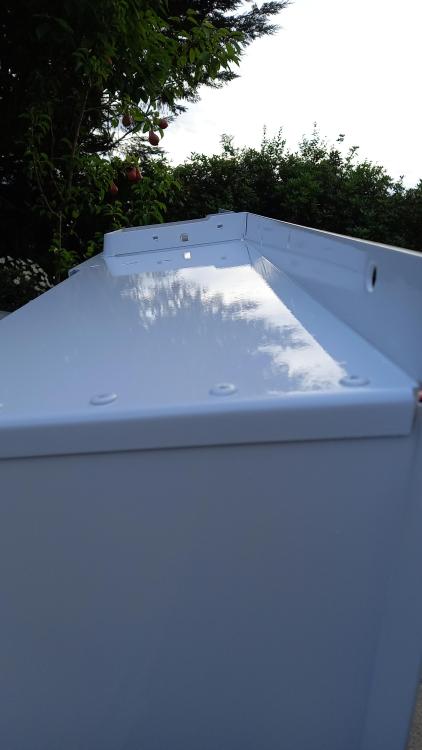
This was last night, perfect painting conditions, light breeze, warm evening, wife and son & dog out, bit of sun, I sprayed the patio with the hose before I started to dampen it, helps reduce dust, finish is about 98% perfect, I have 2 defects on "seen" parts, both tiny and once installed I don't think I could even find them again. If it was a bonnet or door or kitchen door, both of those defects would be resolved with localised 2400 grit paper, then some rubbing compound followed by finishing over the whole panel or a local fade depending on the result. For that seatbox (from a Land Rover) it took about 120ml of paint, that included the battery box under the passenger side seat area, the last coat was 10% more thinner for a high gloss finish, also easy clean! I am very pleased, and if I had not been, I have more paint and a lots of sanding paper/discs in stock!
.thumb.jpg.6df85f2e6aea654806491f14a6700dce.jpg)
-
It is actually fairly common to add more panels than the inverter rating, the idea being that say 20% more panel peak capacity than the inverter can handle will mean that when you see 80% peak generation on the panels you sort of end up at the full rated output... I seem to see about 83% of peak panel power as a norm during this current sunny weather.
-
That mask looks reasonable enough, but I think those filter caps are just a dust filter, it would stop the paint particles but not the vapours and gases from the various solvents and chemicals in the paint. Check with the manufacturers datasheets and see what filter it is and what cartridges are available. If unopened and not suitable I’d keep it for general dusty work on your house, or flog on eBay and get a 3M full face mask as you should really protect your eyes too but not critical if you paint outside or in well ventilated areas – I used a ½ face 3M mask like that for years before I upgraded to the full face. The paint looks fine, it will be good tough paint for sure, my only comment would be don’t use 2k primer going forward, you have it now, fine, just use it, but 1k primer is easier to use, you can literally just thin some, tip it in the gun in any quantity etc. no need to mix up properly. It also means you are reducing your exposure to isocyanide products. If clean you can also tip spare back into the can as it won’t harden in a sealed tin, catalysed 2K will begin to cure immediately.



.jpg.6b0dc772743b9c2109f01e63a2b2525a.jpg)