Carrerahill
-
Posts
2122 -
Joined
-
Last visited
-
Days Won
10
Everything posted by Carrerahill
-
UV resistant black building breather membrane stuff.
-
LSZH SWA cable is cheaper than PVC...am I missing something here?
Carrerahill replied to Thorfun's topic in Electrics - Other
What is the anticipated board load? TPN board, each a potential of 100A, but what is the demand actually going to be? Reason I ask is 25mm could fly quite easily if the loads were OK. At 25mm² you might save £5 a metre! Also, 35mm² additional earth is a bit excessive, on 25/35mm² SWA the armour will be fine, I have never had a cable calc fail on a 25/35 armour earth on a SWA, if worried tack a 16mm² on in tandem. Put it this way, practically every cable schedule we do, for SWA's up to about 70mm² will go out with armour as the earth. Next time you are in a building with exposed services, look for all the sub-mains, most of them will be SWA on their own. What is being proposed is not wrong I hasten to add, just a lot of overkill and maybe some over egging on some figures which you are paying for. -
LSZH SWA cable is cheaper than PVC...am I missing something here?
Carrerahill replied to Thorfun's topic in Electrics - Other
What is the cable route? -
I don't actually see any PV - maybe the top picture the little bit at the top right but those just look like tin roofs with roof lights.
-
Lack of investment. Most of those big sheds will be owned by big firms, big firms are usually owned by shareholders, assets change hands, businesses are bought and sold. If I own 50% of a business who plans to use funds to invest in the business I might decide, well if I can get 5 more years out of this and sell up then I'll be sorted why would I let them spend x amount on PV - sad truth. It takes long term investors and future thinking for big businesses to get things like this. Most of these older big sheds are pretty rough inside. I did a site survey of the M&E services of a shed for a £365m turnover (with high margin before anyone comments) company, the place was a pit, a total pit, lighting was from the 80's, place was literally manky, H&S almost didn't exist, I was almost hit by 2 forklifts being driven round blind corners at high speed, a single peep peep on the horn being the safety measure. Holes in the roof, I walked into the site and had 100% access without any checks, no manned security, a few poor girls in a disgusting office. Upstairs things were maybe better, the line up of Bentleys and Land Rover's told the story really. I am also involved in new build sheds from time to time, often the developer will not want to spend a single penny more than they need to. Different game but similar deal, housing developers will put in the bare minimum to comply. We got SAP calcs in which stated each flat needed 0.45kW per flat to comply. We proposed a 500W panel per flat, contractor reduced it to a 450W panel because it was £25 a flat cheaper. Personally I would have filled the roof, but what benefit does the developer get? They don't give a stuff. We have another national client who owns and builds for its own use up and down the country, no PV going on the roof even though their buildings have heavy electrical loads. No PV needed, they comply because they have a CHP. Architect said, oh lets cover the roof in PV - client, "Oh do we need that to comply". If not, it is not going on. I think maybe things will start to change, but sadly I think the PV market has now turned and prices are increased, there was a general downward trend in PV prices, not now.
-
Do you have RCCB's? I would suggest you do not and that you have an RCD - if it was an RCCB then it would add another slight level of complexity to your fault, so for the avoidance of doubt, what do you have? The Workshop circuit could simply be damp or something as simple as some creepy crawlies in amongst them, it could be external lighting or a lamp. I once had external lights with slugs on the junction box. The lights would reset and work fine for a day or two then the MCB or RCD would go, the RCD usually went when the lights were off, the MCB when the lights were on. Simple low impedance offered by the slug over N and PE was enough to make the RCD upset, similar event on a live circuit acted as a dead short and the exploding slug cleared itself, circuit reset until another slug had a shot! This is where full RCBO boards are great!
-
You're better to start with string with a piece of rag tied to the end to make a plug, then suck that through, then pull in the rope and so on...
-
That is how I drew cable through conduits on my extension and house to garage routes. I have even put a vacuum in a wall to draw ribbon through a stud wall past a noggin to pull a T&E cable down. God bless Henry hoovers!
-
This is what I did too.
-
Sounds like that was a jolly fine plan!
-
So he owns it, but what is the legal arrangement for him to supply them water? The only way I would be comfortable with this arrangement would be if there was an agreement, legally, for water to be supplied, perhaps a service charge for the water. Where we go on holiday the chap that owns several cottages and lodges owns the local water treatment plant, everyone connected pays him £120 a year for water. He uses that money for maintenance and upgrades. So assuming there is an agreement, what does it say? If the farmer has just kept the borehole and agreed to let people take water from if FOC and with no agreement, then what is to stop him stopping supply one day or like now, the new residents having no recourse when the borehole water becomes undrinkable... I would advise your friends to initially investigate the agreement in place. If there is nothing, I think they are snookered and will need to get water in themselves or talk to the farmer and pay for the borehole to be upgraded and agree a 100 year contract or something reasonable now and in the future on it. There might also be some mileage to be had speaking to the developer who converted/sold the conversions, surely building control signed this all off, so what was the proper arrangement?
-
Looking at that PDF I am assuming that the hips are too high. As you allude to, 300mm is not needed for flashing, 150mm but I have seen 75mm argued. So I can assume that actually the 300mm is because they are minus 150mm at the moment and to create 150mm they need 300mm... If someone thinks they need 300mm for flashing then, there is another issue here!
-
So, to get the flashing in, the roof had to come down 300mm - OK. So when it was all drawn, how did the roof sit in relation to the existing house and appear to work, is that the drawing you attached? Which dimension(s) are not the same on the plan as in real life. If it works on the drawing, but not in real life, then something must be different. Is the extension higher than planned? I so see, more often than not, ground level changes on site that screw things up. In fact, my own extension roof pitch had to change because what was drawn would only work if the ground level had been about 300mm lower than the drawing suggested. It did work on paper, but the ground level was not going to be taken that low or we would have created a low point all around our extension in relation to the rest of the garden/house which we didn't want.
-
Those notes seem pretty common, we have notes similar on our building services drawings. Designing something on CAD and then building it in real life often throws up differences, particularly where building extensions and changes exist and site measuring is critical. I would never order things like windows and doors off plan, if I did I would supply frames for brickys and framers to work to to ensure a good fit but even then, that would not save you in this situation. It is not critically clear what went wrong and why this needed to change, if there was an on site deviation brought about by a detail uncovered during the build then I would say the architect is not at fault, if the contractor varied something on site, then it is not the architects fault. The only time you could claim it was his error would be if clearly something was totally missing from the drawing and not considered. Clear up the whys and we might see a reason. Did the architect draw the house then get the structure designed? Perhaps SE came back and had to make something bigger or smaller somewhere to get something to work and this is the knock-on, but was the architect to update drawings? Sometimes they are off the job at that point and the onus is then on whoever manages it to catch the SE changes and then rework it or appoint architect to tweak design. I am going to suggest you cannot claim for the windows, he clearly states site measurements to be used. You might be able to get him to help you understand why it went wrong, and if he puts his hands up and say looks yes, this happened, then maybe he will knock something off your bill. It is so common for stuff to change on site, and often people just re-design around it, I spend as much as 1/3 of my time on redesign due to site changes beyond our control that I think it is pretty normal now.
-
Feedback re workmanship on new roof
Carrerahill replied to Manchester123's topic in Roofing, Tiling & Slating
We have some wonky bits on our roof, and 3 or 4 of the roofers we had to quote for replacement said they would pack those battens up and using a string get them into spec. @Gus Potterand I also discussed roofs, we were going to join forces and work together to do each others roofs and we discussed options to level out some wonky rafters that had sagged a bit etc. So he talked utter rubbish saying "nothing can be done" and was being lazy not doing something about it. To an extent a little wonky is OK but, too much can be fixed. -
do micro inverters need to be g98 compliant ?
Carrerahill replied to morg-ris's topic in Photovoltaics (PV)
I bought some of the cheap Chinese ones, they are not certified compliant with anything, but that is not to say they could not comply. In an ideal world they would not be connected, but my little 120W and 260W grid-tied inverters from AliExpress seem to work quite well, apart from if you accidentally hose them, they blow up... As @Dillsue says above I am not actually correct in what I said earlier, for connection, yes, it should be G98 or G99 compliant, that is perfectly correct, if it is for some funding, grants, payment and link in with your utility co. it should be MCS certified installers/approved kit. It has been a long day and I have spend 2 days sorting our solar designs for a charity with government funding who need to use fully MCS accredited installers and kit, so I had MCS on my mind and lost sight of the question it seems. -
do micro inverters need to be g98 compliant ?
Carrerahill replied to morg-ris's topic in Photovoltaics (PV)
It is not so much compliant with G98 but MCS compliant although I appreciate some do state G98 compliance but that isn't really correct. Any inverter connected to the grid should be MCS compliant. However, I have some micro inverters that I bought for experimenting and they are neither, however, they have anti-islanding mode which was enough for me to use for experiments and tests. -
Absolutely. So your full draw at full chat for ASHP & EVC together would be 43A. Lots of spare. Make sure the consumer unit and all associated wiring for these circuits is good, even just checking terminals have not become loose, 43A continuous through the night would soon turn a loose terminal into a arcing burning mess.
-
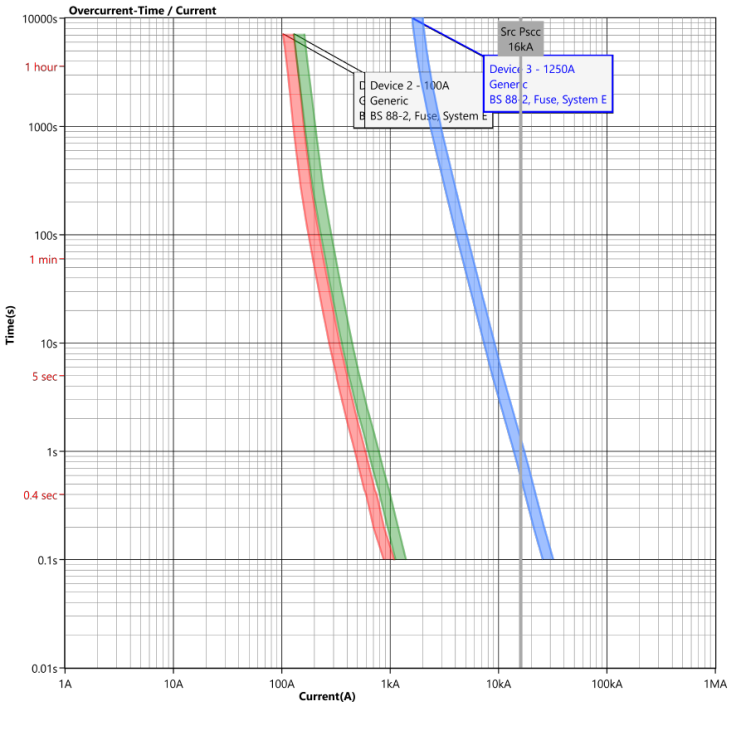
Note breaking curve for 80 & 100A BS88's - you can put nearly 25% more through them for 100 seconds. The 1250A BS88 is just a potential upstream protection device.
-
Is that 8kW output or input? Lets assume worst case and that is input, then I doubt it will pull full current all the time. Worst case is the two will therefore pull 65A solid. I would assume you're on an 80A or 100A BS88 cut out fuse - so leaves 15A spare at night. BS88 will not blow at rated current would be over 2.7hours, so even if you did peak 90/100A sometimes, on a 80A you would be fine. You can get EVC's which have CT clamps on the main tails and monitor load, if it peaks over a pre-set (you can per-set) value, it drops output to the EVC until it fixes. In my personal & professional opinion, I think you are fine. See if you can workout what size fuse you are on - only real way to know is to kill everything and pull it, means you need to cut the seal and you are not meant to, but if I have £1 for every time it was done I would be a millionaire.
-
How did you fit your PIR into wall cavity...
Carrerahill replied to Carrerahill's topic in Brick & Block
We have a 100mm cavity. I think I will cut the sheets down, I will try and make use of the longer (640mm) last cut piece in the gables and things. On your own build, I wouldn't go for the EPS beads full fill, keep the cavity clear, there for a reason for it, let it breath. -
I have a thermalite/concrete block cavity wall going up, 50mm PIR specified for the cavity. We will be doing the insulation, bricklayer said he can build the thermalite walls first leaving the wall ties and we can fit the PIR, or he will build thermalite and block simultaneously and we can follow him and fit insulation. The next minor issue is the sheet size, I just bought 4x8 sheets, I was sort of hoping to try and wrangle them in as whole sheets by poking wall ties through or something (I was not thinking it through when ordering materials) but I think I will make more penetrations and holes than just cutting them all square to 450mm and putting them in piece at a time, I can then foil tape them and foam joint any bad bits. So I was just looking for some feedback and thoughts from you guys as to what you did (or builder did for you). I am angling towards getting the inner wall up first, cutting the sheets to 450mm slices, fit it all snug, tape it all up, foam it where needed and make sure the corners are nice and tight and what not, and generally create a full building "wrap" of insulation.
-
I worked for a multinational conglomerate in their engineering division, essentially we designed solutions for clients, however, as part of the divisions within the firm we would sometimes spec our own equipment, this usually then led to someone from the sales department of said division calling us and wanting to get involved, we often tried to keep them out of it because we designed a suitable solution, not a solution based on a product we happened to sell. Anyway, we got involved with them and we ended up having some meetings with the client, an account manager flew in and we went to the meeting where I presented the solution, she just kept looking at me as if to say "what the hell are you doing" because I was using different manufacturers and advising against one system for another etc. Later in the car on the way back home I said to her, "I am an engineer, I will propose, to the best of my knowledge and abilities, a solution that best meets the British regs, and the needs, standards and budget of my client". She took it quite well and I also gave her technical feedback on their product as to why they were not suitable and she finally agreed with me, but I bet she is still trying to sell a product that might not actually be the ideal solution!
-
In-Ceiling Height Norm for Flats
Carrerahill replied to Jack O's topic in New House & Self Build Design
It depends on many things, like what is the construction, steel frame and concrete might have 100mm where steels run but up to 350mm between them. However, I would bet my bottom dollar on it there is not anything like 200-250mm of clear free space. I think you will need a rethink. Things are tight, developers like to minimise wasted height, also developers like to keep buildings under the magic 18m for example as then fire regs are more onerous, fire fighting lifts, maybe sprinkers... so they try and keep it lean, although your development will be well under that (I would presume) architects and developers still stick to a fairly standard building detail. Put it this way, my mechanical consultant colleagues often get called to site to discuss duct routes on flats as the voids are not big enough, even with flat duct! Dare I say it, a fold down TV sounds a bit OTT - save your money, there is a recession coming. -
Ah, that image is rather deceptive, I assumed that was a loft space or something! Yes no swinging from it then! In fairness, if you give it a good wiggle you will know. A little scootch of glue between the timbers in the middle might not be a bad idea to give you belts and braces and cheap solution for a few dabs.