


Gus Potter
-
Posts
2383 -
Joined
-
Last visited
-
Days Won
34
Everything posted by Gus Potter
-
Had to edit as my soft side kicked in.
-
Your post over lapped! You posted when I was writing! Steady on here.. Sounds to me like time for cool heads. Don't let that get to you.. surprisingly folk will sit for many hours/ days and write objections.. some are complete bonkers.. but it is a public service so some folk just like letting off steam. What matters to the planners. is relevant comment. I have Clients that have had some horrible things posted on the planning portal.. objections. then they get planning and the neighbours realise that they.. they (the new folk) are a good bunch.. and wish they had not written that stuff on the public record! Calm down and take step back. From reading your posts you seem to have some means so you don't qualify in my book as say a young person just starting out buying their first home . Me too have had brushes with the police so if you want a bit of help then as an old Electiricial (who was a Church Elder) that I worked with used to say. Gus.. the truth will set you free! @PXR5 I think you are not playing this off a straight batt Over to you!
-
Ok I get it, country boy myself, go beating / lamping and so on.. get your point. Play the it country way! Go canny, post some photos and lets see how bad the wall is and then you can get heavy with a few technical observations.. probably scare them off. The objective is to put the ball into their court and let them realise that to defend they will have to stump up some cash. Also you need to finesse.. you have chosen to live in the country for a different life.. don't come and try to change it to suit your ideal. In the country we shoot deer / foxes, have hounds and do vermin control. We eat deer..called venison. Waitrose sell the same but in a nice plastic packet... but most have been shot by folk like myself. Yes even farmed deer are head shot folks, they don't get put in a trailer like sheep and carted off to the slaughter house.. a horrific journey? But if you have ever been near a sluaghter house..it's not for the faint hearted.. the animals can smell fear. What do you want to do build development wise? Don't panic.. and stay away from the legal stuff for now.. you'll get lot's of help here BH. If you give a bit of info you can probably turn this around.. and let the new folk "see the light" and the benefits of living in the country. I think if you can hit them with the risk / cost element they may embrace the fact that country folk are not daft? I do wonder if this will get by the mods? Can I talk about how you design a house in the country and how that fits with the life in the country and where our food comes from. Mods.. if this sounds a bit blood thirsty for you.. what about this.. I kept free range chickens / ducks and had a few pheasant pens.. but they mostly the hens (chi9ckens) laid their eggs under hedges.. next thing a hedgehog comes along and scoffs up their nearly hatched eggs, the hens went nuts.. but for me the hog was a delight.. You see @PXR5 yes push back hard against the incomers wanting to make the environment like a city. If we don't the country and our way of life will be be lost to our kids. For those that live in cities.. if they all become one you will have nowhere to go for tranquility and that woke stuff called "diversity"
-
I laid it on a bit thick in my last post so please don't take it as being nasty. Yes post some pics.. and will be happy to chip in.. more friendly the next time!
-
This is also a bit for all on BH. I'll assume that you are going to build a home for yourself rather than just looking at this as a commercial opportunity? If so (commercial) then you should be sticking your hand in your pocket for professional advice and not be tooling about on BH for free advice as folk on BH also think about their neighbours. I do a bit of claims work I but don't just act for developers / builders I also act to defend home owners against development in an SE capacity. I hope you get my drift? Here is a thing. As an SE I do a bit of claims against say the NHBC.. by the time I get called up folk are often at their wits end, suffered a lot and have spent loads of cash, often unnecessarily. Positive note: Let's assume you are building your forever home.. you want to get on with your neighbours, some can become great friends, keep an eye out on your property when you are away.. gives your kids a neighbour to go to in an emergency or you too when you get older and need a hand out. That has a value. Holding that train of thought.. you want to get on with your neighbours... really you do in the long run. I'm stating the obvious but your neighbours may feel they were there first.. have ownership of the view / privacy and been able to plant up their garden the way we they wanted. This is human nature.. imagine yourself in their shoes? If you can't then you need to learn more about negotiation. I'm not suggesting you go all soft.. but to negotiate well you have to put yourself in your "enemies" shoes and if you want a forever home you need to compromise to get good neighbours and what you want without a big legal barny and the risk that comes with it. Lastly never under estimate your neighbours, some may have friends / have relatives who may be with KC's, Lawyers QS's, Architechts, SE's and CE's the list goes on.. and if they feel you are bullying they will jump to their defense and often work pro bono.. I do and can tell you I can quickly rack up the stakes for you just as an SE.. to the point where you will often wish you had never gone down the legal route. Imagine your neighbour came on BH looking for advice? How would that play out? To make a start on resolving something like this, your post suggests you are already frustrated? Go back to the start. Ask: 1/ Is the wall dangerous.. is it a high wall? say greater than 1.0m in height. Could it hurt someone. Lets say the boundary wall is 1.2m - 2.0 high. As a rule of thumb if the top of the wall is more than 1/3 over the centre of gravity then that is a good starting basis as an SE for making the case that the wall is not safe. Say the wall is in old money 1 foot / 12 inches thick. The middle third is 12/3 = 4 inches. Thus if the wall is leaning out more than 2" (50mm) at the top then you question the stability. Next is the condition of the mortar.. if it has deteriorated then that has to be considered. If roots have penetrated the wall.. again this leads to instability. 2/ What do I want to build? How close to the disputed wall do I want to go? Best thing to do is to mull this over at your end. Post a few photos and your ideas / plans. The good news is that you probably have more options than you realise, often with a bit of tact things can be resolved. I totally get that you feel you may want to go legal.. but you'll just suffer grief. The first thing you need to do is fully understand the problem. Why is the wall bulging and what are the consequences. Safety is paramount and that is where your best argument lies. Unless the wall is unsafe your neighbours are probably doing nothing wrong! It may well fall to you to prove it is unsafe. Also if you build something next to the wall that compromises it further then the responsibility lies with you.. be careful what you wish for!
-
Here a few thoughts, please excuse the spelling / grammer as "off duty". @ProDave Enjoyed reading your input, great points and observations you make. I'll try and add a bit where I can maybe fill in some gaps for you. But first there are a couple of pedantic thoughts do you really have a 1990's TF.. lets clear that up first. The 140 block flags up.. normally it would be 100mm thick for a UK TF. Forgive me if I sound a bit odd / pedantic .. it's just that there seems some discrepancy in the description of the thickness of the blockwork. I know you have probably copied what you can from the old drawings.. but what flags up and this is why I'm asking is the cavity thickness 25mm. As a minimum it should be 50mm for TF. The EPC also seems to suggest that you may not have a real TF? @Space Race In Scotland we have the home report system. There are good and bad bits about this.. I could write at length.. for another day. But basically they are so heavily caveated that they don't provide the info you need to make a reasonably informed offer., a big hole is a real consideration of how onerous the maintenance requirements may be for example. Tenement flats are worse so be glad you have the info you have. But you also need to cut the surveyor a bit of slack. Anyway.. I may be wrong but have been "pedantic" as best to ask the daft questions now rather than suffer later. Ok my thoughts are.. do you really have a TF of do you have a more traditional type of construction.. solid walls strapped on the inside. It is not unkown.. folk used to take a solid wall construction, mitigate for vapour / condensation and strap and line. If you are say in the NE of Scotland.. there were a lot of folk who had grown up in solid granite houses.. they wanted something just as robust but a bit warmer.. hence a cavity and an insulated TFnon load bearing lining. Say that is what you are looking at.. then make another visit and look carefully for cracks / sloping floors etc.. post here what you find. In the round though if you do have some form of solid wall construction (the blockwork does the structural heavy lifting and resisting the big winds you get in the NE of Scotland) then it is not a bad thing. If you do have a TF then the good news is that it is probably very drafty (less chance of rot setting in) maybe has 75 -100 mm of glass wool between the studs. The studs could be 89mm x 38mm .. that is a Canadian lumber size, they may be 95 x45.. UK metric graded size or they may have just used ungraded 100 x 50 as this can work too. I can speculate but.. little point at this stage. In the round though if it is a solid wall construction it probably makes it easier to upgrade to a modern standard. Post more if you can and we'll all chip in. Ok you are thinking about offering on this house. What are the risks? If it has stood since the early 1990's then the skeleton is probaby robust enough? If you are a Build Hubber and going to gut the place then actually the solid wall may turn out to be a bonus once you get to air tighness, insulation detailin and running the services you want. Best thing to do is post a few photos / more of your thoughts, provide a bit more info and we will all keep chipping in.
-
Calculating for the use of sand for a thermal store.
Gus Potter replied to Marvin's topic in Boffin's Corner
What a great thread. @SteamyTea you have encouraged me to bush up on my maths in this area. Thank you. -
Good for the sole to help out. My thoughts are: That extension is quite long 6.0m and will pick up a bit of wind on the long sides thus you need to stop it moving sideways in the plane of the main rear elevation of the existing house. You starting point here is to ask.. can we transfer all the sideways wind load to the existing building and how do we do that.. and is the existing building able to take the extra sideways loads. It looks like a terraced house. One commonly accepted principle is that if you live in a terrace your house has to take it's "share" of the load. In other words you can't shed load onto your neighbours.. because if everyone starts doing it you can destabalise the whole terrace of houses. The back door introduces a significant break in the load path, that is an anomoly particularly as it is next to a pier which will probably be carrying quite a lot of load from the main roof.. it will protest if you try and use it to hold an extension still. My initilal thoughts looking at the geometry is that you'll need a goal post (steel portal frame) along the front elevation of the extension. If it only extended some 3.5m from the house then you may get away with that masonry return on one side. I would recommend that you speak to an SE.
-
Council Tax Blow!
Gus Potter replied to richo106's topic in Self Build VAT, Community Infrastructure Levy (CIL), S106 & Tax
Good spot that crack. Have been following this thread but don't know enough about council tax rules etc in the rest of the UK.. Scotland's are hard enough! Can't say much about the crack just from the photos.. other than yes there is some movement but it does not look like you can put your finger in it.. if you could then you would be thinking major movement.. temporary structural stability issues.. particularly if there are other cracks / things dropping elsewhere. For me I would want to see the whole building in person before making any meaningful comment. -
Council Tax Blow!
Gus Potter replied to richo106's topic in Self Build VAT, Community Infrastructure Levy (CIL), S106 & Tax
This is a good view. Some are "slow", some are just young and learning what is a very big subject.. need to speak to their boss. -
Welfare facilities under CDM
Gus Potter replied to Post and beam's topic in Project & Site Management
I think this could develop into a "hot topic"..which will have an impact on BH members.. how much I don't know but there will be some form of cost attached. BC in Scotland are having a big drive.. lots of CPD and seminars. I think this may get picked up on in the rest of the UK if not already. I'm certainly not against this as we need to make our housing / building stock safe. Getting PI cover for fire is let's say.. not easy and it takes a lot of time to understand what cover is being offered by the brokers. While I would like to give lots of particular detail I won't as it is commercially sensitive from my pont of view. I'm in a bit of an odd position in that I often do the SE stuff plus the Architectural side of things. Often (not all the time though) the SE say's.. fire protection is for the Architect on smaller domestic jobs, even larger projects. The SE says.. I need one hour here, two hours there and so on and leave it up to the Architect to detail it out and thus it falls on their cover. But the way I see things at the moment in terms of risk is (my view may change) this. The designer's risk can be split into two broad categories: 1/ You botch the fire design in terms of your design, the building goes on fire.. occupants get killed / injured, the building collapses and kills members of say the Fire / Rescue services or the building starts to come apart at the seams and sets fire to surrounding buildings. The above is what we have been designing for traditionally... but Grenfell changed all of that in that the system of checks and balances fell to bits.. if one person had made a stand.. and been heard / action taken then maybe Grenfell could have been avoided. Now due in part to the Grenfell enquiry light is now being shone into the darker corners.. the way manufacture's have been presenting their test data, the way designers have been interpreting the data and the commercial pressures that are brought upon the local authorities to bow down / approve and not question the "big commercial" interests. I know of one BC officer who a specialist in fire design.. but the funding is not there to allow them to challenge the big builders and so on. This type of herd behavoir leads to bad design.. unsafe design. 2/ A good few of the manufacture's have withdrawn data and design guidance. Why you ask.. what is the reason for this? My broker explained to me.. the problem Gus is that now there does not even need to be a fire. A Client can come back to in a couple of years and say.. remember that building you designed.. well we are worried about it and are going to raise an action against you.. that leaves the designer facing big defense costs.. you are trying to defend against a hypothetical scenario.. now that could be hard and expensive if the manufacture's have pulled their data not least. I have figured out an approach that I think is a reasonable balance of risk, everyone will have their own approach. Part of my strategy is to communicate with the Client, other designers and discuss how we are going to design something safe. Have the hard conversation at the concept design stage about who is doing the fire design.. this is like being a Principle designer (PD).. someone needs to coordiante the design and make sure all the different elements are safe when put together in a system. If you do this then while some may sue few will win (hopefully none) as you have acted responsibly and designed well with an understanding of the materials you are using and where you put them and how you interface them. -
Welfare facilities under CDM
Gus Potter replied to Post and beam's topic in Project & Site Management
Yes given the size of contractor you were 20k was not that bad. When I was a Contractor I had about 10- 15 full time staff and paid about 5.0 - 10K a year for full insurance. Full contracts work... the whole shebang. Over the years premiums went up and down.. providers left the market and so on. But so long as you were marked down as an "honest broker" all in the round was ok. Now the Pi Insurance. At the moment fire is a big problem. It is happening in Scotland.. BC are having a major clampdown. English BC will follow .. but the main thing is that SE's are finding it hard to get fire cover.. the manufuacurers are pulling their data sheets big time off the internet...that is all I will say for now. -
Beam and block external patio
Gus Potter replied to DeanoFromTheDock's topic in Landscaping, Decking & Patios
Can you report back on what your SE says? -
Beam and block external patio
Gus Potter replied to DeanoFromTheDock's topic in Landscaping, Decking & Patios
All the best. Yes it was a long reply.. then main thing is that if you read my post I was not just writing for you really.. it was for everyone on BH.. we all pinch ideas and discuss design be it planning or all the other issues. If you want more help then post more on your thoughts. If you give a bit on BH you'll find that you get much more in return. -
It is from time to time Jilly.. like a lot of jobs there is paper work/ compliance. That is less fun. You maybe have the same in you profession.. someone said to me when I was in my twenties.. if you can find a job / something to do that really floats your boat.. that you really get off on for 10 - 15% of you waking day then you are doing pretty OK. We also concluded that if you look back on say a year of your job and you had less than 5% enjoyment then it is not good for your mental health. Time for a change? Now you could say.. hey Gus you are blinkered.. but I spent a big bit of my childhood in Africa, met folk who were into preserving the wildlife.. David Attinbourgh wrote books / referenced them.. but I can tell you that all these folks worked pretty hard and had to do mundane stuff.. just like us in the UK.
-
replace floor/ceiling joists -am I insane?
Gus Potter replied to Crowbar hero's topic in General Structural Issues
No that is far from crazy.. more a good understanding of how things work and the theory. Ok SE wise @saveasteading is bang on so not crazy at all. The idea is that you make the floor beam deeper so it acts like a deeper timber. Yes you can do this on the top or the bottom of a beam..great idea from @saveasteading it's these small ideas on BH that can save you loads of cash. To make it work you need to make sure that what to add to the top or bottom of the beam is connected to it in such a way that is acts like a solid timber. The best way to do this is to use a structural glue and really clean the mating surfaces. Any dirt is a no no as the glue does not work as intended. Modern structural glues are stroger than a typical softwood.. D4 glue is NOT a structural glue specification. The D stands for DURABILITY.. not structural STRENGTH.. hey folks the clue is in the prefix.. it's a D so don't use it in a structural application and expect your SE to sign off! No point in me pointing out just the problems.. solution is use say Cascamite or similar glue.. this is a STRUCTURAL resin glue and by default meets the durability requirements. But both D4 and resin glues are very hard to clean off your hands so wear gloves! In my day job I'm reluctant to do this plating of timbers unless I really know who the builder is, that they will do what the are told and that the Client is willing to pay the builder to do what is quite a technical job. Alternatively a Client can pay me to supervise the job.. but often they don't want to pay for that last and most crucial part..I have probably saved them thousands by being an old sckool SE.. such is life. But as we are BH folk we will spend that time and attention to detail.. you are more inclinded to do it right! That lifts my spirits as it does (I'm sure) for the MODS and all the other folk that post on BH. Where the ply comes in is that you can also use ply to act like a wider flange like on an enginnered joist and that can give a lot more bang to for your buck. But you like an engineered joist you can't then go cutting service slots and holes in it. It a long storey but @saveasteading has put forward a nugget / great solution.. all you need to do is think if it suits your application. it sounds complcated but if unsure post loads of info on you project / ideas and folk will chip in on how it all could work for you. -
Welfare facilities under CDM
Gus Potter replied to Post and beam's topic in Project & Site Management
Thanks Peter, that is interesting. On my PI I have acting as PD for about 5% of my jobs and it seems to have little impact... I wonder if it was the "Contractor element" that sent it haywire. What I can say is that everyone is struggling to get cover for fire protection design. The insurers are running a mile.. BC have been having major seminars and asking for all sorts.. the material manufactures are pullinng their fire data off the web.. In summary I have spent loads of time over the last few months sorting out fire protection.. -
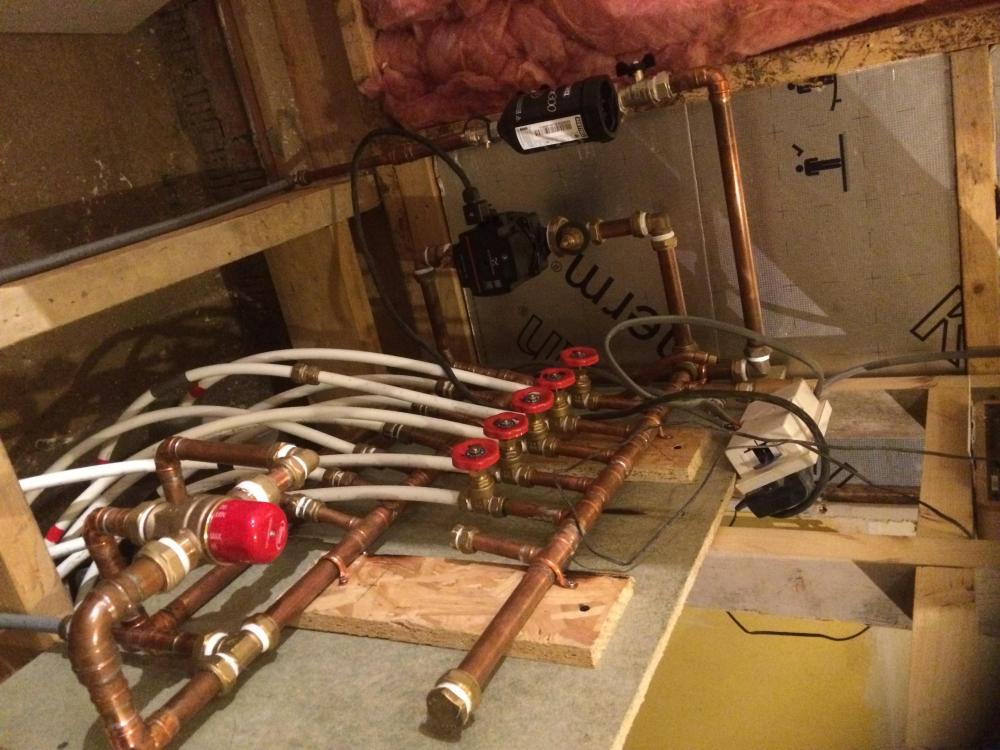
Thanks folk for all you comments and time spent writing. Trying to digest it all at my end and thought I would respond in a way longer than you.. I have an ex council house, extended with a hybrid system. Thus new solid concrete slabs and retro fitted timber suspended floors Rads on the top floor I oversized them to keep the flow / return temperature down to promote the boiler to condensate. Ground floor has a combination of retrofitted UF on the old timber suspended floor with and extenion that has a concrete slab. It sounds dog rough but I made my own manifolds and it is really simple. Few electronics. But it is user friendly and simple to maintain. The house is much bigger now and we use less energy to heat it even though the house is much bigger. If things break I can fix it in an hour roughly.. don't know as have had no problems. Look folks.. this home automation.. have you factored in how often you are going to have to replace the different parts? Also who other than you is going to be able to fix it? You could be doing something that detracts from the house value? I'm all for technology, I'm a pretty innovative designer, love working with new materials and learning about their behavoir.. but I also as a designer I need to give best advise to my Clients and that includes ongoing potential maintenance and often environmental cost. Relpacemnt of parts is also an environmental cost.. intuitively the less parts the lower the environmental cost? I'm just asking you to think about this, I'm not slagging the concept off. I'm not kidding you.. I got a guy in to service my boiler.. he has a PHD.. but became a heating enginneer, he had the cheek to say to me you are asking me tecky questions and you are asking me to give away my trade secrets, my response.. hey donkey if you want play that game.. and this is from a guy that works with a regular contractor that I do design work for. I am paying him to be techy with me and want sensible answers.. ground my gears. The point is .. keep it simple.. yes if you want to make your house high tech.. fine but I would not buy your house... unless you can produce a full and verified O & M manual.. otherwise you could buy a pup! High tech can be an appreciation of simplicity and how you get the best out of it. Folks UFH is supposed to be simple that is the elegance of the principle. I'l say agin UFH is supposed to be simple and environmentally friendly! It works great when you design the rest of the house to suit. It's holistic design. I designed my first UFH some 25 years ago. The Scandinavians have done it for much longer. Lets just look at the cost of all the controls, flow meters, zoning, automation. It will probalbly be fine at first installation but just wait for two or three years.. then when things start to fail, getting replacemet parts.. good luck to you. Yes weather compensation works but when you look at the lifetime of the buildings and they way folk use it.. I'm not sure about how friendly it all is. The house I have at the moment has hybrid floors, all sorts of nuances but as a kick off I just built a simple manifold DIY.. it's working great, to set it up I just put my hand on the flow and returns pipes and crancked down the really hot ones. yes folk say I should not use gate valves but I did this 25 years ago.. if one leakes.. a couple of quid to fix it. To say again..UFH is easy to design, the controls can be very simple. There are some basic conservative rules. For 15mm pipe keep the loops under 75m, DO NOT over bend the pipe. MAKE sure you get plenty flow rate.. it can be turned down. It is really simple with common sense. If you are using a pug mix my own view is that you should pressurise the UF pipes to say 4 bar then pour in the concrete. Reasoning is this.. the pipes need to last for 50 years. The heating system may run at about 1.5 Bar but will expand and contract over the length of the runs. They have bends that are in the pug mix.. thus abrasion will occur. The pressure relief valve on a typical system is set at 3.0 bar.. in the round the 4.0 bar pressure at time of laying the pug mix will be just enough to compensats for the screed shrinkage and movement in the sreed plus say movement in the structural floor.. my gut feeling is that this will allow the pipe to last 50 years. To put this into context. I did my first UF system some 25 years ago, have been keeping an eye on others and had hand in others for some 30 years.. have not seen signs of abrasion in the UF pipes in a pug mix to date. To be honest when these pipes were installed they were sold as barrier pipes.. to stop oxygen ingress, I though it was a bit bollocks at the time but the boilers have held up so maybe it was not sales bollocks after all. Nice to be proved wrong. Yes if the weather suddenly warms up there is a lag time.. but all that happens is we say.. it's warm outside and the house is a bit warmer.. but that can happen on a sunny day too as we get a lot of solar gain. The thing is that in the UK UFH is great but from time to time the house may get a little warm.. it is rare.. just open a window or the door! There will probably be folk going in and out the house anyway so any heat model you make it likely a bit rough. Save your money folks and go for the most simple system you can.. have a look at the Sputnik that the Russians sent to the moon. .it had gate valves (look like Screwfix today) brave boys right enough. Think.. how much is my home automation going to cost vs a Guses "Fintstone" design.. If there are any takers I'll be happy to defend my design approach as I think this is the best environmental choice and most cost effective in the long run. There is one caveat.,. you need to make sure we are debating on a reasonable insulated external house envelope. There you go have stuck my head above the parapet. In other words.. I'm saying that for UFH go for the simple stupid, low maintenance solution. Save yourmoney and spend it on the insulation envelope.. or if you have large areas of glazing then spend you money on sinking the solar gain into an internal wall to be released later. I know folks on BH debate thermal mass.. but that is not what I'm talking about.. more the concept of how a Tromb wall works and how you start with the paint finish and store the solar gained heat from that. @tuftythesquirrel When I say simple DIY UF manifold have attached the prototype I talk about above. Yes I know it is probaly a million miles away from what you envisage. But it works, is cheep maintainable and reliable.
-
Welfare facilities under CDM
Gus Potter replied to Post and beam's topic in Project & Site Management
No need to applogise, you are asking a great question. I hope this helps. Not often I caveat what I write on BH but in this instance I do in that my following comments are without predudice. Also forgive my spelling / grammer as this is informal. In the selfbuild market and just for folk building an extension the CDM statutory legislation has wide and very onerous implications. @Post and beam I'll start with some general thoughts on how you deal with / things to think about as a self builders / say an extension and then try and offer some thoughts on what you maybe can do next. I have made previous posts on CDM but the concept of the statutory legislation (the stuff you can go to jail for) is this. The big buildiers used to kill lots of their workers. Once we reduced the mortality / injury rate rightly the focus turned to small builders / the self employed and folk building their own house / extension. Some self builds can be very substancial projects! Some small attic conversions can be partcularly dangerous as you can loose a lot of stability in a gable wall. A small gable wall can kill easily if it falls over and old buildings can be unpredictable in the way they behave... often as others have mucked about with them in the past and there is no record. Now it is actually fairly easy to comply with the CDM regulations, much is common sense. If you don't then you run the risk that you may get drawn into some thing that is no fault of your own. One example. You get a quote from a builder to do an extension. One of their employees gets hurt. HSE turn up and the employee gets a lawyer.. at some point you will get sucked in and this will probably cost you money and be very stressful. The key to avoid this is as soon as you start to talk to your Designer / Architect / builder ask about CDM? It sounds odd but CDM pretty much kicks in at the conceptual design stage. You can look up the latest RIBA advice, but the simple way is to think along the lines of.. health and safety is an intrinsict part of any project.. it is part of the design from concept onwards. Major contractors will set aside some 3 -5 % of the project cost to keep everyone safe.. this also applies to you! Ask yourself.. can you afford to build and not kill anyone.. frankly if someone gets badly hurt on your build you will find it hard to live with.. I have been on sites where folk have been killed.. it bears heavily on you. As a self builder you could rack up some big legal costs.. trying to defend even if you are not at fault. The thing is that we live in a claims culture.. you have an asset that folk can go after. While you may not be directly to blame a claims lawyer will pick the easy target. I was up at an IStructE talk.. one thing the presentor made clear was this. Folk know that SE's carry a lot of insurance.. so we are prime targets for an easy claim. You as plot / home owners are also an easy target, defending any claim is going to be horrid. Now I design a lot of wall slappings.. making a house open plan. Here it is pretty straight forward. I talk to the Client, do my Planning / SE BC drawings and calcs. The objective is to allow them to get builder's prices. But there is a big bit slapped all over the drawings that says that the Client is a domestic Client and the builder has to take on the duties of the Client also. This reflects the current HSE advice and it also works.. as often I get a heads up on who the contractor is.. I avoid if possible the cowboys. I also do a few other jobs that are larger. Here is a thought. You should factor into any build cost the 3 -5 % for safety.. ask you Contractor this question.. if they have no answer then ask.. where does the risk lie? On a selfbuild as soon as you start to talk to say an Architect / designer raise the question about CDM . They will guide you. If you are a seasoned self builder then anticipate what I will require (SE) from you before I touch your job.. how do we allocate responsibility and risk? It sounds complicated but it's not.. often we look at things and say .. if we want to build a high wall how do we brace it during construction? Often it's these things that kill folk and it's not hard to design to keep folk safe.. the important thng is to catch it early. Funnily if you think about these things early is also leads to good economic design. Sometimes the temporary works can be used to brace the building .. everyone is a winner! I have laid it on a bit thick above but in summary what I'm say is grasp the nettle early if you are self building or doing a big extension that you want to manage youself. I would go back to Potton and ask for help. Your opening gambit may be to write along the lines of... 1/ I have tried my best but I'm stuck. Just be honest.. as a domestic Client this can carry a lot of weight, mind you I write to folk.. hey your data tables are not clear.. can you explaIn.. ? Best to ask as a dafty and appear thick rather than invite disaster? 2/ I want to buy your product but just don't understand the health and saftey (CDM) aspect not least and what I need to do. 3/ I am a novice and need guidance from you about who for example is the Principle designer. 4/ I recognise that I may have missed some key stages in the design in terms of HSE planning and CDM compliance but I want to get back on track. 5/ Please can you help me. Can you put me in touch with your HSE person. Now that may get a result. It is a double edged sword.. you write in such a way that while asking for advice.. if they don't provide it or give answer it makes them potentially liable. If you don't then you can start to play hard ball. 1/ Refer back to their offer.. they should have mentioned who is the Principle Designer.. the PD.. and ask again. I would be very surprised if their HSE person does not get in touch and help you out. If you deal with the big ticket items they will probably tell you what to do with the bogs and so on. -
The tolerance that the brickie is allowed in the verticality of the block work. I have an old Elu table saw, good 300mm dia blade and expect to have to rip down the door standards on occasion, facings and stops from time to time.. use old scool skills to hang a door. You can buy door sets.. like you go to Kwik fit, but if you want quality expect that a door will take an extra 6 hours to fit right and remain right for many years. I have used hard woods that are oiled hence part of the extra time. Take your time on hanging doors and forming the door sets.. in my own house I spent ages fitting them.. they just shut great, tight and will remain so.. but it takes time to get this quality job. You also need good quality ironmongery. What has made the job easier when I look back is modern adhesives and the invention of the chop (mitre saw)... but if you have a finishing joiner turning up and they don't have a sharp hand plane.. then they probably don't know what they are really doing. If you are having really traditional finishes you may not want to use posidrive screws on the hinges, to keep things authentic you want to maybe use slotted wood screws.. the slot in the screws in a traditional hinge should be vertical when tightened.. this is to stop the oils / paints from dripping and the slots should all be in aligment.. yes it's those details that matter.
-
Beam and block external patio
Gus Potter replied to DeanoFromTheDock's topic in Landscaping, Decking & Patios
In principal you can use beam and block externally. In Scotland you can (in the right circumstances) have B&B over a a raw soil solum.. i.e no DPM with solum screed. They can stand a damp environment. But there is one big caveat. As a bit of background the Champlain Towers South in Florida that collapsed, I think the documentary is on I Player. There is one school of thought. They had a swimming pool and the slab connected into the main structure. They did not realise that the swimming pool slab was "really tied in" so when it failed it pulled the rest of the building with it. If you asked me to design this I would want to play safe and say.. I want you to make sure that the B&B floor / roof is subject to no more a harsh environment that they would be say in a ground floor. In other words it needs to be waterproofed from above. One main reason is that some folk put salt on their drives and patios in winter weather. Folk may get too keen on fertilising pot plants.. again these chemicals can promote corrosion of the steel in the beams. Reinforced concrete can protest and this can lead to failure that will drag the house with it. Yes I know you may not do it (use salt etc) but subsequent owners may be unaware. For all @DeanoFromTheDock is cracking on and has a big chunky retaining wall. Looking at the photo the design looks reasonably balanced as the house is not that wide along the road elevation.. but if it was a little wider then it opens up the possibility to make big savings on the retaining wall. Here you use the house to brace the retaining wall at the top and that can be a game changer in terms of retaining wall cost. Depending on the soil you have and the loads on the ground uphill there is a trick you can deploy. We know for example that some CLAY soils can push quite hard horizontally against a retaining wall. This can be great if you are doing a passive build or eco freindly house. You are probably using EPS ayway so can get a good deal on price. What you do is to dig out more of the soil (if you have the space) and replace with EPS.. this takes out a lot of the lateral soil load, you brace against the house (If you are using ICF walls they can offer great stiff sideways/ horizontal support).. in other words you look at the design holistically and get try and get every bit to work most efficiently. Oh but it sounds like I could sell you chalk from the Downs.. but.. here is a pit fall. If you use this trick you have to be sure about how you are going to control and understand the ground water. EPS floats so you need to check for "ballast".. if not you could wake up one morning and find your EPS is now blocking the view from the windows.. not a good look if you are the designer. @DeanoFromTheDock Let us know what your SE thinks. -
replace floor/ceiling joists -am I insane?
Gus Potter replied to Crowbar hero's topic in General Structural Issues
Great point @Annker Something looks a bit odd here. From the info you give I have understood this is definitly the first floor. On these 1930's houses you often find that the first floor joists are 1 1/2 " thick ~ 38mm. The old rule of thumb is when working on a 2" thick joist is to take the span in feet( 3.5m ~ 11.5 feet) divide 11.5 by two .. 11.5 /2 = 5.7 and add two inches for joists at 2' centres. Thus 5.7 + 2 = 7.7.. about 8". By inspection you can then say.. a thinner 1 1/2" x 8" deep joist looks about right at 18" centres. But you may ask.. why did they go to the bother of putting in thinner joists at closer centres. One reason is that the closer centre joists lets you make the floor boards thinner. In todays money we know that for domestic floor loading you need 22m thick chipboard for 600mm spaced joists and 18mm thick for 400mm spaced joists. Measure you floor board thickness and let us know. But you mention you have 4 x 3 floor joists. Yes the width is a lot more but I suspect you have a steel transfer beam hidden in the floor that you have not found yet. Even though you have much thicker joists I doubt they are spanning the full 3.5m. You may find you have an old rolled steel joist in the floor depth acting as a transfer beam. If you are able to drop the ceilings then there are a few things you can do. But you need to know about this transfer beam. For all. Lets just say you don't have a transfer beam. You want to add UFH, beef up the sound proofing, make the floor less bouncy and say make the ceiling more level as it may have sagged over time. The easy way is to just bolt and glue deeper timbers to the sides of the old timbers. This stiffens and strengthens the timber between the walls. But at the ends the new timbers don't get embeded into the walls.. you leave the walls, bearing and restraint as @Annker alludes to. But now you have created a stronger timber with a big nasty notch at the end where it bears onto the walls. When you check this you'll often find that the timbers now fail in shear at the ends and the grain wants to delaminate / split not least. You can get round this sometimes by using steel straps at the joist ends .. like stirrups. You can see this with Engineered joists where the top flange is the bearing part on the wall head, they configure the nail plates to act as stirrups. @Crowbar hero If you want post more info, a few sketches would help a lot. -
Just a quick thought. Got called out to a job a few months back where the structure was unstable. Builder had got some props and so on. The key here was to stop further movement until it could all be examined and understood. The temptation is to make the props tight and whack in bracing tight. This is the wrong thing to do. Nine times out of ten.. put in props and just nip them up. Bracing.. absolute finesse it, just there and no more. If you crank up props and braced hard you can make things worse. A building will do it's best to find alterantive load paths before it falls down. If you start cranking up props hard you can lift the last bits of bearing and that often causes more problems. Most often temporary support is just there to stop things moving more until you can work out the best solution.
-
Absolutely! When in panic mode have something to eat, save the skin though as a real haggis has a flexible sheeps gut. On more a serious note if your are heading out to do an investigation as an SE you have two choices: 1/ You can pitch up on the job and say to the Client.. can't do that, this and oh I can only look at what I can see and I have my chocolate fire guard.. I open stuff up by myself. But when you do that you risk.. falling through a ceiling, busting pipe and cables. On a job that is structuraly unstable you have two choices.. turn round and say to the poor Client.. oh I can't investigate as we need a Contractor who I can pass the can to.. or you can just get stuck in. I'm old sckool and carry insurance to get stuck in. At the end of the day it is hard for folk to sue if you act in the interest of public safety. We are Engineers.. be confident in what you do. An old mentor of mine said.. learn as much as you can, some may sue but if you know what you are doing none / few will win..yes your will have some sleepless nights but your PI will pick up the legal costs of folk chancing their arm. I run about in an old Astra Van on an 05 plate. In the back is.. apart from my tecky and first aid stuff / surveying stuff is.. 1/ Dust sheets, a mop, bucket and cloths. 2/ 30 amp junction boxes 3/ A selection of terminal blocks / 2.5mm and 1.5mm cable and other stuff just to make electrics temporarily safe. 4/ My plumbing tool box.. stop ends.. 15, 22 and 28mm pipe.. all the stuff I need to fix small leaks.. plus a big set of crimps and bungs if I get a big burst a big pipe. here all I want to do is to reduce the flow so things don't flood. 5/ My general tool box.. and boxes of screws and fixings also a few small bits of timber. 6/ At home I keep some Acrow props and a few lengths of 6 x 2 and 4x 2 timber that I can nip back for. If a problem occurs I evaluate, eat some Haggis and all is well. No need for panic.
-
Not at all.. I did not read it this way. I can see where you are coming from.. good economic and practical design insulation wise. Please don't take this as being critical.. we are all here to help each other on BH. I laid it on thick in my earlier post to try and highlight the SE side of things. To touch on the technical. The regs in Scotland are different from those in other parts of the UK, tend to be more onerous. You mention various detailing of the construction.. I read this as standard stuff until I came to the bit where you were running the battens horizontally.. now that is clever. Normally as a starting point I would take a TF wall as having 15% repeating bridges, in practice a heavily load bearing kit will have a bit more than that but BC don't often complain. That said from a buildability point of view you still need the dwangs / noggings so they would need to run vertically and your average builder would probaby stuggle to fix these without splitting the timber. For me it all sound great until you look at buildability, Yes it you were doing a 7 storey student accomodation block you could educate the Contractor but on a one off small build... it can limit your options. For all on BH.. if you get too "fixated" on some detail that will save you a few mm of insulation it will work against you.. better to make it easy for the builder.. get more quotes and say.. I'll spend the saving on extra insulation in the walls ratherthan asking for complex details around windows / doors or tight level tolerances. Also for folk building you own house. This is about people management.. yes you don't want to get ripped off but if you do get on ok with your builder you want to keep them to the end.. then they too can see the end of the job and will make an effort to finish it off...their pride will often kick in if you don't get too tight with the money. I used to be a building contractor before I became an SE so speak from experience. Like your ideas about sound performance and just practical stuff like fitting pictures.. that holds weight.. cost the same to screw the plaster board.



