IanR
-
Posts
1841 -
Joined
-
Days Won
6
Everything posted by IanR
-
Under the raft in a twin pipe, pre-insulated duct.
-
Yes, because the context of the discussion at that point was about the vehicle, as I was responding to: Which, I quoted. The EV manufacturer can't offer V2H, as that requires infrastructure at the property. The Vehicle manufacturer can only offer V2L, it's then up to the property owner if they want to take the next step and utilise the vehicle's V2L for V2H. It will suit a lot of users, but not all. The automotive manufacturer wants to increase the value of the in-vehicle battery by replacing the need for a home battery, (or significantly reducing the required size of the home battery). A combination of storing excess solar PV, and low rate, nigh time electricity, can be used by the home when the solar is meeting demand, and still leave enough charge in the vehicle for the regular, short journeys. Some scheduling on the vehicle or charger side will be needed if there is an irregular, longer journey planned to ensure the vehicle has sufficient charge. Faster charge and discharge rates at home (than standard 7kW), will make V2H more effective.
-
Bi-directional "charging", while it's term used for V2H chargers, it's not about actually charging anything back in the home, just allowing the power to flow from the vehicle's HV battery to the house. V2L and V2H are the same from the automotive perspective, it's the home charger that allows the power to go to the home via the charging socket. Yes a V2L vehicle will be able to power tools and appliances directly, via a 3 pin plug socket, but the hardware included on the vehicle then opens up V2H via a bi-directional home charger.
-
Of course, and I was specifically referring to V2L. I can't see a route to V2G. I don't know how the government incentivises the charger and solar industry to reduce the value of home batteries and increase the value of automotive batteries.
-
But that is changing now. Newly developed vehicles being introduced now and in the coming near future are offering this as an option. It's the home chargers that need to catch up and offer bidirectional 22kW charging at a reasonable price. To make use of V2L, the charging window will be reduced so EVs need to charge faster at home.
-
Since you are planning a significant refit, including ground floor UFH, you have plenty of opportunity to insulate well and improve air tightness. There should be no issue providing space heating and hot water from a single phase powered ASHP, but you'll need to calculate the predicted energy loses and pay careful attention when the work is done to ensure no corners are cut.
-
How much oil do you use a year? and do you have any other space heating installed, ie. log burner etc. A well insulated and airtight 300m² house could be comfortably heated with an 8kW ASHP. But, how good is your insulation and are you prepared to update?
-
It's the type of planning permission that allows it to be a separate residential unit, the LPA don't need to get involved after they've permitted the creation of a space "Ancillary" to the main residential unit, or add any additional conditions. The Land Registry would allow it to be separated on to its own Title, but if someone bought it and lived in it, they'd be in breach of its planning permission and would likely end up with an enforcement action against them.
-
My experience is that an LPA may have no issue with an annexe that is ancillary to the residential dwelling and could include the kitchen and bathroom, but would not allow the same out-building to be a separate residential unit that could be split from the principle dwelling and sold. The issue being the creation of an additional residential unit. Once a building has planning for residential, it can undergo internal only changes, without planning, as it is outside the planning definition of "development" (as long as it doesn't materially effect the Use Class)
-
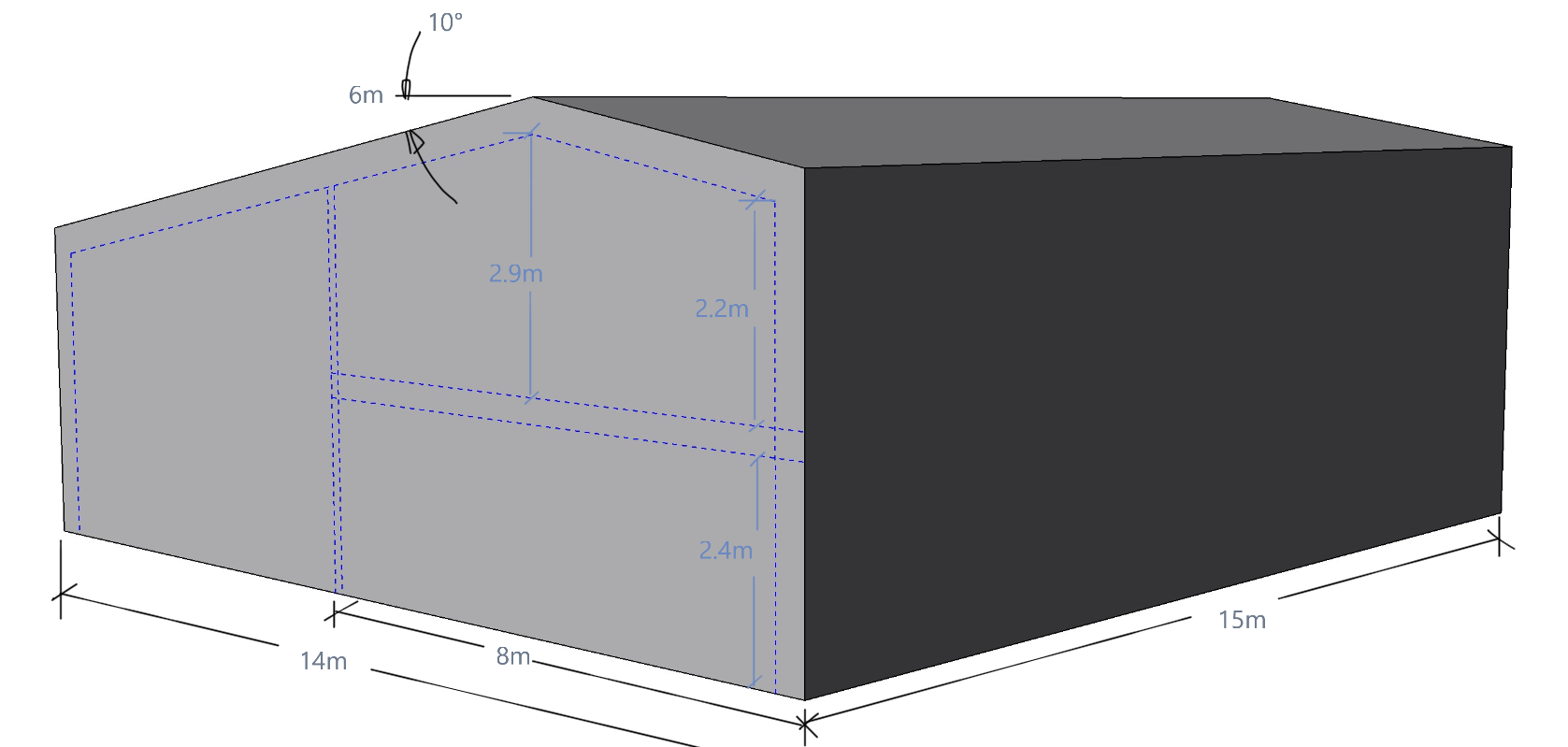
 When you say a "contemporary barn style", do you mean a contemporary re-imagining of a traditional barn, or of a modern barn/shed? Traditional barns do tend to have a 45°ish pitch roof, but modern barns/sheds will have a 10° - 15° pitch. I don't know what size of dwelling you are seeking, but from your comments it suggests a moderate to large dwelling. I may be wide of the mark, but the below proportions follow the form of a modern agricultural barn/shed and give a GIA of circa 300m² under a 6m ridge with a 10° pitch. Perhaps you could post some images of what you are thinking of.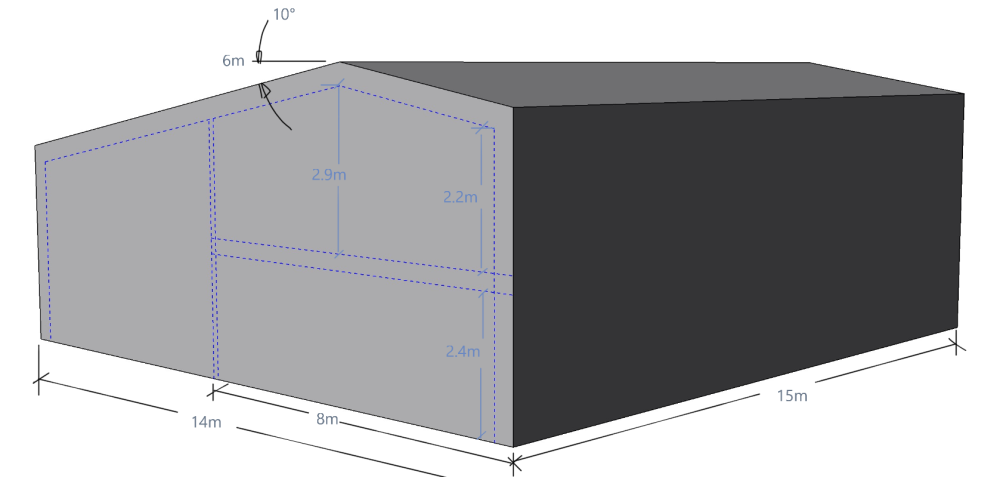
-
Ideas wanted to pass Part O Simplified modelling or to use Dynamic modelling?
IanR replied to Susie's topic in Ventilation
I didn't look too much into integral blinds. Internorm at the time only offered blinds on opening sashes, and they were then between the 3G unit and a 4th pane. Norsken, who I was also considering, did offer them within the sealed unit, but I felt the cable going out through the spacer was an unneeded risk to the unit. I do wonder if there's likely more radiated heat from a blind within the unit, especially for a dark blind. Integral blinds were also more costly than external blinds. -
Ideas wanted to pass Part O Simplified modelling or to use Dynamic modelling?
IanR replied to Susie's topic in Ventilation
You've said "no" to 'Shading provided', but your three large windows on the Southern façade appear to have an overhang, which would provide good summer shading to those windows. If you need more shading, you could consider external blinds on the 3 windows on the Eastern façade. They need to be automated to be effective, so it's not the cheapest option, but should be able to be hidden under the cladding, so no need for any planning changes. -
The planners may well be open to a change, but you'll need to request it formally, hopefully just by varying a condition (drawing update). Once you know what your preferred roof finish is it's worth a chat with the planning officer.
-
Is the roof finish detailed on the drawings? You likely have a condition that states the development must be in line with the "named" drawings submitted as part of the application.
-
They've a new version which can take an SD card for simpler data transfer. It also appears to include the Bluetooth module. Works out around £75 incl. VAT and delivery for an 8Ch temp logger. https://www.ebay.com/itm/115695655888
-
Is the Farmhouse within an urban setting? My understanding is urban green space are designated areas within cities and large towns that should be kept clear from development to allow open areas for health and well being as well as biodiversity. Perhaps you can explain how it may effect the area around the Farmhouse, in case we have different understanding of "urban green space" You're more likely to hit issues regarding development not protecting the scene of the Listed Building, or if the farmhouse is not within the settlement boundary then rules against development in the open countryside, which would need to be navigated around.
-
It's going to be pretty negligible on a new build, you can mitigate less efficient plan view profiles. To the planning officer the local vernacular is more important than you achieving the ideal U value with the least amount of insulation. You're better off arguing against what the Planning Officer is putting forward as the local vernacular. Although if their argument is sound then compromise will get you a positive outcome far quicker than trying to tell the planning officer they are wrong.
-
The heritage/conservation Officer is unfortunately entirely correct. Your current planning relies on the conversion of the existing buildings, which planning rules require them to be Structurally capable of conversion. There is no route to planning for a new build by arguing the existing buildings are not structurally capable of conversion. If that's what you have argued and have provided evidence to the LPA it's likely you are already stuffed. I'd withdraw your application and consider your next steps carefully. You may need to apply for a Certificate of Lawful Development, to check if the LPA still accepts your original planning is still valid. You are likely to need a new Structural Survey which confirms its structurally sound, but some how doesn't contradict the new survey you just shared with the LPA.
-
The industry is already responding to the need for 22kW home charging, having listened to their customers. It may take time for some brands to introduce them as it often pushes the need for a different cooling strategy for improved efficiencies, so may not be easy to upgrade.
-
EV A/C charging at 22kW will become more common in the 5 - 10 year future, as battery capacity increases. If you don't install 3 phase initially, make it an easy upgrade in the future so you're not stuck with 7kW charging at home, otherwise you'll find yourself paying a premium for DC fast charging at public charging points more often as you can't get enough charge at home - epically with multiple EVs in a household.
-
Your inundation pond is intended, in part, to be a site for "aquatic local wildlife". In England, you can't discharge within 50m of it, including your leach-field site, without a permit from the EA.
-
So in terms of u value, what can you swap a zinc roof for?
IanR replied to CalvinHobbes's topic in Roofing, Tiling & Slating
I've heard that said a few times, but it really doesn't to my eye. There's noticeable differences between a steel standing seam roof and a Zinc or Aluminium roof, but there's a huge difference to a single ply membrane roof with a profile stuck on it. It's a good value option, but doesn't have the same appearance. -
So in terms of u value, what can you swap a zinc roof for?
IanR replied to CalvinHobbes's topic in Roofing, Tiling & Slating
Since the ply deck the zinc sits on has a ventilation gap underneath, it's not doing anything for your U value. You can go with an 18mm OSB3 deck and save a little. A good alternative to zinc is Aluminium. Same ductility, so can be hand formed just the same, and more forgiving to condensation issues if there's any ventilation problems. Aluminum was about half the price of zinc for the product, but same labor cost, when I used it. Came in the same price as colourcoat urban steel. -
When is a cold bridge a cold bridge?
IanR replied to SimonD's topic in Energy Efficient & Sustainable Design Concepts
In PassivHaus terms a thermal bridge is any junction that has a calculated Psi value higher than 0.01 W/m.K. For my frame we tried to work on having a minimum 2/3rds of the nominal insulation thickness in the tight areas, but did have to drop to 50% in a couple of places. Calculated Psi values were still below the target. In standard building regs terms I believe a cold/thermal bridge is when it leads to a risk of condensation on the inner wall ie. the inner surface of the wall dropping below dew point. 21°C air at 65%RHI has a dew point of 14°C. Mould growth doesn't actually need condensation, just an RHI of +80%, but it does need those conditions to persist for a period of time (days). -
Thankfully, it won't happen, since a heating load at that level will keep the ASHP on. The heat pump will only switch off when the heating load is lower than the pump can modulate down to. Again, it shouldn't happen, as the heat pump will fulfil the heat demand, and not run at a lower rate than is required by the demand. It switches off once it's at the bottom end of its modulation, but the return temp is still rising. It has made me think about what happens when a defrost happens. There is a chance this could happen when the buffer has less that a full charge, and if the defrost takes longer than it takes for the heating demand to deplete the "flow temp" layer of water at the top, then then heating circuit will start to draw off water at what was the original return temp and will start to return water to the buffer at some lower temp. Since defrosting happens after the pump has been running for a while, the buffer is likely to be fully charged. Hopefully it takes longer for the heating demand to deplete the useable energy from the buffer than it does to complete a defrost event. The heat pump will often run faster than the heating demand, increasing the volume of flow temp water at the top of the tank and reducing the volume of return temp water at the bottom, with the thermocline boundary coming down the tank. The warmer water above the thermocline remains at flow temp, it doesn't cool. Since the flow temp water at the top does not mix with the return temp water at the bottom, the temp returning to the ASHP from the buffer continues to return at "return temp", until the buffer is fully charged and the thermocline gets to the bottom of the tank, at the same level as the inlet from the heating circuits and outlet to the ASHP. Now the return water from the heating circuit will briefly mix with flow temp water and this returns to eth ASHP where it can't modulate down any further but has warmer return water coming to it which would push up the flow temp above target, so it would switch off. Pretty much. When using flow temp control, there does have to be a breakdown of the stratification at the point the buffer is full in order to send warmer water to the ASHP to switch it off, but stratification will reform as soon as the ASHP switches off. Thermocouples at 25/75 of the tank height could avoid this, but would require more setting up on the control. I can't see an issue with it, so there's probably no reason to add the extra kit. Unfortunately I don't understand the logic to your 4P Buffer. What you describe happening can be explained by the buffer being fully mixed, so it could just be a volumiser in your flow or return line (return would be better). The their part controller does add to the evidence that your package is a one-size fits all package that de-risks the installation for the installer. Not really a problem as long as its able to keep the property warm.