IanR
-
Posts
1841 -
Joined
-
Days Won
6
Everything posted by IanR
-
What do you mean by "employed"? Short term employment contract where the "employer" will pay the hours completed for whatever task they will ask you to do on any given day and you are working under their control and supervision? This would be inside IR35 and they'll need to put you on PAYE or employ you via an umbrella company. In these circumstances I would expect you to be covered by their Insurances. or Sole Trader / Limited Company, quoted on fixed price fixed, deliverable based contracts? This would be outside of IR35 where they would pay you gross and I would expect you to require your own Insurances to an Indemnity value they specify. Even if they sign off your work, suggesting they are taking an overriding responsibility for what you produce, you should still protect yourself with professional insurances. This should be agreed and set out in a contract, so you know what your liabilities are and you can insure against them. To me "contract engineers" suggests fixed price, fixed deliverable, so as above for Insurances. Software is up to you and the client to negotiate. "Freelance" to me is Limited Company / Sole Trader, so yes, Insurances required. Do you have the right to work in those countries? Most countries will want you to join their Tax system once you have worked 183 days in any year, within their country. Gets complicated to not have both the UK and another country wanting to tax you. Do able, as long as you are paying tax somewhere, but lots of paperwork.
-
 Yep. Architect (for some PH detailing), SE, Planning Consultant, Drainage Engineer all contracted time & materials. Timber frame design, insulated raft Design and PHPP consultant were fixed price, deliverables based. Then demand it. As long as it is in-house and how they design, not subbed out. That would seriously reduce your options, for a self-build and cost you a premium. Makes a lot of sense though for large commercial projects. All my engineering design services were using different systems and formats and only the frame design was in 3D. The SE was free-hand sketches. I acted as the conduit for passing data (and converting formats) between the service providers.
 -
Insulated Concrete Slab Garden Office - Questions
IanR replied to Ticky's topic in Garages & Workshops
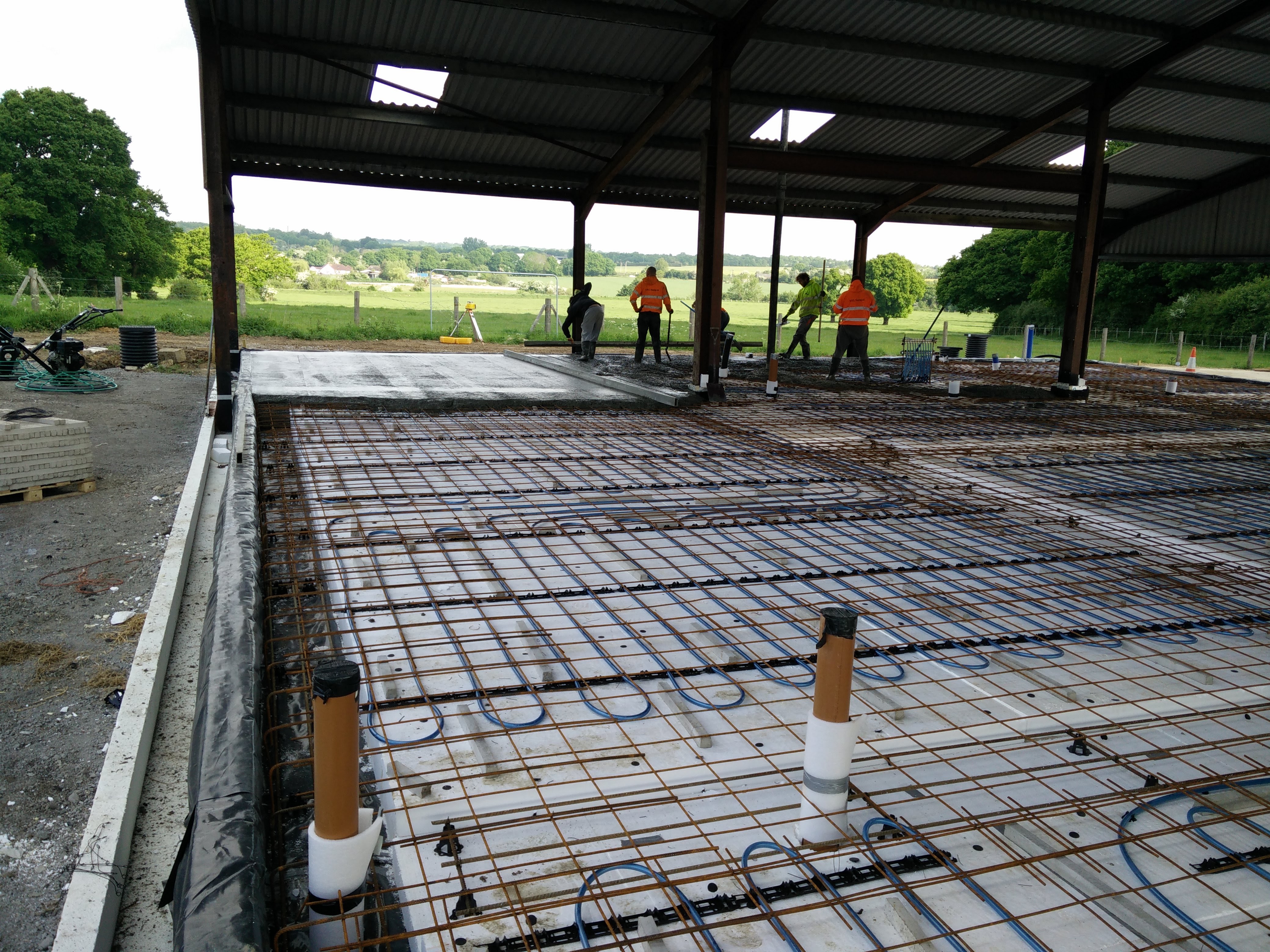
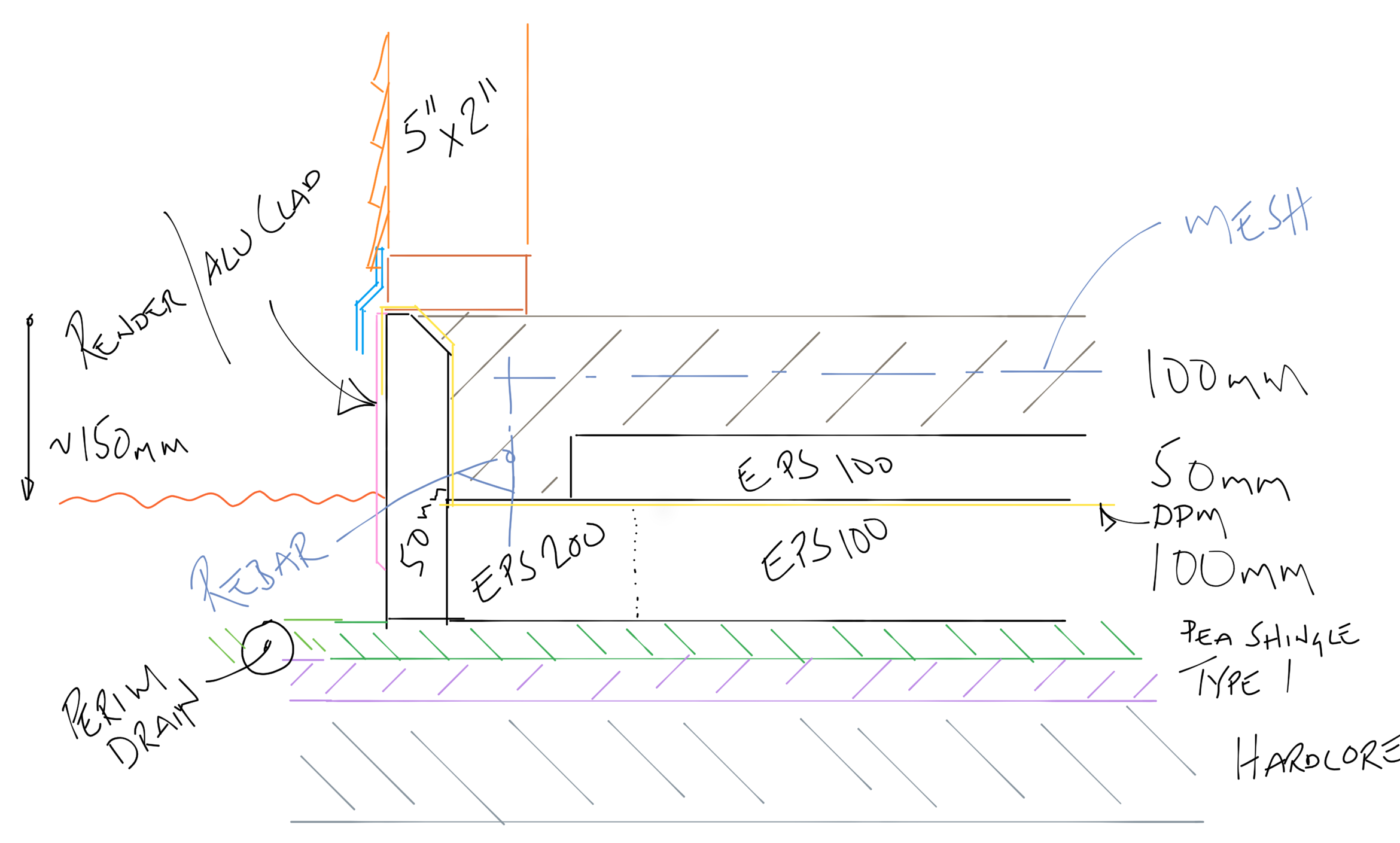
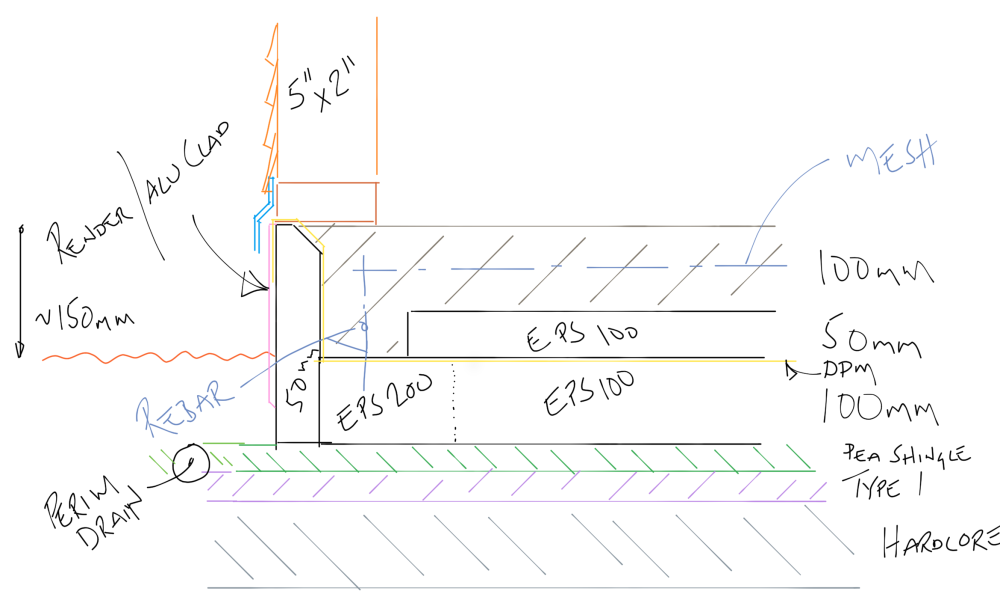
In my section I showed the DPM between the top and second layer, to get the ring-beam filled without any voids. The problem this can cause is the top layer of EPS "floating" up if you pour into the ring-beam first. The easy answer is to pour on to the top layer first, to weigh it down and allow the concrete to them flow into the ring-beam from the top surface. You can see the DPM on my slab coming out from under the top layer of EPS, along the bottom of the ring-beam then up and over the upstand: The sub-base layers in my section total 200mm from the bottom of the hardcore (which should be sitting on a geotex membrane) to the underside of the first layer of EPS. For the top layer I wouldn't use anything as big as 20mm-25mm, I'd use 10mm pea shingle or granite chippings, but importantly, "no fines" to ensure it is free draining. There should be a perforated pipe within this layer, around the periphery, to drain away any water that collects in the sub-base. EPS is fine getting wet, as in it doesn't absorb any moisture, but if it's sitting in water up to the DPM it may as well not be there in insulation terms. The layer itself doesn't need to be any more that 30mm - 40mm, thick, although make it a bit deeper at the edge where the land drain is so that the perforated pipe is fully enclosed in the pea shingle/granite chippings. There's no need to compact this layer. The MOT Type 1 is also a relatively thin layer, just to level the hardcore and get it compacted. Around 30mm - 40mm thick again is fine. 40mm crushed hardcore for the bottom layer, around 120mm - 150mm thick. The dig for this build up could be as shallow as 300mm deep from grass level, to get the FFL 150mm above.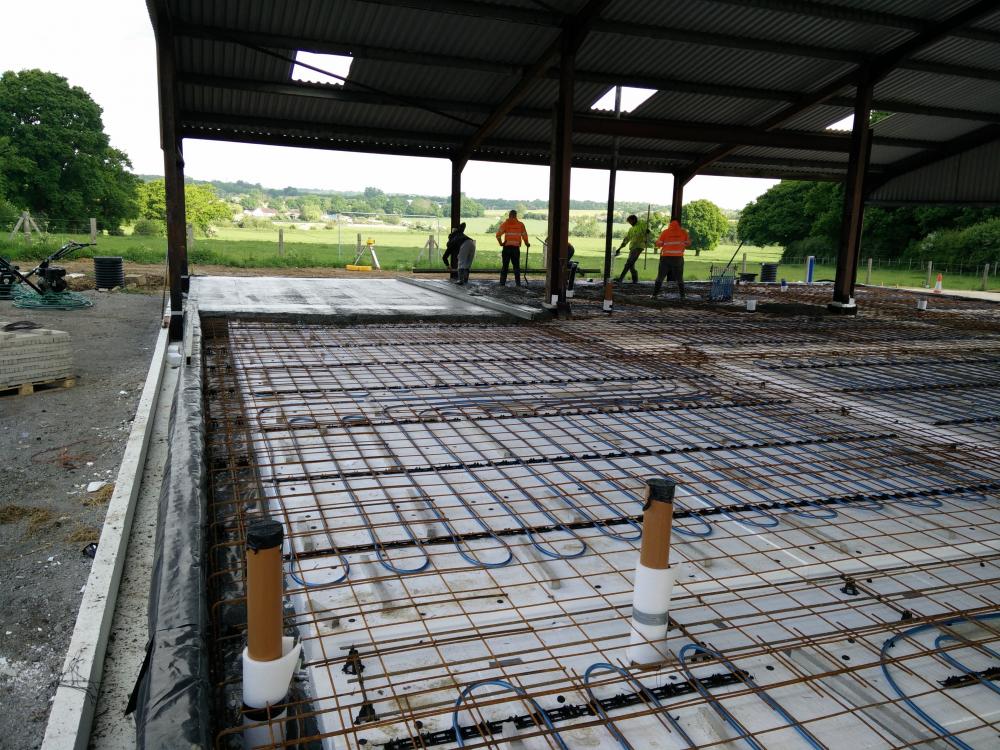
-
I'm not sure how any of us would know. I was told my installation was typical of a Nibe install at the time, accept for the cooling. It does look as though your flow Temp is around 5°C higher than your emitters require to meet the heat demand. Are all the temps taken at the buffer? From the temp trace there doesn't appear to be any of the cycling you mention, was the temp trace during a particularly cold period? Are your tanks installed within the thermal envelope? I can see what looks like an external wall, and, is that buffer insulated? Neither would account for the delta between buffer in and out temps, it's just out of interest. Visually, it does look as though the port positions on the buffer are unlikely to stop the buffer mixing.
-
Was that clear on the Class Q planning submission? I know our LPA are happy with modified foundations, but a lot seem not to be.
-
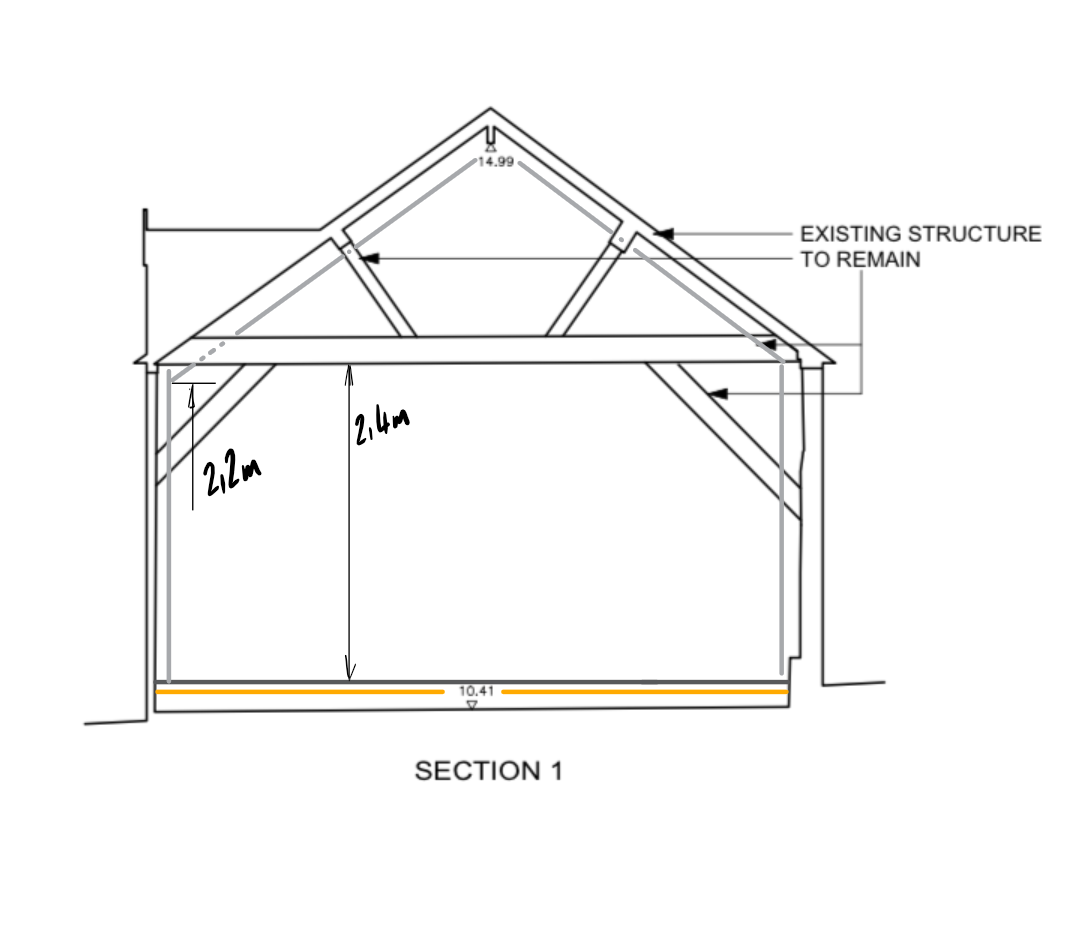
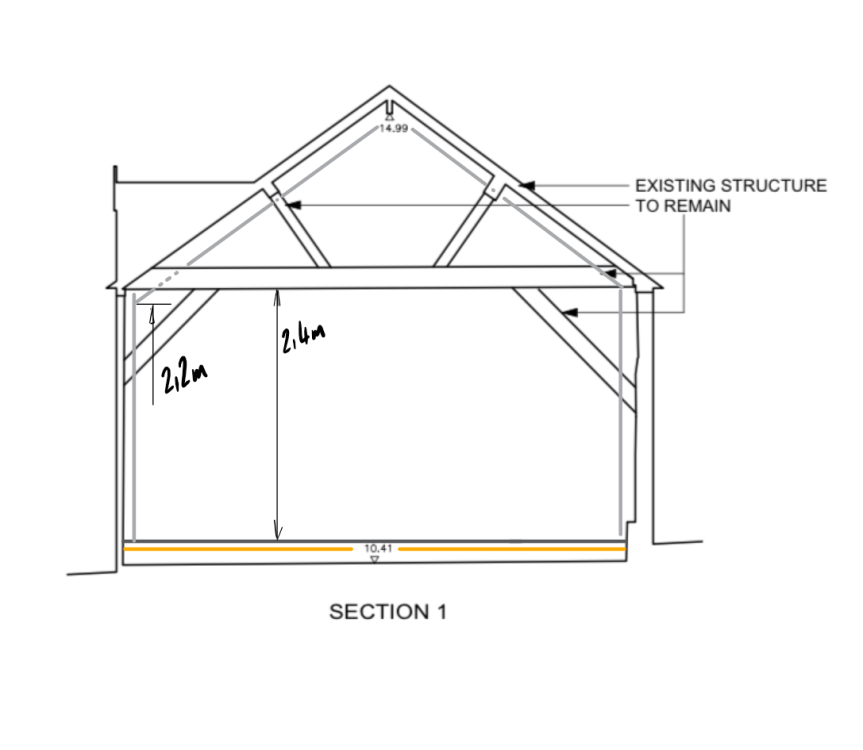
It does look like you can squeeze in 2.4m to the bottom chord, but it needs some detailing around the eaves to squeeze out as much height as possible for the structure around window and door openings. Ball park it looks as though structural openings could be around 2.2m, which is enough, but if another 100mm was lost in levelling the existing floor and estimating heights from a jpeg image then the sight lines through the window glass could start to be a little compromised. This also only accounts for approx. building regs floor insulation, you may want the FFL a little higher if you plan a higher energy performance than building regs.
-
The mention of concrete footings suggest that there may be more than the 200mm RC slab, although at 150 years old it's unlikely to be the original foundation. If you can get an SE, engaged by you, to agree you're covered structurally. But, It looks to me from the first image that the eaves are relatively low. Is the top of the concrete slab level with the bottom of those doors? If you felt you had to use the existing slab, you are first going to need to get it level, if it's not already. Agricultural slabs will often have a fall on them to drain. If it's was built for animals then that fall may be quite significant. Once level you'll then need to build it up with insulation, a screed and your floor finishes. The Finished Floor Level is likely to be around 200mm above that levelled slab. If you then work from the plane of the current corrugated sheeting, which under Class Q you can't exceed, you'll need at least 300mm - 350mm thickness to the inside of the plasterboard. Is there sufficient headroom left inside once you account for the layers that need to be added for the conversion?
-
Is it a reinforced slab. At 200mm thick it may well be able to take a timber frame construction on it. Building Control will be happy if the Structural Engineer signs it off. But to your question... Replacing or reinforcing existing foundations remains a controversial area for Class Q (to coin Martin Goodall's phrase). Some LPA's are happy to Approve a Class Q conversion that will replace walls, floors and roofs putting additional loads into the existing structure, without any evidence that the existing foundations are strong enough to support the conversion. Once Approved, the LPA will not be coming along to inspect the works that are undertaken, unless perhaps there is a complaint from a neighbour that suggests some wrong doing. Other LPA's, that are still resisting Class Q's, appear to be asking for SE calcs that determine the new loads into the existing structure and the SE's opinion on whether the existing structure can withstand those loads. Within his blog it was Martin Goodall's stated view that although controversial, "up to a point, new foundations and/or underpinning may be acceptable". Since you haven't yet purchased the property, it may not be worth taking the risk, without an SE confirming the existing slab can take the loads of the conversion. Or, you could submit for a Certificate of Lawful Development and set out the works you intend to do and ask the LPA if they agree it is within the planning Approval. The existing owner may not appreciate this route as a negative response from the LPA could nullify the planning approval. Another option maybe to informally approach the LPA on the merit of a full planning application for a Change of Use conversion that uses the existing Class Q Approval as a back stop. This is the optimum scenario, and one that is now supported by successful Appeals. Are you sure the existing barn structure sits on the slab? It's typical of a modern, portal frame structure to have individual foundation pads under each column, and maybe the slab is poured above this level with external walls, between the columns, sitting on that slab. I think this must be a 3rd party's view on the legislation since it is not stated in the legislation that "the introduction of new foundations, loadbearing floor slabs or significant rebuilding works." are not allowed. I would not agree with this view.
-
MVHR is Largely Bogus
IanR replied to DavidHughes's topic in Mechanical Ventilation with Heat Recovery (MVHR)
Do either of the calculations consider the MVHR heat recover gains within the whole house ventilation losses (incl. natural ventilation)? The calculation would need the infiltration rate for the house, in order to do so, and an assumption of the minimum air changes per hour (controlled and uncontrolled) required for "healthy" internal air. As an example, a property that has a UK Building Regs infiltration rate of 8m³/m².h@50Pa has sufficient natural ventilation to not require an MVHR to achieve healthy internal air, so the additional ventilation that an MVHR would bring to this property is ultimately an energy loss, even though it may be recovering 80% - 90% of the energy within that ventilation at the cost of energy to run the MVHR. What seems to be missing in the UK is a simple way of calculating the cost-benefit of MVHR within both the property's controlled and uncontrolled ventilation. -
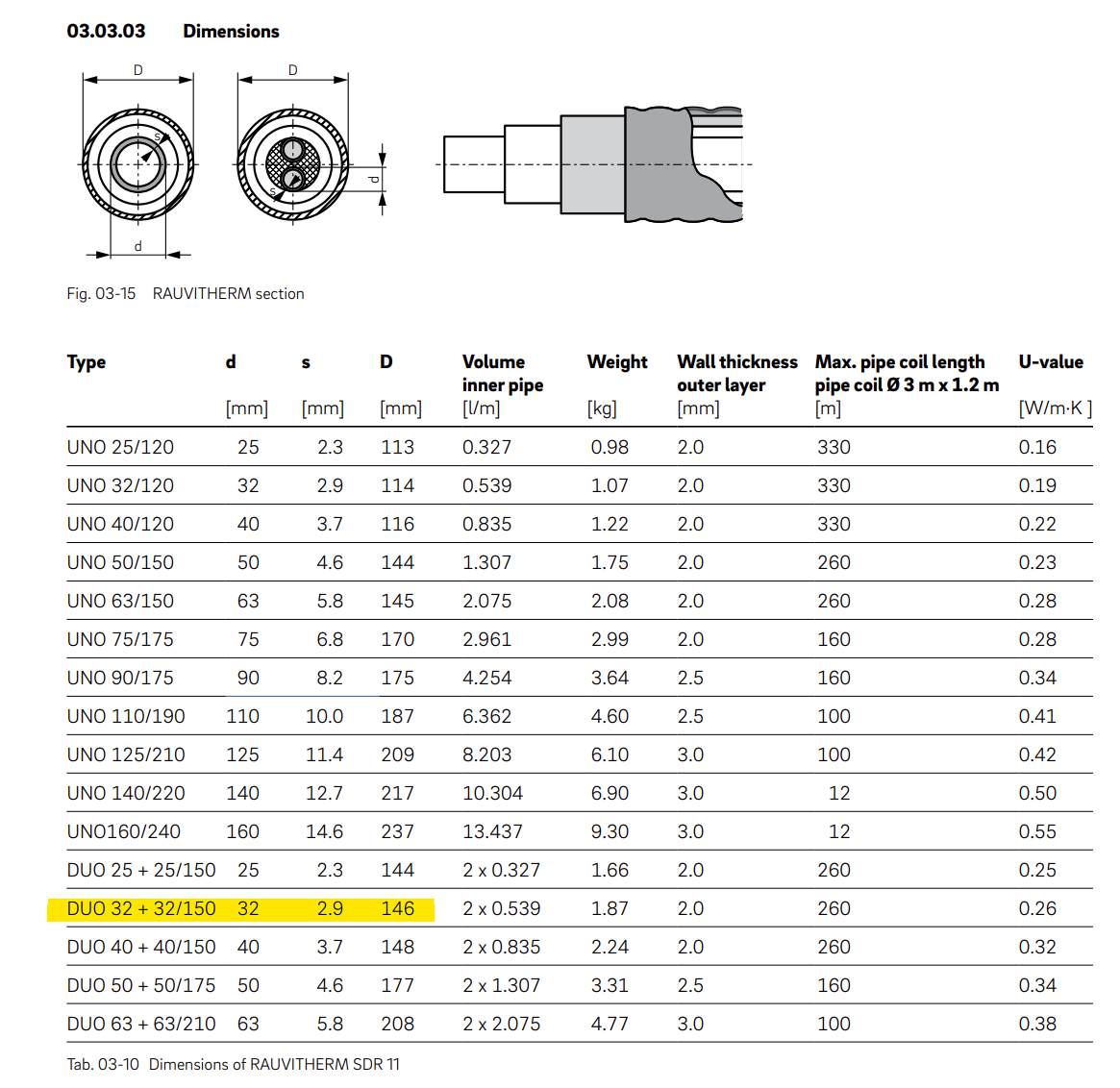
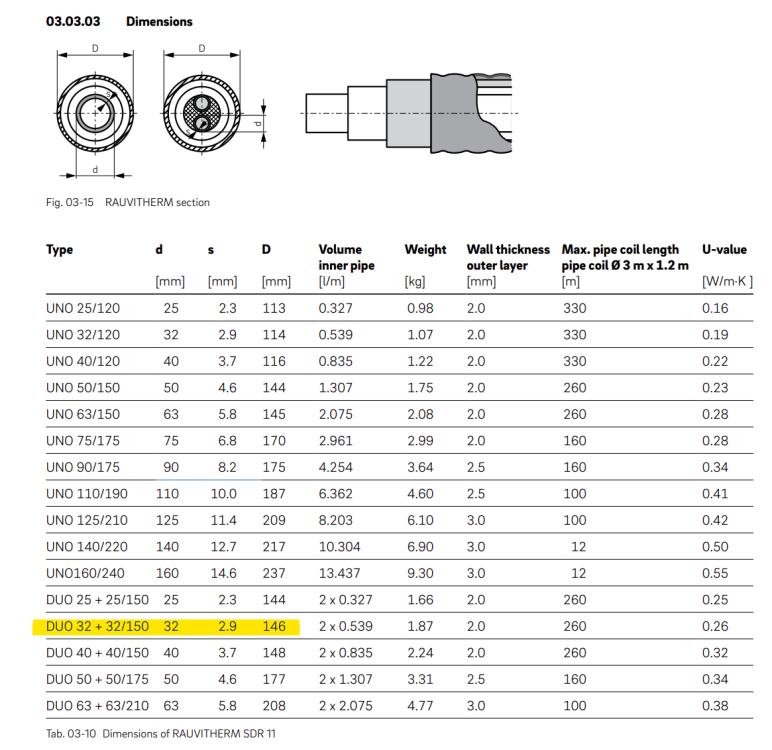
I used 32/150 Rauvitherm pre-insulated twin duct from Rehau. I don't think you'll get the same performance if you make it up yourself. Ref. https://www.rehau.com/downloads/1042866/district-heating-technical-information.pdf They don't do a Ø28 version though, but the Ø32 connectors/adapters were easy to come by.
-
MVHR is Largely Bogus
IanR replied to DavidHughes's topic in Mechanical Ventilation with Heat Recovery (MVHR)
Centralised mechanical ventilation is consequence of minimising energy losses, and is only required if you are setting a high energy performance target for your conversion. One significant factor with regards energy loss is uncontrolled ventilation, where the fabric of the building is leaking the warm air that the heating system has been heating up. If you take steps to reduce those energy losses, through the uncontrolled ventilation, then you get to a point, around 3m³/m².h@50Pa on an infiltration test, that you will no longer meet building regs for natural ventilation. At this point the Building Control officer will look for a whole house ventilation system that then brings the property back to meet the minimum ventilation requirements. If you've plugged up all the leaky holes and gaps to stop the energy losses through uncontrolled ventilation, then an MVHR system allows you to control the ventilation and recover the heat from the internal air in the property, but if you're "only" achieving an infiltration rate of say 2.5 or 3m³/m².h@50Pa then you have to question whether the MVHR will be cost effective. If you are achieving in the region of 1m³/m².h@50Pa infiltration rate, then MVHR is very likely to be cost effective. But, if you are not setting your energy performance targets at that level it may be better to hit 3m³/m².h@50Pa infiltration rate, go without MVHR, have controllable trickle vents on your windows and use extracts in the wet rooms. -
As part of the Class Q Application was there an SE report submitted that assessed the building's capability of conversion? Since you didn't engage the SE, you won't be able to rely on that report, but it may be a good starting point to know what you are facing. You'll likely need an SE to sign off any structural changes you plan to make for the conversion. Agricultural buildings are typically "light weight", and the conversion will add weight to the structure as you put in place domestic insulation, rain screen materials, mezzanine etc. which may all require upgraded structure and foundations. With the Class Q, there will have been drawings submitted that show at least elevations, floor plans and finish materials. Are you wishing to change these? If so you may need to submit the Design & Appearance condition of the Class Q, if not, you may not need an Architect, there are other options for Building Regs drawings. Have you got a plan on the process for making the conversion. Will you add new elements in timber-frame, masonry, ICF, other? Are you using the existing floor structure? What's you aspiration for building energy performance? Are you happy/confident to research options and make decisions, or do you want a turn-key solution where the conversion is delivered at a premium price, but is de-risked.
-
Does Class Q mean residential status is granted
IanR replied to ChrisF8's topic in Planning Permission
Unfortunately the residential status does not come into play until the Conversion is complete. You may not get knock down and rebuild (but worth going for one) but the LPA should consider a Change of Use under a standard planning app to allow you to move away from all the Class Q restrictions. -
Based on slightly better than Building Regs level performance data, the proposed 16kW ASHP seems about right for a 420m² house. Of note is the caveat on your "Building fabric summary" image in your first post "*These costs are based on an air source heat pump providing the space heating.". So the 6332kWh annual figure quoted is the electricity to run the heat pump, equates to 21,044kWh of annual energy loss through the fabric and ventilation. You therefore have a 50.1kWh/m² annual energy loss. Is this planned to be a long term home? If so you are saddled with these energy losses for the time you own the home. I personally would be looking for cost effective ways of reducing this figure. 15kWh/m² annual energy loss is an achievable target. Going for the 0.12 U Value wall option for instance. The stated air tightness target of 5m³/h.m²@50Pa is really quite poor. Your EC shouldn't be suggesting an MVHR system at that level as it will bring no benefit, just cost a load to Install, run and maintain. MVHR's come into their own at 3m³/h.m²@50Pa, and are best at 1m³/h.m²@50Pa or lower. If this is your long term home I'd suggest targeting 1m³/h.m²@50Pa. You describe the property as having some large double volume areas, in those circumstances you'll find that good air tightness considerably lowers your energy losses. If you are to target 1m³/h.m²@50Pa air tightness, then I'd research your chosen ICF. I've not looked into ICF much but the feedback I've picked up from this site, on wood-concrete ICF blocks, is that there is a lot of work involved in getting good airtightness from them. Maybe there are alternate ICF solutions that will make the job easier. If you can target better energy performance from the fabric of the building, then rather than the space heating requirement driving ASHP it will become DHW. You've specified a 400l UVC, I'd say that's the minimum size you should go with for the size of property, or perhaps a 500l. If you are heating the hot water via an ASHP you need to be able to store the water at 50°C or less to keep the ASHP efficiency at a reasonable level, so you need a greater volume of 50°C water than if you were heating it to 65°C. With large UVC's, you then need to watch your re-heat times. ie. you may get your space heating down to just a 6kW requirement, but you may still want to specify a 9kW - 12kW ASHP for better UVC reheat times. My own property is a similar size to yours, my heat loss is calculated at 15kWh/m² per annum, but has come in at around 12.75kWh/m². At today's prices that's around £535 per year for space heating which is a £1,700 per annum saving on your current performance targets. Index linked over 20 years gives a reasonable budget for performance improvements at the build stage.
-
Self-build steel frame barn conversion - almost complete
IanR replied to mattman's topic in Introduce Yourself
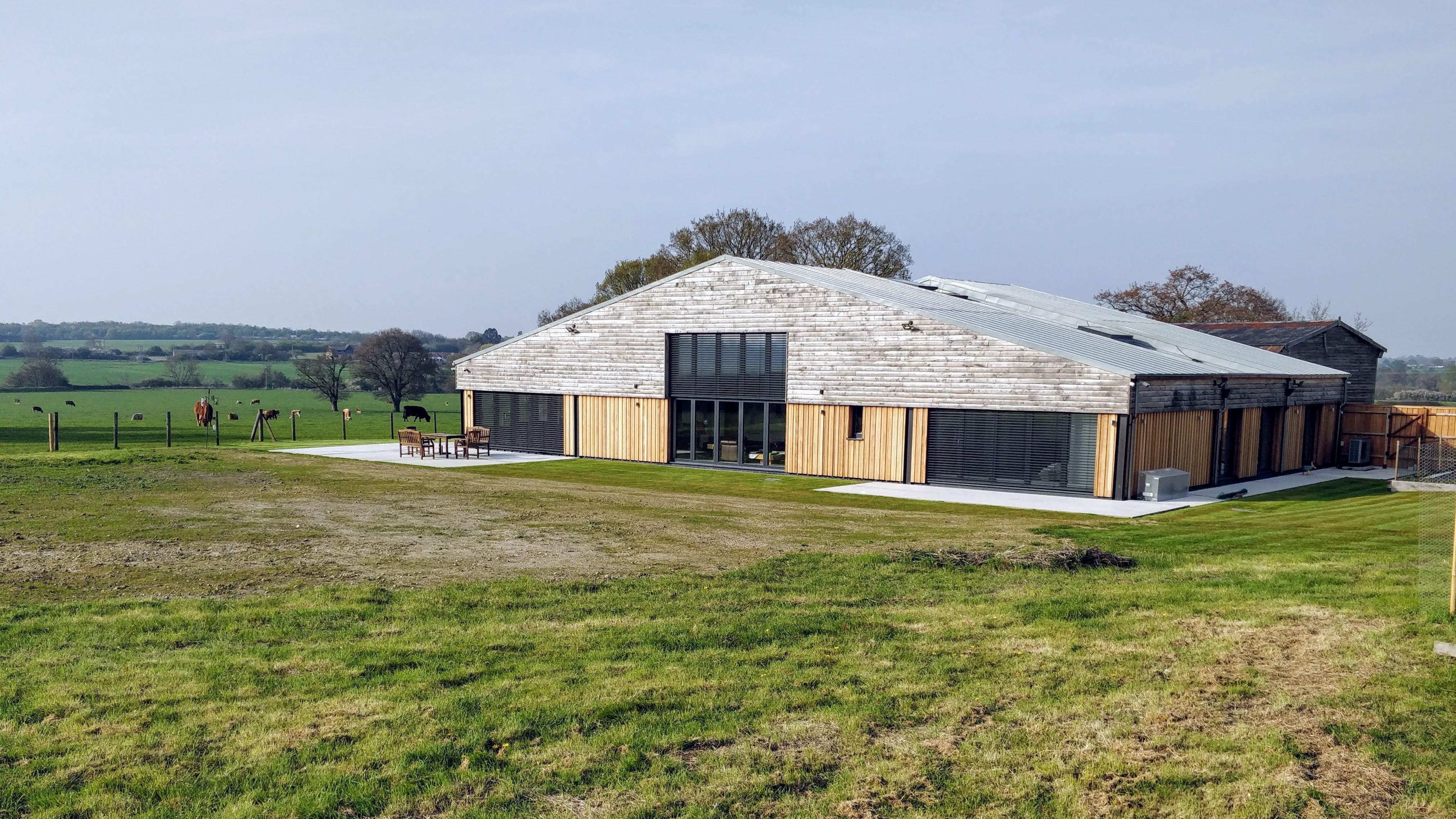
Here's ours, been in for 5.5 years now. This pics from a few years back, just after we cleared the debris from the build and started to get it seeded. I've settled on going with the S5 also, but am hoping to go without the rails. I'm just looking for a few similar installations to get a bit more confidence in attaching in that way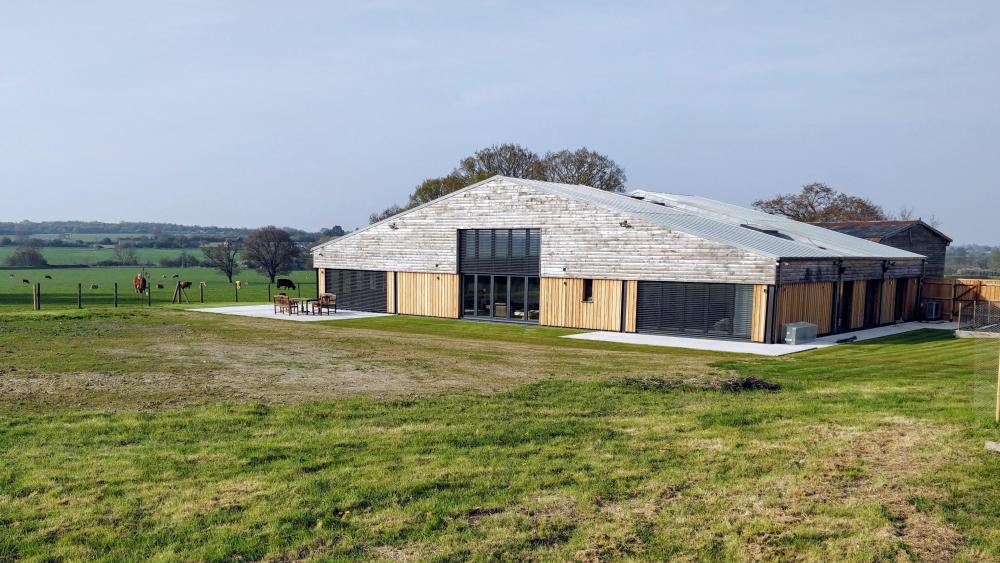
-
Self-build steel frame barn conversion - almost complete
IanR replied to mattman's topic in Introduce Yourself
Hello @mattman, and welcome! Lovely project. I did very similar myself, starting in 2016, although with a timber frame rather than masonry. You appear to have put your PV on rails. What did you connect the rails to the standing seam with? Did you consider fixing direct to teh standing seam, without the rails. I've not made my mind up yet, so am yet to install PV. -
Mine have a track each end, and have a 50mm gap to the window frame. The thicker bar at the bottom won't bend in the wind but the slats do. My 5m wide blinds will visibly bow inwards. If you've got the tensioned intermediate wires for the blinds to run up and down on I believe these move a lot less.
-
Just above (~10mm) the cill. They will move in the wind, so will make a noise and rub either blinds or cill, or both, if they are allowed to contact, They seem very close to the glazing. What sort of gap are you leaving.
-
Hi, and welcome. How long do you have left to complete the build, on the existing Class Q permission? In short, a new Planning Permission (not a Class Q Change of Use), using the Class Q as a fall-back and gets you what you want, would be the ideal way to go and gets the full development VAT free (if you plan to live in it yourself). But, have you got time to do so. ie. if that fails have you still got time to build the Class Q?
-
Ah, good spot, Location doesn't show up on the phone...
-
There are pros and cons to a buffer, with a little more info we can help you identify them. 14kW is a relatively large heat pump for a new build, has this been purchased already? How much energy do your energy loss calcs suggest is required to keep the temp stable in the house on a cold day? What heat emitters are planned and what flow temp is the system designed for? What size of UVC have you opted for and what occupancy level is the system designed for. Do you have space for a large buffer, say, up to 200l? Re. Solar Thermal, it is likely better to go with Solar PV with a diverter to an immersion, unless you are restricted on roof space.
-
That made me check my facts, but I can only find the 2 year rule, ie. Reduced rate of 5% VAT for properties empty more than 2 years, which can then be recovered at the end if it's a self-build. Ref. 8.1.1 https://www.gov.uk/guidance/buildings-and-construction-vat-notice-708#section8 Have you got a link to the 10 year rule? For the 2 year rule, the property has to have a residential Use class. Since the cottage itself has been used for a significant time with an agricultural Use, it may be considered that its Residential Use has been abandoned. Not that that's an issue though, as the whole property would then fall into the conversion of non-Resi (Agricultural) to Resi, and so it qualifies for the reduced rate at 5% anyhow. What type of planning permission do you have for the works? Is it a "Conversion of X to Y", or "Change of Use to Residential", or is it an "Extension"
-
I'd only avoid the areas under fixed furniture, ie. kitchens, bathrooms. built in cupboards etc. to keep flexibility. I was happy to go up to 200mm centres for cooling and it works well. In the bigger picture, pipe is relatively cheap. There's not a single solution that suits all houses. I'm glad for the zoning that I have since with the benefit of solar gain, on the cold days where there's only intermittent sunshine, there's enough gain to heat the rooms that get the gain directly, so those zones will switch off, but the rooms on the North-East side will continue to be heated.
-
Are you saying no part has been lived in since 1937? If so, I believe your builder should be charging you 5% VAT for labor and materials (20% for any materials on their own), which you can recover at the end if you plan to live in it yourself. Renovation and alteration of any residential building that has been empty for at least 2 years prior to work starting is rated at 5%. Likewise conversion of non-resident building to resi is also rated at 5%. You can't recover incorrectly charged VAT, so you'll need to get your builder to re-present his invoices showing 5% VAT
-
I've got Aluminium standing seam (Falzonal) on an OSB deck, with a 50mm vent gap over a 350mm, blown cellulose fibre filled, I-Joist timber structure, and don't specifically notice the sound of rain, however heavy, on the roof. Heavy rain on 3G roof lights is the more dominant sound.