JohnMo
-
Posts
13292 -
Joined
-
Last visited
-
Days Won
200
Everything posted by JohnMo
-
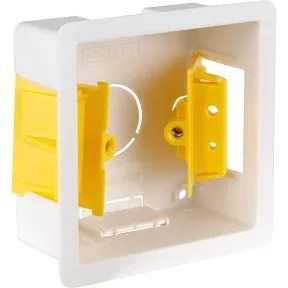
So obvious question, can you not locate the switch away from the steelwork? Wrap steel in 25mm PIR (or more if you have space) and seal all joints with aluminium tape - cold bridge gone. Or use a dry lining pattress box, instead of the normal ones for skimmed walls?
-

What insurance needed to move in before completion?
JohnMo replied to YorkieSelfBuild's topic in Self Build Insurance
We started with One Insurance (think that's they are called) now with direct line. I found I answered the questions that were asked only. We are ICF, so our wall construction is concrete etc. Is it an open timber frame - or just a timber frame? -
I wouldn't do that. Use a coupler in an emergency, but wouldn't plan to do it. Couldn't you decide where the manifold is going and make the connections to the manifold. Then pressurise the loop and add mechanical protection as needed.
-
I would be more concerned that you actually discovered the steel and you can put your hand on it. It should be fully insulated not hidden behind the plasterboard uninsulated.
-
How big are you planning - floor area and number if storeys, on how big a plot?
-
But do you really get that many days at -3, compared to days at 7 to 10 degs.
-
Maybe, but most houses on here are outside their comfort zone, ventilation heat loss just too small, to allow s tick the normal tick box. Hence plenty are specified way over sized.
-
Use a normal domestic one, your just heating a buffer as far as it's concerned. Depending on hot tub size a big one. To keep the ASHP inhibited and pressurised you may need to plate load the hot tub, but size the Plate Heat Exchanger (PHE) correctly, you have a 2 Deg approach temp. Then you have no issues with DHW heating, it just switches the diverter valve as normal. Add a second zone for cooling, so it bypasses the hot tub or have the hot tub cooler in summer and as cooling buffer. Heat pump doesn't care if it doing heating or cooling it just moving the refrigerant 4 port valve to a different position (as long manufacturer hasn't disabled the cooling function). Most heat pumps have the functionality to have different zones as cooling only, heat only or both. And the functions can be independently set for each zone.
-
I just looked and came to same conclusion you did, even NE Scotland I can have in two days.
-
Have you considered using a single heat pump? Size the spa heat pump big enough for the house, use the volume of the hot tub as a heat source for the house via a plate heat exchanger and mixer valve. Heat pump does two jobs, keeps hot tub temp stable, and or DHW via a diverter valve.
-
Fabric and ventilation heat loss calculator
JohnMo replied to Jeremy Harris's topic in Heat Insulation
Read the data sheet for the heat pump in the offer to make sure it is doing the correct output for your heat loss. The nameplate sizing as with most manufacturers is not very well representative. And make sure you are being pushed into a buffer when you most likely do not need one. Also don't go pre-plumbed cylinder. Lots of stuff on apre plumbed you pay for but may never use. -
Norway isn't in it - fully And we aren't so could do it tomorrow if we wanted
-
They have rules about country made content, something like 70 to 80% of material content of engineered products have to include, materials and manufactured content made in country, otherwise they get with huge import tariffs or no permission to go ahead with the project. Then cost of manpower doesn't matter then, people are employed government gets income tax etc. Why the heck we don't have such rules is bonkers.
-
Well done
-
To put that into reality that is double a passivhaus. Really look at how they have accounted for ventilation heat losses. With MVHR ventilation heat loss drops from big to negligible. Another thing we are 192m² living space plus another 26m² in the insulated space. Our roof area is around 50% more than yours as is our floor area, as we are single storey and every room has vaulted ceilings. All of which (part of form factor) really add to our heat loss per m². We are nearer 13W per m². With a 12kW you may need a volumiser, depending on water volume. You can always get a volumiser with immersion that gives you another 3kW if you really need it. We have an oversized heat pump that doesn't modulate well. I can get acceptable SCoP from it, around 4, if it modulated better I would be getting closed to 5. So a 25% reduction in running costs. So sizing is important. Looking at heat pump monitor a 12kW appears to modulate down to about 4.5kW, cannot see any 16kW on there.
-
And should be scrapped as well as the wearers of the crown and all the hangers on. But that's a different conversation.
-
So if that's heated - have you accounted for the net input this provides to the building. If the space has insulated external walls, the heat in this area is added to the building internals.
-
So how are you heating all of that,is that included as well in heat pump sizing? Depending on how you have calculated ventilation losses there can be plenty of room for error both ways. Is your thermal bridging any worse than the glazing U value? If not impacts aren't much worse than the glazing? If the steel is insulated on the inside most likely not a huge issue.
-
Even at 490m² at -3 your figures sound high. You possibly have better U values to me, your form factor will definable better than ours. So unless one side of the house is all glass, 9kW maybe a little high. At around 200m² we are 3kW. So 2.5 x 3 is 7.5kW, nudging 8kW (including DHW) at -3. So if Panasonic do a 9kW, I would be looking at that with some wiggle room. The bigger you go the bigger the pipes, flow rates to accommodate etc. So definitely wouldn't be looking at 16kW. But you will build houses big - are you actually going to use all of it? If not why not 2x smaller heat pumps in cascade. Then you can modulate down to 2kW and all the way up to 12kW+ should you need it.
-
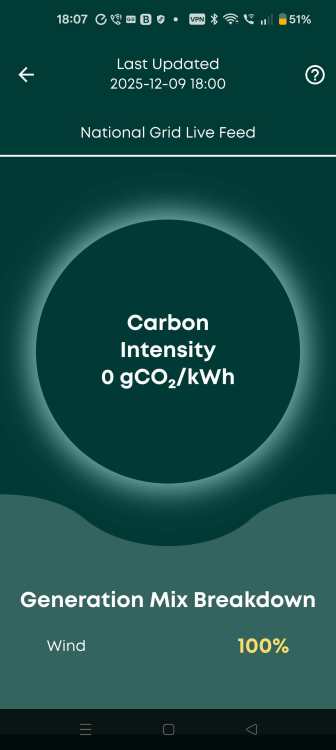
One good thing about plenty of wind power is it's CO2 free. Our current CO2 intensity
-
Should is very different to are. Some or a lot think, new party in parliament, everything will change tomorrow. That maybe due to the wind density in parts of Scotland being among the highest anywhere. So more bang for your buck. But they are better located offshore, can be bigger, nothing in the way to disrupt laminar air flow for best output. High voltage DC to allow transport of the electric with very little losses.
-
Surge protection, fuses and MCBs in loft from PV array.
JohnMo replied to jimseng's topic in Photovoltaics (PV)
Just looking back at the original post on this thread the box shown is a combiner box, so takes two parallel strings and brings them into one. So you double the amps. So may not be suitable anyway. Your other question is are you have string fuses? If so have them in a DIN enclosure in loft or anywhere as an easy place to terminate the strings. Terminate the other side of fuse and take to the inverter. -
Surge protection, fuses and MCBs in loft from PV array.
JohnMo replied to jimseng's topic in Photovoltaics (PV)
ALL inverters need the AC disconnect, prior DC. Big bangs likely in full sun if you don't. Likely to need a new isolator switch if your lucky, if your not, big volt DC isn't good for ones health. -
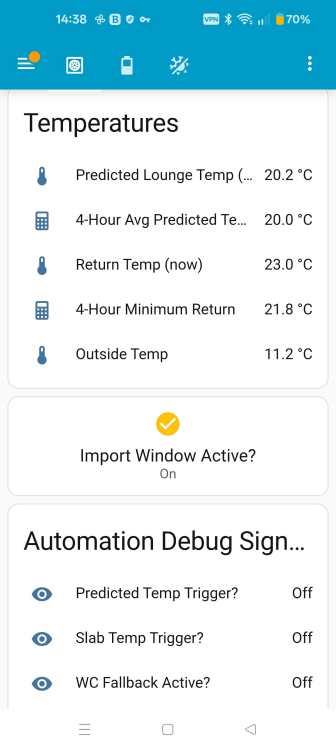
Details of some of the template sensors This is the import windows defined - have only use morning and afternoon slots binary_sensor: - name: hp_import_window state: > {{ now().hour in [4,5,6] or now().hour in [13,14,15] }} Predicted trigger state sensor: - name: hp_predicted_trigger state: > {% set p = states('sensor.lounge_predicted_temperature_in_1_hour') | float(99) %} {% set setp = 20 %} {% if (p < setp - 0.3) and (is_state('binary_sensor.hp_import_window', 'on')) %} on {% else %} off {% endif %}
-
So this is the small dash board on home assistant. I have a target temp set at 20 degC. The yaml code for the prediction automation, this just sends a notification to me if we are running to cool.in the house to see how it works. If connected to an output devise and house was likely to be too cold, ASHP would be started at a flow temp higher than the normal WC curve. alias: ASHP Batch Charge Based on Prediction and Slab Temp description: Batch-charge UFH during cheap windows using predicted + slab return history triggers: - at: "04:00:00" trigger: time - at: "13:00:00" trigger: time actions: - choose: - conditions: - condition: time after: "04:00:00" before: "07:00:00" - condition: or conditions: - condition: template value_template: | {{ predicted_min_4h < (setpoint - 0.35) }} - condition: template value_template: | {{ (return_now - return_min_4h) < -1.5 }} sequence: - action: notify.mobile_app_cph2449 data: message: "Batch heat started test " - delay: "03:00:00" - action: notify.mobile_app_cph2449 data: message: Batch charge finished test - conditions: - condition: time after: "13:00:00" before: "16:00:00" - condition: or conditions: - condition: template value_template: | {{ predicted_min_4h < (setpoint - 0.30) }} - condition: template value_template: | {{ (return_now - return_min_4h) < -1.5 }} sequence: - action: notify.mobile_app_cph2449 data: message: "Batch test " - delay: "03:00:00" - action: notify.mobile_app_cph2449 data: message: Batch charge finished test mode: single variables: setpoint: 20 predicted: "{{ states('sensor.lounge_predicted_temperature_in_1_hour') | float }}" predicted_min_4h: "{{ states('sensor.4h_min_predicted_lounge_temp') | float }}" return_now: "{{ states('sensor.emoncms_emoncms_org_heatmeter_returnt') | float }}" return_min_ 4h: "{{ states('sensor.4h_min_return_temp') | float }}"