


JohnMo
-
Posts
13292 -
Joined
-
Last visited
-
Days Won
200
Everything posted by JohnMo
-

Perimeter insulation - flooring butted up to or laid over?
JohnMo replied to Dunc's topic in General Construction Issues
Took my insulation at the wall edge out as far as the inside edge of the skirting. So bottom image but wider. I would do 200mm PIR and increase screed depth. -
Via the same search, but direct wording from the Emneti website. The Tecno-Varia vent valves allow for automatic air evacuation, but with the patented Tecno-Varia version and the extra manual vent, it is also possible: - monitor the valve's regular operation; - accelerate air evacuation in specific conditions (e.g., system filling). Those were my words
-
You really should do an image search and let AI tell you Operation: For normal automatic operation, the top cap should be left slightly open. It also includes a manual vent function, which is useful for rapidly bleeding air when filling a new system. So is left slightly open to self bleed. Side to quickly manually bleed.
-
Is this a common Vaillant problem?
JohnMo replied to Post and beam's topic in Air Source Heat Pumps (ASHP)
The trouble is, ASHP installer comes along and allows air into system. If air isn't fully purged after they finish the piping you get the situation described by @Nickfromwales. For me the ASHP installer should have revisited the purging. -
Do you use a second pump (on the heater circuit), or does the system rely on buoyant flow across the heating element - similar to the original design for cylinder heating?
-
I used something similar on a 2kW heater it has a melt down after about about a month. You need a relay rated more like 20A, to put up with the switching loads. Build or buy something like this, this is what Grant Boilers use on heat pumps to switch immersions. Choose this link because it shows the inside of box. https://ebay.us/m/iXxCKs
-
Sudden pressure loss in ASHP system
JohnMo replied to kandgmitchell's topic in Air Source Heat Pumps (ASHP)
So was system off while away, or running normally? What is your normal system pressure? -
Is this a common Vaillant problem?
JohnMo replied to Post and beam's topic in Air Source Heat Pumps (ASHP)
Not sure if the heat pump installers did the purge, from the answer? Last person needs to purge air and then inhibit. -
Samsung/Gen6 plumbed boiler (ASHP)
JohnMo replied to Paul16461's topic in Air Source Heat Pumps (ASHP)
Your system looks manky. Delete the strainer and install a proper filter is step one. Is system correctly inhibited? Not a fan of glycol if your system is filled with that. If not needs a suitable inhibitor and if a low temp system biocide. -
No when it starts, air will come out first. It should collect at the high point. The flow indicator will start to move You need a screwdriver turn the brass bit. Water/air will come out the plastic bit - there should be hole.
-
To me you don't want Willis on without pump on. So drive a suitably rated multi pin relay from pump switch in wiring centre. Drive and Willis from relay. How you control zones doesn't matter after that. Your flow temperature will be by inbuilt thermostat, but add overheat protection with a pipe stat downstream of Willis interlocked to pump Willis power. So mains to pipe stat, then relay, input. So if pipe too hot Willis is off.
-
Looks like the party is over....
JohnMo replied to Beelbeebub's topic in Air Source Heat Pumps (ASHP)
But don't you find the reporting and investigation behind the reporting is lacking. Most nights you get two news articles that should feed into each other, but never do. The other night, one article was about new doctors not being able to find jobs in NHS, being paid for by the NHS, the next not enough doctors to reduce backlog. Why aren't they questioning this state of affairs? Same is true for every sector including energy security. They let people off with news grabbing headlines, that may or not be true, and they just report it without due diligence. -
Mine are roof mounted and they wanted a design approval from structural engineer - as a new build that was all done at design stage of the building.
-
Didn't ask me anything about the components, bit of a tick box exercise really. Structural, electric install certificate, G98 certificate. Would avoid, mine had a melt down after about a year. Plenty of cheap new ones on eBay. Various makes and models. 3.6kW inverter can take huge arrays, if you choose well, some will take double that. Most 3.6kW inverters have 2x MPPTs, below that generally have one.
-
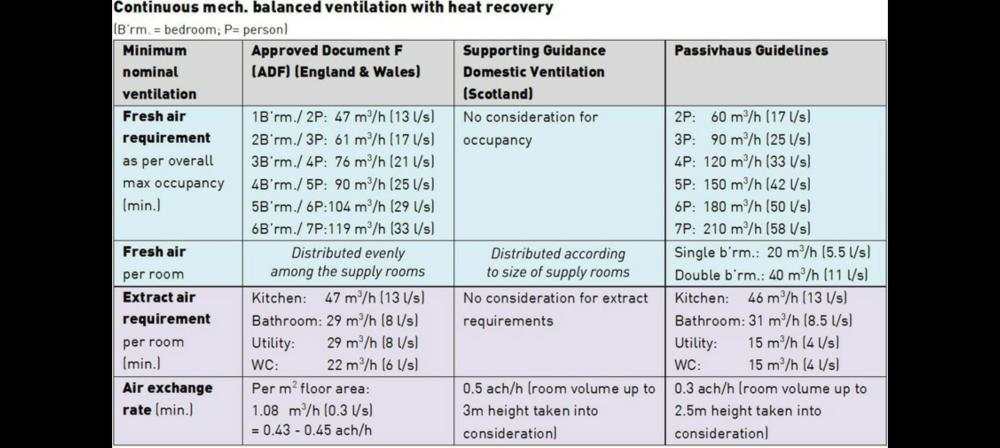
All your numbers are below, just apply them to your house and then balance the the flow and extract.
-
Why not make your wet radiators in bathroom dual fuel (electric element) or add another/bigger radiator? A thought for later. I would add a couple of degrees leave for 24/48 hrs see affects and go from there. If you have already tried that go further. One thing with ensuites, if bedroom is cool the ensuite will never be hot, as the cool bedroom just pulls the heat from the ensuite.
-
Large screw type piled decking foundations
JohnMo replied to Post and beam's topic in Landscaping, Decking & Patios
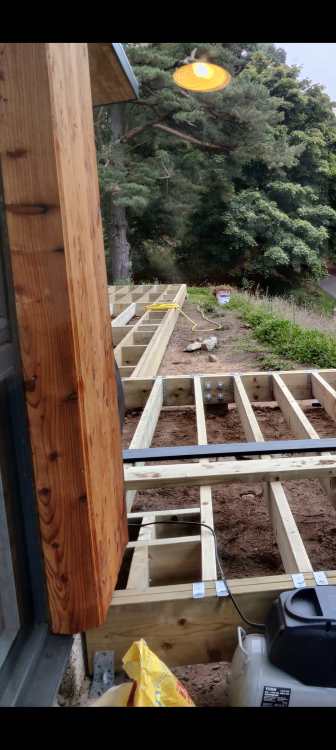
Posts and postcrete? I did mine with 15mm thick galvanized plates concreted in place. The end near the house sits on a blockwork ledge formed when we did the foundation. Secured with brackets.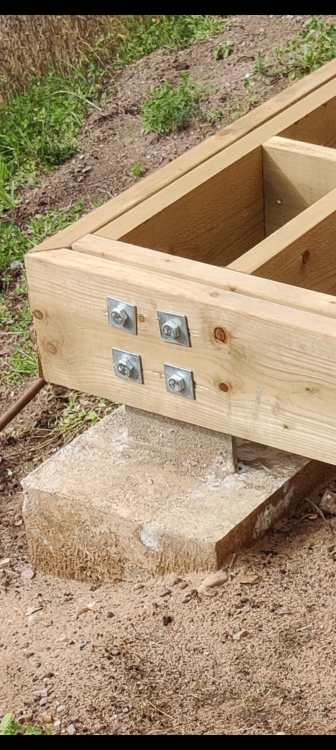
-
I would unscrew the brass bit and see if that frees things up the brass bit may be so far down they have fully closed off flow and pin has nowhere to go?
-
Just been revising this thread and looking at pay back, we are now at about 2/3 point of payback at just over 2 years, so will be cost neutral in year 3. Looking at the costs PV panels have dropped in price quite a bit. These panels (second hand) including the fuel costs to collect, came in at £740. Same size array in bifacial 500W panels £525. So the whole system would have cost almost exactly £2000.
-
The red marker move down to. indicating flow had started. They move in response to water flow. The brass thread section with the pin at the centre sets your flow rate. Would assume screwing upwards increases flow. So it may be worth screwing outward (take note of how far you move in number of turns) watch the red marker if that starts to move that may be your issue. If the red marker hasn't moved after a few of turns that isn't the issue. You are most likely looking at air in the loops. To get things moving. Go round each room and turn off the thermostats (or set to lowest setting), once all are off the pump will stop. Now go to one problem room and set the thermostat on. Pump should start. Open bleed on manifold top rail (white radiator bleed thing - top left). It may spray water so slowly open have a towel handy. You may have to open and close a few times. Once the loop starts running, leave for 5 mins. Close the demand at thermostat. Repeat for each problem loop. Report back.
-
Advice please: cutting metal down pipe.... without
JohnMo replied to ToughButterCup's topic in Rainwater, Guttering & SuDS
https://tradewarehouse.co.uk/blogs/metal-guttering/how-to-cut-metal-guttering?srsltid=AfmBOopQ4EZ-p-gajPUNlRl2O4PXaEP0PWWypwK32BUxOrptG8Qb4rMp -
Looks like the party is over....
JohnMo replied to Beelbeebub's topic in Air Source Heat Pumps (ASHP)
Trouble the system is easy for MPs. They don't need to read a bill to vote on it, they just do as the whip tells them. Whip can tell if they were doing as they were told by the gate they walk through. Having to read and understand every bill one votes on, becomes a full time job, and that just wouldn't doing young fellow. Now get a grip. -
You wouldn't have got to the breaking ground stage in Scotland without the design. You will need full ventilation calculation - so if MVHR all room flow and extract rates. Other ventilation system, trickle vent sizing and fan selection to meet the chosen ventilation scheme and house airtightness target. Heat loss calculation - this in Scotland is provided by an as-deigned SAP report. This also provide hot water usage calculation. But you will most likely have to show how you control usage of hot water, via choice of mixer taps etc. Heat source will need to match heat loss and DHW usage. But as @Nickfromwales says, all this shouldn't guess work for later. If MVHR you need routs for ducts planned, if dMEV know where you need holes in walls, electrics routed too etc. Location of cylinder and UFH manifold(s) and how you get pipes from ASHP to cylinder and UFH manifolds. Read building regs for each section you have been asked for and just follow the rules as set out, put it on paper submit. Then take a good look at the drawings and see what you actually need to do and plan now, you may need to go back to the architect or structural engineer etc to make things work for you.
-
'Smart' heater vs heater with wifi controller?
JohnMo replied to Crofter's topic in Electrics - Other
I have a smart relay on my immersion and have wired so with the switch or the relay can power up the immersion. So if smart relay is off, switch will over ride it. But if smart relay is on the switch has no effect. Either on is on at immersion, both have to be off to switch off immersion. So if a renter switches on manually your smart relay may do nothing until the manual switch is off. Unless you do a switch with a timer so it can only boost for given period of time so it automatically switches it's self off after x minutes. -
If they are an issue, I would be more concerned that the wiring is an issue also. Are you sure you didn't miss hear her? What prompted the request?




