


JohnMo
-
Posts
13292 -
Joined
-
Last visited
-
Days Won
200
Everything posted by JohnMo
-

Heat pumps. Any negative points about 3 phase?
JohnMo replied to saveasteading's topic in Underfloor Heating
First hit in Google https://www.bpdstore.co.uk/glidevale-energy-saver-humidity-sensitive-trickle-ventilator/p/182 -
Heat pumps. Any negative points about 3 phase?
JohnMo replied to saveasteading's topic in Underfloor Heating
There's your second issue, not just ventilation, no heating. -
Heat pumps. Any negative points about 3 phase?
JohnMo replied to saveasteading's topic in Underfloor Heating
But when air is heated the dew point moves. We have a heated summer house it has dMEV fan, humidity inside hasn't been above 40% for that last month. We have bearly had a dry sunny day in the last month humidity outside closer to 100% most the time. Are you heating the house? -
Stainless Steels in warm, damp and chlorine environments.
JohnMo replied to SteamyTea's topic in Boffin's Corner
Making chlorine - rigs make chlorine and add to the cooling water - this is generally seawater. The chlorine is to kill stuff and act as biocide. Otherwise you get mussels etc growing within the heat exchangers. The chlorine makers take seawater, the by products are highly corrosive, the off gas from the process is hydrogen. Generally chlorine making is a very simple, but at the same time a very unreliable process. -
Stainless Steels in warm, damp and chlorine environments.
JohnMo replied to SteamyTea's topic in Boffin's Corner
It is routinely for offshore rig and ships, it uses plastic and titanium components. -
Stainless Steels in warm, damp and chlorine environments.
JohnMo replied to SteamyTea's topic in Boffin's Corner
But not in a warm chlorine environment, still not good enough. -
Stainless Steels in warm, damp and chlorine environments.
JohnMo replied to SteamyTea's topic in Boffin's Corner
Yep -
Vehicle Presence Detection with Loxone
JohnMo replied to SBMS's topic in Networks, AV, Security & Automation
PIR detection, they will pick up heat from the car. Works well with my driveway lights. Doing it that way may be too easy, if your going to add another layer of complexity via Loxone -
Don't move to Scotland then - mandatory for better than 3 to achieve building sign off! The mechanism is building regs.
-
Heat pumps. Any negative points about 3 phase?
JohnMo replied to saveasteading's topic in Underfloor Heating
You can go down the easy route - if you don't have proven airtightness don't go MVHR, you are just chunking money away. Smart dMEV. Change the trickle vents to humidity activated one, but only in dry rooms (bedroom, living room etc). Seal up any in wet rooms. Install Greenwood CV2 or CV3 fans in all wet room including kitchen, set fans to smart humidity control. This system will run fans at a low rate 24/7 and automatically boost when needed. The trickle vents will respond to room humidity levels. All internal doors need 5 to 10mm clearance at the bottom of the door. -
I moved in prior to completion, no 3rd party trades expected after that date, got normal house insurance and declared all the work to be done.
-
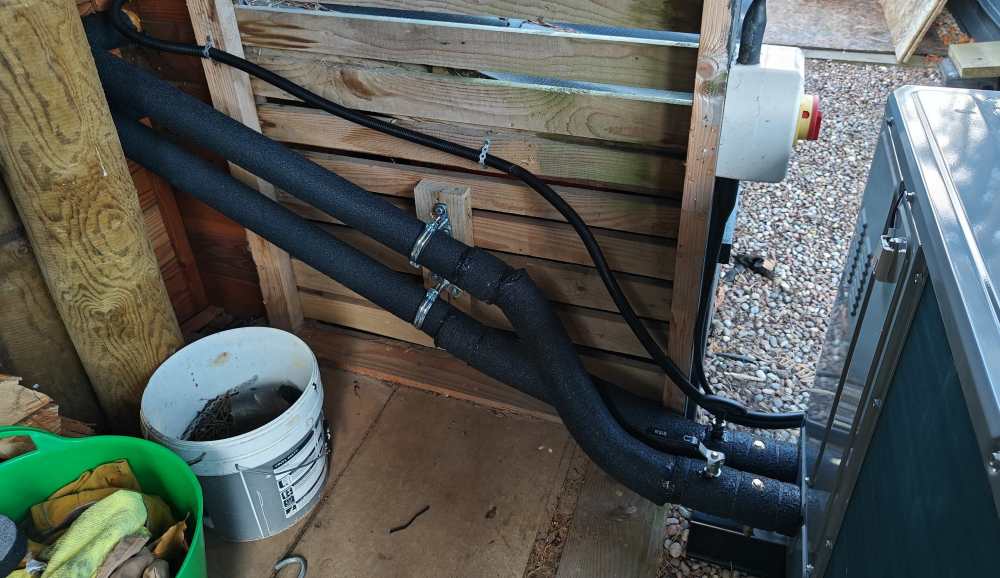
This is what it looks like lagged
-
Heat pumps. Any negative points about 3 phase?
JohnMo replied to saveasteading's topic in Underfloor Heating
All depends how you buy and install. In Scotland, we have no option, if you are better than 3m³/m² airtightness, balance supply and extract is mandatory, so cost and and or pay back isn't a discussion. I would (did) buy from eBay, for pennies in the pound. Then (didn't do) do the supply just like PIV, inject air or most of it in a central area, maybe in an odd supply terminal for odd areas where through ventilation doesn't work in your layout. Then extract like MEV. Minimal ducting, minimal terminals, good air quality, billy bonus heat recovery. CO2 not CO, CO carbon monoxide kills you. -
When it was finished - so when you have a completion certificate. Without that it's not home, it a build in progress. Where is the confusion?
-
When we did similar - some years ago, we had weekly site meeting where progress and financial affairs were openly discussed. Either myself or my wife were always in attendance, these meetings were all minutes by architect,with us approving minutes. No work was progressed until fully priced. Variations always come and bite you. Push back if not in agreement, get them line by line itemised, don't pay until happy.
-
Earth Neutral bond for hybrid inverter (again)
JohnMo replied to jimseng's topic in Photovoltaics (PV)
Are you trying to use a hybrid inverter in wrong situation - it's designed for grid connection - you don't have one. Isn't the correct inverter an off-grid inverter? -
Low points - outside, if that at the heat pump, that's where they go.
-
Damp Bungalow
JohnMo replied to Potatoman's topic in Mechanical Ventilation with Heat Recovery (MVHR)
Really! Missing a trick if you don't, the heat exchanger becomes unbalanced and you don't get the heat recovery you should. Do properly or really don't bother wasting your time, effort and shed load of cash on MVHR. -
Not standard, but best practice, especially if you are doing cooling as well. Make sure the two products are from same manufacturer. I use Adey MCP1+ and MC10+ rapide, can be sprayed into the filling loop, takes 30 seconds. Do once you have all the air out the system and no leaks.
-
Full house renovation and retrofit guidance
JohnMo replied to fisnik's topic in House Extensions & Conservatories
Seen the video, yes you can get a good CoP, but you still have the downward heat loss. Two schools of thought, loads of insulation or none, nothing in-between. Zero insulation you keep the UFH on all the time to keep ground charged. No, unless heat pump is huge. 6kW and 210L is a recharge time of 45 to 60 mins, 300L cylinder would take 50% longer again. DHW heavy usage, gas boiler running against a heat pump cylinder, would give really quick reheat times. -
One each side, so two, you then ensure the piping and heat exchanger within the heat pump are protected
-
Look on eBay - half the price
-
After the existing filter last thing in the return loop on its way to heat pump. Altecnic 1” Filter Ball Valve - 124-6005 CST or Inta Full Bore Ball Valve with Filter Cartridge - 28mm Comp.
-
Heat pumps. Any negative points about 3 phase?
JohnMo replied to saveasteading's topic in Underfloor Heating
You building must be massive to need that size heat pump, as effectively a new build? 5-600m²? -
Full house renovation and retrofit guidance
JohnMo replied to fisnik's topic in House Extensions & Conservatories
If you are going for heat pump grant, photograph and record every insulation and airtightness improvement you make. Many will ignore these improvements otherwise. Get an official air test at the end of works. If you are doing UFH add at least 150mm of insulation (PIR) under and screed above or don't bother with UFH. A retrofit I would just do radiators, heat pump or PDHW boiler setup running Weather Compensation and/or room compensation. The boiler set up in PDHW will give almost instantaneously and endlessly available hot water. Others on here, have similar age building and with upgrading some insulation aspects run radiators at 35, with boiler or heat pump.



