


JohnMo
-
Posts
12465 -
Joined
-
Last visited
-
Days Won
179
Everything posted by JohnMo
-

How to improve the acoustic performance of an ordinary internal door?
JohnMo replied to WWilts's topic in Doors & Door Frames
You can also get noise attenuation wall vents -
Small scale domestic hydro power generation project
JohnMo replied to ProDave's topic in General Alternative Energy Issues
Lorry turbo impellor? -
I did say small gaps , not huge ones
-
Reducing Energy Bills - How goes it?
JohnMo replied to Ferdinand's topic in General Self Build & DIY Discussion
Been making mods to my DHW system. Combi boiler, but has a buffer with DHW coil upstream, with solar PV immersion. Plan was in summer no gas usage as the buffer would be hot enough and pre heated water would pass straight through the boiler. But that didn't work very well. Every time I opened a hot water tap, the cold slug of water between the buffer and combi would cause the combi to fire up, so was using a couple of kWh of gas every day even with a buffer at 60 degC. So installed on of these https://wattswater.eu/catalog/safety-control-accessories-for-heating/valves-for-solar-applications/thermostatic-kit-solarkit/ Now using no gas. -
How to improve the acoustic performance of an ordinary internal door?
JohnMo replied to WWilts's topic in Doors & Door Frames
But you need an undercut of 10mm if you have MVHR or MEV for ventilation purposes. So they will never be great. Fire doors are solid so may have better accoustic properties. Fire seals will stop the noise transmission where you don't need gaps -
Storage combi or UVC choices for new build
JohnMo replied to ruggers's topic in Boilers & Hot Water Tanks
If you run mechanical equipment in a steady state condition there is nothing to wear so the equipment lasts a very long time. Each time you stop or start mechanical equipment there is wear of the moving parts; as lube oil and mechanical tolerances get to their design conditions, the same is also true of stopping mechanical equipment. -
But the maths is slightly different for the floor with UFH as you have a dominant downwards heat flow because the it has a high delta T than the upwards flow. Subsoil temp stabilises at approximately 8 to 9 degrees below the floor and the ufh water flow is circa 30 degrees, so the delta T becomes 21 instead of 13 (used in the linked maths. Heat Flow Q = U*A*dT Heat Loss E_heat = time*average_heat_flow = (days*24hours/day) * U * A * (Average_dT) For me average dT across 6 month 'heating season' is 21K (i.e. 21 Celsius) --> E_heat = (183days/yr * 24hours/day) * 0.13W/m2K * 1m2 * 21K = 11990Wh/yr = 12kWh/yr per m2. That is heat energy, to understand what I'll pay, I need to know how much heat costs me. Using an ASHP with a COP of 300% (reasonable) and an electricity rate of £0.3/kWh electricity, I can calculated that heat costs £0.3 / 300% = £0.1/kWh heat. 12kWh * £0.1/kWh = £1.20/yr per m2. 0.01 change in U value then the cost difference is (0.01 / 0.13) = 1/13 of £1.20/yr /m so £0.092 per m2. My 192m2 floor has a U value of 0.01, so plugging the figures in gives me a saving of circa £70 every year on downwards heat loss by improving on a u value of 0.13.
-
Have you purchased the ply yet? 22mm interlocking waterproof boards may be better, fully glued with D4. Perimeter screwed. Gap around wall for expansion. If ply, fully glue with D4, leave gaps between panels for expansion and around room edges. Glue should expand to fill small gaps instead of shims.
-
Spiral or serpentine UFH layout - which is better?
JohnMo replied to low_and_there's topic in Underfloor Heating
If well insulated flow temps are so low you won't be able to tell the difference. So choose whichever. If you are using a contractor to install go with there recommended layout. MVHR does not move heat, as flow rates are way to low. It's only replacing around a 1/3 the volume each hour. What's your floor build up? -
MVHR - Self install!?
JohnMo replied to richo106's topic in Mechanical Ventilation with Heat Recovery (MVHR)
Just been through my pricing again two Titon MVHR units - £250 and £320 each Direction grilles x2 £340 (total for both) Everything else £1200 So around £2110 -
DIY Fitting of used ashp for cooling and heating.
JohnMo replied to Simon Brooke's topic in Underfloor Heating
I think MCS sort of kills the option for cooling in the UK without modification. If you only need a small amount of heat why not keep the money in you pocket and just go Willis heating. But no cooling or something like a Dream heat pump from Ebay for second hand money, they do heat and cooling -
Someone on here mentioned they were the Rolls Royce of heat pumps, think they come with a similar price tag. There is thread on here looking at standby energy consumption (can be huge), so would be worth having a read of that also.
-
MVHR - Self install!?
JohnMo replied to richo106's topic in Mechanical Ventilation with Heat Recovery (MVHR)
Download LoopCad for a free trial. Also found these on the internet, so you work out flow temps spacing etc.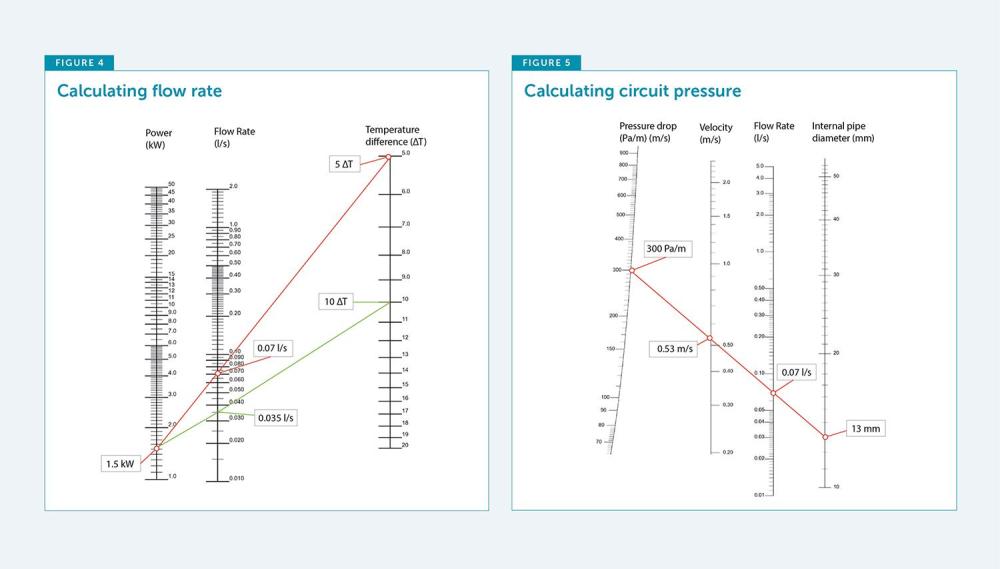
.thumb.jpg.e6f5b10749b0a8b28a782f83356b9791.jpg)
-
Storage combi or UVC choices for new build
JohnMo replied to ruggers's topic in Boilers & Hot Water Tanks
WC, the circulation pump runs 24/7. Heat pump or boiler will kick in to manage the flow and return temp. Ours has a summer set point, so you set the outside temp you want the system not to heat. Ours allows three different set points, for temp, which really means the flow rate is reduced or increased. You can get different temperatures in different rooms by balancing the system, reduce the flow rate in the rooms you want cooler. Sun out or wood burner on, will affect the return temperature as not so much heat is being transferred to the room. So the higher return temp will tell the boiler it can switch off, the circulation pump stays on. I have made some mods to our heating system and started the heating up, the return temps from the floor at start up were 25 degC. Had the CH running for an hour boiler didn't fire up as the return temps were too hot. Had to increase the boiler set point much high to get the boiler to fire up. -
MVHR - Self install!?
JohnMo replied to richo106's topic in Mechanical Ventilation with Heat Recovery (MVHR)
My filters are g4, you are better off with f7 on the supply side g3 or g4 on the extract. -
MVHR - Self install!?
JohnMo replied to richo106's topic in Mechanical Ventilation with Heat Recovery (MVHR)
I to was quoted £10k. In the end after quite of research I did my own system. Got surplus mvhr units (2x) from eBay and sourced everything else, ended up spending around £3k. -
I suppose it depends on you perimeter to area ratio, to what the overall u value becomes. Our house is long and thin, so needed way more to achieve a good u value. Also we had no disposal costs as everything stayed on site.
-
I would go solid floor, with plenty of insulation below - 150 to 200mm PIR. Install blinds on windows as evening solar gain will be high in Autumn and Spring as the sun doesn't go that far west before getting very low in the sky.
-
We have Silks Sarnafil on our roof. Reasons, only supposed to be installed by correctly trained fitters. Fully welded install so less chance of leaks. Our Sarnafil has a loose fit fleece between it the plywood deck.
-
Storage combi or UVC choices for new build
JohnMo replied to ruggers's topic in Boilers & Hot Water Tanks
legionella, not really sure that's needed in the UK as all supplied water is disinfected with chlorine. OSO make some good cylinders with very low heat losses. SAP calcs should give total house instead of room by room. In the boffins corner on this site is a heat loss calculator. Simplistically in weather compensation mode the boiler runs 24/7, it manages the system flows by looking at flow and return temps. Once the delta between the two temps reduces, it shuts down the boiler, but continues circulation of CH water. Once the temperature difference increases it fired the boiler. My manual says Explanation when used as a 100% weather dependent controller The WiZe thermostat can be set to work as a 100% weather dependent controller. This means that the room in which the thermostat is located is no longer imperative for temperature control. Together with the information from the outside temperature, a central heating (CH) flow temperature is worked out which is sufficient to heat the house. Thermostat valves on the radiators allow an individual temperature setting for each room. Required installation parts: a. Outdoor sensor (boiler-specific) connected to a boiler (refer to boiler’s installation instructions). Mounting on north – north/east facade of the house. Prevent outside influences such as snow, ventilation air or chimney heat. b. Thermostatic radiator valves on the radiators in the house to individually control the rooms. c. If ALL radiators are fitted with thermostatic radiator valves, the installation MUST be fitted with an automatic bypass valve. Refer to to boiler installation manual. I take the thermostatic valves are there more as a limit stop on temp, so if you want the room at 21, you have balanced the system to give you 21, you set the thermostat at 22, so if the sun's shining in the window the heating is switched off in that room. -
We have our manifold in the utility and all room pipes lead through hall. So instead of bunching them all together we spread them out, heating is from the flow and return pipes to other areas. Lounge has two loops, kitchen diner another, kitchen diner loop also travels through bathroom. All operated from single stat in hall. We also have loops in bedrooms and one ensuite. Ensuite loop is always on when pump running, bedrooms flow turned down so background heat only.
-
Advantages Smaller buffer or no buffer, less likely to short cycle the heat source. If well insulated, all the area will be at very similar temperature anyway. How do you have 5 zones with 4 stats? Do you mean 5 loops and 4 stats?
-
Think there may be a broken record that keeps saying "if it wasn't for Brexit..."
-
Really would not bother, UFH is a low temperature heating system and really needs to be on for lengthy periods and not really suitable for bedrooms where you want the room warm a short period before and after sleep, but not warm when in bed.
-
Storage combi or UVC choices for new build
JohnMo replied to ruggers's topic in Boilers & Hot Water Tanks
I really would specify everything suitable for a heat pump, it will all give advantages to a gas boiler. UVC, with a heat pump coil, will accept lower flow temps, which will in turn keep you inside condensing mode of the boiler. You can heat to circa 50 instead of 60 plus. The heat exchanger coil is huge compared a gas boiler, which will have a better approach temperature and quicker reheat time. Radiators, use double panel rads to get twice the area, or half the size. I would and do have electric only towel rails, use them any time of the year without have to fire up the heating. Just 400W elements in them, have UFH in the bathroom and en-suites. Operate in weather compensation flow temps are low, boiler are super efficient, running costs low whole house an even temperature, although with suitable balancing you can get cooler rooms if you want. Read heat geek website for some good info.


.jpg.87d6d75adaec59a22c40fcf0ea8d2464.jpg)