
JohnMo
-
Posts
12465 -
Joined
-
Last visited
-
Days Won
179
Everything posted by JohnMo
-

Question on Heating capacity with no heating upstairs
JohnMo replied to Blynchy's topic in Underfloor Heating
I would size for the whole heat loss. You can always decrease flow temp to down rate the system. The thing with UFH loop spacing, is the closer the spacing the lower the mean flow temp for a given W/m2. Also closer spacing results in more pipe and more water in the floor. Which may move you away from any buffer requirements. My heating requirements are 3.1kW on a -5 deg day. But I have 192m2 of UFH at 300mm spacing. My mean design flow temp is 26 degC. A spacing of 150mm would have dropped the mean flow temp to 24 degC. The loops are in 100mm concrete. The system response is slow. Down side of wide spacing is a slow reaction time, if you want on off timers, go for a close spacing. It the W/m2 that is the criteria you need to post. -
Hybrid inverter for small in roof 2kw array - help please!
JohnMo replied to Timmyk's topic in Photovoltaics (PV)
I took the opinion, that if the electrician did it all and it went bang or something was not quite right, there was only a single person responsible, no he did, she did, not my fault governor. -
Do you have a drawing of what you are proposing, it sounds like you may be introducing a big thermal bridge.
-
Sewage treatment plant - air blower electricity costs
JohnMo replied to David Essex's topic in Waste & Sewerage
Sorry bit of a drag up an old thread. We have a Harlequin Hydroclear 6, 2 people in the house. The blower runs 24/7 (55W) so looking to reduce that. PV covers the running cost during the day, so would leave it running during daylight hours. So what's the best way to add a timer? Is it a normal time switch? -
Hybrid inverter for small in roof 2kw array - help please!
JohnMo replied to Timmyk's topic in Photovoltaics (PV)
Simple really Electrician installs the electrical side, he can then sign as the competent person on the G98 form. This cover part P and any equivalent in Scotland. G98 gives you permission to install PV and generate, as long as you retrospectively complete the required paperwork within a given timeframe. Anyone can physically install the panels, but you need the electrician who is signing the G98 form, to do all electrical connections also. -
What fun you have
-
Reducing Energy Bills - How goes it?
JohnMo replied to Ferdinand's topic in General Self Build & DIY Discussion
It gives you an instantaneous reading, just a simple hold phone in front of flashing led. You could glue the phone to your hand if you wanted. Not it would help much. -
Reducing Energy Bills - How goes it?
JohnMo replied to Ferdinand's topic in General Self Build & DIY Discussion
There's an App "my electric meter", that does the counting for you, and give you an ongoing consumption. It just used the phone camera and allows you set to set the imp/kWh rate for your meter. -
Yale and others do a window lock, so the window can be open but cannot be opened further.
-
Energie thermodynamic system anyone have experience
JohnMo replied to Calw's topic in Solar Thermal (ST)
It's likely the worst CoP will be in winter and better CoP in the spring to autumn period. -
Energie thermodynamic system anyone have experience
JohnMo replied to Calw's topic in Solar Thermal (ST)
Just looked at the datasheet, the average electric consumption is stated as 550W, the data sheet says it has a 7 hour charging time to heat cylinder. 0.55 x 7 = 3.85kWh per day 300L of water to heat from 30 to 55, requires 8.73kWh - so a CoP of 2.7. Direct immersion heating would cost 2.7 times more. This assumes the water temp drops that low before charging, if it only goes to 40 it only needs 5.24kWh, so CoP drops to 1.4. Electric cost at £0.3/kWh, is £1.15 per day. Gas at 0.0733 is (assuming 80% efficiency) is £0.77 per day. -
Energie thermodynamic system anyone have experience
JohnMo replied to Calw's topic in Solar Thermal (ST)
Info from users of SAHP's is a bit thin, not easy to get anyone to talk. They are either rubbish or the best thing ever. None of the data sheets, comply with the norms of a heat pump, so very little info there either. -
Why not look elsewhere, we found a local manufacturer, windows made to our spec from scratch.
-
I had the ICF blocks there, but they all got moved, so were rebuilt the next day. I thought I would get ahead, but didn't. The insulation was done prior to the ICF blocks being placed into position.
-
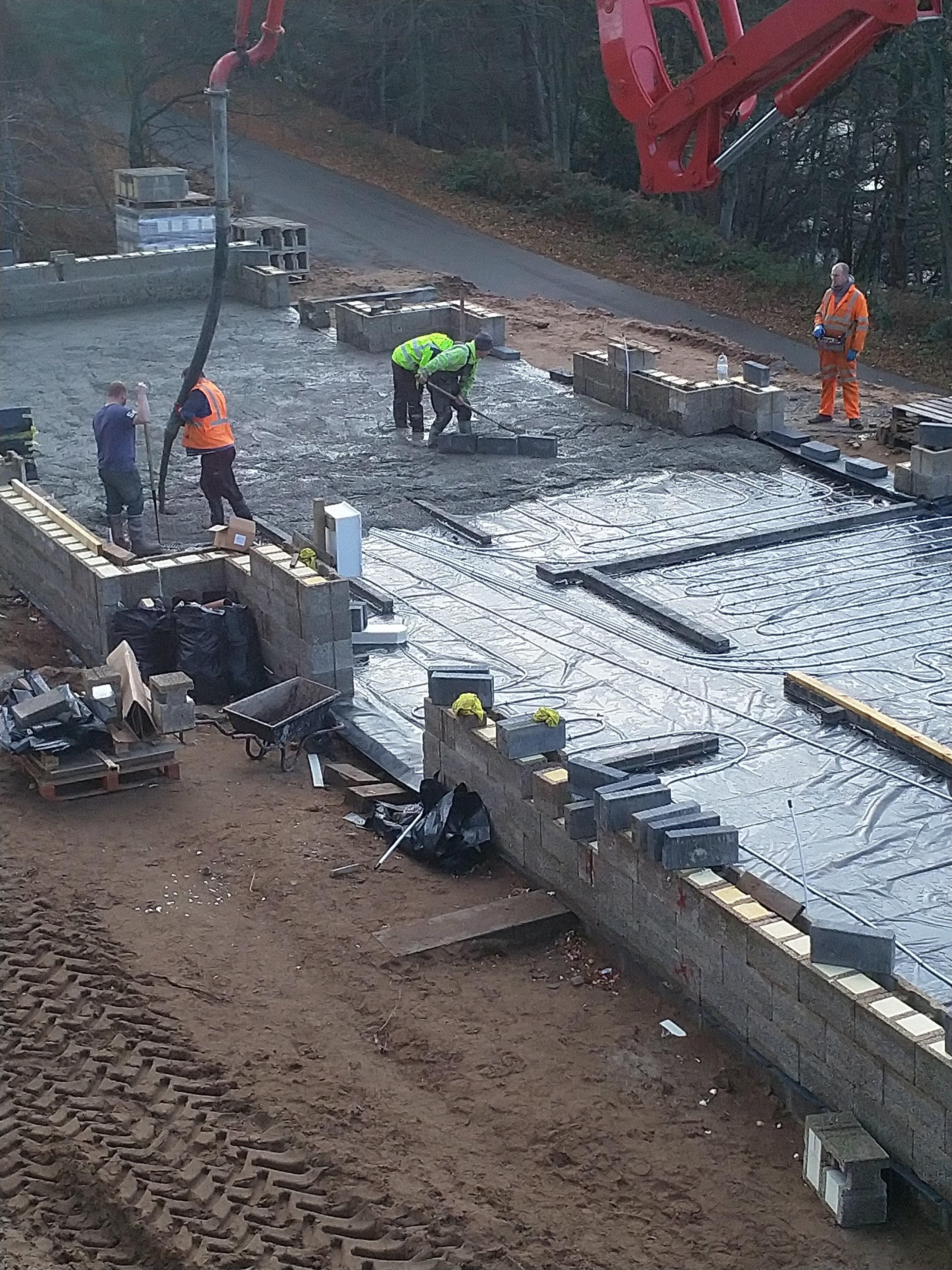
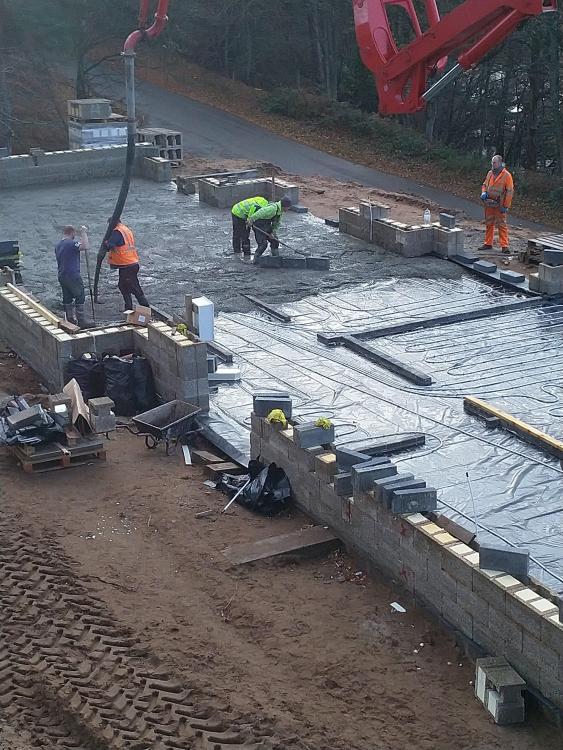
Not sure where you are getting your prices. Insulation Celotex 100mm sheets £37+vat https://www.insulationhub.co.uk/product/100mm-celotex-ga4100-2-4m-x-1-2m/ Not £13k, but £2.6k I did the insulation, UFH pipes and finished floor concrete, prior to the walls. Way easier, just pumped the concrete in. Filled the UFH with antifreeze mix and pressurised.
-
What's the return temp to the heat pump when in DHW heating mode? Is the return path heating the buffer as it flows back to the ASHP?
- 28 replies
-
- 1
-

-
- ashp
- hot water and cooling
- (and 1 more)
-
You don't need to full fill space with insulation, it then acts to transfer noise. 70mm will be better, so it has an air gap. The material you use (wool or whatever) needs to be able to self support it's self between the studs, so it doesn't slump over time.
-
My stub walls are 365mm wide, consist of 150mm concrete blocks (inside), 100mm thermolite block (outside), 115mm void. Void filled with 100mm PIR spray foamed into place. To give me continuous insulation from the roof to below below ground and below my floor installation. This with a 70mm upstand on the inside wall before screed should limit any sideways heat loss from the floor.
-
Your prices seem well over the top. Our foundation, consists of the following for 194m2. Level site Reinforced strip foundation (2m wide at front of house) 70m perimeter. Hardcore and blinding sand, DPM. Stub walls, 100mm PIR insulation in cavity 160mm deep reinforced slab over whole area 200mm PIR insulation 100mm concrete finished floor. I install the insulation, contractor did the rest £36k. U value 0.09. If your buying sand and hardcore, buy direct from quarry, about half the price the builder merchant charges. You need an engineered design, based on your site.
-
A 2 port buffer doesn't require to be heated first, as the main flow goes direct to the heating, anything not required for heating will the heat the buffer. Once buffer is up to heat the heating will be drawn from buffer as the ASHP return temp will be satisfied.
-
60s flat renovation - what's the best way to go?
JohnMo replied to skiberd's topic in Other Heating Systems
dMEV goes in a hole made in a wall same as a normal vent fan, but has built in supply and extract with heat recovery. No need to access to any inter floor spaces as there are no ducts. -
60s flat renovation - what's the best way to go?
JohnMo replied to skiberd's topic in Other Heating Systems
I would really investigate the insulation and airtightness, get them all to a very high standard. That size of flat will only need next to no heat then. The heating requirements should so low that the house will take the excess heat from the flats connected to it. You should be getting your heating requirements down to below a 1kW for the whole flat. Install dMVHR for ventilation. Electric UFH heating in bathroom,with electric towel rad, on a timer. Simple panel heater or storage heater in the living space, immersion heater on suitable tariff for hot water, or air source Hot water tank. But take air outside, not inside. -
Great, thanks
-
Not sure if this is the correct section? I have a central heating pump started by a flow switch. But want to start a second pump about 10m away with no wires between and a very difficult route. Looking for a wireless way to connect the second pump (pump has main power next to it). Or more precisely tell it to start when the first pump starts, without a wire between the pumps. Though about a pair of Shelly relays, but not sure how to go about it or if there is anything else I can use. Don't want to rely on having internet, unless I have to.
-
Generally taken on here as snake oil. You need an unvented air gap either side to get quoted performance, by this point you are taking up as much space as mineral wool, which cheaper.