


JohnMo
-
Posts
13296 -
Joined
-
Last visited
-
Days Won
200
Everything posted by JohnMo
-

ASHP: is my installer talking sense about his design?
JohnMo replied to HandyAndy's topic in Other Heating Systems
A pressurised should allow to charge directly without going through a coil, which is way better than a vented one. You may be better doing the heating direct from from ASHP, if you don't have lots of small zones you can do it without a buffer in most cases, so would just need some basic pluming a 3 way diverter valve. That way you get a better CoP. So on the radiators do your thermostats ever get to set temperature? If so they are big enough and could be argued you could reduce the flow temp. -
can I "extend" my boiler flue?
JohnMo replied to johnhenstock83's topic in Boilers & Hot Water Tanks
No, the condensing occurs within the boiler at the heat exchanger, steam is converted to water (latent heat is captured), condensate drains out of the condensation pipe to drain. Mostly to do with dew point at the exit of the flue, steam get absorbed quickly by the air Your controller or screen on the boiler should show return temps, as you say look at your manual. Basically reduce the your boiler flow temp will directly affect your return temp. Normally a bit of a balancing act. Remember it's not the flow temp it's only the return temp you need to manage. The lower the flow the better the boiler efficiency. My return is about 30 degrees or below due to UFH, boiler efficiency in the region of 115% for heating. -
ASHP: is my installer talking sense about his design?
JohnMo replied to HandyAndy's topic in Other Heating Systems
It depends on how they are plumbed in in and the length. If they are coming off a large header pipe and the runs are short it may not be an issue. Is it a vented or pressurised thermal store? Do you have any other inputs the the TS, such as wood burner? -
can I "extend" my boiler flue?
JohnMo replied to johnhenstock83's topic in Boilers & Hot Water Tanks
Couple of issues The steam being ejected from your flue indicate your boiler is NOT condensing so your boiler return temp is too high for efficiency. Some fine tuning of the flow temps would improve condensing of the boiler and way less steam being emitted from flue. Ideally you need a water return temperature of less than 54 degrees Second you need to be gas safe to install or modify the flue, so a job for the plumber. -
Hope that fixed the balancing, beer and food, or does that lead to an unbalanced system?
-
Samsung 8kw R32 Monobloc Air Source Heat Pump
JohnMo replied to Ceridunn's topic in Air Source Heat Pumps (ASHP)
Couldn't agree more. So do all manuals, but people don't read them, they know better (or not). The install manuals always have at least one system diagram, but also many variants and options in lots of cases. One thing in common, they always have a pressurised system with an expansion vessel, and safety relief valve etc. Stating clearly if included in the ASHP or not. If included also stating to calculate if a further expansion vessel is required due to system size. Good job it's only a low temp heat source, at 70 degrees, something may gone bang. -
Really depends on where you are and local plumper costs, a normal plumber day rate. I got all my materials from here https://www.outsourcedenergy.co.uk/shop/
-
I did the same. A single zone is less likely to need a buffer either. £1500 just for the manifold seems excessive. But maybe I'm missing something. He possibly doesn't want to finish someone else's job. It maybe better to get the plumber installing the pipe network to complete the whole UFH install, manifold and leak test. If anything isn't correct, you will end up with two parties saying it's the others fault otherwise. Ivar manifold is around £150, Ivar mixing station and pump if required a further £270. Then a days labour to connect and leak test.
-
Mines going on 3x2 heavy concrete slabs, bedded on 3-4" of concrete, on well compacted sand. Had the slabs and will give a solid base to work from.
-
We used a volumetric a couple of times on our build. Not cheap, but we'll handy, basically mixes as much or little as you need when you need it to any ratio and slump you want or need.
-
What I did when I experimented with batch charging the floor. I knew the temp would overshoot if I switched off the heating at the ideal room temp. So set a a lower switch off temp of 18.5 and a 3 hour window. As soon as the thermostat got to 18.5 deg, it switched off and over the next couple of hours the temp rose to about 19.5. The heating would run from about 0.30am until about 7 to 9am depending on the heat losses. It worked ok, but did change to WC this year, which is better.
-
Basically an immersion, which is a fixed output similar to your existing heater. So not seeing any advantage.
-
Not sure the saving are anywhere near what they used to be (10 to 15years ago) now that an ASHP modulates. You may get a better CoP on the very cold days with gshp but most other times the ASHP could should be better. Internal house plumbing design, can break any efficiency gain of either HP.
-
Doing it my self, would expect a couple days for a plumber, excluding UFH.
-
I thought you shouldn't have water coming out the taps hotter than 43 deg? For efficiency treat the boiler in same way as you would a heat pump. Store at a lower temp. Or fire the boiler at 80 for a short duration. On your graph there is only 1% difference between a 53 and an 80 return temp. You may find the return temp doesn't alter that much, from the previous lower flow temps as you coil is more efficient at higher flow temps.
-
No. My cost count is £2700, including vat, all delivery, 6kW ASHP, 2 port UFH manifold and pipe, Flexi pipes, feet, valves, strainer ball valve, pipe, piping fitting, expansion vessel, thermostat, electric meter, bleed valves etc etc.and £200 of pipe insulation Add a cylinder £4k total. Take away the UFH piping to get heat pump flow to summer house, well less than £4k. Will need an electrician for about 1/2 day.
-
Turn down the flow temp of your heat pump? Better CoP at the same time
-
The company installing has to do their own calculations for heat loss etc. To get the grant the installer applies prior to install, you can't do later, from my understanding. There is a time limit, I believe from application to getting the job done also. Only registered installers are allowed to get the money. If the grant is unsuccessful you have to pay full quoted price. Not really sure if the grant is good value for money, unless your lucky, as most quotes I have seen have been a rip off. If your willing to shop around you can get a heat pump, suitable cylinder, and most of the fitting for around £4k or less.
-
So that would be the royal 'we' - i.e. you. As said above yes lights overall would be dimmer. But... all said above. Just turn the lights up enough to start the fan. Get rid of the mould, hopefully all sorted. Sounds like a job for the weekend.
-
With an ASHP to get best efficiency you need as low a flow temp as practical. UFH you can have flow temps in the 25 to low 30s depending on outside temperature. Radiators will always flow warmer than UFH, just because the surface area of the emitter is smaller. A steady low temperature flow with UFH, very stable house temps. PH don't need much heat, but still likely to need up to 10W/m2. So a 200m2 house is going to need 2kW at -3/4 degs. Or 48kWh per day.
-
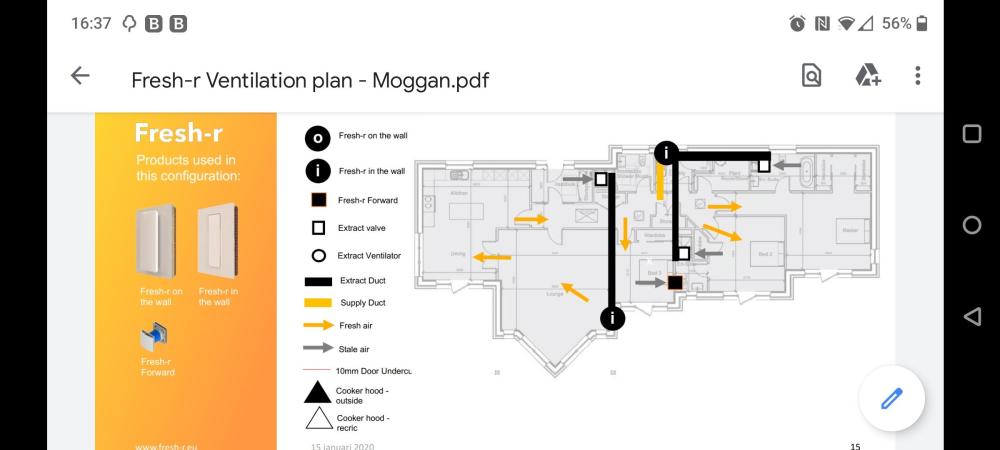
There are also units that have ducts also. Here is the plan from fresh-r for my house. Didn't use in the end, but liked concept. Two units, 3 pipes and one forwarding fan, for 192m2
-
Another view of the world of modern stoves https://stoveindustryalliance.com/higher-levels-of-pm-created-inside-the-home-from-cooking-than-from-modern-wood-burning-stoves/ To give a balanced view of things
-
Think the clue is the word open. Efficiency of about 10% at heat transfer, normally in houses that leak like sieves to feed the fire. Burn enough energy in night, that I could possibly burn in a month, if I wanted a good roasting most nights.
-
You have missed my point. Also by the way the Prana unit is not the same as the Fresh-R or Freeair. Neither Fresh-R or Freeair are dMVHR units. You need to study how they work, they are full MVHR units less the huge amounts of duct normally required. Making very practical for retrofitting. You can use the same design principles using a basic MVHR unit in your loft or cupboard. And cascading air from one place to another.
-
If were me and I am no electrician Budget stretched 3x car chargers, you don't have a car requiring charging, pre run cable, both ends not connected. Outside end in a small waterproof box - all ready for later installation. Outside garden stuff, same as above. Ditch patio heaters as a waste of good electric Find out why a new build needs a 12kW ASHP - use all the money you save on the above fantasies on decent insulation and air tight measures, so are installing a sensible ASHP. No 3 phase required, to run a single phase house!



