
JohnMo
-
Posts
12467 -
Joined
-
Last visited
-
Days Won
179
Everything posted by JohnMo
-

Heat Pump vs Gas Boiler: Lifecycle Cost Comparison (UK)
JohnMo replied to Green Power's topic in Air Source Heat Pumps (ASHP)
The idea is the flue gas passes through a heat exchanger, it condenses, gets drained away. The process has a phase change from steam to water, the latent heat is captured by the heat exchanger and passed to water increasing efficiency. The acidic water goes direct to drain after that and does not go through the flue. A condensing boiler working correctly has no steam coming out the end of the flue. My boiler is running at target flow temp of 26 to 29 degrees depending on outside temperature. So they do go below 35 degrees. -
Heat Pump vs Gas Boiler: Lifecycle Cost Comparison (UK)
JohnMo replied to Green Power's topic in Air Source Heat Pumps (ASHP)
Take a look at the efficiency and recorded flue gas temps at low flow temps. Screenshot from the same manual.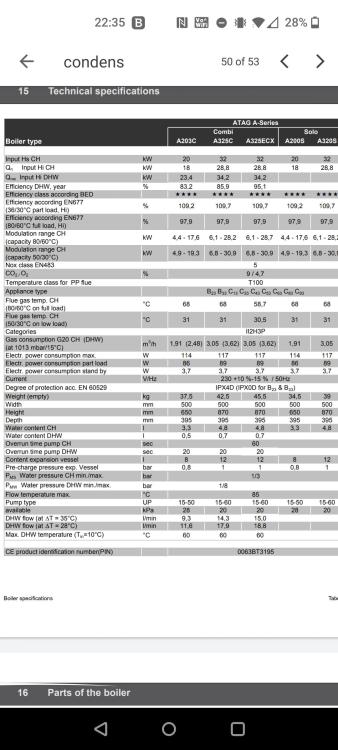
-
Heat Pump vs Gas Boiler: Lifecycle Cost Comparison (UK)
JohnMo replied to Green Power's topic in Air Source Heat Pumps (ASHP)
Direct cut and paste from a condensing boiler manual. "The boiler is equipped with a compact stainless steel heat exchanger with smooth pipes. It is a well thought-out principle using sustainable materials. The boiler burns (natural) gas to supply heat. This heat is transferred in the heat exchanger to the water in the CH installation. The rapid cooling off of the flue gases causes condensation. This results in a very high efficiency. The condensate that is formed, has no negative impact on the heat exchanger and it's operation, and is removed through the internal syphon." -
Heat Pump vs Gas Boiler: Lifecycle Cost Comparison (UK)
JohnMo replied to Green Power's topic in Air Source Heat Pumps (ASHP)
That may be true for a non condensing boiler, but since 2005 it has been illegal to sell or install a non condensing boiler. If you boiler is older than that it may be true. If newer than that he is talking rubbish and really needs to get his facts in line with technology from 20 + years ago. -
Heat Pump vs Gas Boiler: Lifecycle Cost Comparison (UK)
JohnMo replied to Green Power's topic in Air Source Heat Pumps (ASHP)
Thought they all were these days. -
Heat Pump vs Gas Boiler: Lifecycle Cost Comparison (UK)
JohnMo replied to Green Power's topic in Air Source Heat Pumps (ASHP)
So again to compared apples with apples, circulation pumps are on bothe a heat pump and a boiler, in either the pump can be inside the box or outside. Ignition is on for a few or less seconds. Fan will be on almost all the time the boiler is firing. So it's 35w/h X 4 x 180 ( days in heating season. So nearer £8.50. plus an hour a day for DHW, so about £140 over 13 years So close to £150 -
Basics are, the smaller the differential, between flow and return the more heat that goes into the floor/room. You can do this by increasing a loops flow rate. The opposite is also true, bigger differential lower heat output. Decreasing flow rate increaces differential, to output. So it's just a matter of getting the balance right. Remember Wunda and other just want you to buy more products. I got all my UFH from outsourced energy, good prices and products.
-
More over thinking, instead of getting on with the build. You have to follow OEM instructions for install, end of. Install move on.
-
Heat Pump vs Gas Boiler: Lifecycle Cost Comparison (UK)
JohnMo replied to Green Power's topic in Air Source Heat Pumps (ASHP)
It extracts latent heat from the condensation, that is formed in the exhaust, hence the term condensing boiler. Any temp below I think a return of 53 degs, gives an uplift in efficiency, the lower the temperature the better the efficiency. A gas boiler while firing, with no steam coming out is condensing. -
Heat Pump vs Gas Boiler: Lifecycle Cost Comparison (UK)
JohnMo replied to Green Power's topic in Air Source Heat Pumps (ASHP)
I have that with my combi, so it's not that difficult, just have a cylinder upstream of the boiler, with an immersion. During the summer some days I used zero gas, most days nothing much for DHW as it was heated by solar PV. Not as effective as a 3-4 CoP but it can be done, with a CoP of 1. -
Be careful with timer thermostats, and making lots of individually timed zones, this can lead to short cycling of your boiler, which will cost you in more gas usage.
-
Heat Pump vs Gas Boiler: Lifecycle Cost Comparison (UK)
JohnMo replied to Green Power's topic in Air Source Heat Pumps (ASHP)
No they won't and I completely agree, it more like 95%+ of boilers operating at high flow temps. There are lots of heat pumps badly installed also, running higher than ideal temps, with on/off controls and lots of zones. But if we are comparing on a like basis, lets compare from a similar starting point, not apples against pears. -
Heat Pump vs Gas Boiler: Lifecycle Cost Comparison (UK)
JohnMo replied to Green Power's topic in Air Source Heat Pumps (ASHP)
The only thing to say in defence of a gas boiler is the 80% efficiency, is not always the case. If you compare it on a like for like basis i.e. on low flow temperatures, a part load efficiency is being quoted for our boiler (Atag A325ECX) of 109.2%, with a flow temp of 36/30 return. When looking at DHW with flue gas heat recovery it is being quoted as annually 95%. -
Run piping under flooring but above the insulation.
-
So on a good day in mid winter your PV may put a very small proportion of your heating requirements on most days nothing. So your January heating cost could be circa £1500 - minus your PV contribution - based on a Willis. You could buy an 8kW Dream heat pump for £1400, just run the heating off it, good CoP easy install. A CoP of 3 would £500 running cost, so midway through Feb its paid for itself.
-
How are you currently operating? What are your flow temps, how many zones do you have (TRVs and thermostats) , what temp do you heat your DHW to?
-
Doesn't depend on a few different things, like solar gain through windows and fabric structure, the same or similar to heating
-
I would take the opportunity, to increase radiator size or area, to make your house suitable for heat pumps. The added advantage is you can use lower flow temps from your gas boiler to increase efficiency. I would also make sure your pipes are above the floor installation, so they heat heat to the house.
-
Confused why modern heat pump derived aircon is expensive to run, with an equivalent of a CoP of around 6 to 10 depending on model and outside air temp.
-
You have to be very specific when asking for u values, that you want the whole window value, even then some supplies get confused and give you the glazing value, thinking they can get away with it and sell you rubbish frames that leak heat.
-
The idea with WC is you set the flow temp so without TRV or thermostats the house temp is where you want it, it runs 24/7 during the heating season, but with setbacks of a couple degrees at night or when empty. If a room is too hot/cold that room radiator/ufh is flow balanced to get the temperature right. Some set up time is required, a bit of trial and error. The temperature curve will need to be lowered or increased depending on how your house reacts to temperature changes. Load compensation does a similar thing to WC, but without reference to the outside. If you have UFH, load compensation is too slow, so would not use it (have tried). If going for either route on/off/opentherm thermostats are ok, but not needed, they are just set a couple degrees higher than your required room temp as a limit stop. When I decorate next, all my thermostats are being removed - they are not needed with WC. Use the manufacturers controller and keep it simple.
-
I have a drain back solar thermal panel to install. It will be hooked up our buffer, which preheats DHW in the summer and is a buffer proper in the heating season. In the winter the buffer is at around 26 degs, so expect to get a decent yield from the thermal, as only a low temperature is needed in the panel to start producing usable output, amount sun shine needed isn't expected to be that great.
-
Your house is very similar to mine, my walls 1.4, floor 0.09, roof 1.3, our heat demand is 3.1kW @ -5 NE Scotland. Our temps have dropped quite a bit more than yours. So much so, that the heating has been on since the beginning of Oct. Interesting is for the average temp in Oct, our heat demand should be 1.5kW, but so far this month we are averaging at about 20kWh a day including DHW. So about 0.6kW heating input. The only thing to watch for is look at the HP output at your lowest ambient, to make sure you have some room for DHW. If you are batch charging UFH, this allows a bigger HP to be used, if doing WC you will be setting back at night a couple of degrees, so you will have a few hours where the heat pump isn't doing that much anyway.
-
Good chance it's air. You will need to bleed the system.
-
Just compared your SAP to mine, yours Jan 2100kWh, mine 1500kWh, my max heat demand (calculated) is 3kW at -5 degC. Yours pro-rated, is about 4.2kW for a max heat demand. But you need to calculate for local weather conditions. You need to add an allowance for DHW, and the reduced performance as temperature outside reduces. Plus have decent modulation. So on balance, as suggested above by @Conor would do a decent job or something similar. Ideally look for cooling ability built in and weather compensation. Bigger is not better with heat pumps.