


JohnMo
-
Posts
13296 -
Joined
-
Last visited
-
Days Won
200
Everything posted by JohnMo
-
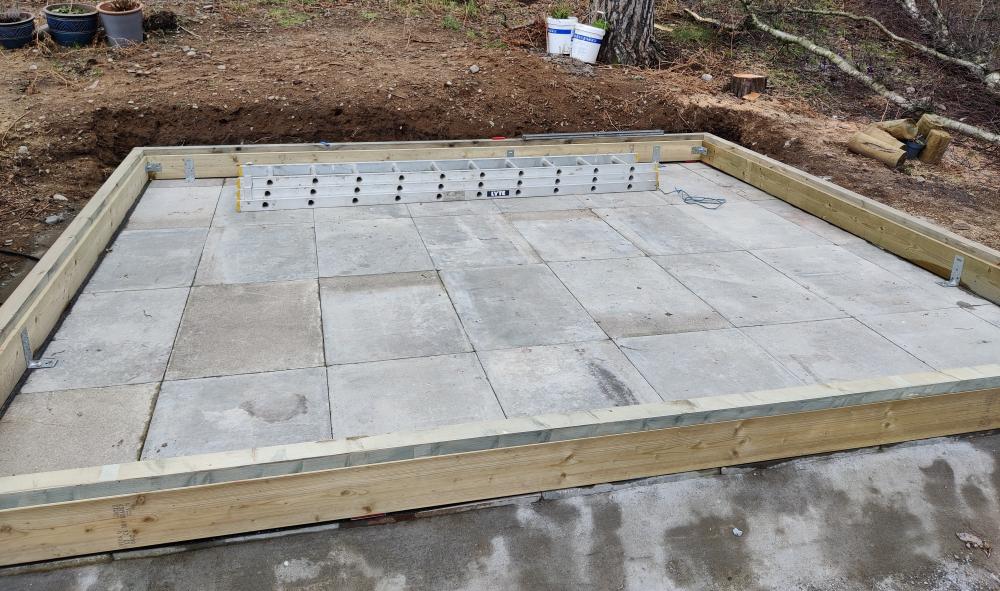
Now started the build. Base formed with 3x2 council slabs on concrete. Asked for the bases to be flat and level, overall it not, there is 12mm run off over about 4m. Compensated so far with shims. So above the base to form a space for floor insulation, floor and an overhang for decking have built a frame using 2x 170mm X 45mm timber. This is under the floor framing that came with the kit. Floor buildup will be as follows. DPM, 100mm EPS100, 50mm EPS100, slip membrane, 2x layers of 9mm OSB, glued and screwed with staggered joints, 50mm battens at 400mm centers, infilled with 50mm UFH EPS mouldings, with UFH pipes at 115mm centres. This will be overlayed with tongue and groove flooring. Overall there will be 200mm of EPS 100 insulation in the floor. Walls next
-
By inside do you mean between the panes of glass, where the argon is, or inside the building?
-
So what do you do with all that data? Reason I ask is because you boiler looks to short cycling?
-
Any HSS drill bit will do it, as long as it's a real one, not cheap Chinese ones. The import bit is applying the correct pressure, this doesn't come from a hand drill, unless you are drill small holes. You need coolant also.
-

Grease filter kitchen extract
JohnMo replied to Oz07's topic in Mechanical Ventilation with Heat Recovery (MVHR)
I use these on all the extract ducts https://www.epicair.co.uk/products/extract-air-valve-filter-for-8960-125mm-valve-10-pieces -
Do you need anything, a thermostat that can do heating or cooling mode, run the flow temp at a fixed 15 degrees - job done. Little or no concern with humidity anywhere and a floor surface temp cool enough to manage house temps. I did a drain down of an UFH loop in the summer and the water coming out was at 25 degrees. So if you flow at or around 15 degrees you should be doing about 10 degs of cooling over the floor area.
-
MVHR is Largely Bogus
JohnMo replied to DavidHughes's topic in Mechanical Ventilation with Heat Recovery (MVHR)
Sorry didn't go all the way back to your older post 2020, just read the above. Where you mentioned bills and reducing costs. -
Isotex and mortgage lenders- any problems ?
JohnMo replied to Surfiejim's topic in Insulated Concrete Formwork (ICF)
We have Durisol, so similar. When I spoke to our building insurance people and said we had built using an ICF block, I asked if that was a novel or standard build, they said standard it's just a reinforced concrete wall. Breaking the construction down, an ICF block is just concrete formwork that remains in place instead of being removed. So your construction is just reinforced concrete that is insulated. -
If you are concerned just use ufh pipe (pert-al-pert) and use a 16mm to 15mm adapter at the radiator, you can do it any length you like with that pipe joint free.
-
Any truth to ASHP problems based on location?
JohnMo replied to Shaun McD's topic in Air Source Heat Pumps (ASHP)
Worth a read https://www.bennetts.co.uk/bikesocial/reviews/products/motorcycle-maintenance-and-servicing/best-rust-corrosion-preventer-inhibitor -
Why do you need the circulation pump on the return going ASHP 2, the heating manifold pumps will do just fine, pulling from the buffer and returning it. You have 4 pumps, without hydraulic seperation, so you could/will end up with pumps chasing there tails. ASHP 1 and 2 seem huge. If No 2 is just back filling if No 1 doesn't cope.
-
VAT reclaim delays
JohnMo replied to Oldsteel's topic in Self Build VAT, Community Infrastructure Levy (CIL), S106 & Tax
My VAT claim was delivered to VAT office yesterday, so will see how long it takes to be processed. Only one A4 box file for me. -
Discount Offers of the Week
JohnMo replied to Ferdinand's topic in General Self Build & DIY Discussion
It was only valid to 01/01/1800. So you're 223 years late to the party.😀 -
It's a Maxa ASHP, with its own inbuilt controller. The only third party bit is a limit stop thermostat, one in the house and one in the summer house. Just need to finish the install, work and weather keep getting in the way.
-
If you wanted
-
CoP would be rubbish most of the time pump 50+deg water around. Think things are being made more complicated than they need to be and would result in something that cost a small fortune to run. Just had a look at my ASHP controller, it can set two flow temps controlled by a open/closed contact, as well as another temp for DHW. But it would only flow either a high or low temp, not both at the same time. It can also control a mixer valve if required. Best CoP and simplest design would come from running UFH and Rads at as low temp as possible (i.e. big radiators).
-
I have often though about this (sad I know). When you compare thermal properties of PIR, those covered in foil and those not (other materials not aluminium) the not reflective coating PIR, always seems to have a worse figure for thermal conductivity. So does the 0.022 thermal conductivity already make the assumption there will be an air gap? I am assuming so, as the aluminium foil is actually a heat conductor if its a reflective surface.
-
Yep
-
I have played with boiler settings quite a bit over the last year or so and found the following. 70 and above, the boiler control will modulate flow rate to achieve a delta of 20. But - as you bring the flow temperature down, the delta T also comes down also, when you have a flow temp in the high 20s to low 30s, the delta T is around 5 or 6, the pump flow rate is automatically adjusted to maintain this. So is working very similar to a heat pump.
-
That may be difficult
-
Is my Vaillant ecoTEC working properly?
JohnMo replied to PiMike's topic in Boilers & Hot Water Tanks
Looks to hitting max kW of 12 ish then it trips? -
Is my Vaillant ecoTEC working properly?
JohnMo replied to PiMike's topic in Boilers & Hot Water Tanks
You will have a max temperature set in the control system, so the boiler slowly increases power and therefore heat output, once it hits the max temperature setting it cuts out. It will continue circulation and when it sees the return temperature drop by a given temperature, it will kick back in to life. This ramping of temperature aids efficiency as the temperature across the heat exchanger stays low for as long as possible promoting condensing as much as possible. Condensing starts at about 56 degrees, the lower the temperature range across the heat exchanger the more condensation the more the efficiency increases. I'm currently at about 120% efficiency consistently for UFH. -
MVHR is Largely Bogus
JohnMo replied to DavidHughes's topic in Mechanical Ventilation with Heat Recovery (MVHR)
Of cause it is, we are not talking cost of a kitchen. If you install something to save on gas as @Levo did (his 3rd motivation), that being MVHR, its running cost is relevant. If it cost £100 to run and maintain and saved £50 in gas consumption, it would be a waste of investment and would fail to achieve his 3rd motivation. In this case, gas saved is greater than electric used and filters, so win win. -
Is my Vaillant ecoTEC working properly?
JohnMo replied to PiMike's topic in Boilers & Hot Water Tanks
What you are seeing is fine, in fact very good. -
Is my Vaillant ecoTEC working properly?
JohnMo replied to PiMike's topic in Boilers & Hot Water Tanks
Good to see, you will find your gas consumption drop considerably. Mine did similar to you first and second graphs, then closer to your final graph, gas consumption dropped by around 30%




