


JohnMo
-
Posts
13296 -
Joined
-
Last visited
-
Days Won
200
Everything posted by JohnMo
-
Not sure of your flow rates, but a flexible hose to 28mm then through wall.
-
I would copper pipe through wall airtight expanding foam and the a bead of sealant between pipe and wall.
-
I would question if the consultant is just taking your money, he sounds to be adding zero value here. Recommending 5m3/m2 and MVHR is just rubbish, wasting your time and more importantly your money. If you are not below 3m3/m2 on a new build with ICF walls something is well a miss with the build and as the consultant he should know that. He should also know that MVHR with a leakage rate above 3 is not the smartest move and not recommended for optimal energy usage. Making rubbish assumptions just makes heating systems bigger than they need to be. Also the ASHP sounds well oversized. That is again just bone idle, no leg work just throw away rubbish statements.
-
Just let it draw and exhaust directly to outside, don't let it take house air. Have an inlet and outlet in the outside wall. Your CoP will reduce in winter, but will still perform better than an immersion. In the summer it will draw warmer outside air and your CoP should be better. A quick look at a Dimplex Edel it has an operating range of -7 to +35. Anything outside that range would be immersion, so you are not loosing anything.
-
How many W/m2 output do you need? Do you have insulation below the UFH pipes. I am in the process of putting UFH in a summer house, I went EPS on 125mm centres, with timber bearers on 400mm centres between the EPS panels and with a 2 layer (glued and screwed) OSB on top. Not sure how it will perform, but don't see any problems.
-

Screw or nail timber cladding?!
JohnMo replied to DC5's topic in General Self Build & DIY Discussion
Stainless ring groove nails. I used a nail gun, with a smooth head, so it didn't damage the wood. Don't use carbon steel, nails or screws as this will lead to black streaks on the wood after a few month's. -
-
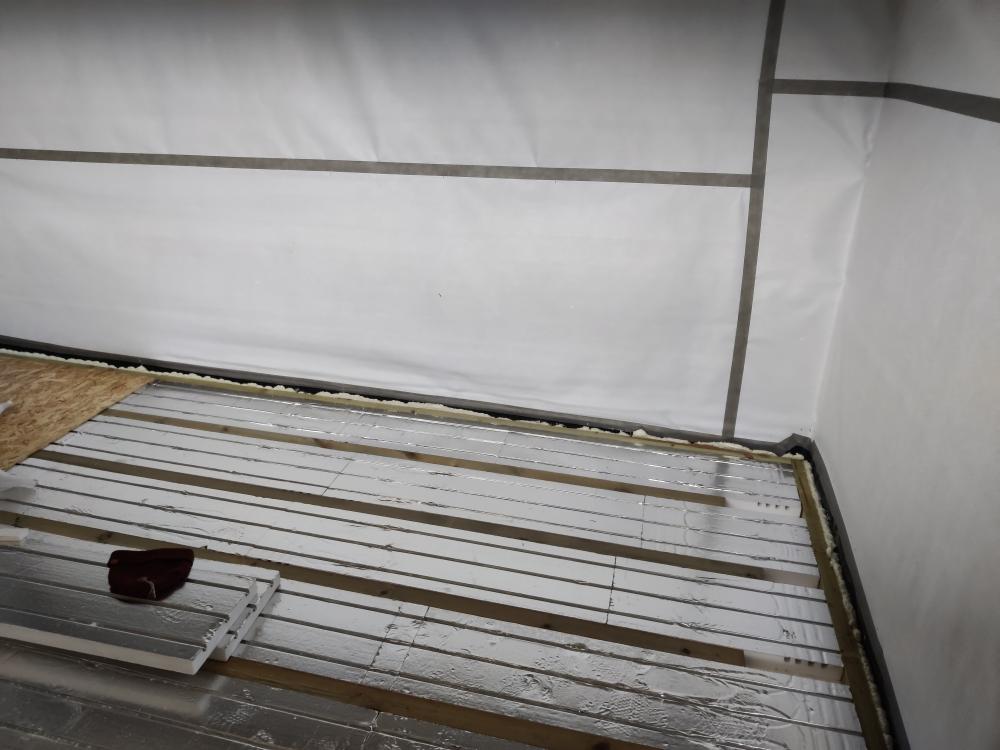
Bit of progress over the weekend and yesterday. 150mm EPS70 used on top of the roof finished so far with 9mm OSB. Breather membrane on inside of wall, double taped at all joints and to roof lining and to DPM. 150mm of EPS70, in floor, plus a further 50mm thick EPS UFH moulded panels. Have set 70mm wide floor bearers into the UFH panels. One loop of UFH pipe installed.
-
Yes it includes verges, fields, etc, anything that can get in the defined line of sight measurements at the required heights.
-
UseHi welcome As above really, lots of comments. You are being pushed to employ lots of of so called specialists and consultants none of which come cheap, and sometimes I wonder if they add value or do the complete opposite. The more specialists the less control you have as you always fall back on the specialist. The less control YOU have the more the costs get out of your control. Example you want ASHP and UFH, add an uvc and that's the heating system done. What value did, does a consultant add? You say MVHR needs to talk to PV and battery no idea why, MVHR is a standalone ventilation system. You want to cut cost but you are installing a battery storage system? You seem to have lots of dead space (voids) on the first floor and rooms seem to look massive, have you done a reality check on room sizes? You may be cheaper doing it all with local contractors and stick build the frame work at site.
-
Oil boilers are pants really, you may as well go lpg or natural gas and get a proper modulating and condensing boiler or a heat pump.
-
Could you run it in the same low temp mode as a heat pump and over 100% efficiency through condensing? Same as a gas boiler?
-
Agreed. I intend pumping circa 18 deg water around Found last summer doing some modifications, that mid summer the water in the UFH pipes was at 25 deg, sitting static. So thatcwould equate to the floor being a similar temperature. So 18 degs should make difference
-
We have 16mm pipe in conduit cast on concrete floor. When it was done the pipe moved about reasonably easily. No bends or really long one are required. Once in place you would hope there is no need to replace. Not sure if there is any difference in the electrical conduit compared to speedfit except the price.
-
Yes that's the aim, great that was my thought also on drips. Thanks for confirming.
-
Hi, I'm just up the road a bit further east by Elgin. If your going passivhaus standards, look at form factor, makes a big difference to the insulation levels you need achieve. So a bit more to read up on. I also moved from England in the 90s.
-
Question Have first layer of EPS in and DPM on top. I will be running a breather membrane on the inside wall, am I best to join the DPM and breather together, so any moisture on the inside of the outside wall cannot get inside the building?
-
Hi, just post specific questions in the relevant forum sub sections. Try not to mix many topics in single post, as you will find it will go off on a tangent and nothing specific will be answered. Make it simple to give answers. Simple rules, keep it short, simple and relevant. If you are asking a question on wall insulation, give details of what you know already, like wall buildup and an idea of what you want to achieve. Enjoy the journey.
-
Fully intend to run cooling this year in 300mm loops. Hot enough already in bed, without a heater under the bed as well, putting the beds anywhere else in the room, would look away from the Loch view so you wouldn't move them. All room are large enough to move around with a walking frame and even have wheelchair access to the front decking.
-
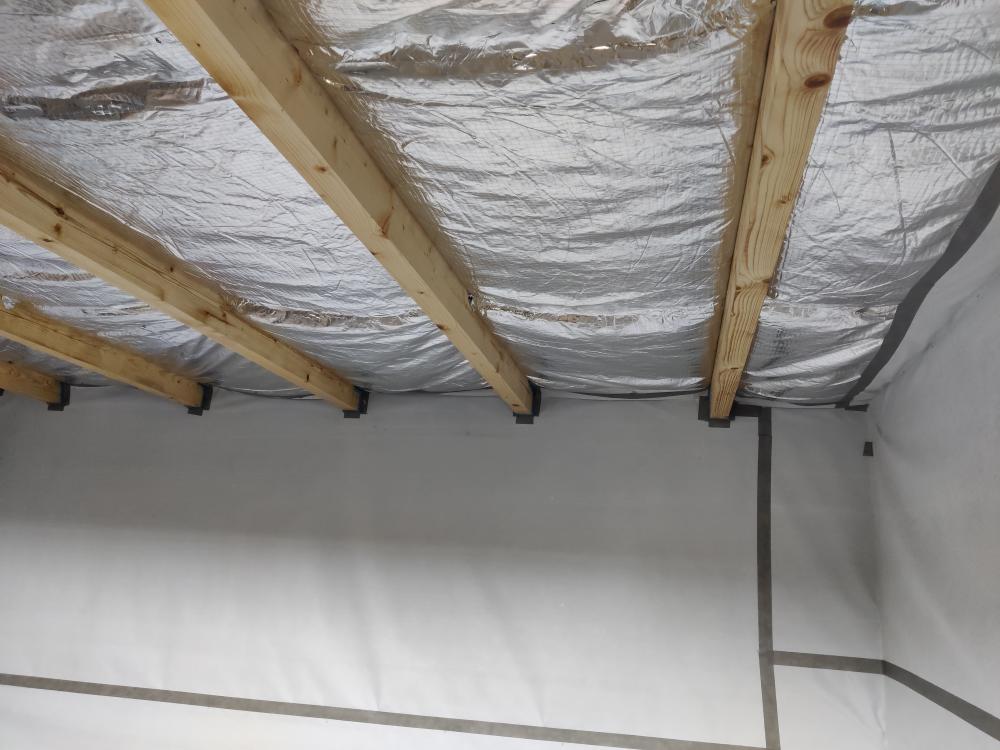
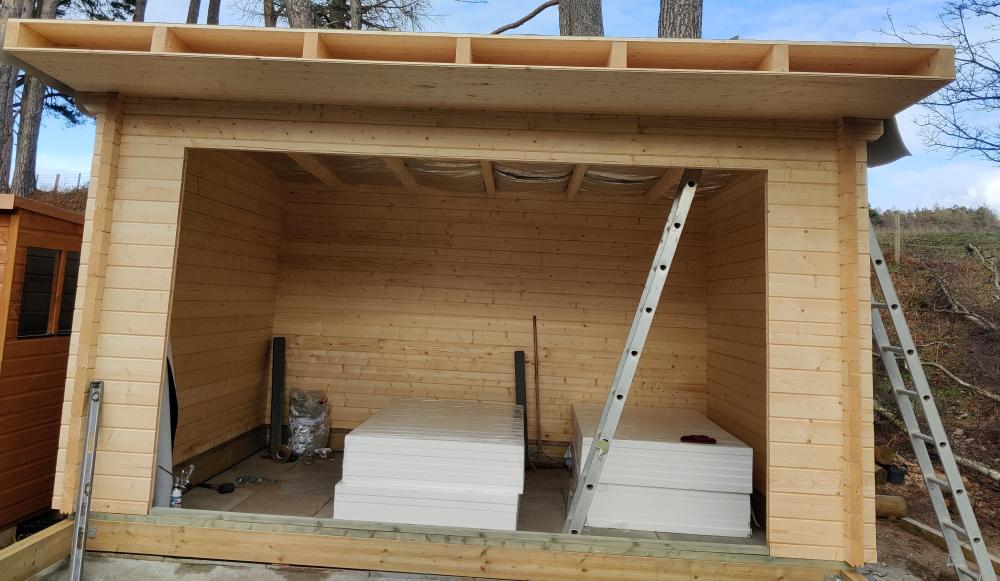
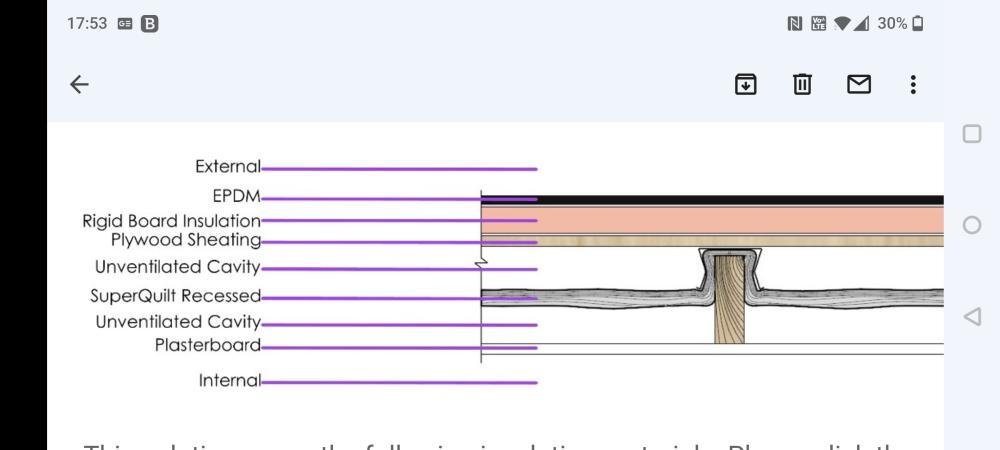
Progress from yesterday, had a day off today doing other things and waiting for deliveries. Basically installed superfoil over rafter and stapled to give a 25 to 50mm invented cavity. Roof topped with tongue and groove timber and a breather membrane to keep the weather off the roof. Roof buildup will be similar to this Perimeter framing on roof next and then EPS insulation on roof. Also floor to insulate and UFH to install.
-
Currently still on a gas boiler, with a big buffer. But getting closer to getting the ASHP hooked up, that will be run on two zones, 1. house and 2. summer house. Summer house will not be allowed to call for heat, just switch off heat. House will have over temp thermostat and generally run 24/7. I wouldn't size for a few hours or days in a year, the norm is to size for -2 to 3. Most of its life it will be above 5 degs. Then you are looking at what the output of the ASHP is at that temp. Mine basically does 6kW down to -15. But it's rated at 6kW at 15 degs also. What's more important is turndown so when it's 10 degs outside and you only need 1kW it works with out short cycling. You need about 60l system capacity open to the heat pump for that. You have a limited choices of ASHP available, too big you need a buffer, too many zones you need a buffer.
-
What I noticed is the more normal house with heat demands in the 50W/m2 + spacing makes a big difference to flow temp, low energy house a very small difference.
-
Use this to make your own informed decision. I made the assumption the outside temp average is more likely to 4 or 5 degs in the heating season instead of the odd day in the -5 or below. So more likely to be heating at 10 to 15W/m2 than 20 W/m2. Which is well below the chart for flow temps.
.thumb.jpg.e6f5b10749b0a8b28a782f83356b9791.jpg)
-
Towel radiators in Ensuite with UFH?
JohnMo replied to Internet Know How's topic in General Plumbing
We have electric only 400W towel rails in all bathrooms in addition to UFH. Great for drying out towels when heating is off. -
Floor 0.09 Walls 0.14 Roof 0.13. Glazing 0.6 to 1. Rooms at 19 to 20, bedrooms at 17 to 18. Our house is approx 3 to 4 degs cooler than the last one (single glazed 1830s house) and more comfortable, there are no drafts, triple glazing doesn't suck the heat from your body like single glazing did, the warm floor is always radiating heat at you. So room air temp can be misleading.








.jpg.87d6d75adaec59a22c40fcf0ea8d2464.jpg)