JohnMo
-
Posts
13306 -
Joined
-
Last visited
-
Days Won
200
Everything posted by JohnMo
-
No that how must trades seem to work these days from experience also. Their bosses have contracts with other companies that pay better, have call off penalties etc. You are just a fill in job, between better paying ones
-
Drill a hole down to insulation?
-

Guidance on underfloor heating in a 1950 bungalow
JohnMo replied to swank's topic in Underfloor Heating
There have been a couple of similar threads recently, with links on how to do suspended floor insulation. Sorry can't be much more help. Take a scan through relevent sections of the forum. -
Good catch with the mixer valves, the other thought I had was, to route the flow to the UFH first then use the return flow from the UFH to heat the pool. So in series instead of parallel. So your pool demand, acts a huge accumulator. You certainly get the best and steadiest output from the ASHP.
-
Guidance on underfloor heating in a 1950 bungalow
JohnMo replied to swank's topic in Underfloor Heating
With UFH you need lots of insulation, aiming for a floor U value of 0.15 (150mm PUR, or 250mm of good mineral wool) or better or frankly don't waste your hard earned money installing and then for ever more, paying for heating. -
which trades, when and in what order
JohnMo replied to Post and beam's topic in General Construction Issues
In your letter from the council, they will list what inspection and what certificates are required. It is normal for a building control inspection, prior to plasterboarding, so they can inspect whatever they wish, prior to it being hidden for ever. -
From my perspective - no, tried with the gas boiler, it had built-in algorithms room temperature just yo-yos. Those algorithms were also controlling flow temperature. On an ASHP you are just giving an on off signal. Room compensation comes with some ASHP, but that is only any good with radiators as it requires a short response time. For me - Either a small hysterisis thermostat and almost fix flow temp (very small WC curve) to switch on/off the ASHP or a well set WC curve are the only things that get my vote.
-
So reverting back to option 1 and 2. Option 2 just looks too complex, so in all probability will be to install and control. Option 1 is basically a hybrid ASHP gas boiler installation. Almost any ASHP is pre equipped to run hybrid mode out the box, some are more difficult than others. The Daikin ASHP especially for hybrid installs is designed to work with other manufacturers gas boilers and you set up to manage which heat source is online based on cost or emmisions. You could also get away with a smaller ASHP as you would design to say +3 degs instead of -3 degs. So ASHP is utilised 95% of the time, gas boiler for other few percent.
-
Could you just heat the pool and use it as a thermal store. So heat pump just continually manages pool temp. Then take water direct from the pool and circulate through the UFH? Or take via a plate exchanger to keep them seperate. Could do all with an all seasons pool ASHP. Use a plate heat exchanger as DHW preheat before cold water is entering an unvented cylinder, and let the ASHP heat that via a 3 way valve a couple of times or even once per day? Or just heat with an immersion as very little work would need to be done.
-
Range is 2 to 23 l/s. I have one set about 4 - you have to take the cover of to check it running as it is completely silent. CV2-GIP.pdf
-
Hi welcome - have visited your site many time, very informative.
-
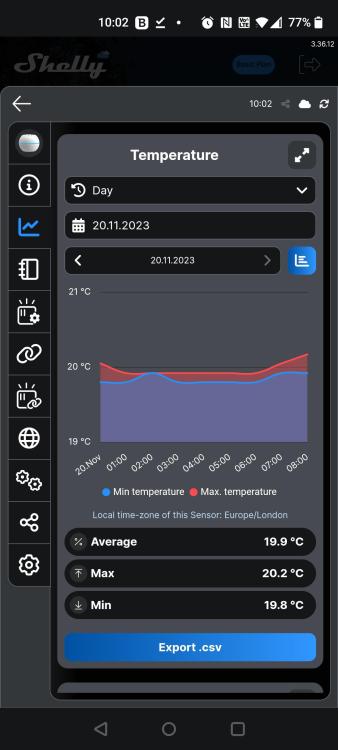
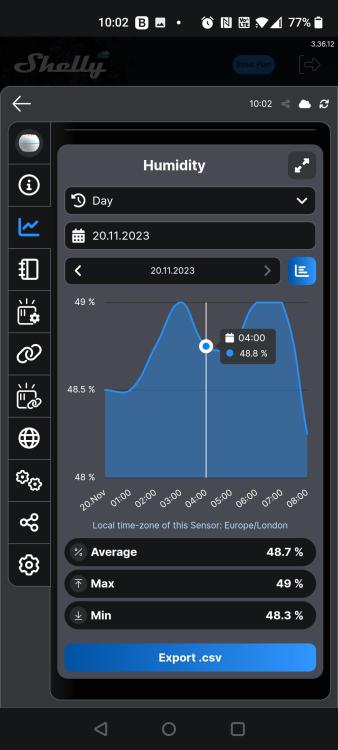
Or Shelly H&T, currently 40% off, at Shelly store, similar output. Not sure how you get data to excel though.
-
Make from a higher density EPS or XPS, mine are just XPS in a metal casing. MDF laminated with EPS, to give some mechanical strength. Other issue is filters unless you have the external to the unit.
-
Looks good, but the heat exchanger looks very small. How about using individual extract fans say Greenwood dMEV, let them feed to the heat exchanger. The fans come with built in humidity sensors, are fully user adjustable. Then just run the supply at fixed speed. For the short period of boost in a single room, unbalancing isn't really much of an issue.
-
@BeelbeebubOr just use one of these off the shelf items to control from a buffer https://www.ebay.co.uk/itm/126168847679?hash=item1d603fd53f:g:dzwAAOSw93JlRK6R&amdata=enc%3AAQAIAAAAwJE0AgmF7NYnmL%2Bb3NHl2nvvJs%2BbcZvTFN%2BOBVKGewKstjeKAYl2eR3SSF2IJmsxwJYj09wDR9tEYcC1gFA%2Blp2Q5jIZ4TqaTTGhDjMjQuo6yjexVnRtNY0jqE%2BLMSSMxYRgwEFD5E3kVXPIa%2BDEcgcwiYhvsOH8C6%2BCc4Gb6M1KyeGASY4cuRXY2VK6cr0%2FBZSNOPYEQ7HEs1LuEpFlzPFOgQfLpBBaxK8a9yearpCZWrEPzaT5vybPfl8mZhHgaw%3D%3D|tkp%3ABk9SR4r5ub_9Yg Clima500.pdf
-
Simple thermostat is all you need (thick screed 0.1 hysterisis, thin screed any thermostat will do), if single zoned with a heat pump on weather compensation, you can actual run without a thermostat. Mine has done nothing for weeks, outside temperature has ranged from -3 to +14 Basically if the house becomes hotter due to solar gain etc, the heat input into house reduces due to floor to room dT reducing. The return flow to heat pump stays slightly warmer, heat pump reduces input to maintain dT across flow and return. Your WC curve needs to be setup well for this to work in practice.
-
My thoughts also, no wonder this thread is 40 pages long
-
Outdoor unit in ventilated garage??
JohnMo replied to Archer's topic in Air Source Heat Pumps (ASHP)
In another statement you made earlier you stated it was for heat only, but obviously it heat and cool like you expect from an A2A. So are you applying for full planning permission? I have attached the noise data for my A2W and it can be seen distance is your friend. A2A piping isn't that much of an issue for long distances.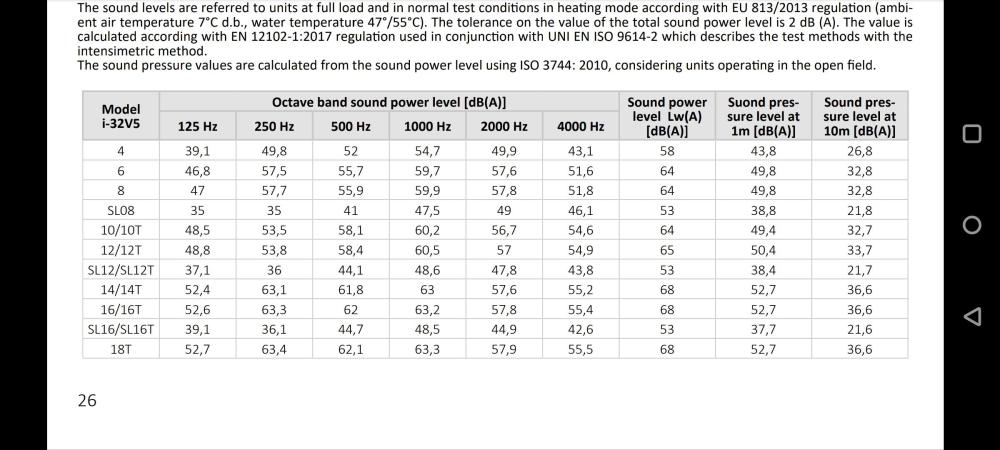
-
So is this MVHR unit you made yourself? What are the temperature sensors you used?
-
You don't need vents under a ground bearing slab. You would need the telescopic vents under block and beam to ventilate the space.
-
Are words that could mean to get royally fu..ed over. We had a rental, the agent was phoned by tenant to get a basic repair, asked what was involved and where the tradesmen were travelling from. Turns out they were travelling circa 100 miles each way to do a 10 minute job. I got my own trades from then on.
-
Wooden Floor thickness UFH and heating costs
JohnMo replied to Foldyard's topic in Underfloor Heating
That may be true for a gas boiler, which has an almost direct relationship between consumption and power output, but not a heat pump. For my ASHP (similar would be true of a GSHP) - for the same weather conditions electric consumption increases by 25%, not 6% if you increase flow temp from 30 to 45. -
Wooden Floor thickness UFH and heating costs
JohnMo replied to Foldyard's topic in Underfloor Heating
There is a difference between heating being on continuously and the heat pump giving a heat rate at a constant rate. As detailed in point 2. above. But still no detail on your system specifics or how you operate it? I will await details before responding again. -
Wooden Floor thickness UFH and heating costs
JohnMo replied to Foldyard's topic in Underfloor Heating
Again no, the same material that is thicker has an increased thermal resistance. A material has thermal conductivity defined by W/mK, The thermal resistance or R-value is calculated by using the formula R-Value = l/λ Where: l is the thickness of the material in metres and λ is the thermal conductivity in W/mK. takes into account the actual material thickness, the 'U' value is just the inverse of the 'R' value So thickness has a big impact. Double the thickness half the heat transfer. Otherwise you just insulate your house with 1mm insulation and all would be good. -
Small blanking plug missing from my Willis heater based UFH
JohnMo replied to dnb's topic in Underfloor Heating
A 1/4" BSP or NPT has an outside diameter of about 1/2" (close to M12), so likely to that. Two minute job to remove that section, take to plumbing merchant, b&q, Screwfix etc, and find the plug that fits.