


JohnMo
-
Posts
13308 -
Joined
-
Last visited
-
Days Won
200
Everything posted by JohnMo
-
Me also, but used only during the thinking process and getting ideas on paper. Once I had my plan it was frozen, think during the build we only changed the shape of a cupboard in the hallway and moved a few lights. Stayed offline (buildhub) during the whole build, so as not to get diverted, on many tangents and over thinking decisions that had already been made, for me that was a good decision. Did lots of the build myself with hired help when needed, a year from starting foundation (late 2020) we were sleeping in the house (mostly finished). Then came back to contribute once the bulk of the house was complete. Have I found things I would change, a few. Have since installed an ASHP (mostly for cooling) and unvented cylinder, I could have made the house slightly smaller and changed a couple of windows for smaller sizes. Things I learnt during the whole process Have a plan for everything before you start, down to where you want light switches etc. Airtightness is good. Have a ventilation strategy and stick to it, make sure every room is ventilated. MVHR will reduce your heating requirements. Understand how you route ducts and pipes before you start building You can never have enough insulation Hot and cold water distribution manifolds are good and make life simple. Low energy houses and big boilers are not a mix made in heaven. Do not listen to anyone that uses rules of thumb, they are generally wrong and screw things up. Do the calculations yourself and make your own decisions. If it's difficult, move on to something else and come back to it the next day. Ways to get around a problem come when you are thinking about it (it's how the brain works). Shop around, big variations in pricing. MCS and ASHP equals being ripped off, unless you are very careful. Forgot to mention - don't work everyday, you will burn yourself out. I worked from 7.30 until day light stopped me during the winter and a out 5pm when it didn't. Treat it as a job, if doing it yourself.
-

Stainless Steel Slate Hooks or Copper Slate Nails?
JohnMo replied to JamieK's topic in Roofing, Tiling & Slating
Whatever is done locally, anything thing else may look strange. -
Rigid vs Semi-Rigid
JohnMo replied to joshwk's topic in Mechanical Ventilation with Heat Recovery (MVHR)
All depends on the quality of the system design and implementation. Both can be good both can be rubbish. It's all about keeping flow velocity low and duct run pressure drops low, so fan speed is low. You need to consider room cross talk with a rigid branch system you don't with a manifold system (rigid or semi flex). Semi flex generally easy to install no joints. Where does that info come from? Not saying it's correct or not, but sounds.... -
MVHR New Install advice - Ducting in cold loft space insulation requirements
JohnMo replied to Olu's topic in Foundations
There are a lot of inlet and outlet terminals going on, looks overkill. 4 extracts in a kitchen and 2 in most bathrooms is just daft. It's fine running multiple ducts to a single terminal to keep the pressure drops in check, but you just don't need all this terminal points littering your ceiling. You only need one extractor or supply to each room. I would. You will need to seal the terminal manifold to the plasterboard once it's complete. I would have a single supply thermal in your master bedroom and only one extract in each bathroom to reduce the number of points to make airtight.- 6 replies
-
- 4
-

-
- mvhr
- mvhr ducting
- (and 1 more)
-
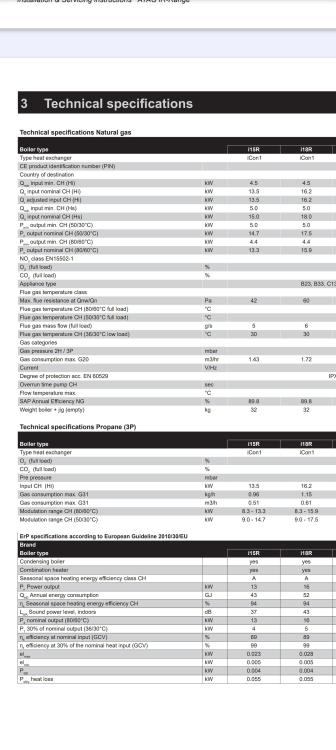
Page 8 of the install instructions Turn down is not quite as good as the Viessmann. But having used an Atag, they are super quiet and work well. The way to keep any heat source happy is enough engaged water capacity, you need about 50L to support 6kW so it doesn't short cycle.
-
Another boiler to chuck into the boiler options is an Atag boiler.
-
Or should say 4.3kW. which is very good While doing that you really need to take a look at pipe sizes to make sure your required flow rates matches the pipe sizes. When you reduce flow temp the dT across the radiator also reduces. 40 deg flow and a decent boiler may be looking to control at 5dT. So your flow rates through the radiator may increase. Or a Viessmann 200 boiler will go down to 1.8kW and not need to switch on and off in mild weather. A system boiler will control the circulation pump and modulate it's speed for better control. So able to run two different speeds for hot water and heating. Where a heat only boiler will more than likely be a fixed speed pump compromise. Did find a setback energy calculator, must be on the old phone, but worth a play, as the saving from setback is extremely small. Due to the hotter flow temps required to catch back up - but every house is different.
-
But doesn't your loan to cost ratio move more towards your favour. Say you want to borrow £200k, the QS say cost is £800k you are only borrowing 25%. Lower risk for the mortgage company. Or am I missing something?
-
I'm with @Russell griffiths, you have good cold bridge below your door. Notice you don't even have an insulation upstand for your concrete, that's an omission. You need an insulation material in the door threshold that can take structural loads. Compacfoam would be a good solution. You can screw this to the blockwork as you would have done with the wood.
-
Fabric and ventilation heat loss calculator
JohnMo replied to Jeremy Harris's topic in Heat Insulation
See the equivalent wind speed on the chart half way down this page https://efficiencymatrix.com/how-can-air-leakage-testing-help-you/#:~:text=As seen in the graph,to a 5km%2Fh wind So the equivalent of a 32km/h wind, but the point was it's applied to every surface at the same time - when it's windy the wind normally comes from one direction, not all at once. 32km/h is a fresh breeze, so pretty windy. -
Worcester Bosch Combi GSHP PV Eddie integration.
JohnMo replied to gustyturbine's topic in Ground Source Heat Pumps (GSHP)
The house loads including the heat pump are drawn first from the battery then the grid or if the loads are over the inverter capacity from battery and grid at the same time. In winter the pv will give you next to nothing most days, when it's sunny the solar day is short, so the kWh captured isn't huge. -
Same ballpark our problem site - 195m2, 0.09 U value, strip foundation with reinforced concrete slab. £32k Strip foundations reinforced at the front 2m wide (due to being at edge of a hill), insulated stub walls, 200mm with 2x rebar reinforced concrete, 200mm PIR insulation (U value 0.09) 70mm upstands and 100mm fibre reinforced finished slab. Included materials, time and concrete pump lorry twice.
-
So what are you trying to find out, where to get best efficiency i.e. smallest panel for a given output (generally the expensive one on the list) or best value? Or something different? What do you want the list to do? Panels are generally obsolete just after you buy them, so perhaps the lists don't exist anymore!
-
When running weather compensation the thermostat is there as a limit stop. It's not for room temperature control, it's for limiting room or house max temperature via solar gain for example. This thermostat is set to 23 degs if you want a room at 21. So it's always on. With WC (water law) on the heating just flows at low temp all the time. The heat pump will cycle on and off when heat demand is less than lowest modulation allowed. This is normal. The important bit is you don't try and switch on and off all the time as it's then playing catch up and using way more energy than it needs to. If the house gets to warm or to cold the water law temp needs to be adjusted. I see you mentioned you have a passivhaus, your rate of temperature change is low. UFH is fine, it just a matter of controlling it and really is just a big energy store. It just drips heat into the house in a comfortable way. It's also self controlling as the floor temp should not be more than a couple degs hotter than the house. Blasting heat as suggested by your architect is nonsense in any system or house type.
-
Low transmittance glass for skylight
JohnMo replied to Bancroft's topic in General Construction Issues
Your talking safety and standard stuff, this is about a blind in a skylight -
Low transmittance glass for skylight
JohnMo replied to Bancroft's topic in General Construction Issues
The likelihood of the building inspector getting down to this level of detail is zero. Include whatever they want on the plans as long as you can retrofit, if they push it at the final inspection, all good you can retrofit. -
Not exactly sure where the upper water level actually is. When they drilled they hit some water at 6m, but had to go down to 35m to get lots of it. Total head unsure, that would depend on the current water level. But with the amount of water we have had it could be quite high. Say 6m, plus 25 (0 to 2.5 bar) plus couple of meters pipe losses. So about 32 to 35m.
-
There are several ways do things First low flow (about 20L/min) and big storage (300L is quite large with 150L usable capacity), or high flow 40L/min and small storage. Then there is pump location submerged or not. Not submerged requires care to ensure the net suction head available and required marry together. Get it wrong you cavitate the pump. My pump is down hole 34m (vertical lift) and 25m to pump house and then upto 2.5 bar in accumulator, flow rate is 40L/min it pulls 1200W also. Note: Looking at my central heating pump on speed 3, it flows 1m3 and pulls 33W, so there must be low wattage pumps out there.
-
Fridge in hallway / fire regs and ventilation
JohnMo replied to makingprogress's topic in Building Regulations
+1 -
Posts for raised decking: timber or plastic?
JohnMo replied to Lift span's topic in Landscaping, Decking & Patios
I think some of the where about 3 to 4m. But we have a similar arrangement holding down our roof overhang and they must be about 7 to 8m. -
Ours is a fixed speed, think it's a 100L accumulator. Works fine. Fixed are way cheaper than variable speed and for domestic use fixed speed is fine. If your using a 300L accumulator a VSD pump would run most it's life at full speed anyway. So why bother with the complications and additional expenses. With those suction and discharge heads you are only going to pull 10s of watts anyway, with the right pump.
-
Fridge in hallway / fire regs and ventilation
JohnMo replied to makingprogress's topic in Building Regulations
I would just omit all together, putting a fridge in a sealed room? Transfer what you want cold on a daily basis to the normal fridge, like everyone else does. -
Fridge in hallway / fire regs and ventilation
JohnMo replied to makingprogress's topic in Building Regulations
Hi no image. I would put in utility, get BC sign off then put it where was best for me. But not sure in a hallway would be my first option. -
We did concrete, but did it before the walls went up. Not sure all screeds can be done in a 100mm, so you have to do some investigation. Hopefully someone will be along to answer in more detail.
-
@ProDave @thaldine our house is sitting at 42% RH currently and its 21.5 degs, we have had a bedroom window open all day and lounge windows open this evening. But outside is 79% humidity and 7 degs. It's interesting to see the difference between the enthalpy HE compared to stock heat exchanger.


