
JohnMo
-
Posts
12470 -
Joined
-
Last visited
-
Days Won
179
Everything posted by JohnMo
-
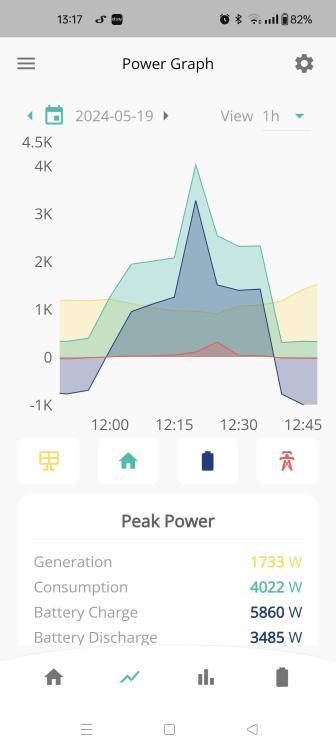
A snapshot of our battery app. Showing an hour today, doing DHW heating and the spike is kettle going on at the same time. It's cloudy today and only generating around 1kW Yellow is PV output Green is electric demand from house Blue is what the batteries doing, below red line is being charged, above red line is giving electricity to house Red is what the grid is doing. So today, when we do hot water heating, the PV isn't sufficient, so we borrow from the battery, as soon as the heating is finished, excess PV flows in to the battery until fully charged.
-
Mine is a dry ridge on slate, there are small brackets and screws to the ridge beam or rafters.
-
I didn't get a temporary power supply couldn't see the point, so just got the proper final supply on site as soon as I could - at foundation stage. Mounted a meter box on a post in approx correct position. When I was at a stage to mount the meter in its final position, the house was water tight, so cut the box away from the meter and the electrician placed it in the final location.

-
Couldn't agree more. We have a 6kW inverter and 13.5kWh battery. Inverter is about the right size so you don't keep pulling in grid electric while you make the tea for example, an oven and couple of hobs all asking for power at same time will exceed 3.6kW very easily. Mid winter we only go to about 7pm on the battery, so 5.5hrs short of the whole day. PV diverter, if you have a smart meter and MCS certificate as said by @Conor no point just export, if no smart meter you will get 4.5p kWh, so diverter to hot water. No MCS use diverter.
-
 That's a lot of space for 2 bedrooms, we rattle about in 195m2 and 3 bedrooms. But to answer your question, really depends on the complexity, building methods and how many detailed drawings need to be produced, so the contractor doesn't build a non Passivhaus - is it actually a Passivhaus or sort of a passive house? Very different in the level of detail required, one has to be certified the other not.
 -
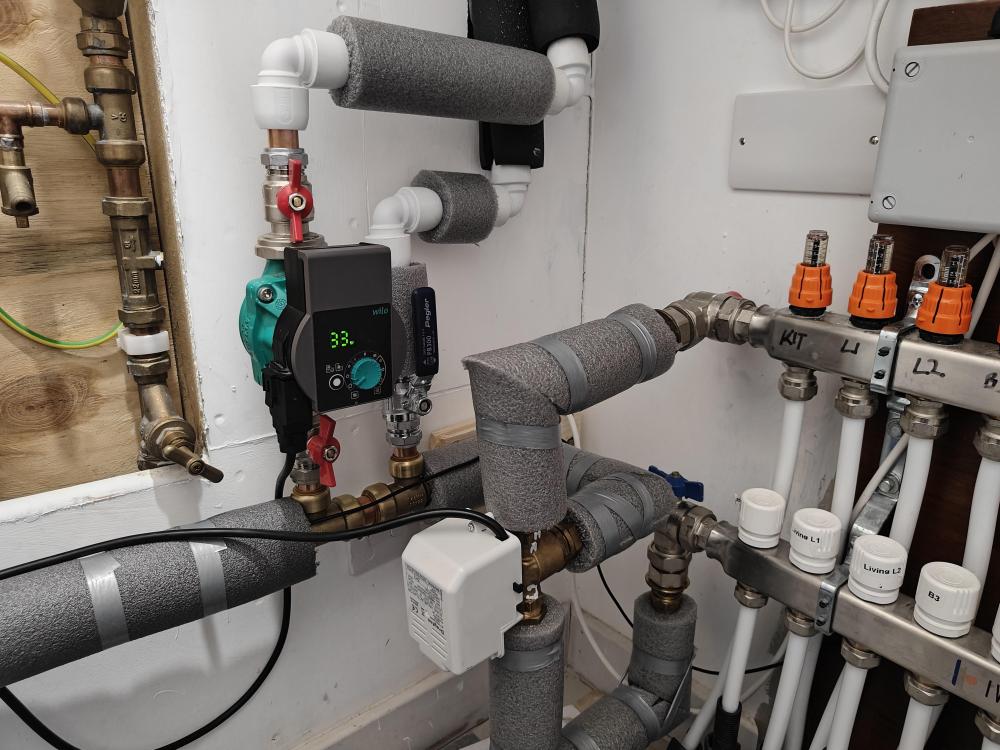
At the end of the heating season, I started testing - did I really need a buffer, and did I really need a mixer. The answer was no. I also challenged myself did I need a set point temp of 35, again over a few weeks I reduced to 32. Thought after those finding I would simplify the items not needed in the system. So buffer deleted out of system and while I was at it I added a heat meter to flow from the heat pump. Can use it to get a proper idea of CoP, next heating season. Next I looked at the mixer, so this was removed. Within the same pipe work is a diverter valve for UFH or cylinder and a return pump from the cylinder (long pipe run). So reconfigured to get some proper hydration separation, so configured as a close couple tee. So flow is normally to 3 port diverter, then into UFH. Demand for cylinder heat, CCT pump and 3 port diverter are energised. Diverter gives a flow path back to the heat pump. Towards the end of March I had the house thermostat set as per my original setting, but increase the summer house target temperature so it had no setbacks. The house floor acting as buffer, whenever the summer house called for heat. The house temperature remained quite stable as the floor was getting regular top-up of heat. In fact the house stopped calling for heat at all even with outside temp below zero.
-
UFH pipes in concrete slab, on insulation or tied to mesh
JohnMo replied to Chanmenie's topic in Foundations
That's a lot of concrete to heat up. My 100mm takes 24 hrs at the start of the heating season to get going and heating the house. I would just put on the top layer of rebar, otherwise you will be heating the floor for days to get heat out. Basically the heat radiates from the pipe in all directions and looses temperature in a informed manner, until it hits a resistance (insulation, heat flux from another pipe, surface). -
Building regs have specific ventilation requirements for garages - so your first port to take a look into.
-
Not really More efficient for production of hot water above 60 degrees, because R32 will only do 60 degs max. But when comparing SCoP at 35 - Vaillant 5kW 4.48, my Maxa R32 6kW, 4.46. So no real difference.
-
They are also towards the bottom of the chart also. You have to careful reading this information, mild Bristol isn't the same as a cold Highlands of Scotland, so expected SCoP will be very different... Any heat pump can be made to work well or badly.
-
Something like a Panasonic R32 monobloc, seems to good. More important than make is the way it's installed. Makes and models last - heat demand calc first, then system design, then which heat pump. For me important bits are 1. Heat pump max output, needs to be as close to max heat input required (allowing for DHW heating also). 2. Open system, no zones (if upstairs and down stairs maybe two zones max.) 3. If you have Radiators and UFH, run at same temperature, so no mixers are required. 4. No buffer or secondary circuits (requiring additional pumps) or unnecessary mixing of supply and return water. 5. Use only manufacturer controls, if possible avoid 3rd party control. 6. If the design seems complicated it isn't right. It should be simple. I use a Maxa heat pump, not normally imported to UK, unless rebranded to Viessmann. I do use a 3rd party thermostat only because the Maxa/Viessmann one wasn't available for sensible money.
-
You need your heat loss calculation first, then go from there. But once you know the rating then irrespective of make they will be all similar sizes for a given output. Locations, could it be located where it says patio on the drawing by the tree or shrub?
-
This what they said to me, your quoting the bit about moving elsewhere, I was reading the bit about staying with octopus but changing tariff. "We’ve also removed exit fees from our Loyal Octopus tariff — so if prices do continue falling in July and beyond, you can simply choose another tariff in your online account."
-
Or make your own with with tongue and groove wood on either side and this in the middle (a sandwich panel) https://www.soundinsulationstore.co.uk/products/barrier-mat-10kg Or build a shed between ASHP and the window, line one wall with the barrier mat.
-
So something like these, look like a stock fence panel https://www.jacksons-security.co.uk/acoustic-security-barriers
-
If you look at the T&C's they may say it's free to opt out at any time - it does say on your post zero early exit fee. I signed up on that basis, then there is nothing to loose if prices dip, you just revert to standard tariff.
-
Scottish government declares national housing emergency
JohnMo replied to Guest28's topic in Housing Politics
So not really sure what that bit means? Are they unhappy with the allocation of funding or lack of? Unhappy with the council tax freeze for the last decade, which stops them self funding? Or is it something else? -
Scottish government declares national housing emergency
JohnMo replied to Guest28's topic in Housing Politics
What does a housing emergency mean? Walking about you see houses not occupied - that's one problem You see new houses being built and people living in them You see holiday rentals - is this a problem that should be addressed So exactly is the issue? -
If you have single glazed windows you should have good thick curtains to help insulate, so this effect is killed off. Double glazing and triple glazing the effect would be minimised, the same would also be true for low temperature heating systems as strong updraft currents would not be there.
-
Scottish government declares national housing emergency
JohnMo replied to Guest28's topic in Housing Politics
Or the long version https://migrationobservatory.ox.ac.uk/resources/briefings/long-term-international-migration-flows-to-and-from-the-uk/#:~:text=Net migration was unusually high in the year ending June,of migration in the UK. -
No, it's just a cross flow heat exchanger. Hot air from house goes in one end of the exchanger (end A) and cooled air come out the other end (end B). Cold air from outside enters at end B and come out to feed the house at end A. Imagine a tube, inside a tube, the inside tube is the outgoing flow, the annulus formed between the tubes has the incoming flow. Both flow in opposite directions. If the tubes were long enough the temperature of the air at both ends of inner and outer/inner tube annulus would end up at the same temperature. As heat always moves to cold. If the heat exchanger was 100% efficient the mid point between end A and B would be at half the difference between inside air temperature and outside air temperature for both incoming and outgoings air streams. But because they are not 100% efficient you get a slight difference in temperature at end A and B between the incoming and outgoing flows. No magic going on.
-
6mm2 at least, but you really need to do calcs though. Armoured cable may be better as well with MC4 connections.
-
Your building heat loss is the same irrespective of number of rooms or number of UFH loops and or number of radiators. A well insulated house, really doesn't need bedroom rads, it will get all the heat it needs via the downstairs heating. I heat my 192m2 and 26m2 garden room from a 6kW ASHP and it's really too big. All depends on how well insulated and how good your airtightness is and the ventilation strategy. You need to do heat loss calculation first then the heat pump size follows.
-
The only work being done is done by the fans to move the air. https://www.open.edu/openlearn/nature-environment/energy-buildings/content-section-2.3.2
-
Never seen the point of them on an external wall, even on our 1830s house I moved then to internal walls.