


JohnMo
-
Posts
13296 -
Joined
-
Last visited
-
Days Won
200
Everything posted by JohnMo
-
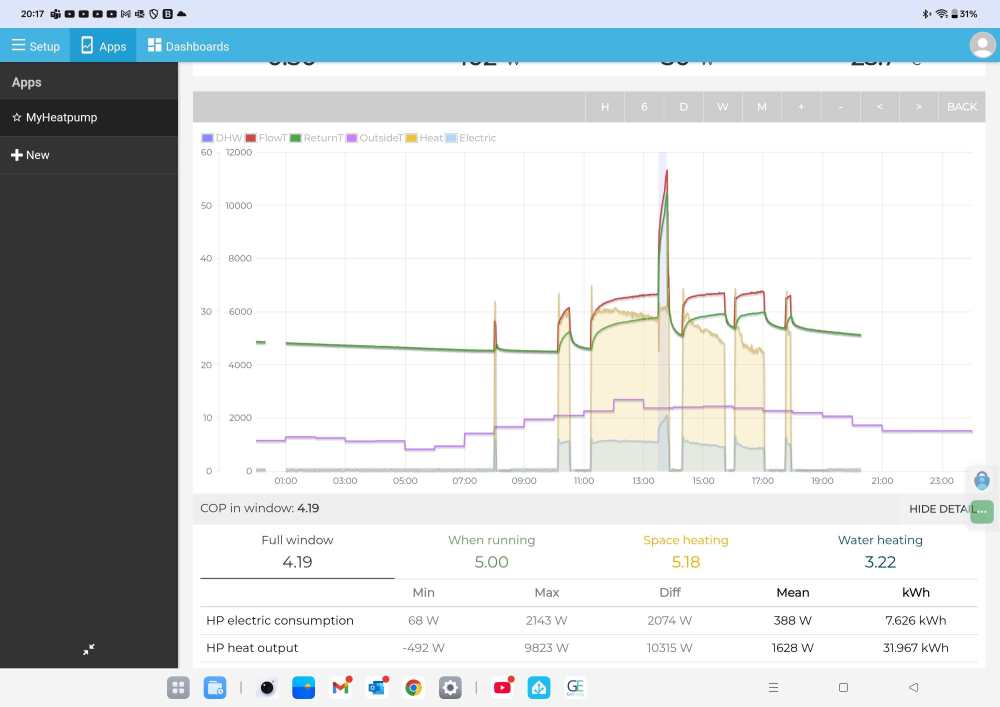
We heat intermittently, but house stays pretty stable temperature wise. So today our average temp over the day is about 8 degs, so we are still in heating mode, but are getting plenty of solar. So heating is generally powered by PV (since start of March) and a floating battery state of charge to get reasonable run times. So the heating is free - can't do that with gas or oil or with direct electric heating (without a solar farm). So turns a modest PV excess of 7.6kWh in 32kWh. Any additional went into hot water via immersion
-
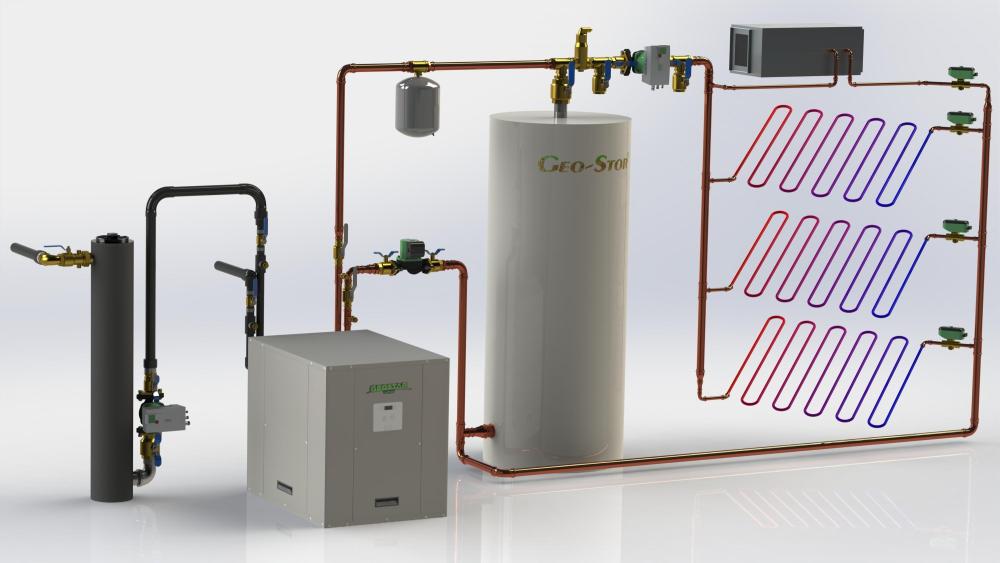
Not necessarily. A 4 port all flow and all returned water flows through the buffer. A 2 port, only when the flow on primary side is higher than secondary (a zone is closed for example) does any water go through buffer. The control of a 2 port are also different. A 2 port control is: Heat source is there to only satisfy a thermostat on the buffer. The heat source stops and starts only against that thermostat. The secondary side is run from the house thermostat(s). After playing with most versions of buffer and a volumiser, my heating runs far better without a buffer or volumiser, and definitely better without zones.
-
A 2 port buffer looks like this - the grey box being the heat pump
-
They are not the same thing, a 2 port buffer would straddle flow and return and provide hydraulic separation, a volumiser will sit in either the supply or return pipes (not both) and provide zero hydraulic separation. Buffers are in general bad because they introduce distortion, which in basic terms is a difference in flow temp on the primary and secondary sides of the system. The ASHP will therefore run hotter than is actually needed. If flow rates are equal each side in the primary and secondary circuit then distortion doesn't occur, but if that's the case the buffer is serving no purpose, so the additional pump is an additional electric drain.
-

Condensate Drain Pipe
JohnMo replied to Fiona Brick's topic in Mechanical Ventilation with Heat Recovery (MVHR)
Little confused. Is the reinforced plastic pipe connected to the MVHR? If that's the case, it isn't correct. The MVHR drain should feed into a dry trap, then be an airtight join to drain system. Similarly the A2A connection should be done the same way. It looks like your brown drain pipes outside need connecting - 2 parties not talking to each other? No -
Cheaper electricity bills on the Way for Scotland?
JohnMo replied to ProDave's topic in Housing Politics
Don't think I will hold my breath for the change to actually happen. -
It doesn't - look at my image, that's hot, cold distribution and all UFH
-
Why - you can just fit the Mixergy heat pump kit? So why change it, unless it's tiny capacity wise.
-
Not quite true about 10 000 installers were trained on condensing theory etc - but it was one off training never repeated. I think in one ear out the other. They are a problem, because they don't know or care what they are heating W and X plan know when heating house or cylinder. Effectively the same plumbing as S and Y but wiring for two flow temp
-
What have I missed? In what way are heat pumps political. By any stretch of the imagination? Aren't they just another heat source, misunderstood by the Joe public, just like a condensing boiler is? But unlike a boiler misuse, bad operation, etc. a heat pump costs you in the wallet. The only controversy is the average plumber is trained pretty poorly. The requirements for low temperature heating systems, came in with condensing boiler, decades ago. Operating at, and training for, low temperature heating, should have been mandatory at the same time as condensing boilers became mandatory, and S and Y plan banned at the same time.
-
Servicing of HW Cylinder/ASHP to maintain warranty- is it worth it?
JohnMo replied to ykhan16's topic in General Plumbing
Thought we were expensive at £3k but we do not have to pay water or waste water charges (another £1k) -for two of us. -
Pressure moves about with temperature change. You also get a drop in pressure as the air in the water comes out of suspension from the water. So you fill system, a while after you start to get a pressure drop (air coming out of suspension) then pressure moves about as ambient temp changes. Once water filled, the pipe will be almost impossible to crush.
-
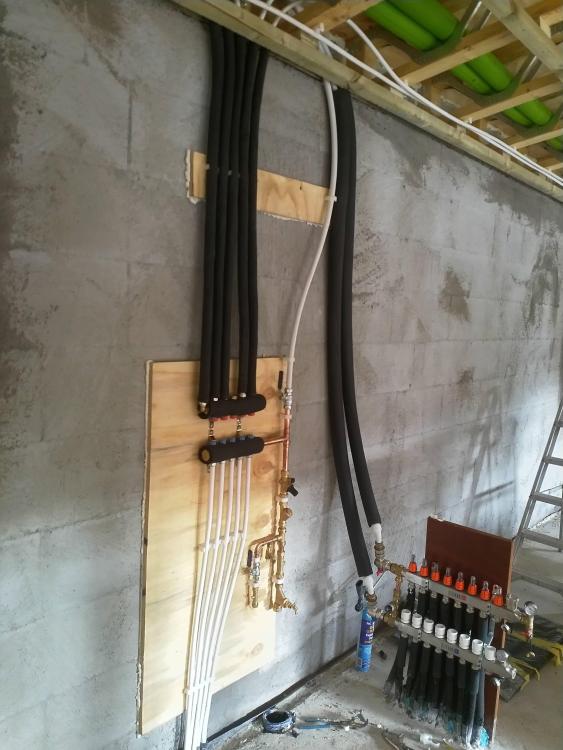
Our system is slightly different as we added the UVC after. But in effect it works as you describe. Our original was a combi boiler. We have a pressure regulator valve as the mains water comes into house. So cold water manifold after that. Early build photo attached. Showing stop cock with no mains connection. Pipes going into floor are cold, pipes going up are hot. Top left pipe is feed from combi (now UVC) the white pipe going up is the cold feed to combi boiler (now UVC). But you would just feed everything from from the balanced feed.
-
I also looked when we were planning, at the Rehab system, but as our site is pure sand it's a system that cannot get all the benefits when in sand. The install instructions state do not bed pipes in sand, use either clay or soil.
-
We just did one hot, one cold per wet room, and the split in the room to each user. No issues at all. Can flush loo and shower temp doesn't change for example. Did each feed in 16mm. No issues filling a bath either. So if you need to work on the plumbing in ensuite you just close a single hot and cold valve on manifold instead of 5.
-
Ask your structural engineer?
-
Good luck with that, if the scum of the earth, can nick a £100k car in a minute or less, you have no hope. Remove battery and take it home with you? Leave in a position that makes it hard to move without hydraulics. They then need at least a battery to get it to run.
-
MVHR ? Who needs it? I don't.
JohnMo replied to ToughButterCup's topic in Mechanical Ventilation with Heat Recovery (MVHR)
It doesn't have to be expensive, extract from each wet room and then depending on house layout one or two locations to have supply too. Then the rest of the ventilation is via transfer through different areas, as the air finds it way back to extract points. My MVHR came from ebay -
Think you may need more details - what sort of raft and spec? We did a concrete raft, but there were also strip foundations under and around it, on difficult site, so our costs may not be want you are wanting.
-
We bought a power shed a couple of years ago, no issues so far. https://www.powersheds.com/
-
Review the low star reviews also, some recent reviews are pretty rubbish.
-
No, as they are parallel loops, you just calculate the single longest (master loop).
-
To comply with building regs you really need the pipe in conduit. It is supposed to be replaceable. We did cold under the insulation - this works well and keeps cold water cold. Hot we didn't do in the floor, but between the insulation for that should be ok.
-
Buying at full price, I would go Panasonic monobloc and just go to City Plumbing or Cylinder2Go (you get a discount )for the cylinder. Then you just need an UFH manifold. Next job - do your pressure drop calculation assume a 100m long UFH loop and then use your pipe length to sort out primary feed pipe sizes. You want to be getting around 1.4m³/h flow rate (assuming 6kW), to keep UFH and cylinder happy.
-
I found with boiler it's super efficient at heating via UFH. I run at a fixed temperature, chosen so the boiler runs without stopping when ever it's on (when it's been below 5 degs for more than 6 hrs - hybrid install). And running against a heat pump cylinder generally runs about 4 degs hotter than the cylinder ends up. So about 56 degs max temperature.




