


JohnMo
-
Posts
13296 -
Joined
-
Last visited
-
Days Won
200
Everything posted by JohnMo
-
Are you paying the utility bills for a rental?
-

ASHP without Boiler Upgrade Scheme?
JohnMo replied to timhowes's topic in Air Source Heat Pumps (ASHP)
My cylinder was in a summer sale so several hundred off normal price (currently selling at £1200) Heat pump was on eBay a distributor selling excess stock normal price around £4500, I paid £1300 after some bargaining. I got no warranty, but was willing to take the risk, it was still in the manufacturers box unopened. My labour is free. -
Are these MVHR numbers correct?
JohnMo replied to SBMS's topic in Mechanical Ventilation with Heat Recovery (MVHR)
If the quoted unit is capable of 600m³ and it's being asked to sub 400m³ at boost I see zero issues. I would expect to drop to level 1 (220m³) once the house has dried out - unless there are 10 people living in the house. Also get a humidity sensor, in winter you don't want to drop below about 40% RH. -
Are these MVHR numbers correct?
JohnMo replied to SBMS's topic in Mechanical Ventilation with Heat Recovery (MVHR)
Because building regs tell you too. It's also based on number of people that could be living there. Passivhaus have a figure for single bedroom and a different one for double rooms. Wet rooms have have there own figures. BR sort of do the same. -
Are these MVHR numbers correct?
JohnMo replied to SBMS's topic in Mechanical Ventilation with Heat Recovery (MVHR)
For building regs compliance you need a given volume flow, this is calculated differently in England and Scotland. So go to the relevant page in the building regs. But passivhaus work on approx 0.3ACH. The issue with a big house (you have a big house) is over ventilation and the house air getting very dry in winter. Ventilation is nothing to do with bedroom volume - it's all about how much CO2 and humidity is being generated. Two people in a big or small room generate the same amount of each. They have include volume and the ventilation mode is cascade. Cascade is a pretty standard way of ventilation. So imagine air being pumped in to a bedroom and being extracted via bathroom, the hall is being ventilated via cascade. -
If it's solar PV you heat via the immersion, using a diverter. Wouldn't bother with solar thermal these days, it's an expensive one trick pony. But if you are getting an MCS solar PV then just export excess and get paid for it. If a self install divert to hot water via immersion. Either way a 2 coil cylinder is for solar thermal. It also takes away a chuck of cylinder volume dedicated to solar thermal.
-
What would you be doing with the second coil? A normal heat pump cylinder is perfectly adequate with a single coil. Just get one with around 3m² coil. Job done.
-
ASHP without Boiler Upgrade Scheme?
JohnMo replied to timhowes's topic in Air Source Heat Pumps (ASHP)
To add to the above - didn't bother with MCS. I paid £800 for a heat pump specific 210L cylinder, new from City Plumbing. £1300 for a monobloc 6kW ASHP, billy bargain from eBay. £ a couple of hundred for cable, pipes and fittings. Installed myself, except final electrical hookup - electrician for 1 hour, while doing other work. So all in circa £2500. No heating mods needed, as I have UFH. -
ASHP without Boiler Upgrade Scheme?
JohnMo replied to timhowes's topic in Air Source Heat Pumps (ASHP)
Search ASHP MCS Umbrella scheme -
ASHP without Boiler Upgrade Scheme?
JohnMo replied to timhowes's topic in Air Source Heat Pumps (ASHP)
Nothing to do with grant. You will still get the grant. But, Buffers and hydraulic separation remove efficiency, so adds to running cost, but also require secondary circulation pump. Both suffer from distortion where the heat pump sees higher flow temperatures than the heating system, this drive efficiency down. Flow temp, the higher it is, the higher the running costs. A single zone system allows heat pump to have the flow regime it requires, without a buffer or hydraulic seperation. The cheapest way to run a heat pump, is generally always on, flowing to a open heating system on weather compensation. No thermostats. -
ASHP without Boiler Upgrade Scheme?
JohnMo replied to timhowes's topic in Air Source Heat Pumps (ASHP)
Welcome Look in to MCS self installation schemes. This where the supplier take the design responsibility, looks after the grant aspects, leave you to arrange installation, they then commission. This means you get the grant, without MCS inflation. Things to watch out for Design temp need to be 45 degs or lower. Single zone No buffer No hydraulic separation -
Or in an area of inflated house prices, where you throw money at it and still see a profit. Plenty around us pay people to everything, but house prices are not high, not sure why they bother?
-
As soon as you flow water below dew point (let's say 12 degs) for more than a few minutes you will start to generate condensation. Target flow temps below dew point, you get condensation forming. Our summer house has a fan coil and have never seen a single drip from it. It flows from the same circuit as the house UFH.
-
MVHR and cooling
JohnMo replied to flanagaj's topic in Mechanical Ventilation with Heat Recovery (MVHR)
Now lost? What is an Aircon exhaust pipe? -
MVHR and cooling
JohnMo replied to flanagaj's topic in Mechanical Ventilation with Heat Recovery (MVHR)
To do what? Read the post or pre cooling data sheets and related water temps, air flow rates and then kW output in cooling mode. Yes you can cool, but not very well at normal flue rates, even if you configure to run boost it's still a low kW output. Really doesn't make much difference if you install anywhere in the MVHR circuit. If you install a MVHR that was massive, and min flow rates suited your house design, set up a normal boost and super boost you may have something, but ducts would be oversized, every inside the house fully insulated. -
MVHR and cooling
JohnMo replied to flanagaj's topic in Mechanical Ventilation with Heat Recovery (MVHR)
I spoke to a contractor last year, he had been south to hot world called England. Anyway driving down the motorway all windows open in his car, Aircon full cold, couldn't understand why the car was so hot inside. 30+ outside all windows open, 70mph blast of hot air! -
We get loads of weeds in our gravel drive. We don't have a weed membrane, but the weed are wind driven seeds that land in the gravel and root in the wind driven soil from the fields around us. So would be there with or without membrane. 20 mins with a spray backpack and weedkiller once a year does the trick.
-
That's a good suggestion - a pergola doesn't have to cost much. I just built one with 2x PV panels. So solar shade and generation in one assembly. Vertical just do 3x 500W panels to a 1kW inverter. Or as you say horizontal or any angle in between. It's also useful to have PV generation in winter, vertical will give twice the output in Dec/Jan. A 200m² new build to a half decent build spec, should only need a 4kW heat pump. CoP of 5 to 6 doing cooling, will generally be pulling less than 500W (modulated down). If the sun's out and you need cooling, PV is generating. Our two horizontal 500W panels in full sun the other day were generating between 800 and 900W, which is enough to run our 6kW heat pump.
-
Mine was a zero cost option, replace blinds with curtains if you want. Choose the right ASHP it will come with cooling out the box. Mine switches from heat to cool via a repurposed light switch. So £2 if you don't have one kicking about. Runs WC for cooling and heating so you don't even need a thermostat. PV - buy 2 to 4 500W panels, £68 each, string inverter £250 to £300, DC and AC isolation switch £100 for both. £100 for cable, MC4 plugs and sundry bits. Then you need mounts depending on where you locate. Panels make great fence panels, roof for pergola etc.
-
So do you use only AC for heating and cooling? How do you do hot water?
-
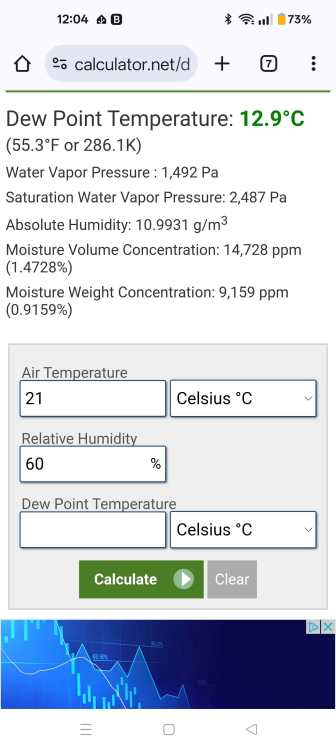
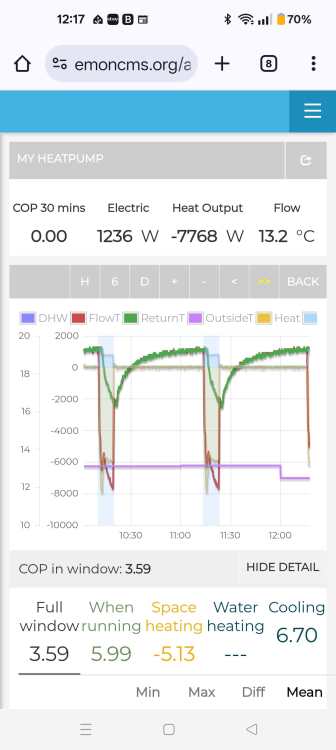
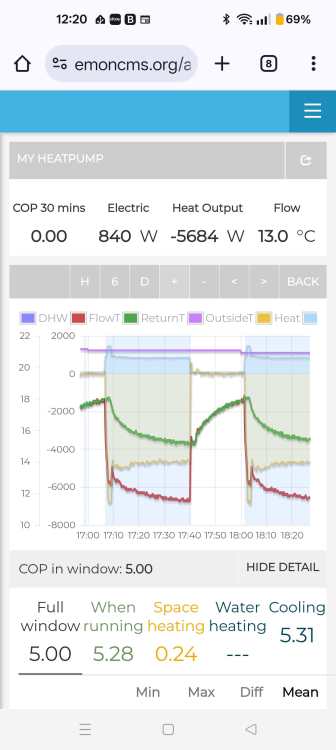
The way to operate is to run with a single flow temp for both fan coil and UFH. It means the fan coils are bigger for a given output in kW. But running everything above dew point, means no condensation, so no drains required. A quick look at an online dew point calculation, house kept at 21, RH 60%, dew point is 12.9. I set my target flow temperature at around that. I get no condensation on the UFH manifold. Floor surface temperature is around 19 to 20 depending on floor covering. So a mile away from condensation. The heat pump cycles based on return temp of around 19 degs. This is in the morning no solar gain So short 10 min runs then off for an hour or so. This it when we get solar gain Much longer runs. When we get to heights of summer, the heat pump runs several hours at a time. Our house internal temp almost all driven by solar gains, without internal blinds and UFH cooling our lounge l easily gets to 27 degs. Now it may go up to 24, but it recovers back sensibly levels quickly. But with a floor that is cooler than the air, it always feels cooler than it says on the a temperature gauge. Think old stone church always feels cool even when it's baking hot.
-
We have a long thin house, so way different from factor yourself, it didn't change our test result much when converted to ACH.
-
Your answer is pretty much 1.4 ACH
-
Are you sure, I think it's (1.4 x 479) / volume. So if house is 200m² and ceiling are 2.4m high is 200 X 2.4 = 4800. (1.4 x 479) / (2.4 x 200) = 1.4 ACH
-
Without knowing your house volume he cannot know that!





