


JohnMo
-
Posts
13296 -
Joined
-
Last visited
-
Days Won
200
Everything posted by JohnMo
-
Similar here also. But if you are on a single track road you also need a pull into layby for delivery vehicles (mail etc), so they impede other vehicles.
-

MVHR ducting 125 mm to 150mm
JohnMo replied to SLABdan's topic in Mechanical Ventilation with Heat Recovery (MVHR)
Loft install - insulated everything, including the manifolds and pipes either side. Ensue your condensation drain is done correctly with suitable slope and a dry trap is installed. -
MVHR ducting 125 mm to 150mm
JohnMo replied to SLABdan's topic in Mechanical Ventilation with Heat Recovery (MVHR)
Just a 125 to 150 adapter at spigot. You can get them from Screwfix or Toolstation normally a stock item. Is the spirit on the MVHR unit is 125mm that will be all it needs. Having bigger duct attached will reduce the flow velocity, so reducing noise and resistance. Less resistance lets fan run lower on its curve for less noise - big duct is win, win for noise. -
If your looking at that you should also look at the visibility splay as well. But this should all be detailed on your planning drawings.
-
I would whole house. Do spot checks on floor temp, and do a dew point calculation based on internal conditions.
-
BBC Archive (1981) Future Home 2000
JohnMo replied to Nick Laslett's topic in Property TV Programmes
Not yet. Watching it all tonight when wife goes out -
BBC Archive (1981) Future Home 2000
JohnMo replied to Nick Laslett's topic in Property TV Programmes
Tradesmen with hammers and nails and manual screwdrivers. Not sure many now would cope with that. Compared to the insulation standards many follow now, the insulation added to walls etc is pretty thin. Build is very quick, many lessons from that build still not implemented. Part way through second episode- 27 replies
-
- 1
-

-
- bbc
- innovation
- (and 3 more)
-
ICF Pricing and ease of use questions
JohnMo replied to IATM's topic in Insulated Concrete Formwork (ICF)
Our walls are Durisol, now Ecobrix. Perimeter is 70m and average height 3m, so 210m², back in 2021, it cost us £27k all in all allowing for cost of a labourer and me to build, all concrete infill, concrete pumping lorry (X2 visits). With service cavity a u value of 0.14. So £128 per m² finished. No additional costs for props etc required. Parge coat or membrane inside prior to service battens or wet plaster for airtightness. -
In addition to what @jack says, some UFH controllers are configured to manage cooling, automatically or manually. A normal thermostat set to 21 degs, if below 21 it call for the heat source to start, above 21 it tells it to stop. Cooling needs the opposite.
-
So do you have a buffer or volumiser? If so where are they located in the system with respect the diverter valve (for heating or DHW)? UFH heating pump and mixer? Thermostats?
-
Yes but you are then spending needless money etc. getting screed done. Just bring concrete up to FFL - done. Make sure UFH don't go under where internal walls are, take all pipes through doorways. Then you won't get any nasty surprises. Architect will take lots of rubbish about heat up times when buried in deep floors, reaction time, which is only relevant when running against a thermostat I suspect.
- 17 replies
-
- 1
-

-
- ufh
- raft foundation
- (and 3 more)
-
One - why are they touching your guttering? What were they trying to fix?
-
Sounds like you need to find the leak as well.
-
Download the manual if you don't have it. Normally need volt free contacts making or breaking. If you don't have fan coils or UFH, it will not help and it's not suitable for radiators.
-
Just use Hep2O.
-
Why? Flexis are a consumables item, expect a failure. So need to be replaceable. Assume you want an airtight house, not sure how you would make the duct sealed?
-
The Flexi is just there to break any carried over vibration that could be transmitted through solid pipe. Why would you need multiples. Various lengths here https://www.bes.co.uk/heating-ventilation/renewable/air-source/hose-fittings/?gad_campaignid=21010157190&gad_source=1&gbraid=0AAAAAD9gc2nUit89wBNyhSlbWINtellFp&gclid=CjwKCAjw6s7CBhACEiwAuHQcko06ksxFJVc4OnBQtzTzjmFROda-qjnPCdSxWj2tc56-A6t3EU11fBoCwTYQAvD_BwE
-
Both the raft and slab support the low and slow heating and they can do batch charge or storage heater mode well. Response will be slow due to the number tonnes of concrete. I see zero advantage to adding a thin layer of insulation then adding screed on top. For me the thin screed will allow heat to leach into the concrete below and it would never get back to the house. With a little care a strip foundation can be made thermal bridge free also. It's also easier (certainly where I am) to get a contractor for strip foundations, but you do have to watch over them.
- 17 replies
-
- 2
-
-
- ufh
- raft foundation
- (and 3 more)
-
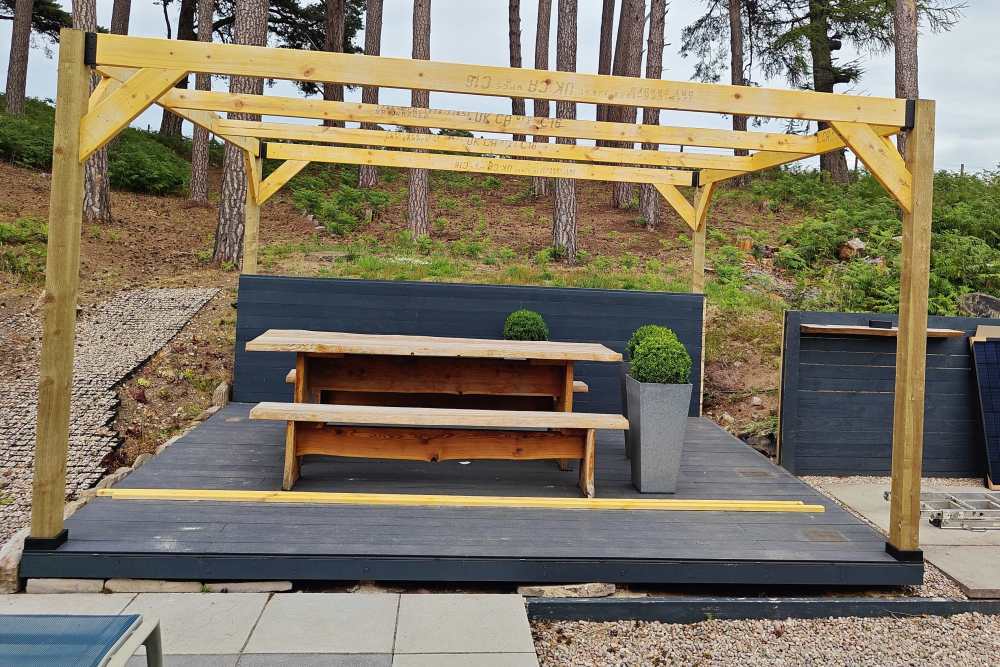
Progress today - photo a bit squint, not the decking. All diagonal braces fitted. Two stringers to hold PV panels, reduced in height by 30mm to match PV panels. Flashing tape installed on top of PV mount stringers. That was all the wood ordered. So additional 6x2 ordered to split the front and rear bays in to half for roof slats and for additional support for PV stringers - square edge 95 x 12mm wood ordered to make slats for roof. Lots of 45 Deg spacers to make tomorrow for roof slats. Lots of wood to use from other projects for that.
-
How thick is the reinforced concrete and how thick is the proposed screed?
-
From the looks of the drawing the cylinder has a low loss headers (a small capacity buffer) which takes the flow from boiler and heat pump. So both heat pump, boiler and heating circuits are hydraulically separated. So a good start, but like a buffer you will take an efficiency hit and you have multiple pumps. The "but", I have experimented with my ASHP, using the inbuilt hybrid mode, the way the logic works it's looking for a target flow temperature within a given tiime. If that conditions is not met, the second heat source is activated. This is where you may need to speak to manufacturer. From what I've seen, when you start your generator the ASHP will see power, so will assume it has enough power to do what it does and it will try to start, because everything is fit and healthy, as far as its concerned. It will trip a small generator on overload. If you go outside and manually isolate the outdoor unit, obviously when you start your generator the ASHP cannot start, but the FTC6 unit on the cylinder has some hefty loads as well, it also has a 24v signal from the outdoor unit (which is switched off). So will you have a permissive for anything to start? I have no clue, this where you need input from manufacturer. Are you looking to get a grant for the ASHP, anything seen as hybrid, is excluded from the grant scheme
-
So back to topic - topic says hybrid, but the reality isn't that, it's a secondary heat source, which is very different. So in a power cut, you need the heat pump off, or it will try to start up. A hybrid system uses the ASHP primary circulation pump. That will not be available. The secondary heat source needs to have full autonomy to heat without ASHP being powered and using it's circulation pump. In hybrid mode, no ASHP power, no heating. So you need hydraulic separation for ASHP and boiler. And either needs to provide heating circulation and DHW heating. It starts to grow arms and legs complexity wise if you are not careful. Or you install a buffer and take an efficiency hit every day. But that doesn't address DHW in a power cut. @newbuild upnorth you to write down step be step what you really need to achieve. What resources you will have available. Then work through how to achieve it. Hybrid running will not provide heating in a power cut with a small generator.
-
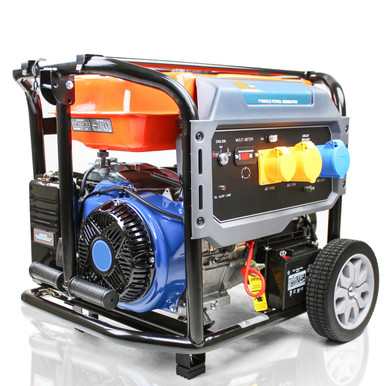
It's on wheels, pull out of shed, use proper extension to plug into house (external socket), flick the change over relay, full house has power. £700 for geny, £50 for changeover switch, lots cheaper than an oil boiler, tank etc. Log stove?
-
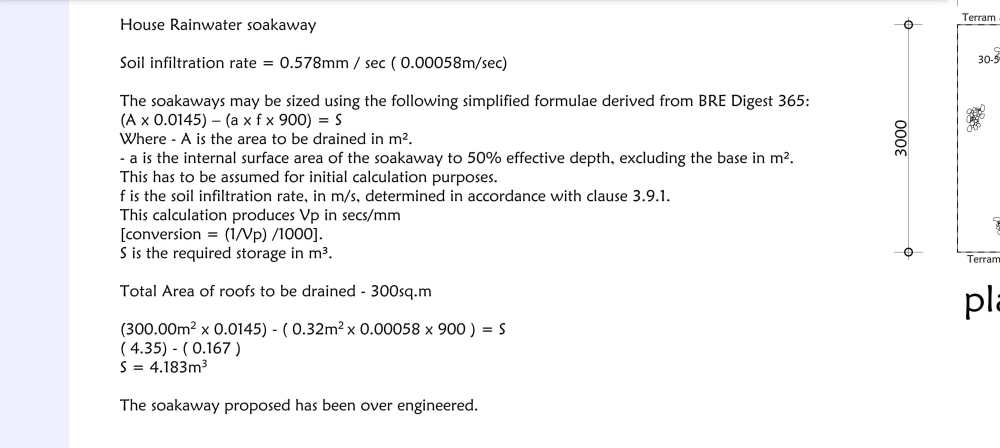
That sounds huge for a rain water soakaway, thought the size was for a treatment plant soakaway. Our roof area is about 300m² This what our drawings show, with the calculation
-
Is that by the lorry load or by the 1 tonne sack. Direct from quarry is about half the cost of a building merchant.


