


Brickie
-
Posts
634 -
Joined
-
Last visited
Everything posted by Brickie
-
Creating a smile in the mind - with bricks.
Brickie replied to ToughButterCup's topic in Brick & Block
Saw this on Social media-very clever! Never done anything similar myself. intrigued by the bond used-assume it’s a ‘Wild Bond’ that the lads who went to the continent in the 90’s used to talk about. The only rule appears to be not to repeat the same course for a nominal vertical distance. -
Swap that half block out for a full one & have two 100mm pieces either side of the next block along. The small cut on the RHS isn’t the issue here-leaving very little bond at the corner on LHS for the next course is.
-
‘Paint grade’ might be the phrase to use when asking merchants.
-
Couple of thoughts (apologies if I’m repeating anything @Russell griffiths or anyone has said-skipped through the thread)- 1/ you’re overthinking,the runs are long enough that the perp joints could be opened or tightened slightly to make it work bricks,especially if they are ‘new’ imperials-likely to be longer than 215mm. Just make the piers brick dimensions I.e 890mm,1340mm etc but check brick dims with your manufacturer. 2/ unless you’re footing is going to spot on forget about trench blocks. 3/ if it’ll work for the maximum lengths,hide the mj’s round the corners behind the down pipes from the roof.
-
I hear you @Canski -I don’t currently employ anyone (&have only ever had max two on for me) but the lack of engagement with the task in hand is par for the course. Got a lovely fella working with me (not for me) but Jeez-can’t lay to the line,puts ties in the wrong course,forgets tray damp,overall has no concept of problem solving. Just have to keep telling myself ‘he doesn’t work for me,he doesn’t work for me.’
-
Brick efflorescence and brick face erosion on gable end.
Brickie replied to ianmoone's topic in Damp & DPCs
Be worth popping outside during a downpour & checking that nothing’s overflowing from that gutter. If that’s blocked & sending additional rainwater down to splash up,that will exacerbate the problem. -
How to improve the look of this dodgy workmanship
Brickie replied to Monz87's topic in Bricklaying, Blockwork & Mortar
That’s been done by a DIYer,I’d say,the small cut up the left hand side reveal is a big no-no to a proper bricklayer. They’ve re-used the bricks from somewhere else too-you can see a mastic or paint line on some of the half bricks on the right. I would apply brick acid with a paint brush so you keep it off the mortar joints and wash off with the hose. Looks like it will need a good few times to see any improvement though. -
Outside wall becoming an inside wall
Brickie replied to Dave Jones's topic in Energy Efficient & Sustainable Design Concepts
Think @Temp means above the lead line. -
Doubt it’s slate from the 50’s.
-
I’d be tempted to drill dowels into them all just for peace of mind.
-
You could make some plywood protection for them once they’re installed. Much prefer to build in as I go.
-
Think he should’ve used a water level to transfer a metre above ffl from adjacent rooms. Any discrepancy would’ve become apparent at that point & a plan could’ve been made.
-
Is this something to be concerned about?
Brickie replied to Romfordian's topic in General Structural Issues
Either that or get them to cut that course out & rebuild I guess. Either way I’d monitor it & keep a record. -
Is this something to be concerned about?
Brickie replied to Romfordian's topic in General Structural Issues
Either or. I’d imagine they might have built the main house all the way up,struck the scaffold & then built the annexe separately but maybe not. Longer term-I’d say all you can do is fill it & monitor. -
Is this something to be concerned about?
Brickie replied to Romfordian's topic in General Structural Issues
Not a problem,and not dumb. What I think maybe has happened is this-the brickwork has been built to 24 courses (“first lift”). The scaffolders,by accident or not caring,have butted the wall with a tube when putting the first lift in and left it with 2 or 3 course tipping back,giving the 5mm gap we see in the photo. The gap would be at our below the scaffold board height so not necessarily seen by the brickies (or they saw but didn’t care.) The offending tube stayed in position during the rest of the build and so did the 5mm gap. -
Is this something to be concerned about?
Brickie replied to Romfordian's topic in General Structural Issues
So around 1.5m. If they built 24 courses from dpc 24 x 0.075m=1.8m,scaffold ledgers would normally go in a bit below that so that there’s a bit of work showing that you can plumb off. Starting to feel like Columbo. In all seriousness,I’ve come across this many times on sites-scaffolders often can’t be arsed to cut boards or tubes so they just force them in,walk away & to hell with the consequences. -
Is this something to be concerned about?
Brickie replied to Romfordian's topic in General Structural Issues
Looks like a movement joint where the two meet-obviously can’t see if it’s continuous behind the render but if it is,that would probably rule out differential movement/settlement. I think it my earlier scaffold lift theory looks more & more likely-what height from ground floor is the crack approximately?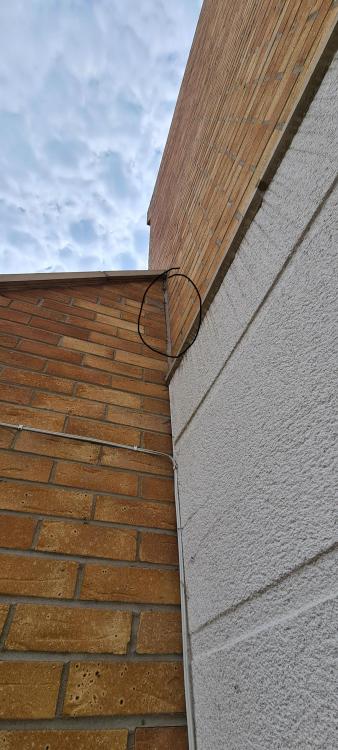
-
Is this something to be concerned about?
Brickie replied to Romfordian's topic in General Structural Issues
One possibility is that that the scaffolders butted too hard against the wall when putting a lift in,literally lifting a couple of courses up. When the bricklayers jumped up to carry on it may not have been spotted or they did & didn’t care. Hold your level up the wall there & see if there’s a bump & hollow. -
Roger,Roger.
-
Frog up for me. People lay frog down to save on mortar or sometimes to grind the joints down bit by bit if the work below was built over gauge. I’ve known of frog down work to be taken down if NHBC come across it.
-
Surely the difference is that multi can be used on board or S&C/bonding background & board finish can’t? @nod?
-
Suggestions for cleaning brickwork
Brickie replied to SilverShadow's topic in Bricklaying, Blockwork & Mortar
Could you send post more photos,from farther away? -
Laying brick on a compacted base?
Brickie replied to Tony K's topic in Landscaping, Decking & Patios
Actually it will have moved-the creep of the building,as it’s known. It’s just that the lime mortar it’s almost definitely built in can accommodate this gradual process. -
I used to do brick cleaning many years ago. 1750 a day cleaned & palleted was my target & used to hit it mainly. I was a young single man so my wrist strength was already high 😃
-
Low Level Brick Spalling / Brickwork Fracture
Brickie replied to azureblue's topic in General Structural Issues
For me the first action would be to cut 150mm of concrete back from the wall,along the whole elevation. This will allow inspection of ground level brickwork & to install a French Drain. +1 re chimney stack-it also looks like it’s shifted laterally which is a worry. A window right next to the stack is unusual,possibly installed by a previous owner. I’d want to see (as best you can) the condition of the lintol above.



